What to Believe?

What to Believe?

If you’ve been reading my blog posts, you’ve probably noticed that I sometimes quote Lewis Garrard, the seventeen-year-old American who visited New Mexico in 1847.  His book about his adventures there, Wah-to-yah and the Taos Trail, was published in 1850. It doesn’t seem to have made much of a hit at the time, but it’s now often used as a primary source for everything from how to make coffee on the trail to the April 1847 trials after the Taos insurrection was suppressed. In fact, Garrard’s report of the trials and subsequent hangings is the only firsthand account of them that we have.

Title page of Lewis H. Garrard’s 1850 edition, courtesy of archive.org

But Wah-to-yah also contains secondhand accounts. Of the insurrection itself and the battle at Taos Pueblo, as well as of the death of Taos leader Tomás Romero afterward. And this is where things get complicated.

The circumstances around Romero’s assassination are of particular interest to me because his death plays a role in my novel An Unhappy Country. Based on U.S. military records this is what we know about what happened:

  1. People from Taos pueblo sued for an end to hostilities the morning of Friday, February 5, 1847. Colonel Price agreed on condition that the remaining insurrection leaders be turned over to him.
  2. The only uncaptured leader alive and in the Taos area was Tomás Romero, who turned himself in later that day.
  3. Romero was taken to the jail in the village of Taos, where he was shot and killed by a U.S. Army dragoon private named Fitzgerald.
  4. Fitzgerald was arrested and jailed.
  5. About six weeks later, on March 18, 1847, Fitzgerald was dishonorably discharged from the U.S. Army. This was well before the expiration of his term of enlistment.

And that’s all we know from the official accounts.

According to Lewis Garrard, he met Fitzgerald in the second half of March, while Garrard and his party were camped roughly 55 miles east of Taos in the vicinity of today’s village of Cimarron, New Mexico. He says Fitzgerald told him that he’d come to New Mexico specifically to wreak vengeance on “the Mexicans” for the death of his older brother, who’d been a member of the 1841 Texas Expedition to Santa Fe.

According to Garrard, the older Fitzgerald had been killed by Damasio Salazar, the militia captain who supervised the Texans’ removal from New Mexico. The younger Fitzgerald boasted that he accomplished his mission when “in the fight at the Pueblo, three Mexicans fell by his hand; and, the day following, he walked up to [Romero] and deliberately shot him down.”  

Whether Fitzgerald did kill three men in addition to Tomás Romero is anyone’s guess. But Garrard’s report of Fitzgerald’s motivation raises a number of issues. Either he was confused, or Fitzgerald was.

You see, the only Fitzgerald with the 1841 Texas Santa Fe Expedition was an Irish/Anglo man whose first name was Archibald. And Archibald Fitzgerald didn’t die in New Mexico. He survived the trek under Captain Salazar as well as imprisonment in Mexico and was released in late February 1842.

Instead of returning home to Ireland, Archibald Fitzgerald went back to Texas. There, he joined the young republic’s forces and fought with them at the December 1842 battle of Mier. According to historian Noel Loomis, Fitzgerald was captured there and thrown into prison at Salado. He and his fellow Texans staged a successful breakout, but Fitzgerald was killed in the aftermath.

So, either Archibald’s younger brother didn’t know what happened to him, Private Fitzgerald told Lewis Garrard a tall tale in order to justify what he’d done, or Garrard misremembered/embroidered the story when he retold it in 1850. In any case, this is one portion of Wah-to-yah which does not hold up to verification by other sources.

The younger Fitzgerald apparently also told Lewis he’d escaped from his Taos prison one night by breaking through the roof of his cell, noiselessly creeping to the edge of the roof, and waiting until the guard pacing below turned his back. Then Fitzgerald swung to the ground and “with as much ease as possible” walked to a mess fire where his waiting friends provided him with a pistol and clothing. Fitzgerald headed into the mountains east of Taos and “when day broke,” Garrard says, “The town lay far beneath him.”

Whether this is what actually happened is open to question. I have to admit I’m skeptical. It sounds a little too much like something out of an Alexander Dumas novel.

But then, Garrard also says Fitzgerald told him he was one of five men who breached the wall of the Taos Pueblo church and that during this event the man ahead of him was killed. Somebody is conflating two events here: the first being the attempt to enter the church that resulted in the death of Captain John H.K. Burgwin, and the second successful assault later that day, when no one was killed.

I have incorporated a variation on Garrard’s report of Fitzgerald’s version of events into An Unhappy Country, but whether it reflects what actually happened is anyone’s guess.  But then, that’s why my novels are labeled “historical fiction.” Because no one knows for sure.

Sources: James A. Crutchfield, Revolt at Taos; John Durand, The Taos Massacres; Lewis H. Garrard, A.B. Guthrie, Jr., Ed., Wah-to-yah and the Taos Trail; Noel Loomis, The Texan-Santa Fe Pioneers; Michael McNierney, Ed., Taos 1847, The Revolt in Contemporary Accounts.

© Loretta Miles Tollefson
Aftermath of a Rebellion

Aftermath of a Rebellion

In mid April 1847, the Taos Valley was still experiencing the aftermath of the January 20 rebellion.

The U.S. Army had captured a total of 45 rebels. They released 24 for lack of evidence and tried 21. The trials were over, but the executions weren’t. Seventeen men would hang, one of them for high treason.

The high treason charge was questionable. An argument could be made that a person couldn’t rebel against a country to which they had not pledged allegiance. The war with Mexico wasn’t over. New Mexico was still officially part of occupied Mexico, and its people were still citizens of that country. There’d been a trial in early January which had found the high treason charge suspect. But that didn’t stop 26-year-old prosecuting attorney Francis P. Blaire, Jr. from continuing to use it.

In early March, Blaire filed the charge against three men: Antonio Maria Trujillo, Pantaleon Archuleta, Trinidad Barceló, and Pedro Vigil. Apparently the only rebel trials held in Santa Fe, the charges against Archuleta, Barceló, and Pedro Vigil were eventually dropped after the proceedings ended in a mistrial.

Trujillo was found guilty, but because he was elderly and unwell, the jury and judge requested that the sentence be commuted. Military Governor Sterling Price granted the pardon, and Santa Fe was spared a demonstration of the effectiveness of the gallows.

Taos wasn’t. Of the eighteen prisoners tried there, all were convicted and hung.

There had been a single execution on February 7 of Pablo Montoya, one of the rebellion leaders, but the remainder waited until April, when the formal trials began.

These hangings started on Friday, April 9, when Hipolito (Polo) Salazar, Jose Manuel Garcia, Pedro Lucero, Juan Ramon Trujillo, and the Romero brothers Ysidro and Manuel, age sixteen, were executed two days after their trials. Salazar had been convicted of high treason, but the rest of these men were found guilty of killing American-appointed Governor Charles Bent.

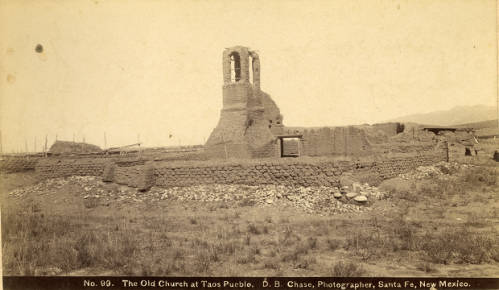
The eleven remaining convicted rebels had to wait to meet their end. Most of them would die three weeks later, on Friday, April 30. These executions seem to have occurred in two batches. The six men from Taos Pueblo—Francisco Naranjo, Jose Gabriel Romero (or Samora), Juan Domingo Martin, Juan Antonio Lucero, and a man called El Cuervo—were apparently hanged at the same time. They were buried at the Pueblo at the church which had been destroyed by the Americans in early February.

Ruins of the Taos Pueblo church. Source: Palace of the Governors Archives

Four other men—Manuel Miera, Juan Pacheco, Manuel Sandoval, and Rafael Tafoya—were also executed that day. Then, on the following Friday, Juan Antonio Avila was hanged for his role in the insurrection.

Why the week-long delay? There’s no information in the records. I’d love to know the answer to this question, just as I’d like to know why the trials of Trujillo, Barceló, Archuleta, and Vigil were held in Santa Fe and the reasons for the mistrials for latter three men. Was this a procedural issue? Was family pressure brought to bear?

I’m especially curious about the case of Trinidad Barceló. He was the older brother of businesswoman Gertrudes Barceló, who had assisted the U.S. occupiers in suppressing a revolt the previous December. Did her support of the regime play a part in her brother’s release?

What about the other two: Archuleta and Vigil? Were they related to Acting Governor Donaciano Vigil or some other prominent New Mexican who the Americans wanted on their side?

And then there are the stories of the men who died: their reasons for resistance, the impact on their families, the pain or joy they left behind.

So many stories, so little time.

© Loretta Miles Tollefson

Sources: David C. Beyreis, Blood in the Borderlands; Mary J. Straw Cook, Doña Tules; James A. Crutchfield, Revolt at Taos; Mark L. Gardner and Marc Simmons, eds., The Mexican War Correspondence of Richard Smith Elliott; Lewis H. Garrard, Wah-to-ya and the Taos Trail; Lucy Lippard, Pueblo Chico, Land and Lives in Galisteo since 1814; Michael McNierney, ed. Taos 1847, The Revolt in Contemporary Accounts; Alberto Vidaurre in Corina A. Santistevan and JuliaMoore, Taos, A Topical History.

What’s the Name of That Town Again?

What’s the Name of That Town Again?

The name “Taos” conjures many things. An ancient pueblo. A Mexican outpost. Gringo mountain men. A violent revolt. A funky 21st century village. But the village and pueblo are two separate places. There are Spanish villages and Indigenous pueblos side by side all over New Mexico. As far as I know, only in the Taos valley do the two settlements carry the same name.

And where does the name come from and what does it mean? Now there’s a question. According to F.R. Bob Romero in Santistevan and Moore, Taos, A Topical History, it’s been attributed “to an Indian word meaning ‘Red Willow’ or ‘people of the Red Willow.’” But no one knows for sure. All we know is that it’s what the pueblo was called after the Spanish arrived. Romero says it’s likely a “Tiwa Indian term that perhaps began with the T sound and was Hispanicized as Taos.”

So that explains (or doesn’t!) that. But then there’s the question of the name of the village which is three miles southwest. We call it “Taos,” but it was originally called Don Fernando de Taos, San Fernando de Taos, San Fernandez de Taos, and various forms of these three names, such as Don Fernando, San Fernando, San Fernandez, or simply Fernando or Fernandez. Although the latter two don’t appear very often in the historical record. Even then, if the name is shortened, it becomes simply “Taos.”

As far as I know, Don Fernando de Taos is the only location in New Mexico which has the honorific “Don” attached to it. The Don Fernando for whom it was named was actually a Don Fernando Durán y Chávez, who had a hacienda near Taos Pueblo in the late 1600s. He and his son fled south during the Pueblo Revolt of 1680 and didn’t return. In 1795, the grant was ceded to settlers from the nearby Cañon area, but the village didn’t really start to thrive until French-Canadian and American mountain men [post link here] began to trickle in in the 1820s.The village was a restocking and trading point for the fur trappers. Some of them stayed to set up mercantile businesses and intermarry and the community became the center of americano settlement in the valley.

Ironically, the location that developed in response to the American presence became the flash point of resistance to the 1846 American invasion. Maybe the locals just got sick of us.

© Loretta Miles Tollefson

Sources: Source: Francis L. and Roberta B. Fugate, Roadside History of New Mexico; Robert Julyan, The Place Names of New Mexico, Revised Edition; F.R. Bob Romero in Santistevan and Moore eds., Taos, A Topical History; http://taoscountyhistoricalsociety.org/taoshistory.html, accessed Jan 3, 2017

Sheriff’s Leniency Isn’t Enough – TAOS REVOLT, Part 1

Sheriff’s Leniency Isn’t Enough – TAOS REVOLT, Part 1

On Friday, January 22, 1847, the residents of Santa Fe, in the occupied territory of New Mexico, were on high alert. News had arrived two days before that the U.S.-appointed governor, Charles Bent, was dead at the hands of a mob loyal to Mexico. This came as a surprise because Bent and the U.S. military commander, Sterling Price, had assured everyone that all opposition to the U.S. invasion had been quelled the month before.

Apparently not. The outbreak had started in the early hours of Tuesday, January 19 during an altercation at the village jail about whether Sheriff Stephen Lee would release three men who’d been incarcerated for theft. Lee, intimidated, was about to let them go when Prefect Cornelio Vigil showed up and intervened. In the ensuing argument, friends of the jailed men killed Vigil and released the prisoners, while Lee escaped to his house.

But not for long. Despite the fact that he’d been willing to release the prisoners, Lee would die along with five other men, including Bent, his brother-in-law Pablo Jaramillo, and Judge Carlos Beaubien’s nineteen-year-old son Narciso.

Taos, January 1847. The crosses mark the location where people died. Source: The Taos Massacres, John Durend, 2004.

By the time news of the deaths reached Santa Fe late Wednesday, the fighting at Taos had spread north to Arroyo Hondo and the compound of whisky purveyor Simeon Turley. Of the nine men at Turley’s, seven had died and two escaped before Price could complete his arrangements to head north. He would march out on Saturday morning with 290 men, four howitzers, and a ragtag mob of about fifty men under mountain man Ceran St. Vrain.

It would not be an easy trek. January 1847 was an unusually cold month and there was snow in the north. There weren’t enough horses to carry Price’s men. Even the dragoons were on foot. And the rebels didn’t wait for the Americans to come after them. They mobilized and headed toward Santa Fe. Fortunately, they wouldn’t get that far. But it would still be a campaign to remember.

© Loretta Miles Tollefson

Sources: James A. Crutchfield, Revolt at Taos, The New Mexican and Indian Insurrection of 1847; John Durand, The Taos Massacres; Mark L. Gardner and Marc Simmons, eds., The Mexican War Correspondence of Richard Smith Elliott; Howard R. Lamar, The Far Southwest, 1846-1912, A Territorial History;  Ralph Emerson Twitchell, The History of the Military Occupation of the Territory of New Mexico; Alberto Vidaurre, “1847: Revolt or Resistance?” in Corina A. Santisteven and Julia Moore, Taos, A Topical History.

New Year, New Book!

New Year, New Book!

I’m pleased to announce that my novel The Texian Prisoners will be published in March next year and that the ebook is now available for pre-order!

In Fall 1841, a band of roughly 300 Texans straggled out of the Staked Plains into New Mexico. They had intended to claim everything east of the Rio Grande for Texas. Instead, they were captured and sent south to El Paso del Norte, then on to Mexico City. The largest group of prisoners, which included journalist George Wilkins Kendall, was escorted to El Paso by Captain Damasio Salazar. Five prisoners died on that trek. Kendall would later write a book describing the experience, a book which accused Salazar of food deprivation, mutilation, and murder, and fed the glowing coals that would become the Mexican-American War.

But what really happened on the way to El Paso? The Texian Prisoners tells the story through the eyes of Kendall’s friend George Van Ness, a lawyer burdened with the ability to see his enemy’s point of view, and asks us to consider the possibility that Kendall’s report was not unbiased.

A historically accurate retelling of Larry McMurtry’s Dead Man’s Walk, this fictional memoir will make you question everything you thought you knew about Texas, New Mexico, and the boundary between them.

Available for pre-order from Amazon.com and other ebook retailers.

Damasio Salazar on the Assignment From Hell

Damasio Salazar on the Assignment From Hell

Mexican militia captain Damasio Salazar hadn’t been particularly pleased about his assignment to take the final batch of Santa Fe Texas Expedition prisoners south to El Paso del Norte. However, the past four days hadn’t been too bad. The prisoners had complained, of course, and he’d had a bit of trouble locating enough food for them, but the communities between San Miguel del Bado and Valencia had been surprisingly generous, especially the pueblos north of Albuquerque.


But now, on Monday, October 21, 1841, trouble had really started. First, he woke to a dead prisoner. Felix Ernest had been weak to begin with. And no wonder. He’d been with the Texans who had been out the longest and starved the most. The poor scurvy-ridden devils had ended up eating lizards, snakes, and boiled horse hide. Ernest hadn’t been actually ill, as far as Salazar knew. He was just too weak to wake up.


The Captain acted quickly to prevent other prisoners from dying on him by immediately requisitioning a cart from the Valencia alcalde and loading the weakest men onto it. But the dilapidated thing was so overwhelmed with riders that it fell apart a mile down the road.


This disaster precipitated another problem. A Texan who’d been riding, a man named McAllister, was so lame he couldn’t walk any further. When one of the more stupid of Salazar’s guards threatened to shoot him, the Texan yelled at him to do just that, and the idiot took him at his word.


Now Salazar had two dead prisoners to account for when he reached El Paso. He couldn’t very well carry the bodies with him. He’d had to resort to cutting off the men’s ears as proof they hadn’t run away.


He must have been thankful when he and his column finally reached the day’s destination, a grove of cottonwoods on the east bank of the Rio Grande south of Belen. The captain ordered one of the nineteen Texan cattle slaughtered. Maybe the meat would put some strength into the men and get them through what was to come. There were only a few more towns where he could acquire rations. Then, he and his prisoners would face the Jornada del Muerto.


By his calculations, they would be crossing right at the end of October. He needed to get 187 men, their guards, and the animals across a 90 mile stretch of wasteland notorious for a lack of water, especially this time of year. It was at least a three-day journey across a land of sand, rocky outcroppings, and an occasional stunted cactus. There was a reason it was called the journey at death.


The place lived up to its name. Three more men died crossing the Jornada. Salazar took their ears as well, and presented them to the Presidio commandant at El Paso del Norte. Although the Texan prisoners, particularly American newsman George Kendall, were appalled by what they saw as his savagery, the Captain was actually following orders —and precedent. The use of ears to account for dead enemies had been instituted by the man he presented them to in early November 1841.


Salazar did face a court-martial however, in response to questions Kendall raised about the Texan cattle left grazing outside El Paso. Once he’d been cleared of wrongdoing, the Captain returned to New Mexico. He would live out his days there, although he did have a brush with Anglo retribution in December 1846, when he was accused of participating in a conspiracy against American occupation.


There was no evidence that he’d been involved in those aborted plans and Salazar was allowed to go home in peace. Whether or not he was still haunted by the memories of the 1841 march south to El Paso is another question entirely.

BOOK REVIEW: FATHER STANLEY

BOOK REVIEW: FATHER STANLEY

Instead of doing a typical book review this time, I’ve chosen to write about one of my favorite New Mexico authors, the man who wrote under the pseudonym Fr. Stanley. Born in New York in 1908, Stanley Louis Crocchiola was ordained at age 30 in the Franciscan Order of Atonement. He had contracted tuberculosis by this time, so his superiors sent him to Hereford, Texas where they assumed the arid climate would help him heal. Ironically, he arrived there in February 1939 during a black dust storm. He survived that, though, and in 1940 was transferred to Santa Fe, New Mexico. The dry climate does seem to have suited him. He lived to be 87.


He used that time to learn about the history of the various communities he served in New Mexico and, in 1948, began chronicling their history. The resulting books, published under the pseudonym Fr. Stanley, are a charming mixture of stories told by old-timers, newspaper clippings, and on-the-ground observations. Many of them are printed on folded-over 8.5 x 11 paper stapled in the cross-section, or saddle-stitched, a kind of historical chapbook.


Fr. Stanley’s books often have the same simple cover design–a bright yellow background containing a red zia symbol and typeface. At least for the New Mexico books, the titles are also often nearly identical. The four I own are The Stanley (New Mexico) Story, The Elizabethtown (New Mexico) Story, The San Miguel del Bado (New Mexico) Story, and The Miami (New Mexico) Story.


Father Stanley wrote and published over 170 books, the majority in this simple format, though some, like The Duke City: The Story of Albuquerque, New Mexico and The Civil War in New Mexico were published in hardback. They are all a great resource for discovering the details of New Mexican life in the late 19th and early 20th centuries–everything from the types of apples grown in Miami to the names of the men on the Elizabethtown baseball team.

This interest in the minutiae of life is the defining characteristic of Father Stanley’s books and makes them well worth reading because they give us an almost newspaper-like glimpse into a bygone world. The only trouble is, they’re no longer currently being published. If you want a copy of The Bethel (New Mexico) Story, The Texico (New Mexico) Story, The Causey (New Mexico) Story, The Grant That Maxwell Bought, The Magdalena (New Mexico) Story, The Abo (New Mexico) Story, The Golden (New Mexico) Story, or any of the others, you’re going to have to find a secondhand bookseller.


I encourage you to do so, even at the risk of driving up prices on the many Stanley books that I still don’t have in my collection. For sheer joy in New Mexico history, in all its details, I recommend Father Stanley’s work!

Who Was George Wilkins Kendall?

Who Was George Wilkins Kendall?

I’ve mentioned George Wilkins Kendall in recent posts and thought I should explain who he was and why I think he’s important to the events that led to the 1846-47 conflict between the United States and Mexico.


A rather handsome man, Kendall had thick, wavy brown hair and loved fashionable clothes. He was also a quick learner who tended to focus only on what he was particularly interested in. At age 16, he announced that he wanted to become a printer and went to work for the Amherst Herald, which was owned by his first cousin and a friend.


When the paper collapsed 12 months later, Kendall went to Boston, where he apprenticed with the Statesman and experienced Boston theater. This sparked an interest in acting that took him to New York City and a position with a wandering theatrical group.


For the next five or six years, Kendall around the U.S., sometimes working in theater, sometimes in print shops or as a reporter. At one point, he even operated a stage coach line in North Carolina. Somewhere along the way, he returned to his first interest and acquired the skills of a journeyman printer. Around the same time, he began to transition into the role of newspaper reporter, writing for the Mobile, Alabama Register; the United States Telegraph and National Intelligencer in Washington City; the True American in New Orleans; and the Sentinel in Greensboro, Alabama. In 1836, he settled in New Orleans and he and a friend prepared to begin printing what is today the Times-Picayune/New Orleans Advocate.


For folks in New Orleans, Kendall’s legacy would appear to be a newspaper that’s been in print since January 1837. However, in the 1840’s, he had a more immediate impact on events at large. The Picayune had published a series of pieces by a reporter named Matt Field. The articles, based on Field’s 1839 trip to New Mexico, were picked up by papers across the country and as far away as London. Field made New Mexico look both wild and accessible at the same time, and the popularity of his pieces seems to have sparked Kendall’s interest in going there himself.

Around the same time, there was a lot of national discussion about whether the Republic of Texas should be invited to join the Union. Kendall, and other who supported annexation, saw it as an opportunity to expand the U.S. as far west as the Rio Grande.


Since its founding, Texas had claimed that its western boundary extended to the river and included Santa Fe. In 1840, Texan President Mirabeau B. Lamar decided to enforce that claim by sending a group of soldiers to New Mexico along with a few merchants, to make it look like a commercial venture.
The Texas Santa Fe Expedition started from Austin in June 1841 and included Kendall, who, unlike his fellow travelers, had a passport from the Mexican vice-consul in New Orleans. As a reporter/publisher, Kendall had developed the habit of carrying a small black notebook, where he recorded ideas, jokes, and “sparks of wit” for future publication. He kept up this practice en route to New Mexico, noting both the good and the bad about the Expedition, its members, and their activities. He was devastated and furious when his notes were confiscated after he and other members were captured by New Mexico militia that Fall.


However, Kendall’s years as a reporter and his time on the stage seem to have stood him in good stead. He remembered in great detail what occurred between his capture, incarceration in Mexico City, and final return to New Orleans in May 1842.


As soon as he reached home, he began writing his memories down. The first installments were published in the Picayune in early June. This and the following chapters were reprinted in newspapers across the country and then into a book, A Narrative of an Expedition Across the Great Southwestern Prairies, from Texas to Santa Fe. The two-volume edition published in 1844 went on to become a best seller, with more than 40,000 copies sold over the next eight years.


The Narrative’s description of Mexico was both inflammatory and racist. Kendall portrayed the Texans as brave risk-taking Anglo adventurers while Damasio Salazar, the man who superintended the first part of the Texans’ journey south to Mexico City, was a “dark-visaged” monster with a vendetta against Americans. In addition, Mexican men in general were shiftless and the Mexican Army in particular was weak and poorly armed.


As the prisoners’ route takes them closer to Mexico City, Kendall begins to provide detail about the condition of the roads and the fortifications in the towns along the way. In fact, the book begins to seem more like a reconnaissance report than a traveler’s narrative. One has the sense Kendall hoped it would serve not only as a rallying cry against the “pernicious” Mexicans, but also as a handbook for an American invasion.


And he appears to have got what he wished for. When the war Mexicans know as “The War of the United States Against Mexico” came in 1846, many of the invading volunteers carried copies of Kendall’s book. After it was over, he published an illustrated book about the conflict, then went to Texas, where he settled in its Hill Country.


He is remembered there for his contributions to Texas sheep ranching. However, I consider the Narrative to be Kendall’s most lasting contribution to history. While many in the United States were already convinced in 1842 that its manifest destiny was to own everything to the Pacific, there was no justification for going to war to get it. But Kendall’s account of what he considered the inhumane treatment of the Texan prisoners gave people the excuse they needed.


He should be remembered for that, not with admiration, but as a caution to ourselves to carefully evaluate what we are told and the possible motivations that might influence that story’s content and message. As a reminder to watch out for the Kendalls in our own midst.

Texan Expedition Leaves for Santa Fe!

Texan Expedition Leaves for Santa Fe!

On Friday, June 18, 1841, Texan President Mirabeau Buonaparte Lamar accompanied Texas Santa Fe Expedition on the first leg of their journey to New Mexico.

Lamar sent an open letter with them, printed in both English and Spanish. This missive asserted Texas’s right to New Mexico east of the Rio Grande and said the Republic intended to “admit its remotest citizens to an equal participation of the blessings which have been acquired by our late glorious revolution.” It then went on to invite New Mexico to enter “the doors of the Temple which we have erected to Liberty,” and stated that if they weren’t interested, the Texans would leave quietly.

Mirabeau B. Lamar, courtesy Wikipedia.com

However, Lamar had told the three men he’d appointed to represent him in New Mexico that “upon entering the city of Santa Fe, your first object will be, to endeavor to get into your hands all the public property.” Admittedly, he said to do this without resorting to violence. But ninety percent of the men he’d sent were either current or recent members of the Texas Army. Maybe he thought the mere threat of violence would suffice.

The 300-strong Expedition marched eagerly out of Austin that bright Friday morning in June. On Saturday morning, Lamar reviewed them, delivered a speech, and sent them on their way. Everyone was in good spirits. They’d be home again in a matter of months, and the way to Santa Fe and all its wealth would be open at last. 

The trip wouldn’t go quite as planned, but they didn’t know that yet. For now, adventure awaited.

As did New Mexico Governor Manuel Armijo, who was already marshaling troops and ammunition, and arranging for the Comanches to monitor the Texans’ progress. Lamar’s Expedition would not find New Mexico unprepared.

Supreme Court Rules in Land Grant Company’s Favor

Supreme Court Rules in Land Grant Company’s Favor

On Monday, April 18, 1887, the U.S. Supreme Court finally confirmed the Maxwell Land Grant and Railway Company’s right to almost two million acres in northeast New Mexico.

The controversy over the grant’s size had been going on since the early 1870s. A survey when the Company bought the grant identified around 2 million acres, land that  that included much of what is now New Mexico’s Colfax County and stretched north into Colorado.

But there was a problem. Not everyone agreed that the grant was that large. In fact, U.S. General Land Office surveys insisted that grants issued by Mexico were limited to only 22 square leagues—a far cry from the 2 million acres claimed. Based on this judgment, the Land Office declared much of the acreage open to settlement. When its agents began issuing deeds to eager homesteaders and ranchers, trouble ensued. But the Maxwell Grant Company intended that land for its own uses and this was the American West—might made right. People died.

Map of final Maxwell Land Grant and Railway Company boundaries

At the same time it was using guns and intimidation to keep people off its wide-open spaces, the Company also sought legal recourse. It turned to Washington with a request for an official government survey of the grant based on the geographical descriptions in the original 1840s documents. The request was refused.

Then in 1876, the U.S. Supreme Court allowed another New Mexico land grant to encompass more than 22 square leagues. The Maxwell Land Grant and Railway Company swung into action. Three weeks after the decision, the Maxwell grant was being resurveyed. It took another eleven years, four days of oral argument, and 900 pages of testimony, but the Company finally got its land.  

With that ruling, the Colfax County War, which had begun in earnest in September 1875, finally wound down, making it a longer feud than New Mexico’s more famous Lincoln County War, which had lasted a mere three years (1878-1881).

And proving that if you hang in there long enough—and have enough money—you might just get what you want, after all.

Sources: Howard R. Lamar, Reader’s Encyclopedia of the American West, New York: Harper & Row, 1977; Lawrence R. Murphy, Philmont: A history of New Mexico’s Cimarron Country, Albuquerque: University of New Mexico Press, 1972; Stephen Zimmer, For Good or Bad, The People of the Cimarron Country, Santa Fe: Sunstone Press, 1999; Maria E. Montoya, “Maxwell Land Grant”, Encyclopedia of the Great Plains, plainshumanities.unl.edu/encyclopedia/doc/egp.ha.026, accessed 1/20/22.