I’m pleased to announce that my new novel The Pain and The Sorrow is already in print! This is the story of New Mexico Territory’s serial killer Charles Kennedy and his teenage wife, the girl who endured years of his abuse before finally reporting his nefarious activities to the authorities.  Order it from your favorite bookseller or online! Here are two online sources: Amazon, Barnes and Noble.
Tag: Elizabethtown
Colfax County Serial Killer’s Wife Bears Him a Son
On June 24, 1869 a baby boy was born to Charles and Gregoria Kennedy, presumably at their cabin at the foot of Palo Flechado Pass on the road between Taos and Elizabethtown. Baptized in September that year at Our Lady of Guadalupe church in Taos, he was the only living child of Charles (age 31) and Gregoria (age 17) when the U.S. census taker arrived at the cabin the following summer. Charles Kennedy would become known in New Mexico Territory as the serial killer whose wife turned him in after he killed their child. Following a hung jury in Elizabethtown in Fall 1870, a mob led by Colfax County rancher and gunslinger Clay Allison would spring Kennedy from jail and see that justice was done anyway—at the end of a rope.

Legend has it that Allison then took a butcher knife to Kennedy’s neck, severing his neck and presenting it to hotelkeeper Henri Lambert for display outside his establishment as a warning for all evildoers in Colfax County. It is also said that before he died Kennedy confessed to killing twenty-one men. Without the birth and subsequent death of that little boy, many more men might have died at his father’s hands.
If you’re interested in a fictional account of these events, please consider ordering my novel The Pain and the Sorrow, which will be released by Sunstone Press in early August.
Sources: New Mexico, Births and Christenings, 1726-1918; Howard Bryan, Wildest of the Wild West, Clear Light Publishers, 1988; Southwest Sentinel, Silver City, NM, November 24, 1885.
HOLLOW
Lucien Maxwell, single largest landowner in New Mexico Territory, stepped from the Middaugh Mercantile porch into early June sunlight and gazed unseeing across the green valley. On the flanks of Baldy Mountain, construction workers scurried like ants around a long wooden aquaduct-like structure. When finished, the flume it held would carry water from the Red River’s source to Baldy Mountain’s base. Then high pressure hoses would spray the sides of the gulches that drained the mountain, flushing out gravel and the gold the miners hoped it contained.
They were calling the flume the Big Ditch. It was a first for New Mexico Territory. Maxwell was a major investor, likely to make a substantial return both from water sales and from men wanting to buy mining rights. Yet all he could see was the letter in his hand.
Kit Carson was dead. Kit, the companion of so many of Lucien’s wilderness adventures, always so full of energy, so confident in his quiet-spoken way, with his sixth sense for trouble and how to meet it. Yes, Kit had been ill, but it was still incomprehensible that he could be gone. Lucien Maxwell gazed at the men scrambling across the hillside opposite and could feel no joy in their activity and its outcomes. It all seemed rather hollow, somehow.
Copyright © 2016 Loretta Miles Tollefson
Baldy Mountain Mining Problems Solved!!!!
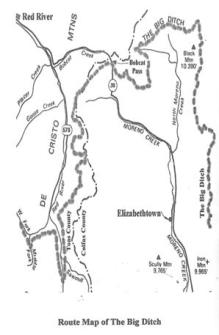
The miners in the Elizabethtown, New Mexico area were mighty frustrated. There just wasn’t enough water to satisfy their need to wash the gold out of the flanks of Baldy Mountain. They were willing to pay, but there was no one selling. But on May 28, 1868, their problem appeared to be on the way to being solved, because construction began on the Big Ditch.
Designed by a East Coast-educated former Army Engineer Capt. N.S. Davis, the Big Ditch project would employ over 400 men to construct a 41-mile system of reservoirs, dams, and wooden trestles that would funnel Red River’s headwaters to the placer mines on Baldy Mountain’s western flanks. About 7.6 million gallons per day (600 miner’s inches) were anticipated, water enough to supply all the miners in the district.
Or so they thought. The problem was that, as the water sat in the three reservoirs, then flowed through the landscape and the primarily wooden flumes on its 41 mile route to the mines, leakage in the flume and evaporation into the dry New Mexico air sucked much of the anticipated liquid right out of the system. When the water bean to flow the following July, only about 1/6 of the expected amount actually reached its destination. Just over one million gallons a day, or about 100 miners inches, remained for the miners to use.

Not only was there not enough water, selling what there was wouldn’t return the $280,000 cost of construction to the original investors. The price of 50 cents per miner’s inch simply didn’t cover the amount invested. The Big Ditch changed hands several times until it was eventually sold to Irish-born Matthew Lynch, who jerry-rigged the system sufficiently to provide for his own hydraulic mining operations and leave a small surplus to sell. So the Big Ditch did turn out to be useful, just not to the level originally projected.
Sources: Red River City, A history of northern New Mexico, J. Rush Pierce, JRP Publications, Red River, NM, 2008; The Leading Facts of New Mexican History, Ralph Emerson Twitchell, Sunstone Press, 2007.
Baldy Miners Organize Themselves
150 years ago today, on May 13, 1867, a group of New Mexico Territory miners met to organize the Baldy Peak/Elizabethtown Mining District. Chaired by John E. Codlin of New Jersey, the committee established the dimensions for lode and placer claims and the amount of necessary to keep a claim active. They also elected a recorder to take responsibility for filing mining, water, and timber rights notices, along with bills of sale and property deeds.
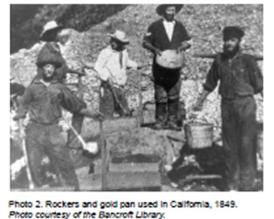 The need for organization was urgent: As many as 400 mining claims had already been staked within an eight mile radius of Baldy Peak. This included Ute Park, where prospectors Tim Foley, Matthew Lynch, and Robert Doherty had found gold in the bed of Ute Creek, a find that would lead the following year to the discovery of the Aztec Mine, a mine that would produce over $100,000 in gold between October 1868 and July 1869.
Most of the districts placer claims were on Baldy’s western slopes, in gulches that ran from the mountain into Moreno Creek, and in the gravel in the Creek. The mines were concentrated along the lower slopes and along the Creek between Mills Gulch, three miles north of Etown, and Anniseta Gulch, 2 miles south. In addition, there were placers along the upper reaches of Willow Creek on Baldy’s southern slopes, on Ute Creek below the Aztec, and in the upper reaches of South Ponil Creek, near the outcrop of the Aztec vein.
It was only fitting that the 27-year-old New Jersey-born John Codlin should chair the effort to organize all this. He’d been part of the group (with Irishman Patrick Lyons, Prussian-born Fred Pfeffer, and a man called “Big Mich”) who’d first discovered gold at what is now Elizabethtown, a few hundred yards east of the where the town was eventually laid out, in what they named Michigan Gulch. They worked the gulch as the Michigan Company.
Codlin seems to have developed a taste for politics. He would go on to become the chairman of the Colfax County Commission in 1897-98 and to fight the 1897 transference of the county seat from Springer to Raton, a legal challenge that eventually made its way to the Supreme Court, which decided in favor of Raton. He died in April 1908 and is buried in the Springer, NM cemetery.
Source: History of New Mexico, Its Resources and People, George Anderson, Pacific States Publishing, Los Angeles, 1907; Placer Gold Deposits of New Mexico, Maureen G. Johnson, Dept. of the Interior, Geological Survey Bulletin 1348, U.S. Government Printing Office, 1972; Lure, Lore and Legends of the Moreno Valley, Moreno Valley Writers Guild, Columbine Books, 1997; Philmont, A History of New Mexico’s Cimarron Country, Lawrence R. Murphy, UNM Press, Albuquerque, 1972; Familysearch.org; 1870 United State Census Data, Colfax County, New Mexico.
Etown Has Stagecoach Service Again!
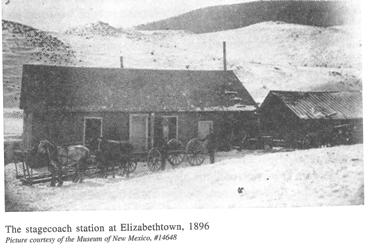
On May 1, 1894, the stagecoach once again arrived in Etown, New Mexico: The Springer and Moreno Valley Stage Line began daily passenger runs between Elizabethtown and Springer, where passengers could connect with the railroad. Even with fares at $5 a day, demand was high. The line was soon running double headers every other day. It didn’t just carry passengers. There were also contracts with Wells Fargo Express and the United States Post Office. In fact, the endeavor was so lucrative that H.H. Hankins jumped to serve the same route with the Moreno Valley Stage and Freight Company line.

These transportation services replaced Col. Valentine “Jim” S. Shelby’s 1868 Moreno Valley Stage and Freight Line, which had run three times a week between Maxwell’s Ranch (today’s Cimarron) and Elizabethtown, departing from Maxwell’s one day and returning from Elizabethtown the next. Fares in 1868 were $8 each way. Shelby, a former army wagon master, seems to have enjoyed a good challenge. A co-owner of the Aztec Mine, he also helped fund the construction project that diverted water from Red River to the Baldy Mountain mining district, then took it over when it failed to live up to projections, on the chance that he could find a buyer—which he did. Shelby eventually left the Etown area and ended up in Santa Fe, where he ran a large gambling “resort”—yet another service in high demand in New Mexico Territory.
Sources: Lure, Lore and Legends of the Moreno Valley, Moreno Valley Writers Guild, Columbine Books, 1997; Philmont, A History of New Mexico’s Cimarron Country, Lawrence R. Murphy, UNM Press,
Condemnation Process Begins for Future Eagle Nest Lake
In April 1909, the Cimarron Valley Land Company filed a lawsuit to condemn land that was destined to lie under what is now known as Eagle Nest Lake in northern New Mexico’s Rocky Mountains. The land in question seems to have belonged entirely to widow Mary Gallagher and her eight children, the youngest of whom was 16.
Mary’s husband John had purchased the property with proceeds from his 1870’s gold mining days in the Elizabethtown area at the northern end of the valley. He was a committed farmer: he’d constructed canals from both Willow and Cieneguilla Creek to irrigate his crops.
When the Cimarron Valley Land Company in Springer requested a State permit to construct a dam at Eagle’s Nest that would back up water onto her and other landowners’ property, Mary Gallagher took action. In January 1908, she filed a formal protest against the proposal. However, the State Engineer approved the permit in early July and the Company began negotiating with the three property owners affected.

But Mary Gallagher held out. Eventually, the Cimarron Valley Land Company realized that only a condemnation suit was likely to dislodge her. So they went to court in April 1909. And that’s when the real delays began. Initially, there was no Judge in the County to take up the matter. Even when that issue was resolved, the proceedings moved at glacial speed. There were appeals, demands for a jury trial, a commission established to determine the value of the property, and so forth. In fact, the process took so long that it didn’t formally end until after Mary’s death in 1916. Work on the dam and its related reservoir began the following spring, after her children had been paid off.
Oddly enough, in April 1915 the Company had requested an extension of the State permit, citing “unprecedented financial conditions” which made the Company “unable to procure the necessary funds.” The application for extension didn’t mention the land condemnation suit. Perhaps the Cimarron Valley Land Company was a little embarrassed by the fact that a little old widow lady (Mary was about 62 at the time) was blocking their progress so effectively. It must have seemed simpler to blame the delay on the international crisis of World War I.
Sources: Sept. 1, 1909 Charles Springer letter to NM Territorial Engineer Vernon S. Sullivan; Sept. 16, 1909 Charles A. Spiess affidavit; Jan 27, 1908 letter from Mary Gallagher to NM Territorial Engineer Vernon S. Sullivan; Jan. 31, 1908 protest from Gallagher family to NM Territorial Engineer Vernon S. Sullivan; March 30, 1915 application for extension of time for construction, NM Territorial Engineer Permit # 71.
Troops Save Gold Miner From Etown Mob
On Thursday, April 9, 1868, gold prospector William “Wall” W. Henderson killed a man in Humbug Gulch east of Elizabethtown, New Mexico Territory. Being a law-abiding man, Henderson went to Etown to turn himself into the authorities. The authorities seem to have been fairly weak at the time, because a mob of about eighty men threatened to take matters into their own hands. Fortunately, a messenger was able to reach the Fort Union cavalry troops stationed thirty miles away at Maxwell’s Ranch (today’s Cimarron) in time to request assistance.
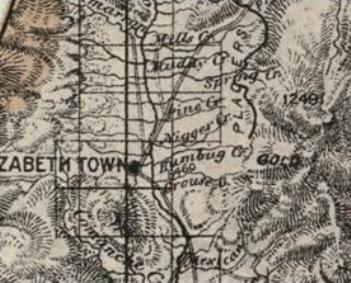
A sergeant and ten men travelled up Cimarron canyon overnight to reach Elizabethtown early the next morning and disperse the mob. They took Henderson back to Maxwell’s, out of harm’s way, and the miners went back to work. In fact, things calmed so much that Henderson returned to Elizabethtown and went back to mining. He was still there the following year, when he served as a member of the petit jury during the Colfax County District Court’s 1869 Spring session. And he did well financially. By the summer of 1870, Henderson had amassed $5,000 in real estate.
That year, he also stood security for Charles Kennedy’s bond to appear before the Fall Court response to embezzlement and assault charges. Ironically, Kennedy himself would be lynched by an Etown mob later that fall, following accusations that he’d killed and robbed a series of men at his cabin about ten miles south of Humbug Gulch.
Sources: Fort Union and the Frontier Army in the Southwest, Leo E. Oliva, Southwest Cultural Resources Center, National Park Service, 1993; 1870 Colfax County Census, Etown precinct; New Mexico Territory District 1 Court Records, 1869 through 1870.
Calling the Jury, Elizabethtown, New Mexico Territory
Judge Palen flattened his palms against the rough wooden table that served as the Court bench and scowled at Sheriff Calhoun. “Are you telling me that you called twenty-one men for jury duty and only seven showed up?”
Calhoun was a big man, but he fingered the broad-brimmed hat in his hands like a schoolboy. “Yes, sir.”
“Well, go get fourteen more.”
The Sheriff nodded, turned, and crossed the creaking wooden floor.
Palen turned his attention to his seven potential jury members. “All right,” he said. “Now how many of you are going to have good excuses for not fulfilling your civic duty?”
Three of them sheepishly raised their hands. Palen nodded to his court clerk to begin taking their excuses and closed his eyes. And he’d thought this appointment as Chief Justice of New Mexico Territory and Judge of its First Judicial District was a logical step up from postmaster of Hudson, New York. He suppressed a sigh. How he missed the broad sweep of the river, the bustle of the town’s port. He grimaced and opened his eyes. Only four jurymen left. Damn this town, anyway. The whole of New Mexico Territory, for that matter.
from Moreno Valley Sketches II
New Mexico Territory’s Chief Justice is Fooled Again
Friday, April 1 was the first day of the Spring 1870 Court session in Colfax County, New Mexico Territory, and Judge Joseph G. Palen must have thought someone had pulled an April Fool’s joke on him. At the end of the 1869 Fall session, he’d made three local men responsible for selecting jurors for the Spring term, but it hadn’t done much good. Only six of the identified grand jury members had showed up, so the Judge ordered Sheriff Andrew J. Calhoun to bring in 15 more potential jurors. Which he did but eleven of them had excuses. The 57-year-old Harvard-educated Judge Palen must have wished he’d never accepted President Ulysses S. Grant’s offer to promote him from Hudson, New York postmaster to Chief Justice of the New Mexico Territorial Court and therefore Judge of the Territory’s First District, which included Colfax County.

Something similar had happened at the beginning of the Fall 1869 session, Judge Palen’s first in Colfax County, and he’d thought he’d solved the problem by giving E.B. Dennison, Benjamin F. Houx, and John Sutton the task of ensuring there’d be enough jurors for the Spring Session. But even their fellow citizens couldn’t corral the miners and ranchers of Colfax County to do their civic duty.
Late that day, the Sheriff finally brought in enough men to fill out the grand jury panel, none of them with reasons strong enough excuse them from the task. However, Palen still had no petit jury members. It was the morning of Tuesday, April 5 before he had both panels in place. Which wouldn’t have been too much of a problem, except that the court session was scheduled to end on Saturday, April 9. There wasn’t much time to address the over 70 separate actions that came before the court during the week-long Spring 1870 session.
Sources: Chasing the Santa Fe Ring, David L. Caffey, UNM Press, 2014; Colfax County District Court Civil and Criminal Record 1, 1869-1871, Serial No. 14400; The Leading Facts of New Mexico History Vol. II, Ralph E. Twitchell, Sunstone Press, 2007.
 Fiction and Fact From Old New Mexico