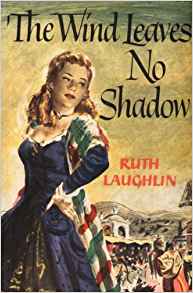
The Wind Leaves No Shadow: Book Review

The Wind Leaves No Shadow cover
by Ruth Laughlin
Caxton Printers, 1951
ISBN-13: 978-0870040832

Doña Tules Barceló was one of New Mexico’s most colorful 19th century characters, and The Wind Leaves No Shadow is, as far as I know, the only fictional or non-fictional treatment of her life.

From humble origins, which Ruth Laughlin imagines effectively, Doña Tules became owner of a Santa Fe gambling establishment where political opponents could meet to arrange accommodations that worked for everyone involved. She also acted as a kind of informal bank, lending money to key actors at critical junctures in New Mexico’s history. Because her gambling house gave her access to information not available everywhere, she was a valuable resource for both the Mexican and the American officials. She is said to have provided information in late 1846 to Governor Bent’s administration about the incipient rebellion against the U.S. occupation, the one that would result in his death a couple months later.

Not much is known about Doña Tules’ life, and Laughlin uses this fact to her advantage, weaving a story that places her in Santa Fe by the mid-1820’s and keeps her there until her death in 1852. The result is a story that not only imagines Doña Tules’ life but also provides the opportunity for an inside look at events (the 1837 Tax Revolt, the 1846 U.S. invasion, the 1847 death of Charles Bent) and people (the fur trappers, the ricos, the Santa Fe merchants, the priests) in Santa Fe during this period.

The Wind Leaves No Shadow was originally published in 1951 and reflects the historical information available to the author at the time as well as the prejudices that period. Although I didn’t always agree with Laughlin’s interpretation of historical events, she does a really great job of incorporating them into an effective story line. I was also uncomfortable with her insistence on Doña Tules’ white skin, red hair, and green eyes. In Laughlin’s interpretation, her coloring sounds more Irish than Spanish. In spite of these caveats, I believe this is still a useful book. If you’d like to get some idea of the life and trials of New Mexico’s famous lady gambler might have been like, or you’d like a fictional interpretation of New Mexico’s history in the 1820-1850 time frame, I recommend this book.
Two Robidoux Brothers Become Mexican Citizens

On Friday, July 17, 1829, Antoine and Louis Robidoux of Missouri became naturalized citizens of Mexico, thus beginning a long and somewhat fruitful association.

Antoine and Louis were two of six brothers, all of them involved in one aspect or another of the Rocky Mountain fur trade. Becoming Mexican citizens made good business sense, because trapping licenses for non-citizens were at times non-existent.

Antoine, who was 35 years old in 1829, had been in New Mexico since 1822. He’d spent the previous two years trapping and trading with the Sioux and his application for citizenship may have been prompted by the fact that he’d married a New Mexican woman in 1828 and it was time to settle down. Or he may have wanted to get involved in local politics. Antoine’s citizenship made him eligible to be elected 1st alcalde and regidor (councilman) of Santa Fe in late 1830 and three years later to serve as 3rd alcalde of Santa Fe and a member of the Santa Fe Commission for forming election districts.


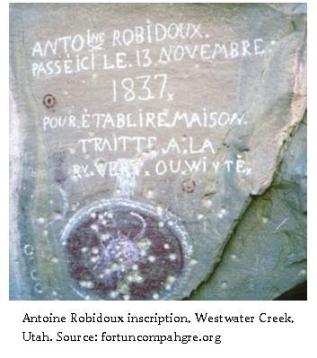
He was also busy making money. During the 1830s, Antoine purchased a mine in the Santa Fe area. He also built Fort Uinta (aka Fort Robidoux) and Fort Uncompahgre in what is now Colorado and used them as a base for trade with the Indians and the trappers in the area.

July 17 illustration.Antoine-Robidoux inscription

However, in 1844, both forts were attacked by Utes and a number of men were killed and women captured. These events seem to have curbed Antoine’s enthusiasm for the frontier life. He left for Missouri shortly thereafter.

But he came back. Eschewing his Mexican citizenship, Antoine served with Col. Stephen Watts Kearny as an interpreter during the 1846 U.S. advance on New Mexico and remained with him during the California campaign which followed. After the war, Antoine returned to Missouri, where he died in 1860.

Louis Robidoux, on the other hand, seems to have remained loyal to his Mexican citizenship. Much of his early career mirrored Antoine’s. He arrived in New Mexico about the same time (probably 1823), married a New Mexican woman (Guadalupe Garcia in 1834), and participated in Santa Fe politics, where he served as first alcalde in 1839. He also participated in various moneymaking schemes, including operating a grist mill and iron works in Santa Fe.

July 17 illustration.Louis Robidoux

And he also left New Mexico. But instead of heading back to Missouri, Louis went to California, a move reportedly bankrolled by a $30,000 win in a Santa Fe card game. He arrived in California with a group of Mexican traders in 1843 and remained there until his death in 1868.

He settled in what would become San Bernardino County, where he set up a large livestock operation and planted orchards, wine vineyards, and a grist mill. He was also involved in politics, becoming the first San Bernardino County Supervisor. The City of Rubidoux, the Louis Robidoux Library, various streets, and Mount Rubidoux are all named after him.

Leroy R. Hafen, Fur Traders and Trappers of the Far Southwest, Logan: Utah State University Press, 1997; David J. Weber, The Taos trappers, the fur trade in the far Southwest, 1540-1846, Norman: University of Oklahoma Press, 1971.

The Lizard as Hero: Book Review

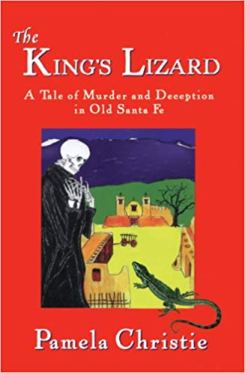
The almost-invisible lizard sunning himself on a rock or a log is a common occurrence  in New Mexico. I almost stepped on one in the garden this morning. However, I would never have thought to use a lizard as a metaphor for a detective and “fixer.” But Pamela Christie did, and the resulting books are a fascinating look at New Mexico in the 1780s.

Kings Lizard cover

In The King’s Lizard, Christie introduces us to the Old New Mexico version of the invisible person—the half-Ute, half-Spanish Fernando “Nando” Aguilar who lives in a kind of limbo between his Spanish and Native origins. This liminal status makes Nando easy to overlook. But it also gives him access to both the Native and Spanish worlds, an access which makes him a valuable tool for Governor Juan Bautista de Anza.

Governor Anza has been tasked with creating a lasting peace with the Comanche. But there are men in New Mexico who don’t want peace. Unsettled conditions give them access to human contraband. And contraband sales fund a more-than-comfortable lifestyle. Nando becomes part of these men’s merchandise and then, after he escapes their clutches, the key to destroying the slave network as well as providing the Governor with a path to peace.

Dead Lizards Dance cover

In Dead Lizard’s Dance, Nando once again saves the day, sorting out a plot that not only threatens the Governor, but also his own family’s security. Rumors of witchcraft go hand in hand with the struggle to control the caravan of goods to and from Mexico that is the colony’s lifeline.

This particular novel also highlights the status of women in the colony, and it isn’t a particularly pretty picture. But Nando protects the women he can, including those who’ve exacted revenge on a man who’s made a life’s work of abuse and betrayal.

Lizard’s Kill appears to be the end of the road for Nando’s work for Anza, because the Governor’s term of office has ended.

Lizards Kill cover

He’s on his way back to Mexico and retirement. But Anza has one more service he hopes to perform for New Mexico and only Nando Aguilar has the skills to achieve the impossible.

Christie brings a deep knowledge of a complex bygone world  to these three books, a knowledge that seems to expand with each story. Her writing and her observations about New Mexico life and politics in the 1780s grows more deft with each novel. If you’d like to know more about this period and are looking for a good mystery series to dive into I recommend these books.

Long live lizards!

P.S. All of these books are also available directly from Pamela Christie, who says she prefers direct contact with her readers. And she’ll also cut deals! You can contact her at christiepr@gmail.com.

New Mexico’s First Protestant Church

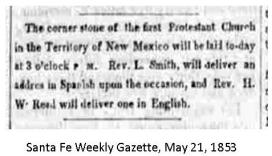
On Saturday, May 21, 1853, Baptist missionaries in Santa Fe began construction of the first Protestant church in New Mexico, located on the corner of what is now Grant and Griffin Street. The Reverend Henry W. Reed and the Reverend L. Smith officiated.

May 21 illustration

Henry Reed had arrived in Santa Fe in Summer 1846 and opened a school. Smith arrived several years later. They seem to have been focused on converting New Mexicans to Protestantism rather than serving the Anglo population. In 1851, Reade reported to his constituency back East that he’d been in Taos to share information about his Baptist school curriculum with Padre Martinez and had attended the Catholic services there. He disapprovingly described the mass as “not above a whisper and in Latin.”

The Baptist church services in Santa Fe were apparently in Spanish and English. At the cornerstone-laying ceremony on May 21, Reverend Smith spoke in Spanish and Reverend Read in English. This bilinqual approach doesn’t seem to have been enough to attract a large congregation. The adobe brick building was sold to the Presbyterians in 1866, at the end of the Civil War.

The Presbyterians eventually pulled the adobe building down and replaced it in 1882 with a brick structure. That building was replaced in 1939 with a Pueblo Revival building designed by John Gaw Meem, which is still in use today.

Sources: Thomas Harwood, The History of New Mexico Spanish and English Missions of the Methodist Episcopal Church, 1850 to 1910, Vol. I. Albuquerque: El Abogado Press, 1908; E. A. Mares, ed., Padre Martinez: New Perspectives From Taos, Taos: Millicent Rogers Museum, 1988; Ralph Emerson Twitchell, The Leading Facts of New Mexican History, Vol. II. Cedar Rapids: The Torch Press, 1912.

Texas Stage Route Is Better In Winter Months

On April 8, 1853, the readers of the Santa Fe Weekly Gazette were reminded that winter wasn’t truly over in New Mexico—the mail and passengers to and from Texas were still being transported under the “winter arrangement.”

There really wasn’t any difference between the summer and winter time schedule. Each month, the stage left Santa Fe on the 15th and arrived in El Paso six to eight days later. The next leg of the trip was from El Paso to San Antonio, where it  arrived on the 14th or 15th of the following month. So it took about a week to get from Santa Fe to El Paso, a trip which takes about five hours today. Interestingly, the fare from Santa Fe to El Paso was $30, only about $10 more than the cost of gas for the same route today. In fact, if wear and tear on one’s vehicle is factored in, it might have been cheaper to travel between Santa Fe and El Paso in 1853 than it is now. That is, of course, if you have seven or eight days for the trip.

April 8 illustration

On the other hand, the cost to travel from Santa Fe to San Antonio was significantly higher in 1853 than it is today—$125 as opposed to $48 in fuel costs. The timeframe for the trip is also considerably less now—about 12 hours as opposed to 30 days.

One thing has remained the same. The advertisement in the Gazette points out that the trip to and from “the States” via the San Antonio route was considerably more pleasant during the winter months than was travel via the Santa Fe Trail to Independence, Missouri. The southern route was, and is still likely to be, “entirely free from the intense cold and heavy snows that so frequently obstruct” the northern Trail.

There was another advantage to taking the stage to San Antonio. Passengers were not required to stand guard.

Sources: Santa Fe Weekly Gazette, April 8, 1853, first page; MapQuest.com, accessed March 5, 2019.


Pike’s Peakers Arrive At Fort Union!!

Tuesday, March 10, 1862 was a momentous day for New Mexico. That morning, Confederate troops from Texas seized control of Santa Fe. Led by Brigadier General Henry Hopkins Sibley, the Texans had moved steadily north through New Mexico since the previous July, receiving little opposition and clashing with Union forces in only one major battle, which they’d won.

By this time, the Texans must have been feeling pretty confident about making it to Denver and its gold fields. The idea was to seize those resources and use them to restore the Confederacy’s fortunes (literally). Then Sibley and his men would press on to California and the Pacific, opening its ports to Confederate shipping and sidestepping the Union blockades on the Eastern seaboard.

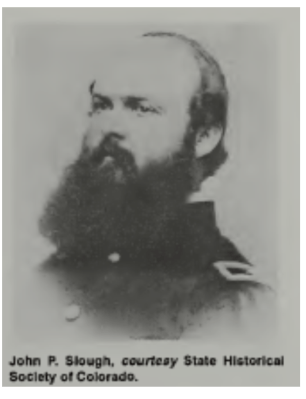
But late on March 10, Colonel John Potts Slough and his 950-man First Regiment of Colorado Volunteers (aka the Pike’s Peakers)  arrived at New Mexico’s Fort Union, more than doubling the number of men available in New Mexico to face down the Confederates.

Slough abruptly assumed command of the Fort. Although the Denver attorney had been in the military for only six months, he’d been a Colonel longer than twenty-seven-year veteran Colonel G.B.  Paul, who was in charge before the Pike’s Peakers arrived. But Slough, ever concerned about his rights and privileges, pulled rank, and Paul conceded his position as Commander, albeit unwillingly. Then Slough got busy outfitting his Pike’s Peakers with clothing, arms, and ammunition from the Fort Union supply depot.

march 10 illustration.john slough

Meanwhile in Santa Fe, Sibley’s Confederates  were also looking to their supplies. Their lines had been stretched thin on the march north and the Union supplies in Santa Fe had either been moved west to Las Vegas with the Governor’s baggage or skillfully hidden.

The Confederates’ stores were dangerously low. Although getting to Santa Fe had been quite an accomplishment, they badly needed Fort Union’s supplies if they were going to make it all the way to Denver.

But on March 10, they didn’t have a lot more time to worry about their situation. In less than two weeks, the thin-skinned and arrogant Slough would begin moving his men south out of Fort Union, then west toward Santa Fe. What would become known as the Battle of Glorieta or, more dramatically, the Gettysburg of the West, was about to begin.

Sources: Howard Bryan, Wildest of the Wild West, Santa Fe: Clear Light Publishing, 1988; Jacqueline D. Meketa, Louis Felsenthal, Citizen-Soldier of Territorial New Mexico, Albuquerque: UNM Press, 1982; David Grant Noble, Pueblos, Villages, Forts & Trails: A guide to New Mexico’s past. Albuquerque: UNM Press, 1994; Leo E. Oliva, Fort Union and the Frontier Army of the Southwest, Santa Fe: Southwest Cultural Resources Center Professional Papers No. 41, Division of History, National Park Service, 1993; Jerry D. Thompson, A Civil War History of the New Mexico Volunteers and Militia¸ Albuquerque: UNM Press, 2015.

WATER OF LIFE

“Now what’re you gettin’ yourself all fired up for?” the matted-haired trapper demanded. “I’m your pa and I can do I want.” He lifted the pottery jug from the wooden table with both hands. “I been feelin’ a mite poorly since I come in from the mountains and this here’s a right good anti-fogmatic.”

“Aquardiente,” the girl said contemptuously. “Your so-called water of life.” She pushed her long black hair away from her face. “Water of hell!”

“Ah, now girlie.” He grasped the jug’s narrow neck with one hand and reached for her arm with the other.

She slapped at him. “I’m not your girlie any longer. Don’t you touch me!”

His eyes narrowed. “I’m still your pappy,” he said. “Just ’cuz I been gone five months don’t mean you can be disrespectin’ me.”

She sniffed and turned away.

He gulped down a swig of the liquor. “Where’s your ma, anyways?”

“She went to the merchant’s to settle her bill.”

“Don’t want me to know how much she spent while I was gone, huh? What new piece of fooferaw have the two of you took a cotton to now?”

The girl whirled. “You mean the cotton for your shirts? The white wheat flour she saved for your biscuits while we spent the entire winter eating cheap corn tortillas?”

The jug thudded onto the table. “What’s eatin’ you girl, that you think you can chaw on me so right catawamptiously? It ain’t fitten!” He surged from the chair, his hand raised. “I’m thinkin’ you need a rememberance of who’s head o’ this household!”

Her lower lip curled. “That’s right. Beat me. Just give me an excuse to leave. That’s everything I could wish for.”

He dropped his hand. “And why would you leave, girl?” He peered at her. “You find a young man to spark you while I was gone?”

She lifted her chin. “I don’t need a man.”

He threw back his head. “Hah! And what else you gonna go and do?” Then his face changed. “You ain’t gone and done something you’ll regret, have you now?”

Her lips twitched with amusement. “You might regret it,” she said. “I won’t be of much use to you.”

He moved toward her. “What the tarnation have you gone and done?”

“You’ll know when I’m ready to tell you.”

As he grabbed her arm, the door opened.

“Be careful of her, por favor!” the girl’s mother said as she entered. “She has been accepted into the convent in Santa Fe, to serve as a helper! Our child is a matter of grace to us now!”

The mountain man stared at his wife, then his daughter. He turned to the table. “Women!” he muttered as he lifted his jug.

from Old One Eye Pete


Governor Bent Misreads New Mexico

On Thursday, January 14, 1847, Charles Bent, New Mexico’s first American governor, left Santa Fe for his home in Taos. A few weeks earlier, Bent had nipped an uprising against his new administration in the bud. He was confident that the U.S. occupation of New Mexico was now secure enough to allow him a visit with his family in Taos. He took with him Narciso Beaubien, the 19-year-old son of newly-appointed American judge Carlos Beaubien, who had recently returned from school in Missouri.

By Sunday, January 17, Charles Bent, Narciso Beaubien, and at least ten others would be dead as the result of an uprising Bent had failed to foresee. In December, he’d thrown men of wealth and position into prison. He believed this was all he needed to do to stamp out any real opposition to the U.S. takeover of New Mexico.

He would discover how wrong he was as he lay dying at the hands of the unimportant people he had discounted, people who may have been striking out at New Mexico’s class system as much as the American occupiers. Bent and the other men killed that week in January were all linked in some way to the U.S. occupation or were believed to have taken advantage of their status as Americans, even if they were originally from another country. And they were all ricos—men of wealth and connections.

Jan 14 illustration.Charles Bent

While Narciso Beaubien was the son of a rico, he hadn’t played a role in the American invasion, or even been in New Mexico when the takeover occurred. Why he was slain in mid-January 1847 remains a mystery. Did he die simply because he was Charles Beaubien’s son?

Sources: Marc Simmons, Kit Carson, And His Three Wives, University of New Mexico Press, Albuquerque, 2003; David J. Weber, The Taos Trappers, University of Oklahoma Press, Norman, 1971; Lewis H. Garrard, Wah-to-yah and the Taos Trail, University of Oklahoma Press, Norman, 1955.

Ewing Young, On The Move Again

On Sunday, January 1, 1832, Tennessee-born Ewing Young was once again on the move. Young had arrived in New Mexico in 1822. In the following ten years, he’d trapped the San Juan, Gila, and Salt Rivers, as well as the Colorado as far as the Grand Canyon. That was during the trapping season. The rest of the year, he kept busy hauling goods from Missouri over the Santa Fe Trail and selling them in Taos and Santa Fe.

Apparently all this activity wasn’t enough for Young. In 1831, he was looking for further adventure and profit. He recruited thirty-six other trappers** and headed farther afield. Young had a Mexican passport that allowed his party to travel to Chihuahua. But he and his men made no attempt to even look like they were headed south from Taos. Instead, they moved almost straight west to the Zuni villages.

There they traded for supplies, then moved across country to the headwaters of the Black River, in what is now eastern Arizona, and down it to the Salt. From the upper Salt, they crossed to the Gila River, then trapped the Gila to its junction with the Colorado. This is where they landed on the first day of 1832.

Jan 1 illustration.Young, Ewing.young man
Ewing Young as a young man

The group’s beaver catch hadn’t been very good. They were apparently all using the same traps, ones with a defect that allowed the beaver to escape from the sprung device. Young must have thought he’d solved the problem with the traps, because he made one last effort to gather plews by trapping down the Colorado to tidewater. When that didn’t work either, the larger group split up and Young and twelve men headed to California.

California had been Young’s destination all along. His business partner David Jackson was already there, trying to gather enough horses and mules to make it worthwhile to drive them east to the New Orleans markets. But by the time Young arrived in California, Jackson had only been able to collect about a quarter of the animals they needed.

The men with Young scattered at this point, some of them remaining in California and others returning to New Mexico and points East. Young himself stayed to hunt sea otter, and eventually settled on the West Coast. He’d wandered over a decade before he landed there.

Sometimes it takes a while for a man to settle down.


**Young’s band of trappers included Job F. Dye, Sidney Cooper, Moses Carson, Benjamin Day, Isaac Sparks, Joseph Gale, Joseph Dofit, John Higans, Isaac Williams, James Green, Cambridge Green, James Anderson, Thomas Low, Julian Bargas, Jose Teforia, John Price, J.J. Warner, and William Day.

Sources: Robert Glass Cleland This Reckless Breed of Men, Knopf, 1950; Leroy R. Hafen, editor, Fur Trappers and Traders of the Far Southwest, Utah State University Press, 1997;  Leroy R. Hafen, editor, Mountain Men and the Fur Trade of the Far West, Vol. I, Arthur  H. Clark, Spokane, 2000.


Fur Catch Causes Nothing But Trouble

Ewing Young had thirteen 90-pound packs of beaver fur in his possession in early May 1827, and he wasn’t interested in having them confiscated. According to the rumors, outgoing Governor Narbona was cracking down on trappers without the proper permissions and incoming Governor Manuel Armijo was likely to be even stricter than Narbona.

So Young did the only sensible thing an American trapper could do. He hid his furs at the Pena Blanca home of his associate Luis Maria Cabeza de Baca.

But he had neglected to realize that some of the men with him might have different ideas about the most sensible approach to government mandates. A member of his trapping party, Ignacio Sandoval, told officials in Santa Fe what Young was up to.

From that point on, things took a turn for the worse. Governor Narbona ordered soldiers to Pena Blanca to confiscate the furs and, in the process, Luis Maria Cabeza de Baca was killed. Then Manuel Armijo became governor on May 20 and signed an order for Young’s arrest for illegal trapping. Young seems to have talked his way out of that predicament and instead got permission to clean the confiscated furs. He and the Santa Fe alcalde were in front of the governor’s long adobe palace, shaking out and inventorying the furs, when another member of Young’s trapping party appeared on the scene. Milton Sublette grabbed a bundle of pelts and made off with them.

When Sublette and the furs disappeared, the governor blamed Ewing Young. He called Young to the palace and threatened him with jail. Young turned on his heel and walked out of Armijo’s office, but he wasn’t free for long. And when the soldiers did catch up with him, he was thrown in the calaboza, where he languished until he became ill and was finally released.

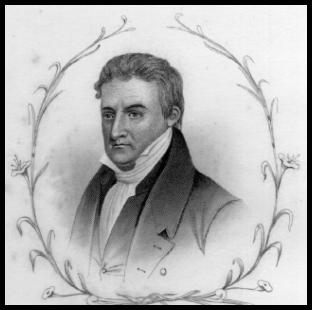
May 15 blog illustration.Armijo, Manuel.illustrated history of nm
Source: Illustrated History of New Mexico,
Reed

But he didn’t get his furs back. Many of them had been badly damaged by rain leaking through the roof of the building where they were stored, so they were sold for about two-thirds what they would have brought in good condition. The total was still a decent amount, about $3500. But it’s not clear who received the resulting funds. After all, the plews were government-confiscated property.

Sources: Carl P. Russell, Firearms, Traps, and Tools of the Mountain Men, Skyhorse Publishing, 2010; David J. Weber, The Taos Trappers, University of Oklahoma Press, 1970.