Pike’s Peakers Arrive At Fort Union!!

Tuesday, March 10, 1862 was a momentous day for New Mexico. That morning, Confederate troops from Texas seized control of Santa Fe. Led by Brigadier General Henry Hopkins Sibley, the Texans had moved steadily north through New Mexico since the previous July, receiving little opposition and clashing with Union forces in only one major battle, which they’d won.

By this time, the Texans must have been feeling pretty confident about making it to Denver and its gold fields. The idea was to seize those resources and use them to restore the Confederacy’s fortunes (literally). Then Sibley and his men would press on to California and the Pacific, opening its ports to Confederate shipping and sidestepping the Union blockades on the Eastern seaboard.

But late on March 10, Colonel John Potts Slough and his 950-man First Regiment of Colorado Volunteers (aka the Pike’s Peakers)  arrived at New Mexico’s Fort Union, more than doubling the number of men available in New Mexico to face down the Confederates.

Slough abruptly assumed command of the Fort. Although the Denver attorney had been in the military for only six months, he’d been a Colonel longer than twenty-seven-year veteran Colonel G.B.  Paul, who was in charge before the Pike’s Peakers arrived. But Slough, ever concerned about his rights and privileges, pulled rank, and Paul conceded his position as Commander, albeit unwillingly. Then Slough got busy outfitting his Pike’s Peakers with clothing, arms, and ammunition from the Fort Union supply depot.
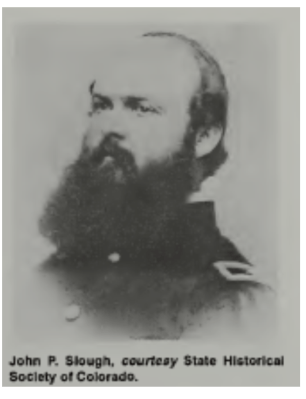
march 10 illustration.john slough

Meanwhile in Santa Fe, Sibley’s Confederates  were also looking to their supplies. Their lines had been stretched thin on the march north and the Union supplies in Santa Fe had either been moved west to Las Vegas with the Governor’s baggage or skillfully hidden.

The Confederates’ stores were dangerously low. Although getting to Santa Fe had been quite an accomplishment, they badly needed Fort Union’s supplies if they were going to make it all the way to Denver.

But on March 10, they didn’t have a lot more time to worry about their situation. In less than two weeks, the thin-skinned and arrogant Slough would begin moving his men south out of Fort Union, then west toward Santa Fe. What would become known as the Battle of Glorieta or, more dramatically, the Gettysburg of the West, was about to begin.

Sources: Howard Bryan, Wildest of the Wild West, Santa Fe: Clear Light Publishing, 1988; Jacqueline D. Meketa, Louis Felsenthal, Citizen-Soldier of Territorial New Mexico, Albuquerque: UNM Press, 1982; David Grant Noble, Pueblos, Villages, Forts & Trails: A guide to New Mexico’s past. Albuquerque: UNM Press, 1994; Leo E. Oliva, Fort Union and the Frontier Army of the Southwest, Santa Fe: Southwest Cultural Resources Center Professional Papers No. 41, Division of History, National Park Service, 1993; Jerry D. Thompson, A Civil War History of the New Mexico Volunteers and Militia¸ Albuquerque: UNM Press, 2015.

VALLEY OF THE EAGLES

It was spring in the valley of the eagles, which meant it had been raining off and on for three weeks and the usually adobe-hard clay soil was soft enough to be dug. Once Old Bill had selected a likely spot for caching the packs of beaver fur, Pepe set to work. Old Bill stood farther up the hillside, chanting in a mixture of Osage and Ute. The prayers would help keep varmints away, Bill had said: both the two-footed and four-footed kind.

It was a good location for a cache, Pepe reflected: tucked under the hillside pines and marked by a massive sandstone boulder that would be easy to identify when they returned. After the Taos alcalde had decided that the few beaver plews they’d set aside to show him were truly Old Bill’s entire winter haul,  Pepe and Old Bill would slip back into the valley with a Taos trader to turn the cached furs into coin. Then Pepe would have a nice amount to take home to his wife while Old Bill gambled his own portion away.

Pepe chuckled and paused his digging to wipe his forehead with his cotton sleeve. He was always surprised at how warm it could get in this valley, as high up in the mountains as it was.

Small stones rattled past him and Old Bill came down the hillside. “War’s th’ other shovel?” he demanded in his nasal twang. “We ain’t got th’ rest o’ eternity!”

from Valley of the Eagles


Illegal Trappers Leave New Mexico, For Now

In February 1815, a group of St. Louis trappers led by Joseph Philibert left Taos for the Arkansas River and on to St. Louis. After five months under arrest in Taos, they were returning to the U.S. with a healthy load of beaver plews.

The entire group had been arrested by Spanish soldiers the previous September and charged with crossing the international boundary illegally. The furs they had with them were confiscated to cover the costs of their incarceration over the course of the winter. It’s not clear where they collected the furs they took back East the following spring. But they seem to have gathered enough plews to make the whole expedition worthwhile.

And to make them want to try the same stunt again. When Philibert headed to St. Louis, he went with the hope of arranging financial backing for yet another venture into New Mexico.

oct 29 illustration.pixabay

Under Spanish law, what Philibert had done and was proposing to do again was flatly illegal. Foreigners weren’t allowed across the New Spain/U.S. border without explicit permission from Spanish officials. In fact, in the five months the Philibert group was in Taos, at least four other illegal foreigners were arrested and sent to New Spain’s interior. Why Philibert’s group was allowed to remain is as much of a mystery as the source of the furs they took back to St. Louis.

What’s clear is that the border between the two countries was already extremely porous. It was almost inevitable that American trappers would continue to filter into Spanish territory. The furs there, and the money they were worth in the U.S., were just too tempting. New Mexico’s officials may have simply been bowing to the inevitable when they allowed Joseph Philibert and his band of men to remain in Taos the winter of 1814/15.

Sources:  Leroy R. Hafen, editor, Fur Trappers and Traders of the Far Southwest, Utah State University press, Logan, 1997; David J. Weber, The Taos Trappers, University of Oklahoma press, Norman, 1971.

WATER OF LIFE

“Now what’re you gettin’ yourself all fired up for?” the matted-haired trapper demanded. “I’m your pa and I can do I want.” He lifted the pottery jug from the wooden table with both hands. “I been feelin’ a mite poorly since I come in from the mountains and this here’s a right good anti-fogmatic.”

“Aquardiente,” the girl said contemptuously. “Your so-called water of life.” She pushed her long black hair away from her face. “Water of hell!”

“Ah, now girlie.” He grasped the jug’s narrow neck with one hand and reached for her arm with the other.

She slapped at him. “I’m not your girlie any longer. Don’t you touch me!”

His eyes narrowed. “I’m still your pappy,” he said. “Just ’cuz I been gone five months don’t mean you can be disrespectin’ me.”

She sniffed and turned away.

He gulped down a swig of the liquor. “Where’s your ma, anyways?”

“She went to the merchant’s to settle her bill.”

“Don’t want me to know how much she spent while I was gone, huh? What new piece of fooferaw have the two of you took a cotton to now?”

The girl whirled. “You mean the cotton for your shirts? The white wheat flour she saved for your biscuits while we spent the entire winter eating cheap corn tortillas?”

The jug thudded onto the table. “What’s eatin’ you girl, that you think you can chaw on me so right catawamptiously? It ain’t fitten!” He surged from the chair, his hand raised. “I’m thinkin’ you need a rememberance of who’s head o’ this household!”

Her lower lip curled. “That’s right. Beat me. Just give me an excuse to leave. That’s everything I could wish for.”

He dropped his hand. “And why would you leave, girl?” He peered at her. “You find a young man to spark you while I was gone?”

She lifted her chin. “I don’t need a man.”

He threw back his head. “Hah! And what else you gonna go and do?” Then his face changed. “You ain’t gone and done something you’ll regret, have you now?”

Her lips twitched with amusement. “You might regret it,” she said. “I won’t be of much use to you.”

He moved toward her. “What the tarnation have you gone and done?”

“You’ll know when I’m ready to tell you.”

As he grabbed her arm, the door opened.

“Be careful of her, por favor!” the girl’s mother said as she entered. “She has been accepted into the convent in Santa Fe, to serve as a helper! Our child is a matter of grace to us now!”

The mountain man stared at his wife, then his daughter. He turned to the table. “Women!” he muttered as he lifted his jug.

from Old One Eye Pete


William Workman Orders Still For Taos Lightning

On Monday, February 13, 1826, William Workman of Taos, New Mexico sent a letter to his brother David in Franklin, Missouri. William asked David to have two 80-gallon stills shipped to him from St. Louis. Copper stills were essential in the production of hard liquor like the wheat-based Taos Lightning that William produced and sold.

Not only did William Workman’s letter ensure that Taos residents would have more liquor available to them, it also may have triggered one of the American West’s most famous runaway stories.

David Workman, a saddle and harness maker, had a teenage apprentice named Christopher “Kit” Carson. The letter from New Mexico may have reminded the young Kit that there were more exciting ways to earn a living. When he took off for New Mexico that August, he may well have traveled in the same wagon train as the stills that William Workman had ordered.

Workman manufactured Taos Lightning until 1841, when he himself had to run away, this time from—rather than to—New Mexico. Workman and his distillery partner John Rowland fled Taos for California that September, after rumors spread that they were collaborating with a Republic of Texas expedition to annex New Mexico.

feb-13-illustration-workman-william-1855-mnm-13492.jpeg
William Workman, 1855. MNM 13492

While Carson stayed in New Mexico and made him name for himself, Workman, in California and still partnering with John Rowland, obtained a Mexican land grant of over 48,000 acres and founded  Rancho de la Puente, now a cultural landmark in Southern California.

In both cases, running away seems to have been the best move either Workman or Carson could have made. They both made a name for themselves as a result.


Sources: Samuel P. Arnold, Eating up the Santa Fe Trail, University Press of Colorado, Niwot, 1990; Leroy R. Hafen, editor, Fur Trappers and Traders of the Far Southwest, Utah State University Press, Logan, 1997; Hampton Sides, Blood and Thunder, Doubleday, New York, 2006; Marc Simmons, Kit Carson, and His Three Wives, University of New Mexico Press, Albuquerque, 2003.


BENT’S FORT

“After what you been through these last couple weeks, I’d of thought you’d be right tickled to get inside four solid walls,” the old man said. He pulled off his boots and lay back on the thin pallet with its mangy once-green wool blanket. His socks were black with grime. The stench of them in the windowless room turned Timothy’s stomach.

“I’ll sleep out,” Timothy repeated. “I suppose I’ve become used to having stars over my head at night.”

The teamster shrugged and stretched his arms luxuriously. “Me, I seen too many downpours,” he said. “Give me a dry bed under a solid roof and I’m in heaven, for sure. All I want to finish it off is a woman.” He propped himself up on one elbow, eyes bright. “You think you could do somethin’ about that third item while you’re out there?”

Timothy laughed. “I don’t speak Indian.”

“Ah, all you need is whiskey and a kiss. And you’re a good lookin’ cub. You probably wouldn’t even need whiskey.” The old man grinned toothlessly. “But you wouldn’t likely bring me that kind of gift, would you now? I know I sure wouldn’t if I was you. Guess I’ll just hafta see what I can rustle up for myself.” He sat up and reached for his boots.

Timothy chuckled and moved to the door. “Good luck with getting all three of your heavenly requirements,” he said.

“Huh?” The teamster was spitting on his hands, then using the moisture to slick back his grimy hair. He stopped his grooming process and frowned. “What requirements?”

“Bed, roof, and woman,” Timothy explained. “Me, I think I’ll just settle for a nice quiet bed.”

“Good luck.” The old man chuckled. “What with those two mule trains that followed us in here this afternoon, I doubt you’re gonna find a quiet spot anywhere near this old fort.”

from Valley of the Eagles


Governor Bent Misreads New Mexico

On Thursday, January 14, 1847, Charles Bent, New Mexico’s first American governor, left Santa Fe for his home in Taos. A few weeks earlier, Bent had nipped an uprising against his new administration in the bud. He was confident that the U.S. occupation of New Mexico was now secure enough to allow him a visit with his family in Taos. He took with him Narciso Beaubien, the 19-year-old son of newly-appointed American judge Carlos Beaubien, who had recently returned from school in Missouri.

By Sunday, January 17, Charles Bent, Narciso Beaubien, and at least ten others would be dead as the result of an uprising Bent had failed to foresee. In December, he’d thrown men of wealth and position into prison. He believed this was all he needed to do to stamp out any real opposition to the U.S. takeover of New Mexico.

He would discover how wrong he was as he lay dying at the hands of the unimportant people he had discounted, people who may have been striking out at New Mexico’s class system as much as the American occupiers. Bent and the other men killed that week in January were all linked in some way to the U.S. occupation or were believed to have taken advantage of their status as Americans, even if they were originally from another country. And they were all ricos—men of wealth and connections.

Jan 14 illustration.Charles Bent

While Narciso Beaubien was the son of a rico, he hadn’t played a role in the American invasion, or even been in New Mexico when the takeover occurred. Why he was slain in mid-January 1847 remains a mystery. Did he die simply because he was Charles Beaubien’s son?

Sources: Marc Simmons, Kit Carson, And His Three Wives, University of New Mexico Press, Albuquerque, 2003; David J. Weber, The Taos Trappers, University of Oklahoma Press, Norman, 1971; Lewis H. Garrard, Wah-to-yah and the Taos Trail, University of Oklahoma Press, Norman, 1955.

SNOW, 1 of 3 – Preparations

Patricia stood in the cabin doorway and looked west, across the valley. The Sangre de Cristo peaks were obscured by thick gray clouds and a white haze drifted down their lower flanks. A cold damp wind snapped against her face. There would be snow before nightfall, more by tomorrow.

“Winter is definitely here,” she muttered, heading toward the barnyard.

The chickens were already in their coop. She lifted the skim of ice from their water pan, filled the grain container, and latched the flap down over their entry door.

The horses and cow were huddled on the east side of the barn. She threw open the door and they crowded in. She ensured they had feed, then took the grain shovel back to the cabin with her, in preparation for tomorrow’s path-clearing.

All she needed now was some assurance that her husband was safe and dry, she thought ruefully as she bolted the cabin door behind her. Wherever he was.

from Valley of the Eagles

Soldier Arrested for Enlisting

On Saturday, December 21, 1861, a worker from Red River (aka the Rio Colorado) named George Montoya, enlisted in the New Mexico militia to fight the Confederate Texas invaders.

However, Montoya had a problem. He had a financial obligation to a rico in the Rio Colorado area. His master didn’t want Montoya to leave the area, so he persuaded the County judge to arrest him for enlisting. As a result, Montoya traded his military quarters for the county jail, in spite of the fact that Colonel Edward R. S. Canby, commander of New Mexico’s Union troops, had recently issued an order that required the masters of peóns who’d enlisted to file a writ of habeas corpus and petition the Territorial Court to have their workers returned. An order from a local judge wasn’t enough to recover their loss.

It’s not clear what happened in this particular case. However, records for the First New Mexico infantry show that two years later, on November 29, 1863, a twenty-five-year-old man named George Montoya was enrolled at Taos as a private. Montoya served as part of a wagon train escort to Tucson, Arizona in 1864 and 1865 and was still in the military in December 1865. It seems likely that this is the same person who was imprisoned for volunteering in 1861.

One can only hope that if he returned to the Taos area, Montoya’s military service gave him the means to address any outstanding financial obligations and enabled him to get on with his life without the specter of jail hanging over him.

Source: Jerry D. Thompson, A Civil War History of the New Mexico Volunteers and Militia, UNM Press: Albuquerque, 2015.

American Civil War Reaches New Mexico

On Wednesday, December 4, 1861, Governor Henry Connelly issued his first proclamation as New Mexico’s governor. Ironically, his message came almost exactly fifteen years after he’d been arrested south of Mesilla by Mexican authorities and taken to Chihuahua.

In 1846, Connelly has been suspected of being part of the invading American Army, which was sweeping south across New Mexico, en route to the Sonora desert, California, and possession of the entire continent.

Now, in 1861, Connelly’s proclamation warned of another invasion, this one moving north from the Mesilla area into the rest of New Mexico. This time, the invasion was from Texas, which had recently joined the Confederate States of America. The Governor’s proclamation called for volunteers to fight the invading forces.

Near Mesilla, at Fort Bliss, the former commander of New Mexico’s Fort Union, Confederate General Henry H. Sibley, was preparing his own proclamation to the citizens of New Mexico. It was addressed to his “old comrades in arms” and declared that his troops’ goal was to free New Mexicans from the “yoke of military despotism.”

But the thought of Texas trying yet again to invade New Mexico, as they had in 1841, swayed the Territory’s citizens more powerfully than Sibley’s reminder that they lived under a rule enforced from Washington DC.

Governor Connelly’s rhetoric was more convincing. “The enemy is Texas and the Texans,” he declared. That was enough for New Mexico’s citizens. The Territory raised five regiments of volunteers and one of militia, as well as three independent militia companies and four independent cavalry companies with three-month enlistments. In all, 3,500 New Mexicans fought for the Union—and against Texas—in the War Between the States.

Sources:  Rubén Sálaz Márquez, New Mexico, a brief multi-history, Cosmic House, Albuquerque, 1999; Jerry D. Thompson, A Civil War History of the New Mexico Volunteers and Militia, UNM Press, Albuquerque, 2015.