Aftermath of a Rebellion

Aftermath of a Rebellion

In mid April 1847, the Taos Valley was still experiencing the aftermath of the January 20 rebellion.

The U.S. Army had captured a total of 45 rebels. They released 24 for lack of evidence and tried 21. The trials were over, but the executions weren’t. Seventeen men would hang, one of them for high treason.

The high treason charge was questionable. An argument could be made that a person couldn’t rebel against a country to which they had not pledged allegiance. The war with Mexico wasn’t over. New Mexico was still officially part of occupied Mexico, and its people were still citizens of that country. There’d been a trial in early January which had found the high treason charge suspect. But that didn’t stop 26-year-old prosecuting attorney Francis P. Blaire, Jr. from continuing to use it.

In early March, Blaire filed the charge against three men: Antonio Maria Trujillo, Pantaleon Archuleta, Trinidad Barceló, and Pedro Vigil. Apparently the only rebel trials held in Santa Fe, the charges against Archuleta, Barceló, and Pedro Vigil were eventually dropped after the proceedings ended in a mistrial.

Trujillo was found guilty, but because he was elderly and unwell, the jury and judge requested that the sentence be commuted. Military Governor Sterling Price granted the pardon, and Santa Fe was spared a demonstration of the effectiveness of the gallows.

Taos wasn’t. Of the eighteen prisoners tried there, all were convicted and hung.

There had been a single execution on February 7 of Pablo Montoya, one of the rebellion leaders, but the remainder waited until April, when the formal trials began.

These hangings started on Friday, April 9, when Hipolito (Polo) Salazar, Jose Manuel Garcia, Pedro Lucero, Juan Ramon Trujillo, and the Romero brothers Ysidro and Manuel, age sixteen, were executed two days after their trials. Salazar had been convicted of high treason, but the rest of these men were found guilty of killing American-appointed Governor Charles Bent.

The eleven remaining convicted rebels had to wait to meet their end. Most of them would die three weeks later, on Friday, April 30. These executions seem to have occurred in two batches. The six men from Taos Pueblo—Francisco Naranjo, Jose Gabriel Romero (or Samora), Juan Domingo Martin, Juan Antonio Lucero, and a man called El Cuervo—were apparently hanged at the same time. They were buried at the Pueblo at the church which had been destroyed by the Americans in early February.

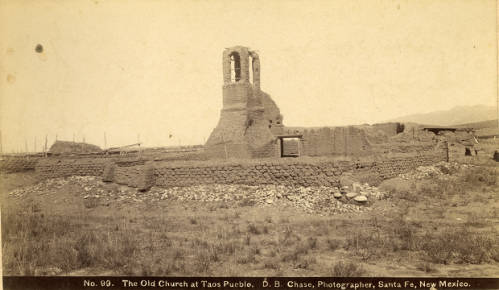
Ruins of the Taos Pueblo church. Source: Palace of the Governors Archives

Four other men—Manuel Miera, Juan Pacheco, Manuel Sandoval, and Rafael Tafoya—were also executed that day. Then, on the following Friday, Juan Antonio Avila was hanged for his role in the insurrection.

Why the week-long delay? There’s no information in the records. I’d love to know the answer to this question, just as I’d like to know why the trials of Trujillo, Barceló, Archuleta, and Vigil were held in Santa Fe and the reasons for the mistrials for latter three men. Was this a procedural issue? Was family pressure brought to bear?

I’m especially curious about the case of Trinidad Barceló. He was the older brother of businesswoman Gertrudes Barceló, who had assisted the U.S. occupiers in suppressing a revolt the previous December. Did her support of the regime play a part in her brother’s release?

What about the other two: Archuleta and Vigil? Were they related to Acting Governor Donaciano Vigil or some other prominent New Mexican who the Americans wanted on their side?

And then there are the stories of the men who died: their reasons for resistance, the impact on their families, the pain or joy they left behind.

So many stories, so little time.

© Loretta Miles Tollefson

Sources: David C. Beyreis, Blood in the Borderlands; Mary J. Straw Cook, Doña Tules; James A. Crutchfield, Revolt at Taos; Mark L. Gardner and Marc Simmons, eds., The Mexican War Correspondence of Richard Smith Elliott; Lewis H. Garrard, Wah-to-ya and the Taos Trail; Lucy Lippard, Pueblo Chico, Land and Lives in Galisteo since 1814; Michael McNierney, ed. Taos 1847, The Revolt in Contemporary Accounts; Alberto Vidaurre in Corina A. Santistevan and JuliaMoore, Taos, A Topical History.

Houses Made of Mud

Houses Made of Mud

In my March 5 post, I mentioned that one of the things that nineteenth century Americans disparaged when they first arrived in New Mexico was what they called “mud houses.” Newspaper correspondent Matt Field wasn’t the only person to describe Santa Fe as a “mud built city” of one-story buildings that reminded him “of an assemblage of mole hills.”

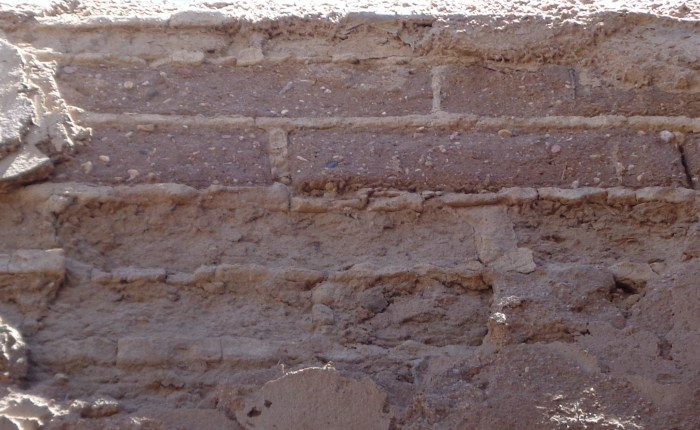
Technically, Field was right. The buildings, even the churches, were in fact built of a mixture of earth and water. These carefully formed bricks had evolved from the indigenous practice of puddled mud construction and by the 1800s were created by packing a stiff, dough-like mud into a rectangular wooden frame that was then lifted away from the resulting block. Two days later, the brick was dry enough to be turned on end and a week later, hard enough to be stacked and cured for another month. To speed up the drying process, adobe makers in the upper Rio Grande region often added straw.

Adobe bricks were used to construct one-story buildings but, with proper buttressing, the walls could be extended higher. Field noted that the Santa Fe parish church was built “as high and quite as large as any of our [U.S.] ordinary size meeting houses.”

He also noted that the adobe walls were strong and durable. In fact, they were so strong and durable that the Fort the invading Americans constructed on the hill overlooking the church in the Fall of 1846 was made of double walls of adobe bricks with a core of rubble between them.  

Diagram of Fort Marcy, constructed Fall 1846. Source: Fort Marcy Park interpretive signage.

Early the following year, the Americans got a taste of just how resilient adobe walls could be. After the January 1847 Taos uprising, the U.S. Army hauled four mounted howitzers and a six-pound cannon north to deal with the rebellion. The insurrectos had retreated to the mission church at Taos Pueblo, but the American artillery made little headway against its adobe walls.  Lt. Richard Smith Elliott reported later that the walls were so thick, the cannon balls would not go through them.

In fact, the artillery crews made little headway against the pueblo church until they positioned the smallest cannon closer to it and began using grapeshot in a spot already damaged by an axe-wielding soldier. Only then were the attackers able to enter the church.

Not even adobe could withstand the fury and tenacity of Americans with newly acquired land to protect.

© Loretta Miles Tollefson

Sources: Bainbridge Bunting, Early Architecture in New Mexico; Stella M. Drumm, Down The Santa Fe Trail and Into Mexico, Diary of Susan Shelby Magoffin 1846-1847; Mark L. Gardner and Marc Simmons, eds., The Mexican War Correspondence of Richard Smith Elliott; Michael McNierny, ed., Taos 1847, The Revolt in Contemporary Accounts; Clyde and Mae Reed Porter, Matt Field on the Santa Fe Trail.

What’s the Name of That Town Again?

What’s the Name of That Town Again?

The name “Taos” conjures many things. An ancient pueblo. A Mexican outpost. Gringo mountain men. A violent revolt. A funky 21st century village. But the village and pueblo are two separate places. There are Spanish villages and Indigenous pueblos side by side all over New Mexico. As far as I know, only in the Taos valley do the two settlements carry the same name.

And where does the name come from and what does it mean? Now there’s a question. According to F.R. Bob Romero in Santistevan and Moore, Taos, A Topical History, it’s been attributed “to an Indian word meaning ‘Red Willow’ or ‘people of the Red Willow.’” But no one knows for sure. All we know is that it’s what the pueblo was called after the Spanish arrived. Romero says it’s likely a “Tiwa Indian term that perhaps began with the T sound and was Hispanicized as Taos.”

So that explains (or doesn’t!) that. But then there’s the question of the name of the village which is three miles southwest. We call it “Taos,” but it was originally called Don Fernando de Taos, San Fernando de Taos, San Fernandez de Taos, and various forms of these three names, such as Don Fernando, San Fernando, San Fernandez, or simply Fernando or Fernandez. Although the latter two don’t appear very often in the historical record. Even then, if the name is shortened, it becomes simply “Taos.”

As far as I know, Don Fernando de Taos is the only location in New Mexico which has the honorific “Don” attached to it. The Don Fernando for whom it was named was actually a Don Fernando Durán y Chávez, who had a hacienda near Taos Pueblo in the late 1600s. He and his son fled south during the Pueblo Revolt of 1680 and didn’t return. In 1795, the grant was ceded to settlers from the nearby Cañon area, but the village didn’t really start to thrive until French-Canadian and American mountain men [post link here] began to trickle in in the 1820s.The village was a restocking and trading point for the fur trappers. Some of them stayed to set up mercantile businesses and intermarry and the community became the center of americano settlement in the valley.

Ironically, the location that developed in response to the American presence became the flash point of resistance to the 1846 American invasion. Maybe the locals just got sick of us.

© Loretta Miles Tollefson

Sources: Source: Francis L. and Roberta B. Fugate, Roadside History of New Mexico; Robert Julyan, The Place Names of New Mexico, Revised Edition; F.R. Bob Romero in Santistevan and Moore eds., Taos, A Topical History; http://taoscountyhistoricalsociety.org/taoshistory.html, accessed Jan 3, 2017

Rebellion Ends With a Bang – TAOS REVOLT, Part 3

Rebellion Ends With a Bang – TAOS REVOLT, Part 3

By Friday, February 5, 1847, the Taos insurrection against the American occupation of New Mexico was over. All that remained was the formal surrender of Taos Pueblo leader Tomás Romero.

The Americans had conditioned the end of hostilities on Romero’s surrender. And the people at the pueblo were eager for things to end. Their church, where the rebels had made their stand, was in ruins. Any further action put the massive housing complexes in danger.

So, Romero surrendered. But he was never tried for his actions in a court of law. While he made it to the Taos village jail, that’s as far as he got. A U.S. dragoon named Fitzgerald shot and killed the Taos leader that morning, instead.  

Fitzgerald later bragged about the killing to seventeen-year-old Lewis Garrard, who reported that Fitzgerald killed Romero and three other men as vengeance for the death of his older brother Archibald Fitzgerald. Archie had been a member of the 1841 Texas Santa Fe Expedition and later died during a prison breakout. Why his younger brother thought the death of Romero and the others avenged him is unclear.

What is clear is that Tomás Romero’s death on February 5 was the last shot fired in the Taos Revolt. Other men would die, but they would do so after a cursory court case and the administration of at least the semblance of law. The Taos leader’s death was simple murder.

Fitzgerald was locked up afterwards in the Taos village courthouse, where he was allowed to escape a month later. On March 18 he was dishonorably discharged from his company at Albuquerque, apparently for desertion. He had fled east by that time and would eventually make his way to Geelong, Australia, become the owner/operator of the Western Sea bathhouse, and die in 1882.

Source: Find-a-Grave.com

Fitzgerald’s action at Taos was one of two links between the revolt and the 1841 Texas Santa Fe Expedition. The Texans had brought along a six-pound cannon which was captured along with them and left behind when they were marched south. The cannon ended up in Santa Fe and was still there when the U.S. Army arrived. They took it with them to Taos, where it was key to the action that breached the pueblo church walls.

While the use of this particular piece of artillery may simply have been convenient, its presence may also have sparked the younger Fitzgerald’s memories of his brother and triggered the subsequent shooting at the Taos village jail. Or maybe he’d planned Romero’s death all along. Or was simply a confused young man with a propensity for killing people.

Like most historical or even current events, it’s doubtful we will ever know why the U.S. dragoon did what he did and why Tomás Romero had to die.

© Loretta Miles Tollefson

Sources: James A. Crutchfield, Revolt at Taos, The New Mexican and Indian Insurrection of 1847; John Durand, The Taos Massacres; Mark L. Gardner and Marc Simmons, eds., The Mexican War Correspondence of Richard Smith Elliott; Lewis Garrard, Wah-to-yah and the Taos Trail; Ralph Emerson Twitchell, The History of the Military Occupation of the Territory of New Mexico; Alberto Vidaurre,” 1847: Revolt or Resistance?” in Corina A. Santisteven and Julia Moore, Taos, A Topical History.  

Sheriff’s Leniency Isn’t Enough – TAOS REVOLT, Part 1

Sheriff’s Leniency Isn’t Enough – TAOS REVOLT, Part 1

On Friday, January 22, 1847, the residents of Santa Fe, in the occupied territory of New Mexico, were on high alert. News had arrived two days before that the U.S.-appointed governor, Charles Bent, was dead at the hands of a mob loyal to Mexico. This came as a surprise because Bent and the U.S. military commander, Sterling Price, had assured everyone that all opposition to the U.S. invasion had been quelled the month before.

Apparently not. The outbreak had started in the early hours of Tuesday, January 19 during an altercation at the village jail about whether Sheriff Stephen Lee would release three men who’d been incarcerated for theft. Lee, intimidated, was about to let them go when Prefect Cornelio Vigil showed up and intervened. In the ensuing argument, friends of the jailed men killed Vigil and released the prisoners, while Lee escaped to his house.

But not for long. Despite the fact that he’d been willing to release the prisoners, Lee would die along with five other men, including Bent, his brother-in-law Pablo Jaramillo, and Judge Carlos Beaubien’s nineteen-year-old son Narciso.

Taos, January 1847. The crosses mark the location where people died. Source: The Taos Massacres, John Durend, 2004.

By the time news of the deaths reached Santa Fe late Wednesday, the fighting at Taos had spread north to Arroyo Hondo and the compound of whisky purveyor Simeon Turley. Of the nine men at Turley’s, seven had died and two escaped before Price could complete his arrangements to head north. He would march out on Saturday morning with 290 men, four howitzers, and a ragtag mob of about fifty men under mountain man Ceran St. Vrain.

It would not be an easy trek. January 1847 was an unusually cold month and there was snow in the north. There weren’t enough horses to carry Price’s men. Even the dragoons were on foot. And the rebels didn’t wait for the Americans to come after them. They mobilized and headed toward Santa Fe. Fortunately, they wouldn’t get that far. But it would still be a campaign to remember.

© Loretta Miles Tollefson

Sources: James A. Crutchfield, Revolt at Taos, The New Mexican and Indian Insurrection of 1847; John Durand, The Taos Massacres; Mark L. Gardner and Marc Simmons, eds., The Mexican War Correspondence of Richard Smith Elliott; Howard R. Lamar, The Far Southwest, 1846-1912, A Territorial History;  Ralph Emerson Twitchell, The History of the Military Occupation of the Territory of New Mexico; Alberto Vidaurre, “1847: Revolt or Resistance?” in Corina A. Santisteven and Julia Moore, Taos, A Topical History.

When is a Rebel Not a Traitor?

When is a Rebel Not a Traitor?

In 1846, early in the Mexican American War, General Stephen Watts Kearny led his Army of the West from Missouri to Santa Fe. He received no resistance in New Mexico and raised the American flag over the Santa Fe plaza in mid-August. By early November, he had moved on to assist in the subjugation of California, leaving troops behind to hold New Mexico. Local leaders laid plans to kick out the remaining troops, but the plot was discovered in mid-December and the most of them were apprehended.

One of the men jailed was Manuel Antonio Chaves, who seems to have been the only one who went to court for his activities. Maybe his was the first and last case at this time because his American lawyer, Captain William Z. Angney, got him off.

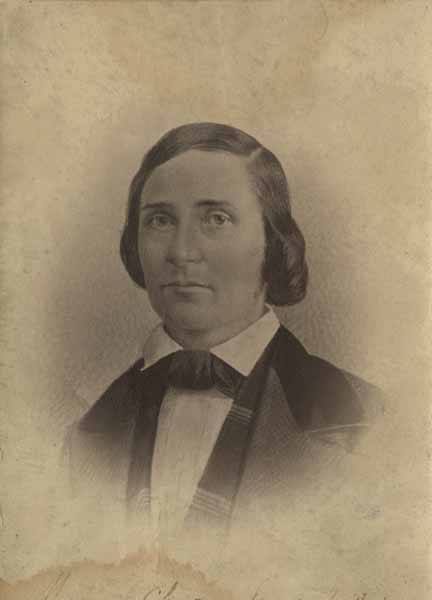
Manuel Antonio Chaves, courtesy of Gill Chaves, 2019

Angney’s arguments were powerful. Chaves had been charged with treason against the United States. Angney argued that, since the war was still in progress, New Mexico was technically still part of the country of Mexico, and therefore Chaves was not an American citizen. You can’t try someone for treason against a country they don’t belong to. In fact, it was not treason, but patriotism, that motivated his actions.

Chaves was acquitted and released. His experience with Angney and in the courtroom seems to have permanently changed his view of Americans. Six months earlier, he’d argued fiercely that New Mexico ought to fight the invaders. The month after his release, he was fighting alongside the Americans to suppress the New Mexican revolt that broke out in Taos. He went on to serve in the Civil War on the side of the Union, rising to the rank of Lieutenant Colonel and playing a key role in the pivotal battle of Glorieta Pass. All because his perceived enemy (Captain Angney) defended Chaves’s right to rebel.

Sources: Mark L. Gardner and Marc Simmons, eds., The Mexican War Correspondence of Richard Smith Elliott; Rubén Sálaz Márquez, New Mexico, A Brief Multi-History; Marc Simmons, The Little Lion of the Southwest, a life of Manuel Antonio Chaves; Ralph Emerson Twitchell, The History of the Military Occupation of the Territory of New Mexico.

© Loretta Miles Tollefson, 2025

New Year in Old New Mexico

New Year in Old New Mexico

There were many celebrations connected with the Christmas season in Old New Mexico, ranging from la posadas, or reenactments of the Christ Child’s birth, to midnight masses on Christmas Eve, to dances at the Rio Grande Pueblos.

However, in New Mexico, the merry making didn’t end on December 25. A week later came Los Días de Los Manueles. January 1 is the feast of Emmanuel, another name for Jesus Christ, and therefore the name day of people christened Manuel or Manuela.

To honor these people, the new year would start just after midnight. The entire community came out under the night sky to visit the homes of anyone named Manuel or Manuela, sing songs in their honor, and feast on posole, chile, and bizcochitos, among other New Mexican traditional foods.

If you happened to live in the village of Ranchos de Taos south of Taos, you would also be honored with dances performed by villagers of Comanche and Hispanic heritage. The performers would start at the church in the plaza and then proceed to the homes of the name day honorees. They performed a set of dances at each location, including a buffalo dance (El Toro), an eagle dance (El Áquila), an enemy dance (El Espantao), courtship dances, and a captivity dance (La Rueda) during which someone is captured and ransomed. This tradition has continued into the 21st century and was enacted as late as 2019, as recorded in the video below. Some of the songs date to the middle 1700s.

What a great way to start the new year!

© Loretta Miles Tollefson

Source: Mary C. Montaño, Tradiciones Nuevomexicanas, Hispano Arts and Culture of New Mexico, UNM Press, Albuquerque, 2001

NOT JUST ANY MAN – CHAPTER 21

NOT JUST ANY MAN – CHAPTER 21

The following material is an extract from NOT JUST ANY MAN, A Novel of Old New Mexico, Copyright © 2018 Loretta Miles Tollefson. Published by Palo Flechado Press, Santa Fe, NM

A Note about Spanish Terms: This novel is set in northern New Mexico and reflects as much as possible the local dialect at that time. Even today, Northern New Mexico Spanish is a unique combination of late 1500s Spanish, indigenous words from the First Peoples of the region and of Mexico, and terms that filtered in with the French and American trappers and traders. I’ve tried to represent the resulting mixture as faithfully as possible. My primary source of information was Rubén Cobos’ excellent work, A Dictionary of New Mexico and Southern Colorado Spanish (University of New Mexico Press, 2003). Any errors in spelling, usage, or definition are solely my responsibility.

CHAPTER 21

 “My cousin Antonia told me a story yesterday that I think you will find of great interest,” Encarnación says as she stirs the mixture of milk and sugar in the pot on the wood stove. Spring sunlight pours through the window, whose wooden shutters are thrown back to allow air into the room. The wooden grate in the window opening casts a shadowy grid on the opposite wall.

“What story is that?” Suzanna asks absently. She shakes the container of black tea leaves, then pries off the lid and peers inside. There’s less here than she’d thought. Prices are so high right now. Perhaps she should switch to strawberry leaf or rosehip tea.

She looks up at the cook. Encarnación has set the hot pan on the wooden tabletop to cool and is separating the yolks and whites of six brown-speckled eggs. “What did Antonia tell you?” Suzanna asks.

Encarnación twists her face in disgust. “That man, that Jones.” She moves to the stove. “Here, can you add the yolks to the milk and stir it? Slowly now, and steadily.”

Suzanna places the canister on the table and moves to the stove as Encarnación begins beating egg whites as if they were Jones himself. “Ugh. I can hardly speak of it,” she says.

“Now you must tell me!” Suzanna says. “What happened?”

Encarnación’s hands slow a little. “You know how it is with Antonia’s casa, how it’s out of sight of all of the others.” She shakes her head and peers at the egg whites, which are frothing nicely. “That man came to her house in the spring, while Gregorio was at the market, and he tried to attack her.” Her head jerks up. “Do you still have that knife I gave you?”

Involuntarily, Suzanna glances at the door to check for her father, then nods. “He attacked Antonia Garcia?” she asks. “And she said nothing?”

Encarnación sets the bowl of egg whites down, moves to the stove, and takes the spoon from Suzanna. She moves it carefully through the custard, scraping along the edge of the pan. “He tried to attack her,” she says grimly. Then she grins and glances slyly at Suzanna. “He was unable to accomplish his task.”

Suzanna steps away from the stove. “He was unable?”

“That’s what she told me.” Encarnación chortles. “It would seem that el amador potente is not all its owner would prefer.”

“Oh, my goodness!” Suzanna moves to the table. Her hand drops to the tea canister. “So perhaps he’s not as dangerous as we think.”

Encarnación frowns. “Perhaps.” She leans toward the pan, studying the thickening mixture, then moves to the table for the egg whites. “Or perhaps el amador springs to attention only for others of his kind.” She shakes her head and glances at the girl. “Certainly, I would continue to carry el cuchilitto. And ask Ramón to accompany you on your errands.”

Footsteps scuff the hard-packed clay floor at the other end of the hall and the two women exchange a mute nod.

“That Jones!” Encarnación says, a little more loudly than necessary. “But if I think of him further, I will curdle les natillas.”

“Oh, Chonita!” Suzanna laughs and turns to place the tea canister back on its shelf. “That would be a shame!” She grins mischievously. “You should think of Ramón Chavez instead!”

The cook gives her a half-amused look as she moves the pan to the side of the stove.

Jeremiah Peabody appears in the doorway and Suzanna abruptly changes her tone. “Where did you store the dried strawberry leaves?” she asks. “I think I’m going to start drinking that for tea, instead of the black. This February cold has begun to make my chest feel a little constricted.”

Encarnación begins to spoon the frothy egg whites into the hot pan. She nods toward the wall by the window. “It’s in the alacena.”

Suzanna moves to the wooden cupboard set into the adobe wall as her father moves across the room toward Encarnación. “Custard?” he asks with a pleased look.

“The hens have begun laying again,” Encarnación tells him. “It’s a way to use the extra eggs.”

“It is also a most excellent way to welcome the spring,” he says. He turns to Suzanna. “Are you ready for your Latin lesson, my dear?” He frowns. “Unless you are tired? Did you say your chest is constricted?” He glances at the open shutters. “Is that window too drafty?” He turns to Encarnación. “Perhaps we should install mica in this one as well.”

Encarnación scowls and Suzanna chuckles. Her father and the cook have this discussion every few months. She knows Encarnación’s opinion. “Oh, it’s not truly uncomfortable, papá,” the girl says easily. “The strawberry is merely a preventative. It will make a nice change.”

He peers into her face, humphs, and leaves the room. The two women smile at each other companionably. Encarnación turns back to her natillas as Suzanna locates the dried strawberry leaf among the other herbs in the wall cupboard.

Copyright © 2018 Loretta Miles Tollefson

NOT JUST ANY MAN – CHAPTER 17

NOT JUST ANY MAN – CHAPTER 17

The following material is an extract from NOT JUST ANY MAN, A Novel of Old New Mexico, Copyright © 2018 Loretta Miles Tollefson. Published by Palo Flechado Press, Santa Fe, NM

A Note about Spanish Terms: This novel is set in northern New Mexico and reflects as much as possible the local dialect at that time. Even today, Northern New Mexico Spanish is a unique combination of late 1500s Spanish, indigenous words from the First Peoples of the region and of Mexico, and terms that filtered in with the French and American trappers and traders. I’ve tried to represent the resulting mixture as faithfully as possible. My primary source of information was Rubén Cobos’ excellent work, A Dictionary of New Mexico and Southern Colorado Spanish (University of New Mexico Press, 2003). Any errors in spelling, usage, or definition are solely my responsibility.

CHAPTER 17

Gerald tells himself that his restlessness is triggered by the Chavez fields and acequia system. The wide pastures and black soil make him wish for land of his own to cultivate. His yearnings have nothing to do with an American/French/Navajo girl who grows Irish potatoes beside a Spanish acequia. He feels a surge of relief when word comes that the men are on their way back from Taos.

But he’s surprised to see that William Wolfskill is not with them. Ewing Young has apparently recovered enough from his illness to head up the dozen and a half men who ride into camp a good two weeks after Wolfskill had headed north.

Yount and Stone are with him. Ignacio Sandoval trails behind with another young mexicano. Gerald’s heart jumps when the rider lifts his head. It’s Gregorio Garcia. He’ll have news of the Peabody household.

Then Gerald’s surge of anticipation is replaced by something else. Enoch Jones rides with the men clustered around Ewing Young.

But there’s no time to do more than greet Gregorio and avoid Jones’ half-drunk scowl before Young gets down to business.

“Wolfskill’s mindin’ the store,” he says brusquely in response to Thomas Smith’s question. He releases his mount to a camp keeper and reaches for the coffee pot, on a rock by the fire. “He told me what happened, but I want t’ hear it again from you all.”

Smith hunkers down on the other side of the fire and launches into a detailed narrative that begins with the first pilfering and ends only when his mule has suffered a lingering death. His ire rises as the story progresses. “Damn Apaches!” he finishes with a growl.

Young is silent for a long while, staring into the flames, then looks around at the other men. “So that’s what happened, is it?” he asks.

Gerald suppresses a smile. Young’s eyes rest on his face and Gerald looks away. Who is he to contradict Thomas Smith: merchant, veteran trapper, and seasoned Indian fighter?

 “Close enough,” Solomon Stone answers as his big hands snap small cottonwood branches into kindling for the fire.

“Jest like he says,” Maurice Leduc asserts rather belligerently.

Young’s eyes swivel back to Gerald’s and Gerald gives him a small shrug and a nod.

“I’m not too sure it’s worth the time and trouble to go back in,” Young says. He looks at Milton Sublette, who’s perched on a chunk of cottonwood log with his legs straight out in front of him. “We’ve already had one man wounded. How’s the leg, Milt?”

“It’s doin’, Captain,” Sublette says. “Long as I can keep the witch woman away from it.”

“La curandera try to help, he no want,” the oldest of the camp keepers explains as he hands Young a bowl of mutton stew.

Young shakes his head and stirs the stew with his spoon. “Those woman healers generally know what they’re about,” he tells Sublette. “You ought to have taken her up on that.”

“She wanted to put some stuff on it that she’d been chawin’ on!” Sublette moves his leg impatiently, then grimaces. “I’ll cut it off before I pack it with stuff some old Mexican woman’s been chawin’ on for who knows how long!”

Young chuckles. “Well, as long as you can walk or ride, it’s no business of mine.” He spoons a bite of stew into his mouth as he scans the faces of the men around the fire. He swallows, takes another bite, then says, “I’m thinkin’ we should call it a loss and get out while the gettin’s good.”

Thomas Smith jumps to his feet. “You ain’t lost nearly what I have! And I’m goin’ back!”

“We all run risks every day of our lives,” the captain says mildly. “I’m just not sure there’s enough beaver there to make it worth our while. Maybe we should try headin’ in a different direction entirely.”

“If we don’t go back, I’m out!” Smith snaps. “I’ll head in there on my own! Those bastards need t’ pay for what they done!”

“And I’ll go with him,” LeDuc says from the shadows.

“And we’ll take anyone else who wants t’ come,” Smith adds.

“You’ll be breakin’ our agreement,” Young says. “I footed the bill for some of your gear. You’ll be owin’ me.”

“And you’ll be owin’ me for a mule!” Smith blusters. “We made an agreement to hunt the Gila and the Salt and beyond. As far as I can see, if you don’t go back, you’re the one breakin’ that contract, not me! Those Apaches need a lesson, or no white man’ll ever be safe to trap that way again! They’re gettin’ way too cocky for my taste!”

Ewing Young gives Smith a long look. “I’ll think on it,” he says.

Smith stomps away from the fire, still muttering, but he gets what he wants. The next morning, Young announces that they’ll head back into the Gila that very afternoon. “We’re gonna have to make good time if we want to get any furs worth mentioning,” he observes. Surprisingly, Smith reacts only with a curt nod.

The mid-day meal includes a last treat of wheat flour tortillas from the Chavez hacienda and a visit from the courtly old man himself. “Vaya con diós,” he tells the assembled trappers. “May He bless all your ventures.” There’s a hush as he turns to leave. Even Enoch Jones is suppressed by the man’s white-haired self-possession.

Then Smith gets to his feet, breaking the spell, and they break camp. The band of thirty trappers moves west across the llano in clusters of threes and fours, the camp keepers trailing behind with the pack mules, Gregorio and Ignacio among them.

Gerald has still not found an opportunity to speak more than two words to either of them. But to lag behind would attract attention and he can feel Enoch Jones’ eyes on him, as the big dirty-blond man stalks silently beside George Yount and Milton Sublette, the only trapper on horseback. Gerald stays where he is, alongside Smith and LeDuc.

It’s an hour past full dark and they’re still on the llano when Young calls a halt for the day. In the interest of time, the evening meal is served cold. Gregorio lays a piece of buckskin on the sand and rock ground and crouches over it to slice mutton off the haunch Señor Chavez has sent with them. He layers the pieces between cold tortillas and hands them to the men as they meander over to him in the moonlight.

 When Gerald presents himself for his portion, Gregorio looks up with a smile. “Hola, Señor Locke,” he says. “Señor Peabody and his daughter send greetings.” His eyes twinkle. “Mi mamá también.”

Gerald smiles. “She allowed you to come, after all.”

The boy’s smile widens. “Señorita Peabody, she persuaded her.”

Gerald chuckles and is about to reply when a rough voice demands. “What’s takin’ so long? The resta us gotta eat too!”

Gerald turns. Enoch Jones scowls back at him.

“You wanta talk, do it later!” Jones growls. Then he leers into Gerald’s face, his breath foul on Gerald’s skin. “It’s plenty dark. The boy’ll be waitin’ for you, if you ask him nice like.”

Gerald looks at the man in disgust and brushes past him without speaking.

“Gotta get it anyway you can, don’t ya, ya black—”

“Your food, señor,” Gregorio interrupts, thrusting the tortilla-wrapped meat into the man’s hands.

Jones jerks back and the meat and tortilla fall to the ground. His closed fist strikes out, hitting the boy in the arm. Gregorio jerks away and half-falls onto the buckskin, knocking the remaining meat into the dirt.

“You greasy mex bastard!” Jones howls. “Look what ya done!” He grabs Gregorio by the arm and yanks him to his feet. “That’s good food yer throwin’ around!”

As Jones pulls back to slug the boy again, Young appears. He grabs Jones’ arm. “That’s enough! Let the boy go.” He nods at Gregorio. “Use your canteen water to wash off that meat and see that everyone’s fed.” He turns brusquely away. “Sandoval, help him clean it up. We don’t have all night.”

As Ignacio moves toward Gregorio, Young swings around, his eyes taking in Gerald and the other men. “We’re moving out at first light, so the sooner we eat and bed down, the better. And don’t guzzle your water. There won’t be any more until late tomorrow.”

As he says this, Ignacio and Gregorio pull out their canteens and begin pouring water over the dirt-covered mutton. The haunch is still a good-sized portion, in spite of feeding half the men, and the grit is well embedded. By the time they’re done, neither will have enough water to get them through the next day.

When everyone’s eaten, Ignacio and Gregorio begin repacking the food in the dark and the trappers roll themselves into their blankets. Even with no fire to center them, they stay close to one another, an instinctive reaction against the darkness and the empty grassland. Gerald is a little behind the others in his preparations. He lays out his blankets, then moves to the two camp keepers. He holds out his canteen. “Let me top off your water,” he says.

Ignacio extends his canteen and Gerald begins to carefully pour water into its small opening, but Gregorio turns to look at the sleeping men and shakes his head anxiously. “Gracias, señor,” he mutters. “But no. They will not like it.”

Ignacio glances at his friend and then at Gerald, then gestures for Gerald to stop pouring. “Gracias, señor,” he mutters. “It is enough.”

Gerald nods and holds the canteen out to Gregorio. The boy looks again at the sleeping men, then reluctantly hands over his own container. Gerald dribbles the precious liquid carefully, not wanting to drip any down the side. It’s hard to see in the dark. When the container feels perhaps a third full, Gerald hands it back. “I’m sorry I brought Jones down on you like that,” he says quietly.

The boy shakes his head. “He’s been that way since we left Taos.” His mouth twists. “It is difficult to avoid him.”

Gerald nods grimly. No wonder Gregorio’s mother didn’t want him to join the trappers. There’s a frail look to him that incites negative attention from men like Jones. He looks at Ignacio.

“Nothing is ever what it seems,” Ignacio says bitterly. Gerald raises an eyebrow, inviting an explanation, but Ignacio turns away and Gregorio follows him.

Gerald shakes his head and heads for his own bedding, careful not to trip over any of the sleeping men. It isn’t his problem, yet he feels somehow responsible for both these Spanish boys. Though they aren’t truly boys. They’re young men. He was barely their age when his father left him behind in Missouri, essentially alone.

Yet still he feels responsible, especially for Gregorio. If nothing else, he’s a link to Suzanna Peabody. Who seems very far away at the moment.

Copyright © 2018 Loretta Miles Tollefson

NOT JUST ANY MAN – CHAPTER 16

NOT JUST ANY MAN – CHAPTER 16

The following material is an extract from NOT JUST ANY MAN, A Novel of Old New Mexico, Copyright © 2018 Loretta Miles Tollefson. Published by Palo Flechado Press, Santa Fe, NM

A Note about Spanish Terms: This novel is set in northern New Mexico and reflects as much as possible the local dialect at that time. Even today, Northern New Mexico Spanish is a unique combination of late 1500s Spanish, indigenous words from the First Peoples of the region and of Mexico, and terms that filtered in with the French and American trappers and traders. I’ve tried to represent the resulting mixture as faithfully as possible. My primary source of information was Rubén Cobos’ excellent work, A Dictionary of New Mexico and Southern Colorado Spanish (University of New Mexico Press, 2003). Any errors in spelling, usage, or definition are solely my responsibility.

CHAPTER 16

“I met William Wolfskill in the plaza this afternoon, on my way back from Padre Martinez’s house,” Jeremiah Peabody says as he helps himself to more mutton stew.

Suzanna’s head jerks up involuntarily. “They’re back?” Then she stops herself. There’s absolutely no reason to sound so delighted.

Her father smiles at the tortilla he’s tearing in two. “Just Wolfskill and a few of his men. Not Mr. Locke, I’m sorry to say.” He glances at his daughter, who’s examining her bowl of stew, and forces the amusement from his voice. “I would have enjoyed hearing his reaction to a prolonged expedition with a large group of men. I expect the experience will be quite different from what he experienced with Old Bill.”

“I expect so.” Suzanna’s voice is carefully neutral. She will not ask whether Gerald Locke has sent a message. She has no right to expect such a thing. And he’s too much of a gentleman to presume to do so. She forces herself to eat another spoonful of stew. “Chonita has done an excellent job of flavoring this stew.” She grins at her father. “Did you notice that it includes Irish potatoes?”

“I did!” he says. “Are these from your harvest?”

She nods, forcing her thoughts away from the memory of Gerald Locke helping her plant the seed for the potatoes, walking beside her along the acequia ditches toward home. To her home, that is. Not his. She looks up at her father. “They’ve stored nicely,” she says. “And the straw Ramón brought me to cover them was extremely clean, so Encarnación found no bad spots when she prepared them.”

Her father nods, knowing a change of subject when he hears one. “They’re quite tasty,” he says.

Suzanna watches him. She wants badly to ask if he’s invited William Wolfskill to tea, but this once quite ordinary question now feels somehow dangerous. “And did Padre Martinez have any news of interest from Santa Fe?” she asks.

Copyright © 2018 Loretta Miles Tollefson