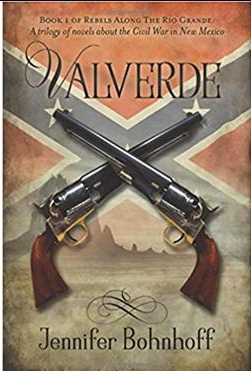
Valverde is a novel about the Civil War in New Mexico that begins in Texas. This location may seem odd to you unless you’re familiar with the relationship of Texas and New Mexico. You see, the Texas Republic tried to invade New Mexico twenty years before the Civil War, and it didn’t go well.
His father’s involvement in that earlier invasion plays a role in teenage Texan Jemmy’s decision to join the Confederate Texan forces. It also affects New Mexico teenager Raul’s attitude toward the invading forces.
Valverde follows each boy as he experiences the beginnings of the Civil War in New Mexico and as their paths cross at the battle of Valverde in February 1862.
The characters are well drawn, the situations are believable, and the battle scenes are handled nicely—there’s enough detail to make the reader feel the characters’ pain but not more than is strictly necessary.
This book is the first in the trilogy Rebels Along the Rio Grande, a series of Middle-Grade novels about the Civil War in New Mexico. The next in the series is Glorieta and I’m looking forward to reading it, too!
You don’t have to be a Middle-Grader to enjoy and learn a little something from this book. I recommend Valverde to young and old!
On Thursday, March 30, 1854, in the mountains of New Mexico, the U.S. Army experienced its worst defeat at the hands of Native American warriors up to that time, west of the Mississippi. It would be another twelve years before larger losses occurred at the 1866 Fetterman defeat near Fort Phil Kearny, and another twenty-two before the Battle of the Little Big Horn.
The New Mexico clash wasn’t what the top brass had ordered. The dragoons from Cantonment Burgwin near Taos had been sent out under Lt. John W. Davidson to monitor the Jicarillas camped west of the traditional Spanish village of Cienequilla (today’s Pilar, New Mexico), not attack them.
There was a history of conflict between the Spanish settlers in the fertile little valley along the Rio Grande and the Jicarilla Apaches. The Jicarilla had been farming and hunting in the area well before 1795, when the Spanish governor granted land there to his settlers. The Apaches protested his decision and, in 1822, petitioned for their own grant of land in the area, but the settlers in Cienequilla and in Taos vigorously opposed the idea and the request was denied.
So the Jicarillas were left to farm and hunt where ever they could find space. By 1854, this was becoming more difficult, as American settlers moved into New Mexico and further reduced the supply of arable as well as hunting land.
Early that year, complaints against the Jicarillas had increased in the area east of the Rio Grande. The Territory’s top military officials were skeptical about the validity of many of these complaints, but in February credible reports began coming in that the Jicarillas were stealing livestock north of Fort Union. A few weeks later, a group of 45 Jicarilla lodges were reported to be camped near Mora, west of the Fort.
When soldiers led by West Point graduate Davidson went to investigate, they discovered that the Apaches had moved away from Mora and were headed west through the mountains. Davidson noted the “miserable quality of their arms and their mean shrinking deportment” and returned to Cantonment Burgwin, where he and his men were stationed, convinced the Apaches weren’t a threat.
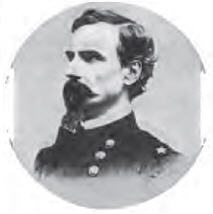
John W. Davidson
Eight days later, he and his U.S. Second dragoons were ordered to the Cieneguilla area to observe the movements of the same band, but not to attack.
On March 30, two hours east of the Rio Grande, the dragoons found the Jicarilla camp. The order not to attack was apparently not obeyed. Someone fired a gun and by nightfall, at least a third of Davidson’s men were dead, with another third wounded, and 45 horses lost.
It must have been a shock to realize that the Jicarillas’ weapons weren’t quite as miserable, and their warriors nearly as shrinking, as Davidson had thought.
Source: David M. Johnson, Chris Adams, Larry Ludwig, and Charles C. Hawk, “Taos, the Jicarilla Apache, and the battle of Cienequilla,” Taos: A Topical History, Corina A. Santistevan and Julia Moore, Museum of New Mexico Press, Santa Fe, 2013; David Grant Noble, Pueblos, Villages, Forts And Trails A Guide To New Mexico’s Past, University of New Mexico Press, Albuquerque, 1994; Jerry D. Thompson, A Civil War History Of The New Mexico Volunteers And Militia, University of New Mexico Press, Albuquerque, 2015.
The girl lifted her skirts away from her feet and eased toward the small brown-mottled duck on the creek bank. It was busily investigating a small marshy area where water had seeped past the bank. Alma wished she’d brought her bow and arrows, but she’d been sent out to collect greens, not meat.
The duck had its back to her. Alma eased forward and crouched, getting into position. Her right foot pressed her skirt into the mud, but she didn’t notice.
The duck turned slightly. Alma lunged forward. As her hands touched the bird’s smooth feathers, her foot ground into her skirt, yanking her off balance. The duck flew off with a panicked series of quacks and Alma pitched forward into the mud.
“Hell and damnation!” she said angrily. “I hate dresses!”
She got to her feet and looked down ruefully. Her mother was not going to be happy.
The men in Seligman’s Mercantile watched silently as the young woman in the trailing pale blue silk skirts swept out of the store.
“She’s a lardy dardy little thing, isn’t she now?” Charles Idle, the expatriate Englishman, asked. He shook his head and stretched his feet closer to the wood stove. “That dress and hat.”
Joseph Kinsinger spat a stream of tobacco toward the empty lard can by the stove. “Those silks ain’t gonna last long in this mud. And the wind’l take that hat.”
His brother Peter grinned. “You’re just worried Desi’s gonna see her and want a getup just like it,” he said.
“I wonder where’s she’s staying,” Idle said thoughtfully. “Hey Jim, where’d she say to deliver that sterling brush and comb set?”
The clerk hesitated, then shrugged. It would be all over town soon enough anyway. “The Moreno Hotel,” he said.
There was a short silence, then Idle said, “Well, I guess I’d better go see how my mine’s doing this morning,” and rose from his chair.
“I’ll bet,” Peter said sardonically, but Idle only smiled and went out.
Knight’s Odyssey is the second in W. Michael Farmer’s Legends of the Desert series and follows the now-fictional Henry Fountain into new terrain.
I say “now-fictional Henry Fountain” because, as those of you familiar with the name know, the historical Henry Fountain disappeared in the deserts of New Mexico when he was eight years old. The first book in the Legends of the Desert series Mariana’s Knight, focused on his disappearance and imagined a way in which he might have survived and revenged his father’s assassination.
This second book in the series imagines Henry’s life after that revenge, taking him into Mexico and through a series of adventures that sees him fall in love and experience even more reasons for vengeance. But revenge isn’t the only purpose in Henry’s life. The story ends in an unexpected way that made me eager to read the next book and find out what happened next.
Knight’s Odyssey is more than a action-filled western with strong characters and well-described landscape. It’s a well-balanced story that looks at both the motivations that drive us and what gives our lives meaning. I recommend it!
On the morning of Monday, February 18, 1878, on an otherwise-deserted road in Southeast New Mexico, a young Englishman was shot and killed, and event which initiated the Lincoln County War.
The young man was John Henry Tunstall. He and Alexander McSween had been in the process of organizing a business partnership when McSween was accused of absconding with some life insurance money. Although Tunstall wasn’t legally responsible, he was wealthy and he was friends with McSween, who had already ruffled feathers in the County. The court decided that Tunstall should participate in repaying the $8,000 involved.
That Monday morning, Tunstall was on his way to the town of Lincoln to try to negotiate a settlement in the case. Instead, he and the four gunfighters he’d recently hired encountered a posse which had been sent out to collect Tunstall’s cattle as partial payment of McSween’s debt. In the ensuing battle, Tunstall was killed.
Born in Middlesex, England, Tunstall emigrated to British Columbia when he was 19, then headed for the American West in February 1876, looking for investment possibilities. After six months looking into sheep ranching in California, he went to New Mexico, where he met Alexander McSween.
McSween persuaded Tunstall to move to Lincoln County. Land was cheap there and the profit potential was high. Eighteen months later, Tunstall was dead. McSween would follow him shortly thereafter.
Tunstall’s death not only started the Lincoln County War, it brought the British government into the conflict. The embassy wanted to know how and why their countryman had been killed and his body left where it fell.
As a result of the British inquiries, Frank Warner Angel was sent West to investigate Tunstall’s murder and other New Mexico violence. Angel’s report would put an end to the current Governor’s term and bring Lew Wallace to New Mexico in his stead.
However, it wouldn’t end the Lincoln County conflict. More people would die, including William Bonney, aka Billy the Kid, who’d fought beside Tunstall that February morning, and Juan Patron, leader of the County’s Mexican-American faction and staunch opponent of Tunstall’s killers.
But eventually, the conflict fizzled out. Like so many wars, it started with a bang but ended with a whimper, with no clear winners and a lot of damage that would never be fully repaired.
Sources: David L. Caffey, Chasing the Santa Fe Ring, UNM Press: Albuquerque, 2014; Howard R. Lamar, ed., The Reader’s Encyclopedia of the American West, Harper & Row: New York, 1977; tomrizzo.com/killing-john-tunstall/accessed 1/10/19; Marc Simmons in Marta Weigle, ed., Telling New Mexico, A New History, Museum of NM Press: Santa Fe, 2009; Stephen Zimmer ed., For Good or Bad, People of the Cimarron Country, Sunstone Press, Santa Fe, 1999
On Saturday, January 22, 1853, the front page of the Santa Fe Weekly Gazette contained an advertisement offering supplies to people traveling to Santa Fe. The ad had been placed by Daniel Boone’s grandson, Albert Gallatin Boone, and stated that Boone has “an acquaintance of many years” with the Trail.
In fact, Boone was more than acquainted with Western travel. He’d served with fur trapper William H. Ashley in the mid-1820s, traveled a number of times across the Santa Fe Trail, and participated in the Indian conflicts in Michigan territory in the early 1830s.
Born in April 1806, Boone was almost 47 when he placed his ad in the Gazette. By then, he’d moved from the adventurous life to the mercantile and supplied travelers as diverse as Washington Irving and John C. Fremont.
Boone’s presence in Santa Fe in late 1852, when he placed the Gazette ad, seems to have been a bit of an anomaly. He had stores in Westport and at Council Grove and may have been on a trading mission—or perhaps a sales trip—when he spoke to the Gazette publishers.
He eventually did go West permanently, but not until 1860 and then to Colorado. In late 1861, he founded the town of Boone east of Pueblo, on the Arkansas River. He also became involved in Colorado politics, which included serving as Indian agent at Fort Lyon, near Christopher “Kit” Carson’s final home.
In fact, Boone accompanied Carson on Kit’s final trip to Washington D.C. to confer with the Commissioner of Indian Affairs in February 1868, shortly before Carson’s death. This was yet another trip over the Santa Fe Trail, though in the opposite direction of the travelers he was outfitting in 1853.
Boone himself died sixteen years later at La Veta, Colorado, having more than proved that he was acquainted with the Santa Fe Trail.
Source: Leroy R Hafen, The Mountain Men and the Fur Trade of the Far West, Arthur H Clark: Spokane, 2003; Santa Fe Weekly Gazette, January 22, 1853; Jerry D. Thompson, A Civil War History of the New Mexico Volunteers & Militia, UNM Press: Albuquerque, 2015.
“Rues? Your last name is Roo-ess?” The young white man sitting at the Elizabethtown restaurant table looked at the old black man quizzically. “You mean Ruiz? Roo-eez? You got some Spanish in you?”
The cook shook his head. “All I know’s what my mama tol’ me,” he said. “My daddy was a Frenchman visiting ’round in Alabama. He stayed at the Big House for three weeks and took a shine to my mama while he was there. When I was born, she give me his last name.”
“Your master let her do that?”
The black man studied the plate of food in his hands for a long minute. “After the war, we could choose what last name we wanted,” he said quietly. “I chose my daddy’s name.”
“That food sure looks good,” the white man said. He moved his knife and fork farther apart on the bare wooden table.
Louis Rues put the plate down and turned away. He shook his head. People are people, no matter where you go, he thought ruefully as he went back to his stove.
Publisher: Five Star Publishing (May 17, 2017) ISBN-13: 978-1432833923
It’s one of New Mexico’s perennial mysteries: What happened to Albert Fountain and his son Henry? By the mid-1890s, southern New Mexico attorney and special prosecutor Albert Fountain had made a lot of enemies. It wasn’t surprising that those enemies would take advantage of Fountains’ trip across the Tularosa basin to take him out.
As a matter of fact, he and his wife expected as much. That’s why Fountain’s wife insisted that he take their eight-year-old son, Henry, with him to Lincoln, where Fountain was scheduled to present evidence against suspected cattle rustlers. Surely no one was wicked enough to kill a little boy, or murder his father while he watched.
When Fountain and the boy disappeared, the entire Territory was stunned.
And that’s where Mariana’s Knight diverges from the historical record. To this day, no one knows what happened to Albert and Henry Fountain in early February 1896. All that remained of them was a patch of blood soaking into the southern New Mexico sand.
Michael Farmer provides an interesting and vivid take on what might have happened that day and afterward and, in the process, gives his reader a look at New Mexico in the late 1800s.
If you’re interested in the Fountain mystery or the history of southern New Mexico, or if you’re just looking for a riveting Western tale, you’ll find Mariana’s Knight a fascinating read. I recommend it!
On Saturday, January 6, 1912, New Mexico finally became a full member of the United States of America.
The day had been a long time coming. The first attempt at statehood had been promptly crushed by the Compromise of 1850, when Congress used New Mexico in a deal to keep the southern states from revolting over the slavery issue. While California was admitted as a “free” state, New Mexico and Utah were classified as Territories where slavery was allowed.
During the following sixty years, the issue of slavery was resolved, but New Mexico still wasn’t made a state. Over fifty bills to initiate a statehood process were proposed, but none passed.
There are different theories about why New Mexico statehood took so long. One is that the Santa Fe Ring, led by Thomas B. Catron, was doing well under Territorial status and didn’t want to rock that particular financial boat.
Ironically, the wheeling and dealing produced by the likes of the Ring also resulted explosions like the Lincoln County War, a story the Eastern papers seemed especially drawn to. Clearly, New Mexico wasn’t civilized and law-abiding enough to be a State.
It’s also possible that the large number of Catholics in New Mexico made Protestant politicians back East nervous. As well as the fact that so many of those Catholics had brown skin.
Whatever the reason, on January 6, 1912, New Mexico became the 47th member of the United States of America. William C. McDonald, a Carrizozo rancher, was the first State Governor and Albert Bacon Fall and Thomas Catron, the first senators.
Fortunately, Catron was past his prime at this point, so he couldn’t do much harm in D.C. But Fall, at age 51, was still young to get in trouble. He became embroiled in the Teapot Dome scandal—he’d accepted a $100,000 “loan” while officially negotiating the lease of federally-owned oil lands—and had to resign.
So New Mexico finally achieved statehood, but it got off to a less than perfect start. Fall proved that it was still a wild place where newcomers, at least, could end up getting themselves in trouble. He had, after all, only been in New Mexico since 1883.
Sources: Don Bullis, New Mexico Biographical Dictionary Vol. I, Rio Grande Books: Los Ranchos de Albuquerque, 2007; Thomas C. Donnelly, The Government of New Mexico, University of New Mexico Press: Albuquerque, 1953; David V. Holtby, Forty-Seventh Star, University of Oklahoma Press: Norman, 2012; Marc Simmons, New Mexico, an interpretive history, University of New Mexico Press: Albuquerque, 1988. ;


 Born in April 1806, Boone was almost 47 when he placed his ad in the Gazette. By then, he’d moved from the adventurous life to the mercantile and supplied travelers as diverse as Washington Irving and John C. Fremont.

 Fiction and Fact From Old New Mexico