Two Robidoux Brothers Become Mexican Citizens

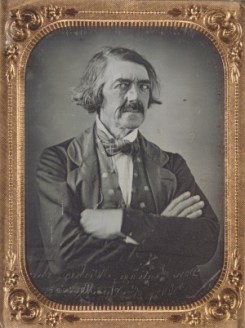
On Friday, July 17, 1829, Antoine and Louis Robidoux of Missouri became naturalized citizens of Mexico, thus beginning a long and somewhat fruitful association.

Antoine and Louis were two of six brothers, all of them involved in one aspect or another of the Rocky Mountain fur trade. Becoming Mexican citizens made good business sense, because trapping licenses for non-citizens were at times non-existent.

Antoine, who was 35 years old in 1829, had been in New Mexico since 1822. He’d spent the previous two years trapping and trading with the Sioux and his application for citizenship may have been prompted by the fact that he’d married a New Mexican woman in 1828 and it was time to settle down. Or he may have wanted to get involved in local politics. Antoine’s citizenship made him eligible to be elected 1st alcalde and regidor (councilman) of Santa Fe in late 1830 and three years later to serve as 3rd alcalde of Santa Fe and a member of the Santa Fe Commission for forming election districts.


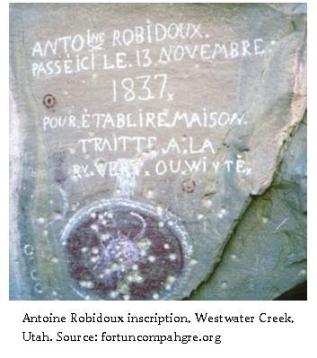
He was also busy making money. During the 1830s, Antoine purchased a mine in the Santa Fe area. He also built Fort Uinta (aka Fort Robidoux) and Fort Uncompahgre in what is now Colorado and used them as a base for trade with the Indians and the trappers in the area.
July 17 illustration.Antoine-Robidoux inscription

However, in 1844, both forts were attacked by Utes and a number of men were killed and women captured. These events seem to have curbed Antoine’s enthusiasm for the frontier life. He left for Missouri shortly thereafter.

But he came back. Eschewing his Mexican citizenship, Antoine served with Col. Stephen Watts Kearny as an interpreter during the 1846 U.S. advance on New Mexico and remained with him during the California campaign which followed. After the war, Antoine returned to Missouri, where he died in 1860.

Louis Robidoux, on the other hand, seems to have remained loyal to his Mexican citizenship. Much of his early career mirrored Antoine’s. He arrived in New Mexico about the same time (probably 1823), married a New Mexican woman (Guadalupe Garcia in 1834), and participated in Santa Fe politics, where he served as first alcalde in 1839. He also participated in various moneymaking schemes, including operating a grist mill and iron works in Santa Fe.

July 17 illustration.Louis Robidoux

And he also left New Mexico. But instead of heading back to Missouri, Louis went to California, a move reportedly bankrolled by a $30,000 win in a Santa Fe card game. He arrived in California with a group of Mexican traders in 1843 and remained there until his death in 1868.

He settled in what would become San Bernardino County, where he set up a large livestock operation and planted orchards, wine vineyards, and a grist mill. He was also involved in politics, becoming the first San Bernardino County Supervisor. The City of Rubidoux, the Louis Robidoux Library, various streets, and Mount Rubidoux are all named after him.

Leroy R. Hafen, Fur Traders and Trappers of the Far Southwest, Logan: Utah State University Press, 1997; David J. Weber, The Taos trappers, the fur trade in the far Southwest, 1540-1846, Norman: University of Oklahoma Press, 1971.
James Kirker’s Lust for Adventure

On Tuesday, July 5, 1825 Irish-born Taos resident James Kirker became a Mexican citizen. Given Kirker’s history up to this point, this was probably not the most optimum citizenship decision the Mexican government ever made.

Kirker had left Ireland at sixteen in order to avoid being drafted by the British during the Napoleonic wars. Ironically, shortly after he arrived in New York City Kirker signed on with the Black Joke, a privateer whose mission was to raid and harass the British fleet.

This didn’t work out too well. The Black Joke was captured by the British. Fortunately for Kirker, the crew was rescued by the USS Hornet and the USS Constitution (later renamed Old Ironsides), and Kirker was returned to New York. When he got there, Kirker headed to the grocery store where he’d been working before he became a privateer, married the young widow who owned the store, and settled down and had a son.

However, Kirker was still in his late teens at this point and he wasn’t really ready to settle down. In 1817 he abandoned his family and headed to St. Louis with some Irish cousins. There, he started another grocery.

But Kirker soon got wanderlust again and in 1823, signed on with Major Andrew Henry to go up the Missouri River. This didn’t last long. Kirker quit in a dispute over terms of employment and headed to Santa Fe.

Mexico seems to have been more to Kirker’s liking. He got involved with managing the Santa Rita copper mines near what is today Silver City, New Mexico and trapped with George Yount and James Ohio Pattie and his father.

But he still wasn’t ready to settle into a routine. In 1835, Kirker obtained a license from New Mexico Governor Albino Perez to trade with the Apaches. But he couldn’t stick to the rules for trading, either. He began illegally providing weapons and ammunition to the Apaches and participating in their raids into Texas and central Mexico.

When the Mexican officials got wind of Kirker’s activities, Governor Perez rescinded his license, ordered him arrested, and placed a $800 bounty on his head. Kirker fled north across the Mexican/American boundary to Bent’s Fort.

This was shortly before Perez’s death during the tax revolt of 1837 (which some people believe Kirker machinated) and by early 1838, newly appointed New Mexican governor Manuel Armijo had invited Kirker back into the country. Kirker went. And immediately returned to his old ways, only this time (at least theoretically) on the side of the establishment.

In early 1838, he was invited to help the Santa Rita mine operators combat the Apache activities that had forced the mines to close. Kirker gathered a couple dozen men and struck an Apache village headed by Mangus Colorado near what is today Cook’s Peak. The attack was brutal but effective, and Chihuahuan officials asked Kirker to lead a full-scale follow-up campaign against the Apaches.

Kirker agreed to their proposal but his first battle was, oddly enough, at Rancho de Taos, not Chihuahua. He lured a band of Apaches into Ranchos with some unguarded horses, then ambushed them after they’d captured the animals and were heading back into the mountains.

This is where the story turns sour. Instead of attacking the Apaches and retrieving the horses, Kirker and his men forced them back into Ranchos, into the walled square around the church there, and picked them off one by one, killing them at leisure. After this ‘success,’ Kirker’s band ranged across New Mexico, Chihuahua, Sonora, and West Texas, killing Apaches and organizing local militia against them.

July 5 illustration.JamesKirker1847.mohistory.org
James Kirker. Source: Missouri History Society

A change in governance in Chihuahua put a stop to his activities, but unfortunately also brought an increase in Apache attacks. Kirker was eventually redrafted. His attacks on the Apaches would result in the undying hatred of Cochise and probably actually increased the intensity of the Apache attacks until the last bands were finally subdued in the 1880s.

But Kirker wasn’t satisfied with killing Apaches. Just as he’d turned traitor to them, he also turned traitor to his adopted country. When Colonel Alexander Donovan marched his Missouri Volunteers into northern Mexico in 1846, Kirker provided Donovan with valuable information about the location, strength, and best strategies for capturing the Mexican gun emplacements at Chihuahua. He was familiar with the fortifications there because of his work for Chihuahua officials against the Apaches.

After the war, Kirker returned to Santa Fe after the war, where he participated in at least one campaign against the Utes. Eventually he headed to California, where he settled and died in early 1853. He seems to have been a model citizen there. Maybe by that time (he was in his mid-50s), he’d decided that there was more to life than adventure.

Richard Batman, James Pattie’s West, the dream and the reality. Norman: University of Oklahoma press, 1986; Leroy R. Hafen, Fur Traders and Trappers of the Far Southwest, Logan: Utah State University Press, 1997; David J. Weber, The Taos trappers, the fur trade in the far Southwest, 1540-1846, Norman: University of Oklahoma press, 1971

President Keeps His Word!

On Thursday, June 16, 1910, the United States Congress finally agreed to allow New Mexico to become a State, ending a quest that had begun 62 years before.

The delay was partly New Mexico’s fault. In their first bid for statehood in 1848, New Mexico’s citizens had stipulated that they enter the Union as a free (non-slave) state. That requirement guaranteed that the slave-holding states would oppose New Mexico’s entry.

But a little opposition never has kept New Mexico from trying again. There were at least three other attempts to gain Congressional approval—in 1850, 1875, and 1902.

When Congress approved a process in 1906 for a combined state of New Mexico/Arizona, it looked like success was in sight. New Mexico voted for the proposal. However, Arizona voters rejected the plan.

Then in 1908, William Howard Taft became President. During the campaign, he’d pledged to make New Mexico a state. He kept his word. His Republican-controlled House and Senate approved legislation that initiated the formal process for Statehood and Taft signed it into law on Saturday, June 18, 1910.

A year and a half later, those formalities were completed and, on Saturday, January 6, 1912, President William H. Taft signed the formal proclamation that approved New Mexico’s entry into the Union. New Mexico was finally a state.

So the next time someone tells you that Presidents never keep their campaign promises, remember President Taft and the case of New Mexico statehood.

Sources: Thomas C. Donnelly, The Government of New Mexico. UNM Press: Albuquerque, 1953; David V. Holtby, Forty-Seventh Star, New Mexico’s struggle for statehood. University of Oklahoma press: Norman, 2012; Marc Simmons, New Mexico, an interpretive history, UNM Press, Albuquerque, 1988


First Hispanic Named New Mexico Governor!

On Wednesday, June 2, 1897 President William McKinley appointed 37-year-old Miguel Antonio Otero II as Territorial Governor of New Mexico.

Otero’s appointment was the beginning of a new approach to politics in New Mexico, one not dominated by the Santa Fe Ring. Although “Gilly,” as he was known to his friends, had been close to Thomas Catron, the Ring’s head, he now began cultivating a younger generation of men, Democrats and Republicans alike. Together, they formed what would become known as the Otero wing of New Mexico’s Republican Party and would align themselves with progressives such as Theodore Roosevelt of New York.

Perhaps because of his progressive views and his past work recruiting New Mexicans for Roosevelt’s Rough Rider regiment, Otero was reappointed Governor in 1902. He served until January 22, 1906, a total of eight years and seven months in office. This made him the longest-serving New Mexico territorial governor and a one of only nine men who, between 1787 and 1912, served as a U.S. territorial governor for eight or more years. Just five served longer than Otero.

June 2 illustration.Miguel Otero

More importantly for New Mexico, Otero was the first Hispanic Governor during the Territorial period. While Juan Bautista Vigil y Alarid acted as governor at the beginning of the 1846 U.S. occupation, New Mexico was still under military rule at that time. It would not be organized as a United States Territory until 1851.

During the Territorial Period (1851-1912), Miguel Otero II was New Mexico’s only Hispanic Governor. To this day, he is the only New Mexico governor—appointed or elected—with more than eight consecutive years of service. Although Bruce King (1971-1974, 1979-1982, 1991-1994) served more years than any other Governor, those terms were not consecutive.

Ironically, Otero, with his New Mexico roots, was not, however, the first New Mexican governor to be born here. That honor goes to Ezequiel Cabaza de Baca, the first Hispanic elected Governor after statehood. Although Otero’s father was born in Valencia County, Gillie Otero himself was born in St. Louis, Missouri.

Sources: Don Bullis, New Mexico, A Biographical Dictionary, 1540-1980, Volume 1. Rio Grande Books: Los Ranchos, 2007; David L. Caffey, Chasing the Santa Fe Ring. University of New Mexico press: Albuquerque, 2014; Thomas C. Donnelly, The Government of New Mexico. UNM Press: Albuquerque, 1953; David V. Holtby, Forty-Seventh Star, New Mexico’s struggle for statehood. University of Oklahoma press: Norman, 2012; Ralph E. Twitchell, The Leading Facts of New Mexican History, Vol. II. The Torch Press: Cedar Rapids. 1912

New Mexico’s First Protestant Church

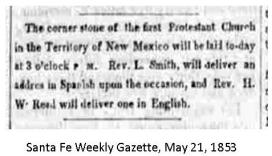
On Saturday, May 21, 1853, Baptist missionaries in Santa Fe began construction of the first Protestant church in New Mexico, located on the corner of what is now Grant and Griffin Street. The Reverend Henry W. Reed and the Reverend L. Smith officiated.

May 21 illustration

Henry Reed had arrived in Santa Fe in Summer 1846 and opened a school. Smith arrived several years later. They seem to have been focused on converting New Mexicans to Protestantism rather than serving the Anglo population. In 1851, Reade reported to his constituency back East that he’d been in Taos to share information about his Baptist school curriculum with Padre Martinez and had attended the Catholic services there. He disapprovingly described the mass as “not above a whisper and in Latin.”

The Baptist church services in Santa Fe were apparently in Spanish and English. At the cornerstone-laying ceremony on May 21, Reverend Smith spoke in Spanish and Reverend Read in English. This bilinqual approach doesn’t seem to have been enough to attract a large congregation. The adobe brick building was sold to the Presbyterians in 1866, at the end of the Civil War.

The Presbyterians eventually pulled the adobe building down and replaced it in 1882 with a brick structure. That building was replaced in 1939 with a Pueblo Revival building designed by John Gaw Meem, which is still in use today.

Sources: Thomas Harwood, The History of New Mexico Spanish and English Missions of the Methodist Episcopal Church, 1850 to 1910, Vol. I. Albuquerque: El Abogado Press, 1908; E. A. Mares, ed., Padre Martinez: New Perspectives From Taos, Taos: Millicent Rogers Museum, 1988; Ralph Emerson Twitchell, The Leading Facts of New Mexican History, Vol. II. Cedar Rapids: The Torch Press, 1912.

May Snow in New Mexico!

New Mexico’s weather so far this year has reflected the weather patterns across the nation—unpredictable, to put it kindly. To put the snow, rain, hail, and general nastiness into perspective, take a look at this May 9, 1907 article from the Cimarron News and Press.

May 9 illustration

The winter had been a dry one. The stockmen’s herds hadn’t been buffeted by much cold, so they were healthy, over all. But the dry conditions meant the summer was going to bring sparse summer grasses. Until early May. When it rained and snowed!

The Cimarron News and Press tended to be very upbeat, so I question just how positively the stockmen felt about the loss of their calves and lambs to the recent storms.

But we can take comforting in noting know that storms this late in the year are not a new phenomenon.


Las Vegas Hot Springs Lodging Available!

In late April 1854, W. W. Donaldson of Las Vegas, New Mexico announced that he’d made “ample arrangements” for accommodating “invalids and others” with board and lodging at the celebrated Las Vegas hot springs.

April 22 illustration

Donaldson wasn’t the first to take advantage of the healing mineral-filled springs six miles northwest of today’s Las Vegas. The Springs had been used for centuries by the Native Americans in the region, reputedly to heal battle wounds and other ailments.

And Donaldson wouldn’t be the last. The board and lodging. He offered were considerably upgraded in 1886. That year, the Atchison, Topeka and Santa Fe Railroad Company built the 90,000 square foot Montezuma Castle as a destination hotel.  The castle capitalized on the hot springs as well as the trout fishing in nearby Gallinas Creek and hosted guests as diverse as Ulysses S. Grant, William Tecumseh Sherman, Jesse James, Theodore Roosevelt, and Emperor Hirohito of Japan.

The hot springs and the hotel, which is now the home of an international high school, are currently owned by the United World College, which still allows public access to the springs. Board and lodging is available in nearby Las Vegas.

Sources: Santa Fe Weekly Gazette, April 22, 1854, front page; http://www.visitlasvegasnm.com/montezuma-castle  Accessed 3/6/19; http://www.visitlasvegasnm.com/montezuma-hot-springs  Accessed 3/6/19.

Texas Stage Route Is Better In Winter Months

On April 8, 1853, the readers of the Santa Fe Weekly Gazette were reminded that winter wasn’t truly over in New Mexico—the mail and passengers to and from Texas were still being transported under the “winter arrangement.”

There really wasn’t any difference between the summer and winter time schedule. Each month, the stage left Santa Fe on the 15th and arrived in El Paso six to eight days later. The next leg of the trip was from El Paso to San Antonio, where it  arrived on the 14th or 15th of the following month. So it took about a week to get from Santa Fe to El Paso, a trip which takes about five hours today. Interestingly, the fare from Santa Fe to El Paso was $30, only about $10 more than the cost of gas for the same route today. In fact, if wear and tear on one’s vehicle is factored in, it might have been cheaper to travel between Santa Fe and El Paso in 1853 than it is now. That is, of course, if you have seven or eight days for the trip.

April 8 illustration

On the other hand, the cost to travel from Santa Fe to San Antonio was significantly higher in 1853 than it is today—$125 as opposed to $48 in fuel costs. The timeframe for the trip is also considerably less now—about 12 hours as opposed to 30 days.

One thing has remained the same. The advertisement in the Gazette points out that the trip to and from “the States” via the San Antonio route was considerably more pleasant during the winter months than was travel via the Santa Fe Trail to Independence, Missouri. The southern route was, and is still likely to be, “entirely free from the intense cold and heavy snows that so frequently obstruct” the northern Trail.

There was another advantage to taking the stage to San Antonio. Passengers were not required to stand guard.

Sources: Santa Fe Weekly Gazette, April 8, 1853, first page; MapQuest.com, accessed March 5, 2019.


The Battle of Glorieta Pass

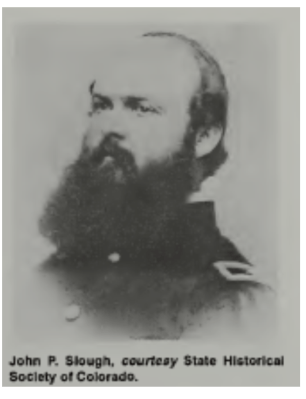
On Saturday, March 22, 1862, Colorado Militia Colonel John Potts Slough led his troops out of Fort Union to meet the Texan Confederate army that had seized Santa Fe twelve days earlier—the same day Slough and his Colorado Militia, or Pike’s Peakers, had arrived at Fort Union. The irascible and rather arrogant Slough, who’d virtually seized command of the Fort when he arrived, had about 1500 men at his disposal, a combination of Pike’s Peakers, New Mexico Militia, and Army infantry and cavalry.

On Sunday, Slough’s Union forces camped overnight at Las Vegas, then on Monday swung west  toward Santa Fe. Tuesday was another day of slowly moving forward and into the mountains. Santa Fe must have seemed a long way away, especially to the Colorado militiamen, who’d already trekked over 300 miles from Denver to Fort Union.

But then on Wednesday, Union scouts clashed with a small Confederate force in Apache Canyon, at the west end of Glorieta Pass and less than twenty miles from Santa Fe.

Both sides pulled back. The Confederates—about 200 men under Major Charles L. Pyron—headed to Johnson’s Ranch at Canoncito, where they were joined by the main Confederate force, which had just arrived via a trail through the mountains north east of Albuquerque.

march 26 illustration

The Union men moved to Kozlowski’s ranch, at the eastern end of the Pass. When the rest of Slough’s forces joined them on Friday morning, everything went into high gear.

Most of Slough’s men headed on into the Pass. But Colonel Manuel Antonio Chaves, of the New Mexico First Infantry, led Major John M. Chivington and 530 men (New Mexico Militia, two Pike’s Peakers infantry columns, and a detachment of Third U.S. Cavalry) into the mountains south of the Pass. Their goal was to circle south and west around the Confederates and hit them from behind while the main body met the Texans head on.

And the Union and Confederate troops did meet head on, at Pigeon’s Ranch, a trail hostelry in the middle of the Pass owned by Frenchman Alexander Valle. It was a hard-fought, all-day battle between evenly-matched combatants. When the fighting ground to a halt late in the day, the two sides agreed to a truce so they could tend their wounded and dying. But both sides saw the break in fighting as temporary. They were confident they’d ultimately win the Battle of Glorieta Pass.

Until that evening, when news arrived from the western end of the Pass.

Instead of Confederate troops, Colonel Chavez and Major Chivington had found a weakly-defended supply train. Chivington ordered his men down from the bluffs above the camp and set them to attacking, pillaging, and then burning the Texan wagons and everything they contained: food, clothing, equipment, ammunition, and medical supplies.

The Confederates had stationed the majority of their horses and mules with the train—as many of 500 animals. Chivington ordered his men to destroy them, as well. It’s not clear what actually happened to all the animals in question, though. At least some were driven off into the mountains and presumably into the hands of citizens for whom they were more useful alive than dead.

Wherever the Confederate livestock ended up, they certainly weren’t going to help the Texans. With their supplies, wagons, and animals gone, Sibley’s men forfeited the Battle of Glorieta Pass and beat a retreat for Santa Fe and, ultimately, Texas.

Most of the Coloradans headed home, too, although at least one of them returned a few years later. In 1865, John Potts Slough was named chief justice of the New Mexico Territorial Court.

Although Slough was an able judge—he would announce the 1867 legal decision that declared Pueblo Indians to be United States citizens—Slough was still as thin-skinned and greedy for honor and position as he’d been five years before. His furious response to New Mexico legislative political intrigues and Capt. William L. Rynerson’s role in them culminated in a December 1867 shootout in what is now Santa Fe’s La Fonda Hotel. Slough died as a result.

At the ensuing trial, Rynerson was found to have drawn his gun in self-defense.

It’s likely Slough would have insisted on a different opinion.


Sources: Howard Bryan, Wildest of the Wild West, Santa Fe: Clear Light Publishing, 1988; David L. Caffey, Chasing the Santa Fe Ring, Albuquerque: UNM Press, 2014; Jacqueline D. Meketa, Louis Felsenthal, Citizen-Soldier of Territorial New Mexico, Albuquerque: UNM Press, 1982; David Grant Noble, Pueblos, Villages, Forts & Trails: A guide to New Mexico’s past. Albuquerque: UNM Press, 1994; Jerry D. Thompson, A Civil War History of the New Mexico Volunteers and Militia¸ Albuquerque: UNM Press, 2015; Ralph Emerson Twitchell, The Leading Facts of New Mexico History, Vol. II. Cedar Rapid: Torch Press, 1912; https://www.ohiocivilwarcentral.com/entry.php?rec=125 Accessed 1/10/19

Pike’s Peakers Arrive At Fort Union!!

Tuesday, March 10, 1862 was a momentous day for New Mexico. That morning, Confederate troops from Texas seized control of Santa Fe. Led by Brigadier General Henry Hopkins Sibley, the Texans had moved steadily north through New Mexico since the previous July, receiving little opposition and clashing with Union forces in only one major battle, which they’d won.

By this time, the Texans must have been feeling pretty confident about making it to Denver and its gold fields. The idea was to seize those resources and use them to restore the Confederacy’s fortunes (literally). Then Sibley and his men would press on to California and the Pacific, opening its ports to Confederate shipping and sidestepping the Union blockades on the Eastern seaboard.

But late on March 10, Colonel John Potts Slough and his 950-man First Regiment of Colorado Volunteers (aka the Pike’s Peakers)  arrived at New Mexico’s Fort Union, more than doubling the number of men available in New Mexico to face down the Confederates.

Slough abruptly assumed command of the Fort. Although the Denver attorney had been in the military for only six months, he’d been a Colonel longer than twenty-seven-year veteran Colonel G.B.  Paul, who was in charge before the Pike’s Peakers arrived. But Slough, ever concerned about his rights and privileges, pulled rank, and Paul conceded his position as Commander, albeit unwillingly. Then Slough got busy outfitting his Pike’s Peakers with clothing, arms, and ammunition from the Fort Union supply depot.

march 10 illustration.john slough

Meanwhile in Santa Fe, Sibley’s Confederates  were also looking to their supplies. Their lines had been stretched thin on the march north and the Union supplies in Santa Fe had either been moved west to Las Vegas with the Governor’s baggage or skillfully hidden.

The Confederates’ stores were dangerously low. Although getting to Santa Fe had been quite an accomplishment, they badly needed Fort Union’s supplies if they were going to make it all the way to Denver.

But on March 10, they didn’t have a lot more time to worry about their situation. In less than two weeks, the thin-skinned and arrogant Slough would begin moving his men south out of Fort Union, then west toward Santa Fe. What would become known as the Battle of Glorieta or, more dramatically, the Gettysburg of the West, was about to begin.

Sources: Howard Bryan, Wildest of the Wild West, Santa Fe: Clear Light Publishing, 1988; Jacqueline D. Meketa, Louis Felsenthal, Citizen-Soldier of Territorial New Mexico, Albuquerque: UNM Press, 1982; David Grant Noble, Pueblos, Villages, Forts & Trails: A guide to New Mexico’s past. Albuquerque: UNM Press, 1994; Leo E. Oliva, Fort Union and the Frontier Army of the Southwest, Santa Fe: Southwest Cultural Resources Center Professional Papers No. 41, Division of History, National Park Service, 1993; Jerry D. Thompson, A Civil War History of the New Mexico Volunteers and Militia¸ Albuquerque: UNM Press, 2015.