Future St. James Hotel Owner Marries Virginia Belle

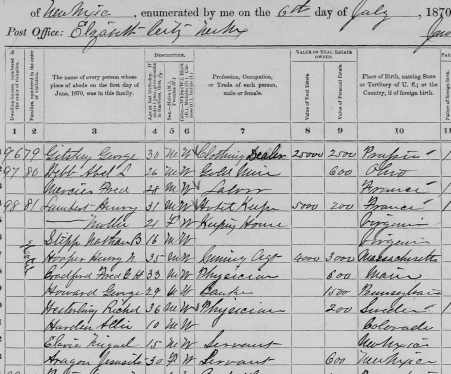
On March 28, 1868, former Fifth Army Corps cook Frenchman Henri Lambert married Anna E. “Molly” Stepp of Petersburg, Virginia, where Henri had been operating a restaurant following his service in the Union Army. Shortly after their marriage, Henry and Mary made their way to Denver by train and then south by wagon to Elizabethtown, where they arrived in May, 1868. Here, Henry worked as a placer miner until Fall set in, when he opened the first of the two hotels he would own in Colfax County. In the fall of 1871, the Lamberts moved to Cimarron, where Henri opened the saloon which would form the first story and basis of today’s St. James Hotel. Although Henri and Mary never had children, they did share their Elizabethtown home with her younger brother Nathan and in the mid 1870’s adopted a New Mexican boy named Jacob. Another brother, William, died September 1, 1881, less than two months before Mary’s death on October 28.
lambert-census-1870
1870 Elizabethtown, NM Census Record for the Lambert hotel and its occupants

Sources: http://genealogytrails.com/newmex/colfax/biographies.htm#lambert March 2015; Ralph E. Twitchell, The Leading Facts of New Mexico History, Torch Press, Cedar Rapid, Iowa, 1911. p. 212; 1870 and 1880 Colfax County Census data; George B. Anderson, History of New Mexico, Its Resources and People, Pacific State Publishing Co., New York, 1907.  p. 696-697; https://www.findagrave.com/.

Taos Heiress Marries Mountain Man

maxwell-beaubien-marriage-record-pages-blended
The marriage record for Lucien B. Maxwell and Maria de la Luz Beaubien

On March 27, 1842, 12 year old María de la Luz Beaubien of Taos, New Mexico, married the mountain man and  merchant Lucien B. Maxwell. Maxwell was 23 years old and had been in Nuevo Mexico six or seven years. María de la Luz, commonly called “Luz,” was the oldest daughter of French Canadian-born Carlos Beaubien and María Paula (Paulita) Lobato. She would be 13 years old in June 1842. A beautiful girl, she had dark hair and hazel eyes. The year before Luz’ marriage, the Mexican government had granted her father and Nuevo Mexico’s Provincial Secretary Guadalupe Miranda joint ownership of the vast swath of land that would become the Maxwell Land Grant after Carlos Beaubien’s death in 1862. Witnesses to the Maxwell/Beaubien alliance included future New Mexico Territorial Governor Charles Bent and Maria Ignacia Jaramillo, Kit Carson’s future sister-in-law. Padre José Antonio Martinez officiated.

Sources: Harriet Freiberger, Lucien Maxwell, Vision or Visionary, Sunstone Press, Santa Fe. 1999, p. 41, 47; María E. Montoya, <a href="http://Translating Property: The Maxwell Land Grant and the Conflict over Land in the American West, 1840-1900” target=”_blank”> University of California Press, Berkeley, p. 50; https://familysearch.org/search/film/007854398?i=119
 

Save

Wild Knowledge

He wasn’t a man to pay much attention to girl children, but this one was different. She didn’t seem interested in cooking or clothes. More likely, she’d be in the canyon, fishing the Cimarron River. Her brother was the dreamy one, the one watching the fish swim ’stead of trying to catch ’em.

So the man was surprised when she came around the curve of the path and stopped to watch him cook the wild carrot root. He’d cut off the flowers and was slicing the root into the pot on the fire.

“Good eatin’,” he told her. “Back home, they say these make your eyes strong.”

She frowned. “Not that,” she said, shaking her head.

He was hungry. He lifted the last piece to his mouth.

“No!” she said sharply.

He raised an eyebrow at her and lowered his hand.

“That isn’t carrot,” she said. “It’s poison hemlock.”

from Moreno Valley Sketches

Eagle Nest Dam Finally Begins Construction

11188151_948738271824312_43356579046834581_n
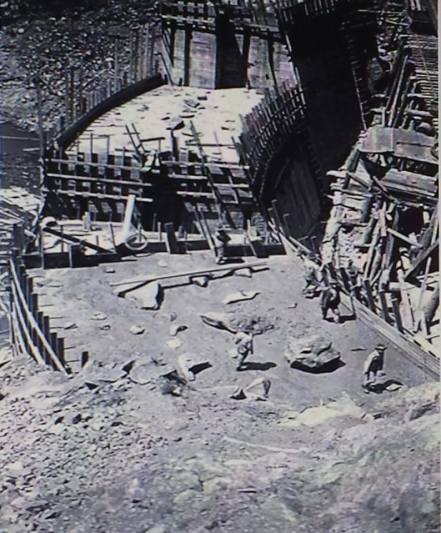
Eagle Nest dam early in the construction process. Source: NM State Engineer’s Office.

On the brink of what would become known as World War I, in March 1917, construction on the Eagle Nest dam and reservoir at the head of the Cimarron Canyon had finally gotten  underway. The project had been held up for nine years while the Cimarron Valley Land Company, under the leadership of Charles Springer, fought to acquire the land that would be flooded by the impounded waters. Long-time Moreno Valley property owner Mary Gallagher had fought valiantly against the project, but when she died in 1916, her eight children seem to have quickly capitulated to the company’s demands. The deeds for the condemned lands were handed over on January 17, 1917, and work commenced. Even with the shortages in material, equipment, supplies, and laborers as a result of the war in Europe, construction proceeded rapidly and the dam was 90 percent complete by mid-December that year.

gallagher-protest-letter-cropped
Mary Gallagher’s 1907 letter protesting the dam and reservoir. Source: Office of the NM State Engineer

Sources: Charles Springer affidavit dated Jan. 29, 1921; Gallagher protest letter dated January 31, 1908.


Future Urraca Ranch Property Sells For $660

In March 1861, Lucien Maxwell and Charles Beaubien sold what is now the Urraca Ranch wealthy Taos merchant Peter Joseph for $660. A Portuguese immigrant, Joseph had trapped and traded with Maxwell and Carson during their mountain man days. Although he died less than a year after the property transfer, in that time Joseph had a ten acre piece of the land (probably along Urraca Creek) surrounded with a board fence so it could be farmed. The eastern border of the Joseph Ranch was the Old Santa Fe Trail between Rayado and Cimarron and its western border was the Cimarron mountains. On the south, it was bounded by the Maxwell/Abreu properties at Rayado, and on the north by the ridge that separated the waters flowing into the Urraca and Cimarroncito creeks.

antonio_joseph
Antonio Joseph. Source: https://en.wikipedia.org/wiki/Antonio_Joseph_(politician)

About five years after Peter Joseph’s death, his sixteen year old son Antonio gained full control of the property. In 1880, he sold the land to speculator Frank R. Sherwin for $8,500, almost thirteen times his father’s original investment. Antonio Joseph went on to become New Mexico Territory’s representative to Congress from 1884 to 1894 and to play an important role in the fight for New Mexico statehood.


Sources: Lawrence R. Murphy, Philmont a history of New Mexico’s Cimarron Country, UNM Press, Albuquerque, p. 135;     1880 Colfax County Census data; David V. Holtby, Forty-Seventh Star, U of Oklahoma Press, Norman, p. 7-15, 286.


Lucky

As they watched, a wild turkey hen stepped onto the frozen riverbed. She walked carefully up the ice-covered stream, stopping occasionally to peck at a fallen leaf or twig.

Finally, she disappeared into the coyote willow at the river’s edge. Carla let out a long breath and sat back against the Model T’s battered seat. She put her bare hands to her neck to warm them, and looked at her mother. “We’re really lucky,” she said.

“Why do you say that?” Eileen poured thin tea from the thermos into their single mug. She held it for a moment, warming her hands, then handed it to Carla.

“We see wild turkeys on a frozen river in January.” Carla sipped the tea carefully. “Not many people have that.”

Eileen looked out the cracked windshield, up at the bare cottonwoods etched against clear turquoise sky. “Not many do,” she agreed. “Not many do.”

from Moreno Valley Sketches II

Corn Damage, 3 of 3

Suzanna looked doubtfully at the tall, thick-bodied tan dog facing her. The man at Mora had generously loaned Gerald one of his three English mastiffs to test the theory that it would keep the deer from her cornfield.

“His name is Duke,” Gerald said, stroking the black-muzzled head. The dog’s tail wagged slowly as it studied Suzanna with sleepy brown eyes.

“He seems very docile,” she said.

“They were bred to hunt and are said to be very protective.” Gerald shrugged. “I guess we’ll just have to see.”

She nodded and watched as Gerald and the dog headed toward the cornfield, their own two mixed-breed dogs romping alongside. The mastiff majestically ignored the other dogs and Suzanna’s lips twitched. Then she shook her head and went back inside.

The barking began at daylight the next morning: high yips from their own dogs and a deeper, more solid sound. Suzanna rose and went to the window. The mongrels were at the edge of the corn patch, dancing around each other. As she watched, Duke appeared at a steady trot, circling the field.

Suzanna grabbed her shawl and went out onto the cabin porch, where she could see the entire patch. There were no deer in the corn. Duke circled the field again, stopping occasionally to mark its boundary, lift his head toward the hills above, and bark menacingly. There were deer on the hillside, moving steadily upward.

Suzanna turned toward the house. Gerald was standing in the doorway, watching her.

“How long will it take a puppy to grow to Duke’s size?” she asked, and he chuckled triumphantly.

from Moreno Valley Sketches II

Moreno Valley’s Serial Killer Gets Married

kennedy-cortez-marriage-record

On Thursday, February 28, 1867, Charles Kennedy married Gregoria Cortes at the Nuestra Senora de Guadalupe Church in Taos. Gregoria was the fourteen year old daughter of widower José Cortez of La Cordillera del Rancho, about two miles west of Mora. Charles was the 28 year old son of William and Fanny Canady (aka Kennedy) of Tennessee. Gregoria and Charles settled in the Moreno Valley at the foot of Palo Flechado Pass, on the road from Elizabethtown to Taos. There they kept a way station for travelers, and Charles Kennedy became embroiled in a series of lawsuits: one for selling liquor without a license, another for assaulting an Elizabethtown merchant with a deadly weapon, and still another for embezzling an Elizabethtown laborer’s money and goods. Kennedy was suspected of other nefarious activities, but nothing could be proven. Then, one day in the fall of 1870, his then seventeen year old wife appeared in Etown and denounced Kennedy as a serial killer. The subsequent Elizabethtown trial and lynching would make the Santa Fe, Silver City, and Indianapolis newspapers. The Silver City report said Kennedy claimed just prior to his lynching that he’d killed twenty-one men.

Corn Damage, 2 of 3

“The ears probably wouldn’t have ripened before the first snow, anyway,” Gerald said as he studied the deer-damaged cornfield. Beside him, the hired man Ramon nodded sympathetically.

Suzanna’s eyes narrowed. “You don’t know that,” she said. “And if some had, then I would have saved them to plant next spring.”

Gerald shook his head. “It’ll take years to get a strain that’ll grow at this high altitude.”

Her chin lifted. “Then it will take years. You want to stay in this God forsaken valley, don’t you?”

He continued to study the damage. “I just don’t think a fence is going to keep the deer out,” he said mildly. “They can jump pretty much anything you put in front of ’em.”

“Then what would you suggest? Those mongrel dogs of yours have proven themselves useless.”

Gerald shook his head without looking at her.

“There is a man at Mora who has dogs called masteef,” Ramon said. He held out a hand, waist high, palm down. “They are this big and used for hunting.”

Gerald turned his eyes from the corn. “Do you think he would sell?”

Ramon shrugged. “When we were there last month he showed me puppies.”

“Ramon, you are an angel,” Suzanna said.

“We don’t know that this will work,” Gerald warned.

“It’s certainly worth a try.” She gave Ramon a brilliant smile and he grinned back at her sympathetically.

from Moreno Valley Sketches II

The Road to Santa Fe–and Taos

santa-fe-trail-map-1826-cropped-small

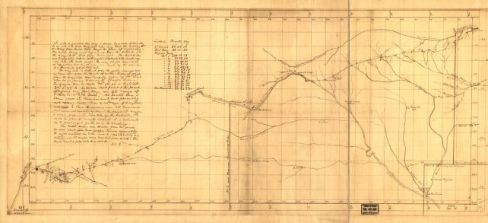
In February 1825, the United States Congress appropriated $25,000 to mark and survey a road between Missouri and Santa Fe. The survey was intended to formalize the informal trail that had been in use since at least 1821. In what would eventually become Colfax County, the “mountain branch” of the Trail crossed Raton Pass and moved directly south through what are now Cimarron and Rayado en route to Santa Fe. However, the Congressional Survey party took what was known as the Cimarron Cut Off, which swung south from the Arkansas River in what is now southwest Kansas to angle southwest until it connected with the mountain branch near Rayado.

At this point, travelers to Taos could decide whether to swing down through Santa Fe and then north or to cut west across the mountains. Taos was an important destination for those Trail travelers who were dealing in beaver fur or looking to outfit men engaged in fur trapping. Travelers headed there could take two different routes, depending on their mode of transportation. If their goods could be packed onto mules, they could follow a well-established mule track across the Cimarron range into the southern part of the Moreno Valley and then over Apache Pass to Valle Escondido. Just north of Valle Escondido, they would hit the San Fernando River, which would lead them into the Taos Valley. But if they needed to get wagons across and into Taos, they would have to find another route, such as the one Santa Fe Road Commissioner George C. Sibley followed. This route swung into the mountains south of Rayado and then north to Taos, where he completed the Santa Fe Road survey maps in late 1825.

Sources: Brown, J. C, and George Champlin Sibley. [Santa Fe route]. 1825. Map. Retrieved from the Library of Congress, <https://www.loc.gov/item/98687168/&gt;.

Schmidt, Steve. Presentation to Santa Fe Trail Association, Cimarron, NM. June 2015.


Save