Moreno Valley’s Serial Killer Gets Married

kennedy-cortez-marriage-record

On Thursday, February 28, 1867, Charles Kennedy married Gregoria Cortes at the Nuestra Senora de Guadalupe Church in Taos. Gregoria was the fourteen year old daughter of widower José Cortez of La Cordillera del Rancho, about two miles west of Mora. Charles was the 28 year old son of William and Fanny Canady (aka Kennedy) of Tennessee. Gregoria and Charles settled in the Moreno Valley at the foot of Palo Flechado Pass, on the road from Elizabethtown to Taos. There they kept a way station for travelers, and Charles Kennedy became embroiled in a series of lawsuits: one for selling liquor without a license, another for assaulting an Elizabethtown merchant with a deadly weapon, and still another for embezzling an Elizabethtown laborer’s money and goods. Kennedy was suspected of other nefarious activities, but nothing could be proven. Then, one day in the fall of 1870, his then seventeen year old wife appeared in Etown and denounced Kennedy as a serial killer. The subsequent Elizabethtown trial and lynching would make the Santa Fe, Silver City, and Indianapolis newspapers. The Silver City report said Kennedy claimed just prior to his lynching that he’d killed twenty-one men.
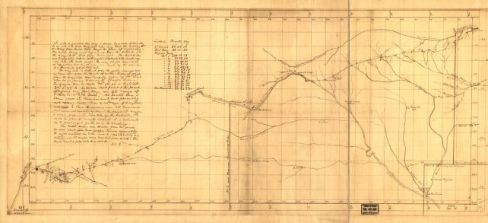
The Road to Santa Fe–and Taos

santa-fe-trail-map-1826-cropped-small

In February 1825, the United States Congress appropriated $25,000 to mark and survey a road between Missouri and Santa Fe. The survey was intended to formalize the informal trail that had been in use since at least 1821. In what would eventually become Colfax County, the “mountain branch” of the Trail crossed Raton Pass and moved directly south through what are now Cimarron and Rayado en route to Santa Fe. However, the Congressional Survey party took what was known as the Cimarron Cut Off, which swung south from the Arkansas River in what is now southwest Kansas to angle southwest until it connected with the mountain branch near Rayado.

At this point, travelers to Taos could decide whether to swing down through Santa Fe and then north or to cut west across the mountains. Taos was an important destination for those Trail travelers who were dealing in beaver fur or looking to outfit men engaged in fur trapping. Travelers headed there could take two different routes, depending on their mode of transportation. If their goods could be packed onto mules, they could follow a well-established mule track across the Cimarron range into the southern part of the Moreno Valley and then over Apache Pass to Valle Escondido. Just north of Valle Escondido, they would hit the San Fernando River, which would lead them into the Taos Valley. But if they needed to get wagons across and into Taos, they would have to find another route, such as the one Santa Fe Road Commissioner George C. Sibley followed. This route swung into the mountains south of Rayado and then north to Taos, where he completed the Santa Fe Road survey maps in late 1825.

Sources: Brown, J. C, and George Champlin Sibley. [Santa Fe route]. 1825. Map. Retrieved from the Library of Congress, <https://www.loc.gov/item/98687168/&gt;.

Schmidt, Steve. Presentation to Santa Fe Trail Association, Cimarron, NM. June 2015.


Save