The Lone Star of Texas in Mexico

The Lone Star of Texas in Mexico

Shortly after American troops invaded New Mexico in Autumn 1846, they discovered four pieces of Mexican artillery in a village south of Santa Fe. Apparently, Governor Manuel Armijo had taken the guns with him when he fled, but abandoned them at Galisteo. One of these pieces was of special interest to the Americans because it had arrived in New Mexico by way of Texas.

The cannon, made in Springfield, MA, had accompanied the ill-fated 1841 Texan expedition to New Mexico. A brass six pounder, it had been cast with a Texas star on its breach and paid for by “patriotic ladies” of the newly formed republic. When the Texans straggled into eastern New Mexico in Fall 1841, they still had the gun with them, despite its weight and their exhaustion.

New Mexico Governor Manuel Armijo confiscated the cannon, of course, and reportedly displayed it in the Santa Fe plaza after he sent the captured Texans on to Mexico City. It was still there in 1846, when it and other artillery pieces were transferred to Apache Pass during the runup to the impeding American invasion.

When Armijo decided to flee instead of fight, he took the Texan gun and other artillery with him. Three of the gun carriages apparently broke down at Galisteo, and the governor was forced to abandon them as well as the weapons they carried. This included the Texan six-pounder, which the American troops dubbed the “Lone Star of Texas.”

Six pound cannon from the 1840-1860s period. Courtesy: U.S. Library of Congress

They transported the gun back to Santa Fe, where it was apparently once again placed on the plaza. Lt. Richard Smith Elliott says it was used in early November to assemble the officers for training drill.

We have no official record of the Texas cannon again until Brigadier General Sterling Price took it with him to Chihuahua.  There, it saw action at Santa Cruz de Rosales, the last battle of the Mexican war, on March 16, 1848.

However, there is a possibility that this was not the first battle in which the Texan cannon was fired. A six-pound cannon played a conclusive role in the February 1847 battle at Taos Pueblo, when it was used to breach the walls of the church where the insurrectos were holed up. This gun may well have been the Lone Star.

After the battle at Santa Cruz de Rosales, the Texan cannon was returned to Santa Fe, where it was stored alongside other Mexican artillery pieces in La Castrense, the old military church on the south side of the plaza. It and the other guns were presumably cleared out when the Americans decided to use the building as a courtroom. What happened to it after that remains a mystery.

Sources: Mark L. Gardner and Marc Simmons, Eds., The Mexican War Correspondence of Richard Smith Elliott; Silver City New Mexico Enterprise, October 9th 1891, courtesy Silver City Library.

© Loretta Miles Tollefson
Aftermath of a Rebellion

Aftermath of a Rebellion

In mid April 1847, the Taos Valley was still experiencing the aftermath of the January 20 rebellion.

The U.S. Army had captured a total of 45 rebels. They released 24 for lack of evidence and tried 21. The trials were over, but the executions weren’t. Seventeen men would hang, one of them for high treason.

The high treason charge was questionable. An argument could be made that a person couldn’t rebel against a country to which they had not pledged allegiance. The war with Mexico wasn’t over. New Mexico was still officially part of occupied Mexico, and its people were still citizens of that country. There’d been a trial in early January which had found the high treason charge suspect. But that didn’t stop 26-year-old prosecuting attorney Francis P. Blaire, Jr. from continuing to use it.

In early March, Blaire filed the charge against three men: Antonio Maria Trujillo, Pantaleon Archuleta, Trinidad Barceló, and Pedro Vigil. Apparently the only rebel trials held in Santa Fe, the charges against Archuleta, Barceló, and Pedro Vigil were eventually dropped after the proceedings ended in a mistrial.

Trujillo was found guilty, but because he was elderly and unwell, the jury and judge requested that the sentence be commuted. Military Governor Sterling Price granted the pardon, and Santa Fe was spared a demonstration of the effectiveness of the gallows.

Taos wasn’t. Of the eighteen prisoners tried there, all were convicted and hung.

There had been a single execution on February 7 of Pablo Montoya, one of the rebellion leaders, but the remainder waited until April, when the formal trials began.

These hangings started on Friday, April 9, when Hipolito (Polo) Salazar, Jose Manuel Garcia, Pedro Lucero, Juan Ramon Trujillo, and the Romero brothers Ysidro and Manuel, age sixteen, were executed two days after their trials. Salazar had been convicted of high treason, but the rest of these men were found guilty of killing American-appointed Governor Charles Bent.

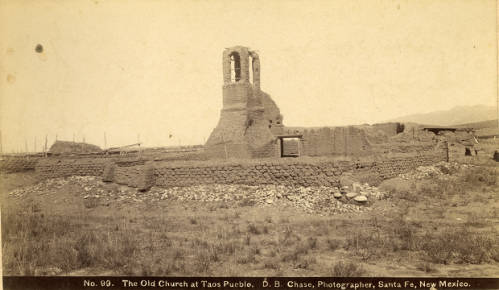
The eleven remaining convicted rebels had to wait to meet their end. Most of them would die three weeks later, on Friday, April 30. These executions seem to have occurred in two batches. The six men from Taos Pueblo—Francisco Naranjo, Jose Gabriel Romero (or Samora), Juan Domingo Martin, Juan Antonio Lucero, and a man called El Cuervo—were apparently hanged at the same time. They were buried at the Pueblo at the church which had been destroyed by the Americans in early February.

Ruins of the Taos Pueblo church. Source: Palace of the Governors Archives

Four other men—Manuel Miera, Juan Pacheco, Manuel Sandoval, and Rafael Tafoya—were also executed that day. Then, on the following Friday, Juan Antonio Avila was hanged for his role in the insurrection.

Why the week-long delay? There’s no information in the records. I’d love to know the answer to this question, just as I’d like to know why the trials of Trujillo, Barceló, Archuleta, and Vigil were held in Santa Fe and the reasons for the mistrials for latter three men. Was this a procedural issue? Was family pressure brought to bear?

I’m especially curious about the case of Trinidad Barceló. He was the older brother of businesswoman Gertrudes Barceló, who had assisted the U.S. occupiers in suppressing a revolt the previous December. Did her support of the regime play a part in her brother’s release?

What about the other two: Archuleta and Vigil? Were they related to Acting Governor Donaciano Vigil or some other prominent New Mexican who the Americans wanted on their side?

And then there are the stories of the men who died: their reasons for resistance, the impact on their families, the pain or joy they left behind.

So many stories, so little time.

© Loretta Miles Tollefson

Sources: David C. Beyreis, Blood in the Borderlands; Mary J. Straw Cook, Doña Tules; James A. Crutchfield, Revolt at Taos; Mark L. Gardner and Marc Simmons, eds., The Mexican War Correspondence of Richard Smith Elliott; Lewis H. Garrard, Wah-to-ya and the Taos Trail; Lucy Lippard, Pueblo Chico, Land and Lives in Galisteo since 1814; Michael McNierney, ed. Taos 1847, The Revolt in Contemporary Accounts; Alberto Vidaurre in Corina A. Santistevan and JuliaMoore, Taos, A Topical History.

Two American Governors for New Mexico

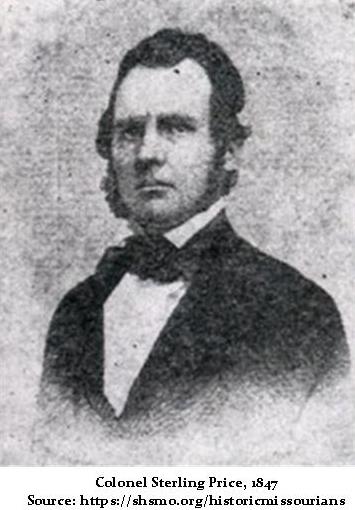
On Tuesday, Sept. 22, 1846, just over a month after Brigadier General Stephen Watts Kearny seized New Mexico for the United States, he appointed Virginia-born Taos businessman Charles Bent as New Mexico’s first American civil governor. When Kearny and the majority of his 1700-man force headed on to California to participate in acquiring it as well, Colonel Sterling Price, as senior U.S. Army officer in New Mexico, became its military governor.

Sept 22 illustration.Bent

Bent had been in Nuevomexico since 1829, first as a fur trapper, then as a Santa Fe trail trader based in Taos. He occupied his post as Governor less than four months. In mid-January 1847, he died at the hands of a New Mexican mob protesting the American occupation.

Two-and-a-half weeks later, Colonel Price, supported heavily by American businessmen and trappers in New Mexico, crushed that rebellion and assured that New Mexico would remain part of the United States.

Sept 22 illustration.Price

Ironically, Price’s own career would include participation in an even larger rebellion against the nation he had helped to force on New Mexico. Following a term as Governor of Missouri, he joined the Confederate Army, rising to the level of General. He died on September 29, 1867, almost exactly 21 years after he took over as military governor of New Mexico.

Sources: Leroy R. Hafen, Ed., Fur Trappers and Traders of the Far Southwest,  Logan: Utah State UP, 1977; Marc Simmons, New Mexico, an interpretive history, Albuquerque, UNM Press, 1988