Although this is a presentation about a book, it has some interesting information about New Mexico Spanish and it’s origins and external (Caribbean and Nahuatl) and internal (Pueblo) influences. Interesting!
Tag: Old New Mexico
Buffalo Soldiers in New Mexico
Because it’s Memorial Day, I’m sharing this video about the Buffalo Soldiers in New Mexico. Don’t know what a Buffalo Soldier was? Watch the video! Note: All opinions expressed in this presentation are those of the speaker. I do not necessarily agree that New Mexico needed to be civilized or that these men were the only reason it finally became a state. But it’s an interesting concept! Tell me what you think!
IMPATIENCE
“This gold. They have found it in large quantities?” The lanky teenage boy named Escubal Martinez poked a stick into the logs on the fire, moving them closer together. At the edge of the mountain valley, a coyote yipped. The Martinez clan’s flock of sheep shifted uneasily in the darkness beyond the firelight.
The Prussian-born traveler from Etown grinned. “Ja,” he said. “But it is hard work, the digging for gold.”
Escubal’s uncle Xavier grunted from the other side of the flames, where he was using a knife to carefully smooth out an uncomfortable bump on the grip of his walking staff. “Borregas y carneros.” He nodded at the boy. “That is wealth.”
Escubal scowled at the fire.
The traveler looked puzzled. “Carner?” he asked. “Meat is wealth?”
“No, Borregas y carneros,” Escubal said.”Ewes and rams.” He gestured impatiently toward the flock.
Xavier moved his staff in the firelight and ran his fingertips gently over the wood. “Carne y ropa,” he said meditatively. “Meat and clothes.”
“Ja,” the Prussian answered. “You are correct.”
Escubal scowled at the fire and the traveler smiled sympathetically. It was not easy to be young and impatient.
The boy poked at the fire again. It flared briefly, lighting the night, and the flock moved restlessly, waiting for morning.
from Valley of the Eagles
Billy The Kid Escapes!
On Thursday, April 28, 1881 William Henry Bonney, better known as Billy the Kid, escaped from the county jail in Lincoln, New Mexico.
Billy was 22 and loved reading books, singing, and dancing. He was fluent in the Spanish language and skillful with a rope, horse, and gun. He was a hard worker and not much of a drinker. He didn’t use tobacco either.
But Billy did have two problems: He was small for his age and he had a hair-trigger temper. Also, like most of us, he didn’t appreciate being made fun of. In August 1877, while he was working as a cowboy in Arizona, a bully taunted the Kid one time too many. Bonney shot and he didn’t miss.
When the man died, Billy fled to New Mexico. By November, he was in the Lincoln area. By early the following year, he had signed on at John Tunstall’s ranch. The rest is history.
Three years later, at the tail-end of the Lincoln County War, Bonney was in jail in the town of Lincoln, waiting to be hung for the murder of Sheriff William Brady. Then he saw his chance and took it. He got away, killing Deputies J.W. Bell and R. Olinger in the process.
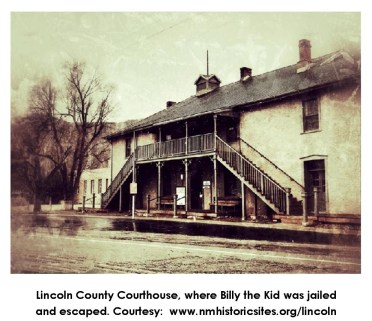
Given that he now had the murder of a Sheriff and two Deputies hanging over him, Billy’s friends thought he should head south to Mexico. Instead, he went north to Fort Sumner. There, sheltered by friends and associates, he kept a low profile.
But it wasn’t low enough. Word of the Kid’s whereabouts got out and Sheriff Pat Garrett started nosing around, making inquiries. One night, Garrett was visiting at the Maxwell ranch just outside town when Billy, not knowing he was there, wandered into the room.
Within a few seconds, William Henry Bonney was dead. It was Thursday, July 14, 1881, just eleven weeks since his escape from the Lincoln County jail.
Billy the Kid should have listened to his friends.
Sources: Don Bullis, New Mexico, A Biographical Dictionary, Vol. I, Rio Grande books, Los Ranchos de Albuquerque, 2007; Howard R. Lamar, The Reader’s Encyclopedia of the American West, Harper & Row, New York, 1977; Ruben Salaz Marquez, New Mexico, a brief multi-history, Cosmic House, Albuquerque, 1999; David Grant Noble, Pueblos, Villages, Forts and Trails, University of New Mexico press, Albuquerque, 1994.
New Mexico Delegate Sees Lincoln Shot!
By mid-April 1865 Jose Francisco Perea had finished his term as New Mexico Territory’s Congressional delegate. The Civil War was over and he must have been looking forward to returning home again to a quieter life.
But Perea had one more Washington DC event to experience. On Friday, April 14, 1685, he attended the Ford’s Theater production of Our American Cousin.
His seat was near President Lincoln’s box.
Perea, who had been educated at a Jesuit college in St. Louis, would have known the meaning of the words John Wilkes Booth yelled as he leapt to the theater stage from Lincon’s box. “Sic temper tyrannis!” meant “Thus always for tyrants!”
It wasn’t the first time Perea had witnessed a death as the result of rebellion. As a seven-year-old in Santa Fe, he’d watched four men who’d led a revolt against the Mexican government suffer the ultimate punishment on a cold January 1837 morning.
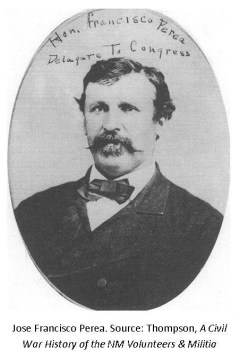
Now he watched as a doctor rushed to Lincoln’s side and gravely shook his head. It was only a matter of time. Booth’s shot was clearly mortal.
Perea himself would live another 48 years, dying in May 1913. Until then, he would busy himself with his business interests, the post office and hotel in Jemez Springs, and his home in Albuquerque. But he would never forget that January morning in 1837 or that rainy night in April 1865.
Sources: W.H.H. Allison, Old Santa Fe Magazine, Vol. II, Ralph Emerson Twitchell, Ed., Old Santa Fe Press, Santa Fe; John W. Kirshon, Ed., Chronicling America, Chronicle Publications, Mt. Kisco, 1987; Jerry D. Thompson, A Civil War HIstory of the New Mexico Volunteers & Militia, UNM Press, Albuquerque, 2015.
FOR SAFETY’S SAKE
As Suzanna rounded the cabin from the garden, she saw Gerald in the yard loading his pistol. Both of the children stood beside him, watching intently.
“What are you doing?” Suzanna asked.
“We’re learning to shoot!” Andrew said gleefully.
Suzanna frowned. “We?” she asked. She looked at Gerald. “Andrew’s one thing, but Alma doesn’t need–”
“But I’m the oldest,” Alma said.
“She’s unfeminine enough,” Suzanna said to Gerald. “Always out fishing when she should be inside with her needlework.”
A smile flitted across his face. “Out here, everyone should know how to shoot,” he said mildly. “For safety’s sake.”
“More reason to move someplace civilized.” She turned and stalked toward the house.
“Can I load it, Papa?” Alma asked.
“Me, too!” Andrew said.
Gerald crouched down to show them again how it was done.
Copyright © 2015 Loretta Miles Tollefson
Book Review: Valverde
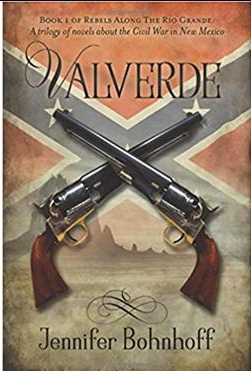
ISBN: 9781534715974
Valverde is a novel about the Civil War in New Mexico that begins in Texas. This location may seem odd to you unless you’re familiar with the relationship of Texas and New Mexico. You see, the Texas Republic tried to invade New Mexico twenty years before the Civil War, and it didn’t go well.
His father’s involvement in that earlier invasion plays a role in teenage Texan Jemmy’s decision to join the Confederate Texan forces. It also affects New Mexico teenager Raul’s attitude toward the invading forces.
Valverde follows each boy as he experiences the beginnings of the Civil War in New Mexico and as their paths cross at the battle of Valverde in February 1862.
The characters are well drawn, the situations are believable, and the battle scenes are handled nicely—there’s enough detail to make the reader feel the characters’ pain but not more than is strictly necessary.
This book is the first in the trilogy Rebels Along the Rio Grande, a series of Middle-Grade novels about the Civil War in New Mexico. The next in the series is Glorieta and I’m looking forward to reading it, too!
You don’t have to be a Middle-Grader to enjoy and learn a little something from this book. I recommend Valverde to young and old!
Jicarilla Warriors put U.S. Dragoons to Flight!!!
On Thursday, March 30, 1854, in the mountains of New Mexico, the U.S. Army experienced its worst defeat at the hands of Native American warriors up to that time, west of the Mississippi. It would be another twelve years before larger losses occurred at the 1866 Fetterman defeat near Fort Phil Kearny, and another twenty-two before the Battle of the Little Big Horn.
The New Mexico clash wasn’t what the top brass had ordered. The dragoons from Cantonment Burgwin near Taos had been sent out under Lt. John W. Davidson to monitor the Jicarillas camped west of the traditional Spanish village of Cienequilla (today’s Pilar, New Mexico), not attack them.
There was a history of conflict between the Spanish settlers in the fertile little valley along the Rio Grande and the Jicarilla Apaches. The Jicarilla had been farming and hunting in the area well before 1795, when the Spanish governor granted land there to his settlers. The Apaches protested his decision and, in 1822, petitioned for their own grant of land in the area, but the settlers in Cienequilla and in Taos vigorously opposed the idea and the request was denied.
So the Jicarillas were left to farm and hunt where ever they could find space. By 1854, this was becoming more difficult, as American settlers moved into New Mexico and further reduced the supply of arable as well as hunting land.
Early that year, complaints against the Jicarillas had increased in the area east of the Rio Grande. The Territory’s top military officials were skeptical about the validity of many of these complaints, but in February credible reports began coming in that the Jicarillas were stealing livestock north of Fort Union. A few weeks later, a group of 45 Jicarilla lodges were reported to be camped near Mora, west of the Fort.
When soldiers led by West Point graduate Davidson went to investigate, they discovered that the Apaches had moved away from Mora and were headed west through the mountains. Davidson noted the “miserable quality of their arms and their mean shrinking deportment” and returned to Cantonment Burgwin, where he and his men were stationed, convinced the Apaches weren’t a threat.
Eight days later, he and his U.S. Second dragoons were ordered to the Cieneguilla area to observe the movements of the same band, but not to attack.
On March 30, two hours east of the Rio Grande, the dragoons found the Jicarilla camp. The order not to attack was apparently not obeyed. Someone fired a gun and by nightfall, at least a third of Davidson’s men were dead, with another third wounded, and 45 horses lost.
It must have been a shock to realize that the Jicarillas’ weapons weren’t quite as miserable, and their warriors nearly as shrinking, as Davidson had thought.
Source: David M. Johnson, Chris Adams, Larry Ludwig, and Charles C. Hawk, “Taos, the Jicarilla Apache, and the battle of Cienequilla,” Taos: A Topical History, Corina A. Santistevan and Julia Moore, Museum of New Mexico Press, Santa Fe, 2013; David Grant Noble, Pueblos, Villages, Forts And Trails A Guide To New Mexico’s Past, University of New Mexico Press, Albuquerque, 1994; Jerry D. Thompson, A Civil War History Of The New Mexico Volunteers And Militia, University of New Mexico Press, Albuquerque, 2015.
DUCK HUNTING
The girl lifted her skirts away from her feet and eased toward the small brown-mottled duck on the creek bank. It was busily investigating a small marshy area where water had seeped past the bank. Alma wished she’d brought her bow and arrows, but she’d been sent out to collect greens, not meat.
The duck had its back to her. Alma eased forward and crouched, getting into position. Her right foot pressed her skirt into the mud, but she didn’t notice.
The duck turned slightly. Alma lunged forward. As her hands touched the bird’s smooth feathers, her foot ground into her skirt, yanking her off balance. The duck flew off with a panicked series of quacks and Alma pitched forward into the mud.
“Hell and damnation!” she said angrily. “I hate dresses!”
She got to her feet and looked down ruefully. Her mother was not going to be happy.
from Valley of the Eagles
John Tunstall Dies, Lincoln County War Begins!!!
On the morning of Monday, February 18, 1878, on an otherwise-deserted road in Southeast New Mexico, a young Englishman was shot and killed, and event which initiated the Lincoln County War.
The young man was John Henry Tunstall. He and Alexander McSween had been in the process of organizing a business partnership when McSween was accused of absconding with some life insurance money. Although Tunstall wasn’t legally responsible, he was wealthy and he was friends with McSween, who had already ruffled feathers in the County. The court decided that Tunstall should participate in repaying the $8,000 involved.

That Monday morning, Tunstall was on his way to the town of Lincoln to try to negotiate a settlement in the case. Instead, he and the four gunfighters he’d recently hired encountered a posse which had been sent out to collect Tunstall’s cattle as partial payment of McSween’s debt. In the ensuing battle, Tunstall was killed.
Born in Middlesex, England, Tunstall emigrated to British Columbia when he was 19, then headed for the American West in February 1876, looking for investment possibilities. After six months looking into sheep ranching in California, he went to New Mexico, where he met Alexander McSween.
McSween persuaded Tunstall to move to Lincoln County. Land was cheap there and the profit potential was high. Eighteen months later, Tunstall was dead. McSween would follow him shortly thereafter.
Tunstall’s death not only started the Lincoln County War, it brought the British government into the conflict. The embassy wanted to know how and why their countryman had been killed and his body left where it fell.
As a result of the British inquiries, Frank Warner Angel was sent West to investigate Tunstall’s murder and other New Mexico violence. Angel’s report would put an end to the current Governor’s term and bring Lew Wallace to New Mexico in his stead.
However, it wouldn’t end the Lincoln County conflict. More people would die, including William Bonney, aka Billy the Kid, who’d fought beside Tunstall that February morning, and Juan Patron, leader of the County’s Mexican-American faction and staunch opponent of Tunstall’s killers.
But eventually, the conflict fizzled out. Like so many wars, it started with a bang but ended with a whimper, with no clear winners and a lot of damage that would never be fully repaired.
Sources: David L. Caffey, Chasing the Santa Fe Ring, UNM Press: Albuquerque, 2014; Howard R. Lamar, ed., The Reader’s Encyclopedia of the American West, Harper & Row: New York, 1977; tomrizzo.com/killing-john-tunstall/accessed 1/10/19; Marc Simmons in Marta Weigle, ed., Telling New Mexico, A New History, Museum of NM Press: Santa Fe, 2009; Stephen Zimmer ed., For Good or Bad, People of the Cimarron Country, Sunstone Press, Santa Fe, 1999
 Fiction and Fact From Old New Mexico