The boy sits silently near the creek bank and watches his twelve week old puppy among the grasses, sniffing invisible trails. The boy has learned from long practice to sit motionless for long stretches of time. Being still has enabled him to see much that other humans, especially adults, will never discover–coyote puppies learning to hunt, damsel fly nymphs emerging from their chrysalis, the way a brook eddies at times against the wind.
The dog may never see these things either, the boy reflects complacently as he watches his new pet. Not until he is much older and has learned to be still.
In the warm mountain sun, the boy’s shoulders relax and his eyes begin to glaze over. He is not prepared for the sudden movement from above. The golden eagle’s outstretched wings shadow the boy and dog at the same moment, then the pup gives a high-pitched yelp and is gone, the boy too startled to cry out.
When he stumbles home with tear-streaked face, his mother folds him wordlessly into her arms. “I sat too still,” he moans into her chest. “I was too silent!”
On the night of Saturday, October 30, 1875 New Mexico Territory rancher William Low joined Mexican-born Cruz Vega beside a campfire about a mile and a half north of Cimarron. Low had hired Vega to watch his cornfields that Halloween weekend. But when a group of masked men led by Methodist missionary Oscar P. McMains showed up that night, Low wasn’t surprised. Reverend McMains had asked him to hire Vega to watch that particular cornfield. He wanted him within easy reach of the Poñil River stage road and the telegraph line that ran it.
McMains and his men had a sinister use for those telegraph poles. They suspected Vega of murdering McMain’s fellow missionary, the Reverend Franklin J. Tolby the month before, and they intended to extract a confession from him.
Las Vegas Gazette, Nov. 14, 1875
According to William Low, “One of them says, halloo boys, and he walked up toward Cruz with a lariat and put it around his neck, and says, come on, and they took him into the road and we along with him. We went up I judge about 500 yards among the timber, along the telegraph line: there was a party of men. It was pretty dark. These four or five men took him to a telegraph pole of their own accord: none of the parties said a word . . . One of the four or five men climbed the telegraph pole and put the rope over the wire and they raised him up, on their own accord, and after a few seconds let him down again.” After Vega recovered enough to talk, McMains interrogated him.
This process was repeated until McMains got all the information he was looking for. Then the Reverend returned to the Poñil River ranch where he and Low were staying the night and left Vega to the mercy of the now-drunken mob. McMains said later that he thought they were too drunk to do Vega any real damage. But shortly after McMains reached the ranch house, he and Low heard gunshots. “My God!” McMains exclaimed. “I fear these are the shots that kill Cruz Vega.”
And he was right. Vega’s body was found the next morning near the base of the telegraph pole. A clump of hair from his bashed-in head lay nearby and rope burns circled his neck.
Ironically, the information McMains gathered that night acquitted Vega of Tolby’s murder. Although Vega admitted that he’d witnessed the killing, he identified Manual Cardenas of Elizabethtown as the shooter. So the murderer was still at large. The saga of Reverend Tolby’s murder wasn’t quite over, and more deaths would ensue before it was. . . . Stay tuned.
Sources: Las Vegas Gazette, Nov. 14, 1875. Las Vegas Gazette, August 25, 1877.
The red-bearded man in the tattered coat and a dirty blue bandana for a hat squatted in the middle of the adobe casita’s single room and scooped the thick stew into his mouth with his fingers, grunting with pleasure. The woman placed a small wooden plate piled high with tortillas beside him. The man sucked his fingers clean, then grabbed a tortilla and used it to shovel more food into his mouth.
The two children perched on the adobe banco in the corner stared silently at the strange americano until their mother motioned at them to go outside. She replenished the man’s stew, then followed them.
“Come como perro amarrado. He eats like a tired dog,” the girl said. She wrinkled her nose. “So rapidly and with no manners.”
Her mother turned from the wood pile, her arms full. “He is our guest,” she said reprovingly. “Come, bring more wood for the fire.”
When they reentered the house, the man had finished his meal.
“More?” the woman asked.
He shook his head. “No, but I thankee. That’s the first meal I’ve et in three days.” He cocked an eyebrow at her. “I’m lookin’ for the wife of Juan Leyba, the one that went to Elizabethtown two years ago t’ find work.”
The woman went still, her lips stiff with fear. She licked them nervously. “I am the wife of Juan Leyba, the one who went to that Elizabethtown to labor in the mines there.” She swallowed hard. “He is well?”
“Oh yes, ma’am!” the americano said. “I’m sorry to frighten you ma’am.” He pulled a small leather bag from a pocket and held it out. “This here’s from him. There’s about two ounces o’ gold in it. He says t’ use it t’ buy that land you wanted, or come to him, whichever seems best t’ you.” As she reached for the bag, he looked at the children and grinned. He shoved his hand into another pocket. “An’ he sent these fer the young uns. Gotta little linty in my pocket, but I think they’re all right.” His fingers opened, revealing a collection of hard candies, enough to keep a careful man going for at least a day and a half.
In Fall 1875, when Rev. Oscar P. McMains took over for the murdered Rev. Franklin J. Tolby, he provided more than ministerial services. He also played detective, and went to work hunting for Tolby’s killer. Colfax County’s collective finger pointed at Cruz Vega, a Civil War veteran who’d run the mail right past the spot in Cimarron Canyon where Tolby had died September 14th. But Vega hadn’t reported seeing Tolby’s body, which many locals deemed mighty suspicious.
Rev. McMains wanted badly to talk with Vega, but he was having trouble locating him. When he did find him, he was going to have another problem: McMains didn’t speak Spanish, the Mexican-born Vega’s native (and apparently only) language.
Source: NM Conference United Methodist History Journal, Nov. 2011
McMains first attempted to locate Vega through Isaiah Rinehart, the rancher that Territorial Governor Samuel Axtell would appoint Colfax County Sheriff the following spring. While Rinehart believed that Vega knew something about Tolby’s death, he declined to get involved: a logical stance for someone who wanted to stay in good standing with the Santa Fe Ring-enmeshed Governor. After all, the Ring was suspected of ordering Reverend Tolby’s execution.
But Reverend McMains was not a man to bow to the mighty or those connected to them, and he didn’t give up. Sometime in the period between October 21 and October 26, he convinced local miner and rancher William Lowe to help him “find” Cruz Vega in Lowe’s Ponil Creek cornfields north of Cimarron. Lowe agreed to hire Vega to watch his fields over the Halloween weekend and McMains arranged to be there with a translator on Saturday, October 30. What happened that night was a story worthy of Halloween. Stay tuned. . .
Sources: David L. Caffey, Chasing the Santa Fe Ring, UNM Press, 2014; Las Vegas Gazette, August 25, 1877; Chuck Parsons, Clay Allison, Portrait of a Shootist, Pioneer Book Publishers, 1983. Will Steinsiek, “O.P. McMains, The Agitator” in New Mexico Conference United Methodist History Journal, Nov. 2011.
As Jorgé Ruibal wandered up the middle of the road toward Elizabethtown proper, the men outside the taberna watched him sympathetically. “El joven es como alma en pena,” Carlos Otero the jeweler said. “The young man is like a lost soul.”
“Si,” said the boy’s uncle. “He has lost his laborer job with Señor Bergmann. His papá is very angry with him.”
“I heard he was in love and that his love was unrequited,” Eduardo Suaso, the taberna’s musician, said.
María de la Luz, the boy’s cousin, appeared from around the corner of the building. She carried a basket of clean linens for delivery to Henri Lambert’s Etown restaurant and hotel. She gazed at Jorgé, who’d stopped to poke his foot at a stone in the road. “He wants to leave here, but his mamá is unwilling,” she said.
Jorgé, oblivious to these speculations, still stood in the dusty street, poking at the stone with his boot. It was so inert and yet so full of a kind of compressed energy. He looked east, toward the massive bulk of Baldy Mountain. The gullies that swung out from its sides were full of rocks and men scrambling through them looking for gold. Yet the mountain bulked there impassively, impervious to the miners who crawled over it. Jorgé crammed his hands in his pockets and stared upward, drinking in its stony greenness, its lack of engagement with the tiny men poking at its skin.
Outside the taberna, the americano miner called Hobart Mitchell came to the door with a drink in his hand and considered the staring boy. “He looks like’n idiot, standin’ there,” Mitchell said. “Touched in the head.”
The others all nodded noncommittally and continued to gaze sympathetically after Jorgé as he wandered on up the road.
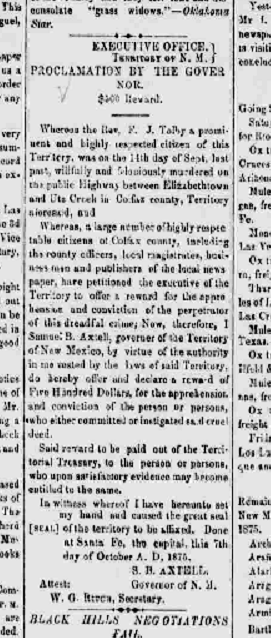
On Thursday, October 7, 1875, three weeks after Reverend Franklin J. Tolby’s body was found shot in the back in Cimarron Canyon, New Mexico’s Territorial Governor Samuel B. Axtell announced a $500 reward for the apprehension and conviction of Tolby’s murderer. The proclamation, published in the Friday, October 8 Las Vegas Gazette, seems to indicate that the Governor felt pressured to offer the reward. “A large number of highly reputable citizens of Colfax County, including the county officers, local magistrates, local business owners, and publishers of the local newspapers” had petitioned the governor to issue the proclamation.
The Governor’s apparent lack of enthusiasm lends supports to a local theory that members of the Santa Fe Ring were behind Tolby’s murder. The Governor was thought to be, at the very least, a tool of the Ring, which included Thomas B. Catron, Colfax County Probate Judge Dr. R. H. Longwill, and others, and would play a role in the Lincoln County War in the late 1870’s.
Whether the reward offer had anything to do with what happened in Colfax County in the following weeks isn’t known. What is known is that local attempts to identify Tolby’s murderer would lead to more deaths, one of them far more violent than a mere shot in the back. Stay tuned . . .
Sources: Las Vegas Gazette, October 8, 1875; David L. Caffey, Chasing the Santa Fe Ring¸ UNM Press, 2014.
Sure enough, there was a beaver in the trap the next morning. But it had lunged for shore, not deeper water, so it was still alive, one hind leg clenched by the trap. It bared its orange incisors and hissed aggressively as the trapper studied it from the bank.
“You were supposed t’drown, damn you,” the man said. He pulled his tomahawk from his belt. The beaver lunged at him. The trapper pulled back sharply and slipped on the muddy bank. One buckskin-covered leg went into the water. The beaver lunged again, growling. The trapper brought the tomahawk’s blunt end down hard on the back of the beaver’s head and it jerked and fell lifeless into the water.
“I gotta eat, too,” the trapper muttered as he hauled trap and animal out of the water. He held it up. “A big one,” he said admiringly. “A thick winter pelt, too.”
The trapper studied the beaver pond carefully. The lodge lay to his left, a four foot high mound of mud and sticks surrounded landward by a thick stand of whip-like coyote willow. Water gurgled over the dam beyond it. Directly across the pond, on a small slick of mud, lay several short thin willow pieces, recently cut, carefully pealed.
The trapper slipped away from the pond and headed upstream, then waded into the icy water and back to the pond. He waded near the bank to within a few feet of the pealed sticks. He unslung the beaver trap from his shoulder and scraped at the bottom muck with his foot. He positioned the trap firmly in the mud, carefully set and baited it with castoreum, then retreated well upstream before climbing out. He headed back to camp to dry out. Now it was just a matter of time.
Alison straightened and put her gloved fists on her hips, pushing her shoulders back. Ten two-hundred foot rows of potato plants stretched before her. She twisted her torso, looking behind her and stretching her muscles at the same time. She had dug up the potatoes from about half a row. Full bushel baskets marked her progress. The yield was good this year, but her back was tired already.
She looked up. There were no clouds at the moment, except for a small gathering over Cimarron Canyon. An east wind was starting up, which meant rain at some point this afternoon or evening. She turned in a slow circle, looking up at the peaks surrounding her high Rocky Mountain valley. Snow dusted the tops of Baldy Mountain to the northeast and Wheeler Peak to the west. She went back to her digging. She didn’t have much time.


 Fiction and Fact From Old New Mexico