Confederates Win in New Mexico!

Confederates Win in New Mexico!

On Friday, February 21, 1862, the Army of the Confederate States of America once again won a battle in New Mexico, their third in a row.

The conflict took place at the Valverde Ford of the Río Grande, and was a decisive victory for the Texan Confederates. Under former Fort Union commander Henry Hopkins Sibley, they moved north, occupying Socorro, Albuquerque, then Santa Fe, en route to their ultimate destination, Colorado’s gold and silver mines. They were on track to replenish the Confederacy’s coffers, then swing west to California and its unblockaded coast.

They never made it. In late March, the Confederates were stopped at Glorieta Pass by Union troops and the scouting skills of New Mexico’s Manuel Antonio Chavez y Garcia de Noriega.

But at Valverde, the Confederates reigned. When Union soldiers attempted to cross the river, the Texans opened fire, killing New Mexico volunteers who were armed with outdated single-shot muskets. The victory was decisive.

Map of the battle at Valverde Ford, courtesy of Matt Bohnhoff.

However, the New Mexicans did capture over 200 of the enemy’s horses and mules. This loss forced the Confederates to discard some of their wagons and supplies. When additional animals and goods were destroyed during the conflict at Glorieta Pass, all hope of reaching Colorado collapsed. The Confederates were forced to turn south for home.

During that retreat, even more supplies would be left behind as the remaining horses and mules died in the harsh conditions. Men perished as well, some of them only half-buried in the rocky soil of New Mexico’s Magdalena Mountains. The Texans would lose a full third of their men to capture or death before they reached home.

Which only goes to show that even a series of initial victories does not guarantee a successful campaign. And that even small losses can lead to catastrophe.

For a fictional telling of the Confederate story in New Mexico, I recommend Jennifer Bohnhoff’s excellent middle-grade Rebels of the Rio Grande novels. The first of the series, which deals with the events at Valverde, is available here. This book, with a map similar to the one above, will be re-released as When Duty Calls this June by Kinkajou Press.

Sources: Jacqueline Dorgan Meketa, Louis Felsenthal, University of New Mexico Press, Albuquerque, 1982; Francois-Marie Patorni, The French in New Mexico, French in America Press, Santa Fe, 2020; Jerry D. Thompson, A Civil War History of the New Mexico Volunteers and Militia, University of New Mexico Press, Albuquerque, 2015.
Pike’s Peakers Arrive At Fort Union!!

Tuesday, March 10, 1862 was a momentous day for New Mexico. That morning, Confederate troops from Texas seized control of Santa Fe. Led by Brigadier General Henry Hopkins Sibley, the Texans had moved steadily north through New Mexico since the previous July, receiving little opposition and clashing with Union forces in only one major battle, which they’d won.

By this time, the Texans must have been feeling pretty confident about making it to Denver and its gold fields. The idea was to seize those resources and use them to restore the Confederacy’s fortunes (literally). Then Sibley and his men would press on to California and the Pacific, opening its ports to Confederate shipping and sidestepping the Union blockades on the Eastern seaboard.

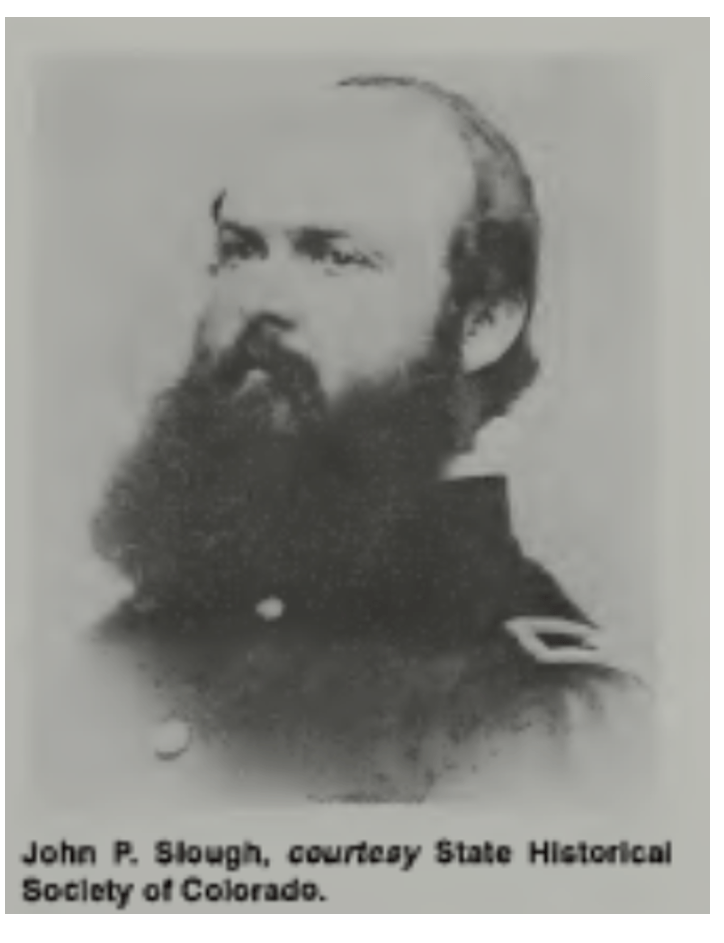
But late on March 10, Colonel John Potts Slough and his 950-man First Regiment of Colorado Volunteers (aka the Pike’s Peakers)  arrived at New Mexico’s Fort Union, more than doubling the number of men available in New Mexico to face down the Confederates.

Slough abruptly assumed command of the Fort. Although the Denver attorney had been in the military for only six months, he’d been a Colonel longer than twenty-seven-year veteran Colonel G.B.  Paul, who was in charge before the Pike’s Peakers arrived. But Slough, ever concerned about his rights and privileges, pulled rank, and Paul conceded his position as Commander, albeit unwillingly. Then Slough got busy outfitting his Pike’s Peakers with clothing, arms, and ammunition from the Fort Union supply depot.

march 10 illustration.john slough

Meanwhile in Santa Fe, Sibley’s Confederates  were also looking to their supplies. Their lines had been stretched thin on the march north and the Union supplies in Santa Fe had either been moved west to Las Vegas with the Governor’s baggage or skillfully hidden.

The Confederates’ stores were dangerously low. Although getting to Santa Fe had been quite an accomplishment, they badly needed Fort Union’s supplies if they were going to make it all the way to Denver.

But on March 10, they didn’t have a lot more time to worry about their situation. In less than two weeks, the thin-skinned and arrogant Slough would begin moving his men south out of Fort Union, then west toward Santa Fe. What would become known as the Battle of Glorieta or, more dramatically, the Gettysburg of the West, was about to begin.

Sources: Howard Bryan, Wildest of the Wild West, Santa Fe: Clear Light Publishing, 1988; Jacqueline D. Meketa, Louis Felsenthal, Citizen-Soldier of Territorial New Mexico, Albuquerque: UNM Press, 1982; David Grant Noble, Pueblos, Villages, Forts & Trails: A guide to New Mexico’s past. Albuquerque: UNM Press, 1994; Leo E. Oliva, Fort Union and the Frontier Army of the Southwest, Santa Fe: Southwest Cultural Resources Center Professional Papers No. 41, Division of History, National Park Service, 1993; Jerry D. Thompson, A Civil War History of the New Mexico Volunteers and Militia¸ Albuquerque: UNM Press, 2015.