Santa Fe Ring Implicated in Reverend Tolby’s Unsolved Murder!!!!

Cruz Vega didn’t go quietly to his death. He told the Cimarron, New Mexico Territory mob who lynched him that they were killing the wrong man. He hadn’t shot Methodist missionary Franklin J. Tolby in Cimarron Canyon on September 14, 1875. Manuel Cardenas had.

Vega’s accusation didn’t save him from death, but it did turn attention to Elizabethtown in the mountains west of Cimarron, where Cardenas lived. When word of Vega’s accusation reached the mining town on Saturday, November 6, 1875, Cardenas turned himself in rather than face a lynch mob of his own. Then he proceeded to tell Etown’s Justice of the Peace what some county residents had suspected from the beginning: Santa Fe Ring members were responsible for Tolby’s murder.

The Santa Fe Ring controlled the Maxwell Land Grant Company and they’d badly wanted to silence  Reverend Tolby. Tolby inveighed regularly against the Company evictions of people they considered squatters as well as the Company’s other efforts to get maximum value from the land they’d purchased from Luz and Lucien Maxwell five years before. According to Tolby, the grant lands were open to homesteading and, if anything, at least part of it should be returned to the Ute and Apache bands who’d used it before the Anglo invasion.

Manuel Cardenas told the Elizabethtown Justice of the Peace that three men associated with the Santa Fe Ring—mail contractor Florencio Donoghue, County probate judge Dr. Robert Longwill, and Attorney Melvin W. Mills—had offered him $500 to kill Tolby. However, according to Cardenas, he turned the job down and the trio hired the now-dead Cruz Vega to shoot Tolby instead.

Cardenas’ charges resulted in a flurry of activity. Robert Longwill fled to Santa Fe pursued by a posse led by anti-Grant Company gunman Clay Allison. Since Allison had bested Santa Fe Ring enforcer Juan Francisco “Pancho” Griego in a shootout at Henri Lambert’s Cimarron saloon earlier that week,  Longwill was wise to take him seriously.
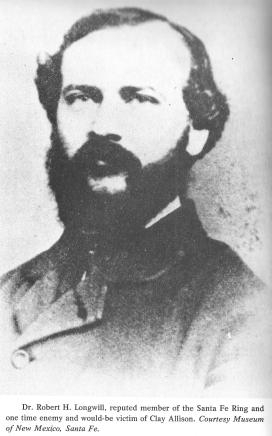
Nov 6 illustration.robert longwill.parsons book
Source: Clay Allison, Portrait of a Shootist, Chuck Parsons

Melvin Mills was made of sterner stuff. He’d been in Colorado when the charges were made and  he returned to Cimarron, indignantly insisting on his innocence. Mills must have arrived back in town around the same time the cavalry detachment from Fort Union showed up on Monday, November 8.  The horse soldiers had been dispatched to Cimarron to maintain civil order, sent out at the request of Territorial Governor Samuel Axtell, who just happened to also be a member of the Santa Fe Ring.

With Longwill safely in Santa Fe, Cardenas and Donaghue in jail, and Mills released for lack of evidence, it seemed reasonable to assume that things had quieted down and would remain so. A hearing date to address Cardenas’ evidence was set for Wednesday, Nov. 10. But there was going to be a least one more death before it was all over. Can you guess who? . . . . Stay tuned.


Nov 6 illustration.robert longwill.parsons bookSources:  David L. Caffey, Chasing the Santa Fe Ring, UNM Press, 2014; Chuck Parsons, Clay Allison, portrait of a shootist, Pioneer Book Publishers, 1983
Clay Allison Kills Pancho Griego in Lambert’s Saloon!!!

Monday, November 1, 1875 in Cimarron, New Mexico should have been a quiet day after an eventful weekend. Cruz Vega, the man thought to have murdered Methodist missionary Reverend Franklin J. Tolby in September, was dead and buried. Now the County could get back to ranching and mining. But Vega’s confession at his Saturday, October 30  lynching had not put the matter to rest.

Vega confessed merely to being involved in the plot to kill Reverend Tolby. He said Manuel Cardenas was the actual shooter. So there was still that to deal with.

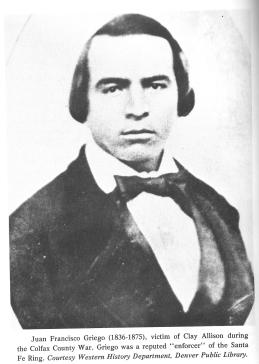
Then there was the matter of how Vega had died. Following the telegraph-pole lynching that produced his accusation against Cardenas, Vega was shot and killed. When his battered body was found the next day, his friends and relatives were upset, to say the least. Their thoughts turned almost immediately to revenge. In fact, before the funeral was over, Civil War veteran Juan Francisco “Pancho” Griego vowed vengeance on the men who’d tortured and killed his friend.

There’s no concrete evidence that gunslinger R. Clay Allison was part of the Vega lynch mob, but the fact that Griego confronted him about it implies that Allison either participated in the lynching or was concerned for the welfare of those who had.

At any rate, Griego and Allison met late Monday, November 1 at Henri Lambert’s saloon in Cimarron (today’s St. James Hotel) and Griego didn’t make it out alive. According to Lambert, who’d been born in France, “Pancho try to pull the pistol. Mr. Allison smarter.” When Pancho fell, Lambert ordered everybody out and closed up shop. It was a smart thing to do. Allison and his friends spent the night “hoorahing” the town and probably would have caused more damage to Lambert’s place besides the blood-stained saloon floor if he hadn’t closed down when he did.

But Tolby’s killer still needed to be dealt with and there were still strong suspicions that the Santa Fe Ring was somehow behind it all. Certainly, the bloodshed hadn’t ended. There would be more in the coming days. Stay tuned . . . .


Nov 1 illustration.pancho griego.parsons book
Source: Clay Allison, Portrait of a Shootist, Chuck Parsons

Sources: Las Vegas Gazette, November 14, 1875. Chuck Parsons, Clay Allison, Portrait of a Shootist, Pioneer Book Publishers, 1983.

TOO SILENT

The boy sits silently near the creek bank and watches his twelve week old puppy among the grasses, sniffing invisible trails. The boy has learned from long practice to sit motionless for long stretches of time. Being still has enabled him to see much that other humans, especially adults, will never discover–coyote puppies learning to hunt, damsel fly nymphs emerging from their chrysalis, the way a brook eddies at times against the wind.

The dog may never see these things either, the boy reflects complacently as he watches his new pet. Not until he is much older and has learned to be still.

In the warm mountain sun, the boy’s shoulders relax and his eyes begin to glaze over. He is not prepared for the sudden movement from above. The golden eagle’s outstretched wings shadow the boy and dog at the same moment, then the pup gives a high-pitched yelp and is gone, the boy too startled to cry out.

When he stumbles home with tear-streaked face, his mother folds him wordlessly into her arms. “I sat too still,” he moans into her chest. “I was too silent!”


Copyright © 2016 Loretta Miles Tollefson


189 words


Death by Investigation

On the night of Saturday, October 30, 1875 New Mexico Territory rancher William Low joined Mexican-born Cruz Vega beside a campfire about a mile and a half north of Cimarron. Low had hired Vega to watch his cornfields that Halloween weekend. But when a group of masked men led by Methodist missionary Oscar P. McMains showed up that night, Low wasn’t surprised. Reverend McMains had asked him to hire Vega to watch that particular cornfield. He wanted him within easy reach of the Poñil River stage road and the telegraph line that ran it.

McMains and his men had a sinister use for those telegraph poles. They suspected Vega of murdering McMain’s fellow missionary, the Reverend Franklin J. Tolby the month before, and they intended to extract a confession from him.

Oct 30 illustration
Las Vegas Gazette, Nov. 14, 1875

According to William Low, “One of them says, halloo boys, and he walked up toward Cruz with a lariat and put it around his neck, and says, come on, and they took him into the road and we along with him. We went up I judge about 500 yards among the timber, along the telegraph line: there was a party of men. It was pretty dark. These four or five men took him to a telegraph pole of their own accord: none of the parties said a word . . . One of the four or five men climbed the telegraph pole and put the rope over the wire and they raised him up, on their own accord, and after a few seconds let him down again.” After Vega recovered enough to talk, McMains interrogated him.

This process was repeated until McMains got all the information he was looking for. Then the Reverend returned to the Poñil River ranch where he and Low were staying the night and left Vega to the mercy of the now-drunken mob. McMains said later that he thought they were too drunk to do Vega any real damage. But shortly after McMains reached the ranch house, he and Low heard gunshots. “My God!” McMains exclaimed. “I fear these are the shots that kill Cruz Vega.”

And he was right. Vega’s body was found the next morning near the base of the telegraph pole. A clump of hair from his bashed-in head lay nearby and rope burns circled his neck.

Ironically, the information McMains gathered that night acquitted Vega of Tolby’s murder. Although Vega admitted that he’d witnessed the killing, he identified Manual Cardenas of Elizabethtown as the shooter. So the murderer was still at large. The saga of Reverend Tolby’s murder wasn’t quite over, and more deaths would ensue before it was. . . . Stay tuned.

Sources: Las Vegas Gazette, Nov. 14, 1875. Las Vegas Gazette, August 25, 1877.


THE TIRED DOG

The red-bearded man in the tattered coat and a dirty blue bandana for a hat squatted in the middle of the adobe casita’s single room and scooped the thick stew into his mouth with his fingers, grunting with pleasure. The woman placed a small wooden plate piled high with tortillas beside him. The man sucked his fingers clean, then grabbed a tortilla and used it to shovel more food into his mouth.

The two children perched on the adobe banco in the corner stared silently at the strange americano until their mother motioned at them to go outside. She replenished the man’s stew, then followed them.

“Come como perro amarrado. He eats like a tired dog,” the girl said. She wrinkled her nose. “So rapidly and with no manners.”

Her mother turned from the wood pile, her arms full. “He is our guest,” she said reprovingly. “Come, bring more wood for the fire.”

When they reentered the house, the man had finished his meal.

“More?” the woman asked.

He shook his head. “No, but I thankee. That’s the first meal I’ve et in three days.” He cocked an eyebrow at her. “I’m lookin’ for the wife of Juan Leyba, the one that went to Elizabethtown two years ago t’ find work.”

The woman went still, her lips stiff with fear. She licked them nervously. “I am the wife of Juan Leyba, the one who went to that Elizabethtown to labor in the mines there.” She swallowed hard. “He is well?”

“Oh yes, ma’am!” the americano said. “I’m sorry to frighten you ma’am.” He pulled a small leather bag from a pocket and held it out. “This here’s from him. There’s about two ounces o’ gold in it. He says t’ use it t’ buy that land you wanted, or come to him, whichever seems best t’ you.” As she reached for the bag, he looked at the children and grinned. He shoved his hand into another pocket. “An’ he sent these fer the young uns. Gotta little linty in my pocket, but I think they’re all right.” His fingers opened, revealing a collection of hard candies, enough to keep a careful man going for at least a day and a half.

Copyright © Loretta Miles Tollefson 2017


Reverend McMains Hunts Franklin Tolby’s Killer

In Fall 1875, when Rev. Oscar P. McMains took over for the murdered Rev. Franklin J. Tolby, he provided more than ministerial services. He also played detective, and went to work hunting for Tolby’s killer. Colfax County’s collective finger pointed at Cruz Vega, a Civil War veteran who’d run the mail right past the spot in Cimarron Canyon where Tolby had died September 14th. But Vega hadn’t reported seeing Tolby’s body, which many locals deemed mighty suspicious.

Rev. McMains wanted badly to talk with Vega, but he was having trouble locating him. When he did find him, he was going to have another problem: McMains didn’t speak Spanish, the Mexican-born Vega’s native (and apparently only) language.

10 22 17 illustration.Oscar P. McMains
Source: NM Conference United Methodist History Journal, Nov. 2011

McMains first attempted to locate Vega through Isaiah Rinehart, the rancher that Territorial Governor Samuel Axtell would appoint Colfax County Sheriff the following spring. While Rinehart believed that Vega knew something about Tolby’s death, he declined to get involved: a logical stance for someone who wanted to stay in good standing with the Santa Fe Ring-enmeshed Governor. After all, the Ring was suspected of ordering Reverend Tolby’s execution.

But Reverend McMains was not a man to bow to the mighty or those connected to them, and he didn’t give up. Sometime in the period between October 21 and October 26, he convinced local miner and rancher William Lowe to help him “find” Cruz Vega in Lowe’s Ponil Creek cornfields north of Cimarron. Lowe agreed to hire Vega to watch his fields over the Halloween weekend and McMains arranged to be there with a translator on Saturday, October 30. What happened that night was a story worthy of Halloween. Stay tuned. . .

Sources: David L. Caffey, Chasing the Santa Fe Ring, UNM Press, 2014; Las Vegas Gazette, August 25, 1877; Chuck Parsons, Clay Allison, Portrait of a Shootist, Pioneer Book Publishers, 1983. Will Steinsiek, “O.P. McMains, The Agitator” in New Mexico Conference United Methodist History Journal, Nov. 2011.

FOR SAFETY’S SAKE

As Suzanna rounded the cabin from the garden, she saw Gerald in the yard loading his pistol. Both of the children stood beside him, watching intently.

“What are you doing?” Suzanna asked.

“We’re learning to shoot!” Andrew said gleefully.

Suzanna frowned. “We?” she asked. She looked at Gerald. “Andrew’s one thing, but Alma doesn’t need–”

“But I’m the oldest,” Alma said.

“She’s unfeminine enough,” Suzanna said to Gerald. “Always out fishing when she should be inside with her needlework.”

A smile flitted across his face. “Out here, everyone should know how to shoot,” he said mildly. “For safety’s sake.”

“More reason to move someplace civilized.” She turned and stalked toward the house.

“Can I load it, Papa?” Alma asked.

“Me, too!” Andrew said.

Gerald crouched down to show them again how it was done.

from Moreno Valley Sketches II


THE LOST SOUL

As Jorgé Ruibal wandered up the middle of the road toward Elizabethtown proper, the men outside the taberna watched him sympathetically. “El joven es como alma en pena,” Carlos Otero the jeweler said. “The young man is like a lost soul.”

“Si,” said the boy’s uncle. “He has lost his laborer job with Señor Bergmann. His papá is very angry with him.”

“I heard he was in love and that his love was unrequited,” Eduardo Suaso, the taberna’s musician, said.

María de la Luz, the boy’s cousin, appeared from around the corner of the building. She carried a basket of clean linens for delivery to Henri Lambert’s Etown restaurant and hotel. She gazed at Jorgé, who’d stopped to poke his foot at a stone in the road. “He wants to leave here, but his mamá is unwilling,” she said.

Jorgé, oblivious to these speculations, still stood in the dusty street, poking at the stone with his boot. It was so inert and yet so full of a kind of compressed energy. He looked east, toward the massive bulk of Baldy Mountain. The gullies that swung out from its sides were full of rocks and men scrambling through them looking for gold. Yet the mountain bulked there impassively, impervious to the miners who crawled over it. Jorgé crammed his hands in his pockets and stared upward, drinking in its stony greenness, its lack of engagement with the tiny men poking at its skin.

Outside the taberna, the americano miner called Hobart Mitchell came to the door with a drink in his hand and considered the staring boy. “He looks like’n idiot, standin’ there,” Mitchell said. “Touched in the head.”

The others all nodded noncommittally and continued to gaze sympathetically after Jorgé as he wandered on up the road.

 2017  © Loretta Miles Tollefson

Governor Offers Reward for Reverend Tolby’s Killer

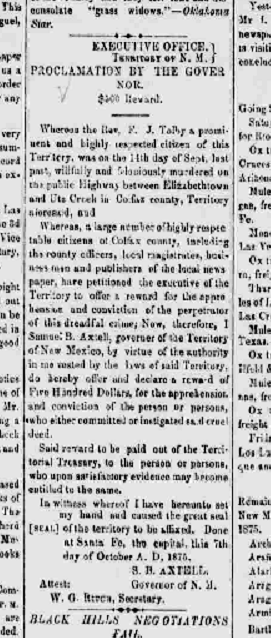
On Thursday, October 7, 1875, three weeks after Reverend Franklin J. Tolby’s body was found shot in the back in Cimarron Canyon, New Mexico’s Territorial Governor Samuel B. Axtell announced a $500 reward for the apprehension and conviction of Tolby’s murderer. The proclamation, published in the Friday, October 8 Las Vegas Gazette, seems to indicate that the Governor felt pressured to offer the reward. “A large number of highly reputable citizens of Colfax County, including the county officers, local magistrates, local business owners, and publishers of the local newspapers” had petitioned the governor to issue the proclamation.

Las Vegas Gazette.10 8 1875.Tolby.clipped

The Governor’s apparent lack of enthusiasm lends supports to a local theory that members of the Santa Fe Ring were behind Tolby’s murder. The Governor was thought to be, at the very least, a tool of the Ring, which included Thomas B. Catron, Colfax County Probate Judge Dr. R. H. Longwill, and others, and would play a role in the Lincoln County War in the late 1870’s.

Whether the reward offer had anything to do with what happened in Colfax County in the following weeks isn’t known. What is known is that local attempts to identify Tolby’s murderer would lead to more deaths, one of them far more violent than a mere shot in the back. Stay tuned . . .

Sources: Las Vegas Gazette, October 8, 1875; David L. Caffey, Chasing the Santa Fe Ring¸ UNM Press, 2014.

THE TRAPPER, 2 of 2

Sure enough, there was a beaver in the trap the next morning. But it had lunged for shore, not deeper water, so it was still alive, one hind leg clenched by the trap. It bared its orange incisors and hissed aggressively as the trapper studied it from the bank.

“You were supposed t’drown, damn you,” the man said. He pulled his tomahawk from his belt. The beaver lunged at him. The trapper pulled back sharply and slipped on the muddy bank. One buckskin-covered leg went into the water. The beaver lunged again, growling. The trapper brought the tomahawk’s blunt end down hard on the back of the beaver’s head and it jerked and fell lifeless into the water.

“I gotta eat, too,” the trapper muttered as he hauled trap and animal out of the water. He held it up. “A big one,” he said admiringly. “A thick winter pelt, too.”

from Moreno Valley Sketches