Two American Governors for New Mexico

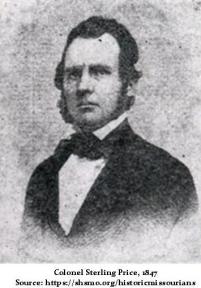
On Tuesday, Sept. 22, 1846, just over a month after Brigadier General Stephen Watts Kearny seized New Mexico for the United States, he appointed Virginia-born Taos businessman Charles Bent as New Mexico’s first American civil governor. When Kearny and the majority of his 1700-man force headed on to California to participate in acquiring it as well, Colonel Sterling Price, as senior U.S. Army officer in New Mexico, became its military governor.

Sept 22 illustration.Bent

Bent had been in Nuevomexico since 1829, first as a fur trapper, then as a Santa Fe trail trader based in Taos. He occupied his post as Governor less than four months. In mid-January 1847, he died at the hands of a New Mexican mob protesting the American occupation.

Two-and-a-half weeks later, Colonel Price, supported heavily by American businessmen and trappers in New Mexico, crushed that rebellion and assured that New Mexico would remain part of the United States.

Sept 22 illustration.Price

Ironically, Price’s own career would include participation in an even larger rebellion against the nation he had helped to force on New Mexico. Following a term as Governor of Missouri, he joined the Confederate Army, rising to the level of General. He died on September 29, 1867, almost exactly 21 years after he took over as military governor of New Mexico.

Sources: Leroy R. Hafen, Ed., Fur Trappers and Traders of the Far Southwest,  Logan: Utah State UP, 1977; Marc Simmons, New Mexico, an interpretive history, Albuquerque, UNM Press, 1988

CALLING THE JURY

Judge Palen flattened his palms against the rough wooden table that served as the Court bench and scowled at Sheriff Calhoun. “Are you telling me that you called twenty-one men for jury duty and only seven showed up?”

Calhoun was a big man, but he fingered the broad-brimmed hat in his hands like a schoolboy. “Yes, sir.”

“Well, go get fourteen more.”

The Sheriff nodded, turned, and crossed the creaking wooden floor.

Palen turned his attention to his seven potential jury members. “All right,” he said. “Now how many of you are going to have good excuses for not fulfilling your civic duty?”

Three of them sheepishly raised their hands. Palen nodded to his court clerk to begin taking their excuses and closed his eyes. And he’d thought this appointment as Chief Justice of New Mexico Territory and Judge of its First Judicial District was a logical step up from postmaster of Hudson, New York. He suppressed a sigh. How he missed the broad sweep of the river, the bustle of the town’s port. He grimaced and opened his eyes. Only four jurymen left. Damn this town, anyway. The whole of New Mexico Territory, for that matter.

 from Valley of the Eagles

Fire Destroys Etown!!

On Tuesday, September 1, 1903, a fire that lasted a little over an hour destroyed almost all of Elizabethtown, New Mexico’s business district and began the demise of the 36-year-old municipality.

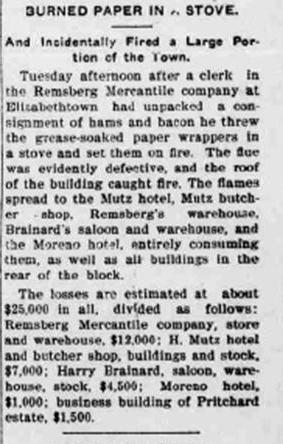
The blaze began around 2:15 p.m. in a defective stove flue at Remsberg & Co. Mercantile. By three o’clock, nothing was left of the store except $300 in merchandise and the company’s books and cash on hand.

Sept 3 illustration.SF NM 9 4 1903
Santa Fe New Mexican, Sept. 4, 1903

In the meantime, the flames had spread to the Mutz Hotel next door. From there, Harry Brainard’s saloon and warehouse caught fire, then the general store next to Brainard’s. Flying embers ignited the Moreno Hotel and it was also destroyed.

By 3:30 p.m., almost all of Etown’s mercantile district had been reduced to ashes. The only store left standing was Herman Froelick’s.

Although the Mutz Hotel would be rebuilt in stone, the conflagration was the beginning of the end for Etown. Over the next two years, miners, store owners, the local schoolteacher, and even Elizabethtowns’ favorite vegetable wagon man would flee town for other locales. Some of the remaining buildings would eventually be dismantled and then reassembled in what is now the Village of Eagle Nest, three miles to the south.

It’s a little amazing what a single fire can do.

Sources: The Elizabethtown New Mexico Story, F. Stanley, Dumas, Texas, 1961; September 4, 1903, Santa Fe New Mexican

RATTLED

“I don’ keer if you don’ believe me,” the old trapper said as he pushed his matted brown hair away from his eyes. He shifted the Harpers Ferry 1803 rifle impatiently. “If’n yer too smart for yer own good, it ain’t none o’ my doin’.” He stroked the maple half-stock with its short barrel, looked balefully at the younger man, and turned to place the rifle next to his pack. The metal rib brazed to the underside of the barrel glinted in the firelight. “Thinks he’s smarter’n the rest o’ us,” the trapper muttered to the wagon master, who was sitting on his heels on the other side of the fire, smoking a carved cottonwood pipe.

“I didn’t say that I disbelieved you,” the young man in the black broadcloth coat said evenly. He brushed a piece of ash from his sleeve. “I simply stated that I was unaware of any unique characteristic of the 1803 issued to Lewis and Clark’s Corps of Discovery, other than the half-stock and its excellent balance.” He shrugged a shoulder. “My father was issued an 1803 during the 1812 conflict. He recollected it quite fondly and frequently. However, he never mentioned an unusually short barrel.”

“Jest cuz yer Daddy didn’ say it, don’ mean it weren’ so,” the old trapper grumbled.

“That may be the case,” the young man said stiffly. “I was unaware that I was contradicting you. I understood that we were merely exchanging some particularly intriguing information.”

“Ten dollar words.” The old man rubbed his matted hair, unfolded himself upward without looking at the others, and stalked off into the night.

The young man in the black coat looked across the firelight at the wagon master. “I didn’t intend to offend him,” he said uneasily.

The wagon master took his pipe from his mouth. “Oh, I wouldn’t worry ’bout it,” he said. “Ol’ Matt gets himself worked up like that sometimes. But he’s like a garden snake, all fizz an’ no real fury.” He glanced into the darkness. “But don’t say I said so. Not where he can hear. He wants ya t’ think he’s a rattler.”

Copyright © 2016 Loretta Miles Tollefson

Uncle Dick Wootton Dies in Colorado

On Tuesday, August 22, 1893, Richens Lacy “Uncle Dick” Wootton died in southern Colorado at the age of 77. Mountain man, trader, road builder, and a few other things besides, Wootton packed a lot of living into those 77 years.

The Virginia-born Wootton was about 7 when his family move to Kentucky. In his late teens. He moved to an uncle’s Mississippi cotton plantation, but at age 20 struck out for Independence, Missouri and got a job on a wagon train bound for Santa Fe.

In the next 57 years, Wootton would trade with the Ute and Sioux; trap with Ceran St. Vrain, Christopher “Kit” Carson, and Old Bill Williams; scout for the U.S. Army; operate a trading post in early Denver; and drive sheep from New Mexico to California, to name just a few of his adventures. However, Wootton is perhaps best remembered for two events: His decision not to guide John Fremont through the Rockies in the fateful winter of 1848/49 and the toll road he operated through Raton Pass between 1865 and 1878.

Wootton signed on in early November 1848 to guide Fremont’s fourth expedition in search of a winter railroad route across the Rocky Mountains. But by the middle of the month, it was clear that the coming winter was going to be unusually cold and Wootton warned Fremont not to even attempt to cross the Rockies. When Fremont refused to listen to his advice, Wootton resigned. Old Bill Williams took over in his stead and the party entered the Rockies under his guidance, but Fremont wouldn’t listen to him either. Only 21 of Fremont’s original 32 men made it out alive and two of them, including Williams, would die a couple months later, trying to retrieve records and equipment that had been left behind in the mad rush to escape the snow-bound mountains.
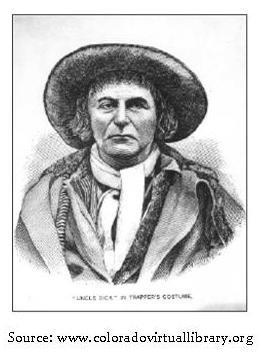
Aug 22 illustration

But Wootton lived to have yet further adventures. His toll road through Raton Pass was another inspired decision. He and a partner built 27 miles of roads and bridges along this mountainous stretch of the Santa Fe Trail and important connection between New Mexico and Colorado Territories. They charged $1.50 for wagons and 25 cents for anyone on horseback. Herded livestock cost 5 cents a head, while Indians were allowed free passage.

The road grossed an average of $600 a month and remained operational until 1878, when the Atchison, Topeka and Santa Fe Railway Company track reached the Pass from Trinidad, Colorado. Then the AT&SF bought Wootton’s toll rights in exchange for $50 a month compensation for the remainder of his life and that of his fourth wife, Maria Paulina, who was some 40 years his junior.

When “Uncle Dick” Wootton died in August 1893, he’d lived a full and adventurous life. For more detailed information about this unique mountain man from an author with access to family material, see No Time to Quit: Pioneer America Seen through the Life of Rocky Mountain Man Uncle Dick Wootton.

.Source: Leroy R. Hafen, ed. Fur Trappers And Traders Of The Far Southwest, Utah State University press, Logan. 1997;

MORENO VALLEY TRADE FAIR, 2 of 2

A short, barrel-chested Indian man stood at the edge of the encampment with his arms folded and a frown on his face, watching the man and packhorse moving slowly up the valley toward him. When the trader was close enough to speak, the man moved into the path and raised a hand.

The traveler looked at him quizzically. “You talk English?” he asked.

“You come to trade?”

“I hope to,” the traveler said. “If you all have something to trade with.”

“If your terms are fair.” His gaze moved to the horse’s laden packsaddle. “You sell whisky?”

The traveler shook his head. “‘Fraid not.”

The other man stepped to the side of the path and gestured toward the camp behind him. “Then you are welcome.”

The trader moved forward but the Indian put up a hand to stop him. “If you are found with whisky, it will not go well for you,” he said flatly.

“Yes sir,” the trader said, and the glimmer of a smile crossed the two faces simultaneously.

Copyright © 2016 Loretta Miles Tollefson

Fateful Trapping Party Is Last Of Its Kind

In August 1827, trapper Sylvester S. Pratte led 36 men north from Abiquiu on the last large-scale trapping expedition out of New Mexico. It would also be Pratte’s last expedition: he would die on it.

Pratte’s death at 28 from an infected dog bite was not the only disaster that befell the group of trappers. A week and a half later, Indians attacked. During the fight, Thomas L. Smith was hit by an arrow which shattered the bones a few inches above his ankle. Smith dealt with the issue immediately, slicing through the mangled tendons with his own hands. Fellow trapper Milton Sublette helped him finish the job by applying a tourniquet of buckskin thongs and covering the wound with an old dirty shirt. Amazingly, although the wound was never cauterized, it did eventually heal.

Aug 8 illustration.Pixabay
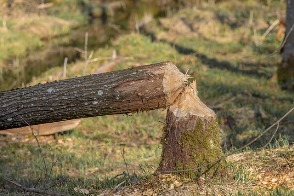
The sure sign of beaver in the vicinity. Source: Pixabay

Pratte had asked his boyhood friend Ceran St. Vrain to act as the expedition’s clerk. After Pratte’s death, the men requested St. Vrain to take his place as its leader. However, this also turned out to be problematic, not on the hunt itself, but when they returned. The venture ended up losing money. Even after Pratte’s personal belongings were sold off to cover expenses, there was still a deficit of over $500.

All in all, this final large-scale trapping expedition out of New Mexico was a disaster on a good many levels, and the negative aspects may have been why the experiment was never repeated.


Sources: Leroy R. Hafen, ed. Fur Trappers And Traders Of The Far Southwest, Utah State University press, Logan. 1997; David J Weber, The Taos Trappers, University of Oklahoma press, Norman. 1971.
 

MORENO VALLEY TRADE FAIR, 1 of 2

It’s a mere mule track, the man thought, eying the rocky ground on the hillside ahead. A fine silt hovered in the air behind him, marking the path he and the packhorse had followed from Rayado and the Santa Fe Trail at the base of the mountains.

They’d been climbing steadily and the vinegar-scented blue-green junipers had given way to taller, straighter, deeper-green trees: fir and pine. The man looked at them appreciatively, glad it was June and not mid-winter, when the snow that provided these trees with the moisture to live would have made the trail difficult.

He clucked at the packhorse and headed up the rocky slope. At Rayado yesterday, Jesús Abreu had told him there’d be a series of small mountain valleys before he reached the larger one. Then he was to move north, to where the Cimarron River began in a marsh on the east side of the Valley. The Indians met there to trade. The traveler shook his head. It was a long way to go on the chance that they’d be there—and able to pay for the goods he had with him. He hoped this worked.

Copyright © 2016 Loretta Miles Tollefson

No Rain In Taos

On Sunday, July 31, 1825, Taos-based physician Rowland Willard had been in Taos since July 2 and the village had received no rain in the past month. The doctor was disappointed.

The New York born Willard had apparently expected to find not only rain but a prosperous community that could afford American fees and make him rich. He was destined to be disappointed on both counts.

July 31 illustration
Source: Over the Santa Fe Trail to Mexico, Julie L. Poole, ed.

Although Doctor Willard had a number of clients in Taos and as far south as Santa Cruz de la Canada, payment for services in the 1820s tended to be in goods rather than in cash. By September, it was clear that Taos was not the land of opportunity he had sought. On September 15, he headed south, to try his luck in Chihuahua.

The move paid off. Willard developed a successful practice in Chihuahua and remained there for the next two years, where he invested in the Santa Rita copper mines as well as his medical practice.

In 1828 Willard decided to return to the United States. To be eligible to leave the country, Mexican law required a 2% duty payment. The good Doctor paid $80 on the $4000 he declared, but actually left Mexico with $7000 in cash and his “outfit.”

Clearly, trappers were not the only Americans who believed they didn’t need to comply with Mexico’s duty laws.

Source: Julie L. Poole ed., Over The Santa Fe Trail To Mexico, The Travel Diaries And Autobiography Of Dr. Rowland Willard, University of Oklahoma Press, Norman 2015

A MAN’S DREAM, 2 of 2

“It’s June now,” Suzanna said. “These are the Sangre de Christo mountains. It’ll be cold up here, come winter.”

“Come January,” Gerald conceded. “Though snow will make for green summer cattle pastures.”

“Grass will bring game and cougars. Cougars prefer cattle to game.”

“No more than anywhere else.”

“And the Utes will want to know why we’re in their hunting grounds.”

“There’s enough for everyone.” He gestured. “And plenty of trees. You won’t have to live in adobe anymore. Besides, Taos is only a day or so away.”

“Taos is two days through a Pass that’s impassable in winter.”

Gerald studied the valley at their feet. “At the foot of this hill and a little north,” he decided. “A cabin between those two outcroppings would be well sheltered. And your garden won’t get too windblown.”

Clearly, there was no use arguing. Suzanna’s mouth tightened. “I want glass windows,” she said.

from Moreno Valley Sketches