On Tuesday, May 5, 1903, a crowd of 15,000 people met President Theodore Roosevelt in Albuquerque during his stop there as part of a 66-day train tour of the American West.
It wasn’t the President’s first visit to New Mexico Territory. He’d been in Las Vegas four years earlier, attending the first annual reunion of his Rough Riders. This was an important moment for Roosevelt and for the Territory. He announced his candidacy for U.S. President and also promised to work for New Mexico statehood.
At the May 1903 event, New Mexicans took the opportunity to remind Roosevelt of his promise. When his mid-afternoon train arrived at the Albuquerque Depot and recently opened Alvarado Hotel, New Mexico’s Territorial Delegate began the festivities with a speech that emphasized the Territory’s eagerness for statehood.
To further enhance his point, the dignitaries’’ platform faced a tableau of 45 young girls carrying banners that represented each of the current states and another child with her hands extended, appealing for admission to the Union. But Roosevelt didn’t let himself be tempted into making promises. His speech and ensuing remarks at a private reception in Albuquerque’s Commercial Club contained only platitudes and generalities.
However, in the end, the President did come through for New Mexico. As best he could, anyway. His December 1905 message to Congress included an endorsement of New Mexico statehood. Unfortunately, he recommended merging it and Arizona into a single unit, a proposal that Arizona shot down at the November 1906 polls, although New Mexico voted for it.
Roosevelt made further attempts to fulfill his promise, but none of them resulted in New Mexico statehood. It would be another seven years before the Territory would become a full member of the Union, in a deal crafted by Roosevelt’s successor, President William Howard Taft.
Despite Roosevelt’s inability to accomplish statehood, May 1903 wasn’t the last time New Mexico would get a glimpse of him. He returned to Albuquerque in Fall 1916, campaigning for Republican presidential nominee Charles Evans Hughes. A short film of his appearance can be found at www.loc.gov/item/mp76000168.
Sources: Albuquerque Historical Society, http://www.albuqhistsoc.org; Howard Bryan, Wildest of the Wild West, Santa Fe: Clear Light Publishing, 1988; David V. Holtby, Forty-Seventh Star, Norman: University of Oklahoma Press, 2012.
On Monday, April 18, 1887, the U.S. Supreme Court finally confirmed the Maxwell Land Grant and Railway Company’s right to almost two million acres in northeast New Mexico.
The controversy over the grant’s size had been going on since the early 1870s. A survey when the Company bought the grant identified around 2 million acres, land that that included much of what is now New Mexico’s Colfax County and stretched north into Colorado.
But there was a problem. Not everyone agreed that the grant was that large. In fact, U.S. General Land Office surveys insisted that grants issued by Mexico were limited to only 22 square leagues—a far cry from the 2 million acres claimed. Based on this judgment, the Land Office declared much of the acreage open to settlement. When its agents began issuing deeds to eager homesteaders and ranchers, trouble ensued. But the Maxwell Grant Company intended that land for its own uses and this was the American West—might made right. People died.
Map of final Maxwell Land Grant and Railway Company boundaries
At the same time it was using guns and intimidation to keep people off its wide-open spaces, the Company also sought legal recourse. It turned to Washington with a request for an official government survey of the grant based on the geographical descriptions in the original 1840s documents. The request was refused.
Then in 1876, the U.S. Supreme Court allowed another New Mexico land grant to encompass more than 22 square leagues. The Maxwell Land Grant and Railway Company swung into action. Three weeks after the decision, the Maxwell grant was being resurveyed. It took another eleven years, four days of oral argument, and 900 pages of testimony, but the Company finally got its land.
With that ruling, the Colfax County War, which had begun in earnest in September 1875, finally wound down, making it a longer feud than New Mexico’s more famous Lincoln County War, which had lasted a mere three years (1878-1881).
And proving that if you hang in there long enough—and have enough money—you might just get what you want, after all.
Sources: Howard R. Lamar, Reader’s Encyclopedia of the American West, New York: Harper & Row, 1977; Lawrence R. Murphy, Philmont: A history of New Mexico’s Cimarron Country, Albuquerque: University of New Mexico Press, 1972; Stephen Zimmer, For Good or Bad, The People of the Cimarron Country, Santa Fe: Sunstone Press, 1999; Maria E. Montoya, “Maxwell Land Grant”, Encyclopedia of the Great Plains, plainshumanities.unl.edu/encyclopedia/doc/egp.ha.026, accessed 1/20/22.
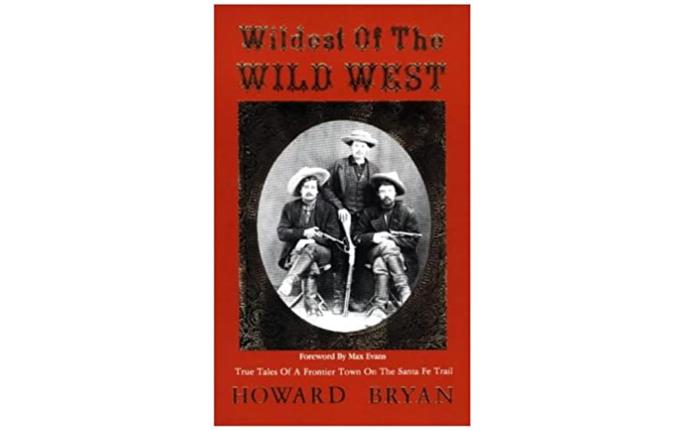
Howard Bryan’s Wildest of the Wild Westis one of the first books I read when I began to explore the possibility of turning pieces of New Mexico’s history into fiction. While Bryan’s book about the town of Las Vegas is nonfiction, it reads like a story. Certainly, some of the events he retells could be lifted straight from a traditional Western novel.
We find an Italian hermit living in a cave above the Spanish-speaking town and revered as a holy man and miracle worker, Jesse James and Billy the Kid soaking in the nearby hot springs, Doc Holliday opening his final dental practice only to abandon it for a saloon and gambling hall, and Hoodoo Brown, formal justice of the peace and informal protection racketeer. Then there’s the actress/singer/poet/faro dealer known as Monte Verde who was actually the famous Confederate spy Belle Siddons. And the enigmatic “Mysterious Dave” Mather, who seems to have robbed a train while serving as Las Vegas Town Marshal.
The stories of these various characters is woven into a coherent narrative of Las Vegas’s history which Bryan tells with humor and verve. If you like nonfiction that reads like a novel, I highly recommend Wildest of the Wild West.
In early April 1835, Mexican Army Colonel Albino Pérez left Chihuahua for his new post as Governor of New Mexico. He arrived in Santa Fe with 1000 pesos “for the needs of that office,” and a strong reputation as a military man. A “man of fine presence … privileged and well-to-do,” Pérez began his administration with a brisk efficiency that boded well.
However, once New Mexicans got a closer look at the governor, they were less impressed. The funds he brought were depleted fairly quickly. Also, Pérez seemed to think his 3,000-peso-a-year salary was insufficient, even though it was high for New Mexico.He borrowed large gilded mirrors from former governor Francisco Sarracino, a chest of drawers from Justice Santiago Abréu, and a large table clock from Judge Juan Estevan Pino. And local transport options weren’t good enough for him. He ordered an American-made two-wheeled carriage and two horses worth 800 pesos from Santa Fe trader Jesse Sutton.
The new governor also lived an immoral life. Although he was believed to have a wife in Mexico City, he became involved in a relationship with his housekeeper, Trinidad Trujillo, and fathered her child.
New Mexicans might have merely muttered at all this and gone on with their lives, but Federal politics began to exacerbate already-negative feelings.
On October 3, 1835, a decree by President Santa Anna’s centralist Congress abolished Mexico’s State and Territorial legislatures and replaced them with five-member Councils with no decision-making powers. Instead, they were subordinate to the president-appointed—and therefore controlled—governor. This gave Governor Pérez much more authority than he’d had when he arrived.
In addition, and perhaps more importantly, New Mexico’s tax exemption was about to run out. There was no assurance it would be renewed. New Federal decrees made the governor responsible for supervising collections, a potentially lucrative job. He didn’t have much incentive to ask for a continued exemption.
Rumors swirled. The governor was about to impose exorbitant tariffs. Thing never taxed before—like water, wood, and pasture—would be now. It was even whispered that men would be taxed for laying with their wives. Some people believed the new rates were actually being levied by the governor, not Mexico City, as a way to fund his lifestyle. When Pérez called a July 10 meeting to discuss the process for collecting the new revenues, the pot of rebellion began to heat up.
A month later, the governor’s naked body would lie headless in the road south of Santa Fe. All the efficiency and fine presence in the world couldn’t save him from the consequences of his lifestyle choices and Congressional mandates.
Sources: Lansing B. Bloom, “New Mexico Under Mexican Administration,” Old Santa Fe Magazine, Vol. II, Santa Fe: Old Santa Fe Press, 1914-1915; Paul Kraemer, An Alternative View of New Mexico’s 1837 Rebellion, Los Alamos Historical Society, 2009; Janet Lecompte, Rebellion in Río Arriba 1837, Albuquerque: University of New Mexico Press, 1985; Benjamin M. Read, Illustrated History of New Mexico, Santa Fe: New Mexican Printing Company, 1912; Ralph E. Twitchell, The Leading Facts of New Mexico History, Vol. 2, Cedar Rapids: Torch Press, 1912; David J. Weber, The Mexican Frontier, 1821-1846, Albuquerque: University of New Mexico Press, 1982.
On Friday, March 22, 1839, 45-year-old Spanish-born Manuel Alvarez was named U.S. Consul at Santa Fe. He was effectively the first American consul in New Mexico—the one appointed in 1825 had decamped to Chihuahua within the year.
As consul, Alvarez was responsible for dealing with American mercantile matters and also taking provisional possession of the estates of Americans who died without legal representation and sending word of their death back home. In addition, he voiced the concerns of Americans in the region, an activity that didn’t always make him popular with the governor.
Alvarez had been a merchant in New Mexico since 1824 and was comfortable complaining to the authorities. In July 1837, he’d signed on to a complaint to Governor Pérez about a confrontation between a group of Americans and some Mexican soldiers. After Pérez’s death the following month, Alvarez was one of the merchants who petitioned the Mexican government for repayment of loans made to the governor and his officials.
The real test of Alvarez’s ability to get things done came in September 1841, two-and-a-half years after he was named consul. Three hundred Texans, two-thirds of them soldiers, were marching toward Santa Fe and it was making everyone nervous. Some people believed the American merchants in New Mexico supported the Texan plan to take it over. Threats were made.
Manuel Alvarez’s signature. Source: Conflict and Acculturation, Manuel Alvarez’s 1842 Memorial by Thomas E. Chavez
Alvarez asked for formal assurance that the Americans would be protected from angry citizens. Governor Manuel Armijo responded that they would be—as long as no one gave aid to the Texans. If anyone did, Alvarez would be held personally responsible.
This warning doesn’t seem to have slowed the consul down much. When the Expedition members arrived and were taken into custody, he offered to act as intermediary, noting that the Republic of Texas had been recognized by the United States, but not by Mexico.
He also requested permission to meet with the American citizens among the Texans. He may have been especially concerned for the safety of George Wilkins Kendall. As publisher of a New Orleans newspaper that had printed disparaging articles about New Mexico in general and Armijo in particular, Kendall was likely to be unpopular with the governor and his associates.
Certainly, Alvarez’s concerns made him unpopular. In fact, the Governor’s shirt-tail relation Ensign Tomás Martín was so irritated that he and a group of friends confronted the consul in his Santa Fe office. During the ensuing altercation, Martín drew a knife and wounded Alvarez on the cheek. Alvarez likely would have suffered further if fellow merchant and New Mexico Secretary of State Guadalupe Miranda hadn’t arrived and dispersed the crowd.
Alvarez fled Santa Fe shortly thereafter, going East to report to Washington D.C. But he returned to New Mexico and his duties, maintaining his position as consul until the American takeover in 1846. At that point, the position was no longer necessary. But Alvarez didn’t turn to mere money making. He became active in regional politics and in 1850 was elected New Mexico’s Lt. Governor. He was also active in the faction that fought for New Mexico to be made a state instead of a territory.
Alvarez continued to be active politically until his August 1856 death in Santa Fe. The consul before him may have left quickly, but Alvarez, for all his faults, appears to have been committed to New Mexico. Or at least the Americans there.
Sources: William Campbell Binkley, “New Mexico and the Texan Santa Fé Expedition,” Southwestern Historical Quarterly, Vol. 27:2, Oct. 1923, pp. 85-107; Lansing Bloom, “Ledgers of a Santa Fe Trader,” New Mexico Historical Review, Vol. 21, April 1946, pp. 135-139; Lansing Bloom, “Texan Aggressions, 1841-1843,” Old Santa Fe Magazine, Vol. 2, pp. 143-156; Thomas Esteban Chavez, “The Trouble With Texans, Manuel Alvarez and the 1841 ‘Invasion,’” New Mexico Historical Review, Vol. 53:2, April 1978, pp. 133-144; Janet Lecompte, “Manuel Armijo, George Wilkins Kendall, and the Baca-Caballero Conspiracy,” New Mexico Historical Review, Vol. 59:1, Jan. 1984, pp. 49-66; Janet Lecompte, Rebellion in Rio Arriba, University of New Mexico Press: Albuquerque, 1985; Max L. Moorhead, New Mexico’s Royal Road, University of Oklahoma Press: Norman, 1958; Joy L. Poole, Ed., Over The Santa Fe Trail to Mexico: The Travel Diaries and Autobiography of Dr. Rowland Willard, University of Oklahoma Press: Norman, 2015; Benjamin M. Read, Illustrated History of New Mexico, New Mexican Printing Company: Albuquerque, 1912; Daniel Tyler, “Gringo Views of Governor Manuel Armijo,” New Mexico Historical Review, Vol. 45:1, Jan. 1970, pp 23-46; David J. Weber, The Mexican Frontier, 1821-1846, University of New Mexico Press: Albuquerque, 1982; Consular duties: https://adst.org/a-brief-history-of-the-consular-service/ accessed 1/18/22)
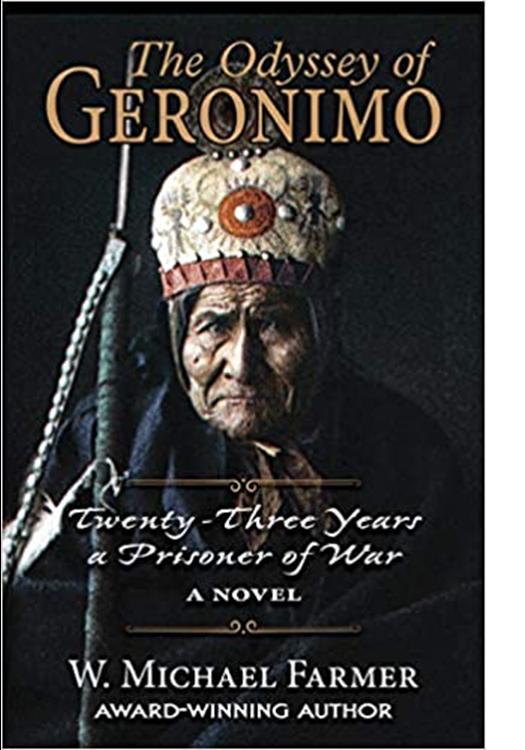
W. Michael Farmer’s The Odyssey of Geronimois one of those rare books, a true biographical fiction that doesn’t sugar-coat the less comfortable characteristics of its protagonist.
I find the title of this book, with its homage to the Odyssey of Homer, especially appealing. Like Homer’s hero, Farmer’s is also a wily man whose actions do not always seem admirable to us today. And yet he lingers in our consciousness. Even though we don’t quite know how to think about it, his story endures. Geronimo, an Apache warrior whose deeds of war made him feared across the American Southwest, continued in captivity and beyond to exert a powerful influence on the American psyche, as Odysseus’s has on the European imagination.
The Odyssey of Geronimo provides context for the old warrior’s actions before, during, and after his capture, and draws an illuminating portrait of a man who spent twenty-three years bridging the gap between his culture and the one he was thrust into by circumstances beyond his control.
This is a book about survival, with all its complexities. I highly recommend it.
On Tuesday, March 6, 1838, Carlos Santistevan asked the New Mexico government for 50 pesos for killing rebel leader Juan Antonio “El Coyote” Vigil five-and-a-half weeks earlier during the battle of Pojoaque Pass. Vigil had co-led the New Mexico revolutonaries with José Angel Gonzales since late the previous year, and had issued the January 1838 call to arms that initiated the final phase of the rebellion and the battle just north of Pojoaque Pueblo.
We don’t know precisely how El Coyote Vigil died, but we do know what happened to his body afterward. It was hung at the nearest crossroads as a warning to anyone with further insurrectionary ideas.
Vigil, from the mountain village of Truchas east of Chimayó, seems to have spent most of late 1837 in Taos. There, he’d threatened Padre Antonio Jose Martínez’s life if the priest didn’t stop preaching against the revolution. This frightened Martínez enough to send him fleeing south to Santa Fe. But it also angered the priest. Once in the capitol, he volunteered to serve as Governor Manuel Armijo’s military chaplain during the January campaign.
The cliffs of Pojoaque Pass in the distance. Courtesy: RanchoJacona.com
Martínez was at Armijo’s side at the battle of Pojoaque Pass and afterward. While the governor gave the order to hang Vigil’s body at the crossroads, one has to wonder if the priest had anything to do with the idea. Certainly, he doesn’t seem to have hesitated to comply with Armijo’s order later that day to hear José Angel Gonzales’ confession before he was taken out to be shot.
If you’re interested in learning more about Vigil, Gonzales, the rebellion, and the loyalist response, check out my recently-published novel There Will Be Consequences. You can find more information here.
Sources: Lansing Bloom, “The Insurrection of 1837,” Old Santa Fe Magazine, Vol. II, Santa Fe: Old Santa Fe Press; Fray Angelico Chavez, But Time and Chance, the story of Padre Martinez of Taos, Sunstone Press, Santa Fe, 1981; Janet Lecompte, Rebellion in Rio Arriba, 1837, UNM Press, Albuquerque, 1985; Ralph E. Twitchell, The Leading Facts of New Mexican History, Vol. II, Torch Press, Cedar Rapids, 1911.
On Friday, February 21, 1862, the Army of the Confederate States of America once again won a battle in New Mexico, their third in a row.
The conflict took place at the Valverde Ford of the Río Grande, and was a decisive victory for the Texan Confederates. Under former Fort Union commander Henry Hopkins Sibley, they moved north, occupying Socorro, Albuquerque, then Santa Fe, en route to their ultimate destination, Colorado’s gold and silver mines. They were on track to replenish the Confederacy’s coffers, then swing west to California and its unblockaded coast.
They never made it. In late March, the Confederates were stopped at Glorieta Pass by Union troops and the scouting skills of New Mexico’s Manuel Antonio Chavez y Garcia de Noriega.
But at Valverde, the Confederates reigned. When Union soldiers attempted to cross the river, the Texans opened fire, killing New Mexico volunteers who were armed with outdated single-shot muskets. The victory was decisive.
Map of the battle at Valverde Ford, courtesy of Matt Bohnhoff.
However, the New Mexicans did capture over 200 of the enemy’s horses and mules. This loss forced the Confederates to discard some of their wagons and supplies. When additional animals and goods were destroyed during the conflict at Glorieta Pass, all hope of reaching Colorado collapsed. The Confederates were forced to turn south for home.
During that retreat, even more supplies would be left behind as the remaining horses and mules died in the harsh conditions. Men perished as well, some of them only half-buried in the rocky soil of New Mexico’s Magdalena Mountains. The Texans would lose a full third of their men to capture or death before they reached home.
Which only goes to show that even a series of initial victories does not guarantee a successful campaign. And that even small losses can lead to catastrophe.
For a fictional telling of the Confederate story in New Mexico, I recommend Jennifer Bohnhoff’s excellent middle-grade Rebels of the Rio Grande novels. The first of the series, which deals with the events at Valverde, is available here. This book, with a map similar to the one above, will be re-released as When Duty Calls this June by Kinkajou Press.
Sources: Jacqueline Dorgan Meketa, Louis Felsenthal, University of New Mexico Press, Albuquerque, 1982; Francois-Marie Patorni, The French in New Mexico, French in America Press, Santa Fe, 2020; Jerry D. Thompson, A Civil War History of the New Mexico Volunteers and Militia, University of New Mexico Press, Albuquerque, 2015.
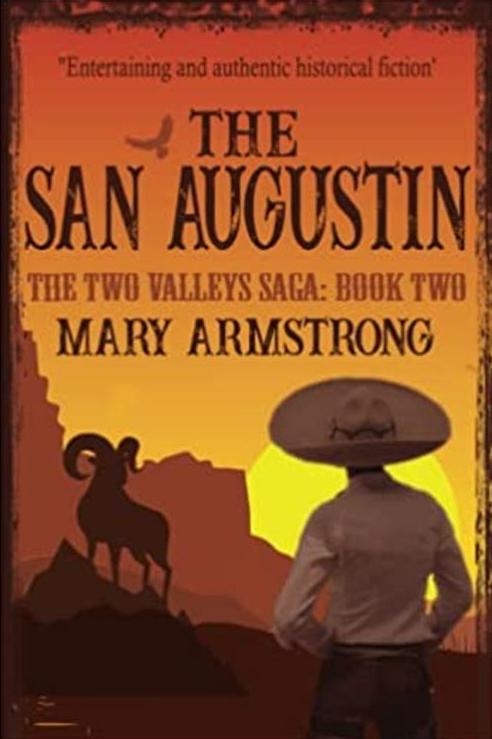
The San Augustin: The Two Valleys Saga, Book Two by Mary Armstrong continues the journey of Jesús Messi, fictional nephew of real-life Colonel Albert J. Fountain, attorney in late 1800s Mesilla, New Mexico and nemesis of cattle rustlers throughout the region.
Jesús’s story began in The Mesilla, when he joined the Fountain family to read law with the Colonel. It continues in The San Augustin as Jesús learns about love and politics as well as law. He plays a growing role in Fountain’s burgeoning practice, meets the young but already ambitious Albert Bacon Fall, and experiences a growing sense of danger as Fall and other men who’ll be blamed for the 1896 disappearance of the Colonel and his young son become active in New Mexico’s Mesilla and Tularosa valleys.
The second of a projected five-book series, The San Augustinmoves the Fountain saga along while also allowing the reader to get to know Jesús and the Fountain family more thoroughly. If you’re interested in the history of southern New Mexico and/or the Fountain disappearances, I recommend this book!
On Tuesday, February 7, 1837, Governor Albino Pérez, his New Mexico militia, and their Pueblo allies returned to the Rio Grande Valley from an unsuccessful campaign against the Navajo.
It had been a difficul campaign from its inception. When the Governor issued a call for the militia to assemble in November 1836, nobody came. This was primarily because of the members’ personal finances. They wouldn’t be paid to be on campaign and also had to supply their own ammunition and mounts. And Pérez couldn’t promise to help. He barely had enough funds to pay his Presidio soldiers to guard Santa Fe while he was gone.
So he decided to levy a forced loan on New Mexico’s ricos. This wasn’t exactly met with enthusiasm either. In fact, the necessary funds for the campaign still hadn’t arrived in the capital when Perez mustered the men who’d finally shown up and set out for Navajo country. They would be gone two months.
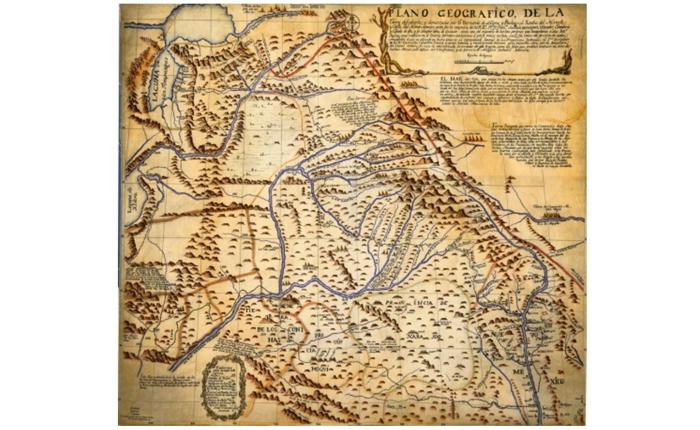
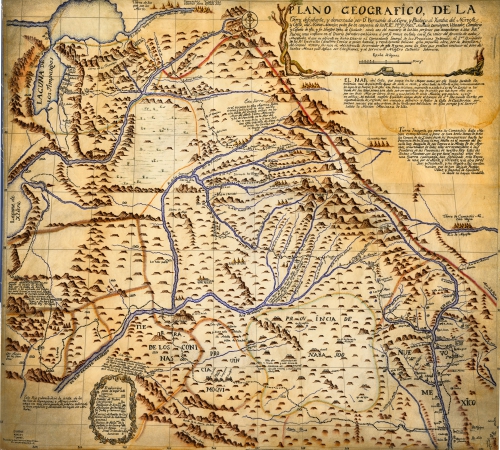
Miera map of New Mexico, circa 1788.
This type of campaign typically lasted forty-five days, so this one was longer than usual. If the militia were going to be paid at the end of it, or at least collect some spoils of war while they were gne, they probably wouldn’t have minded too much. But food supplies ran low. Also, the weather was so cold that one man froze to death and others lost toes and ears to frostbite. The temperatures affected the animals too. The militia’s mounts began to fail. To add insult to injury, the New Mexicans made no contact with the enemy during the entire period they were in the field.
By the time they got home, the New Mexicans and Pueblo warriors were fed up. They headed home in disgust and Governor Pérez turned to local governance issues only to discover that there wasn’t enough money in the treasury to continue paying his Presidio troops. He saw no alternative but to send them home as well. And then the Navajos who hadn’t been anywhere in sight during the winter campaign suddenly materialized and began raiding across the region. The Governor’s year was not starting out well.
It wouldn’t end well, either. Mexico’s Congress had made changes to the Federal constitution, reducing the autonomy of communities throughout the country. In addition, Federal taxes were going up and were set to be collected directly from New Mexicans for the first time in decades. To say people were unhappy is putting it mildly. Navajo raids would be the least of Governor Pérez’s worries in the coming months.
Sources: Lansing Bloom, Old Santa Fe Magazine, Vol. II, Santa Fe: Old Santa Fe Press; Janet Lecompte, Rebellion in Río Arriba 1837, Albuquerque: University of New Mexico Press, 1985; Benjamin M. Read, Illustrated History of New Mexico. Santa Fe: New Mexican Printing Company, 1912, Francis Stanley, Giant in Lilliput: The Story of Donaciano Vigil. Pampa: Pampa Printing, 1963; Daniel Tyler, New Mexico in the 1820’s: The First Administration of Manuel Armijo, PhD Dissertation, 1970, UNM, Albuquerque, New Mexico.






 Fiction and Fact From Old New Mexico