I am pleased to announce the publication of Nothing Lasts Forever, my latest Old New Mexico novel and the fourth volume of my Locke Family Saga series.
This book continues my emphasis on deeply researched historical fiction set in mid-1800s New Mexico and finds Alma Locke in Taos in late 1846/early 1847. Here’s the book description:
On Thursday, January 19, 1847, long-simmering tensions erupted in bloodshed in Taos, New Mexico, brought to a head by the recent American takeover during the Mexican American War. Within 24 hours, almost all the Americans in Taos were dead, including Governor Charles Bent.
The insurrection was eventually crushed by American forces in a final battle that destroyed the Taos Pueblo church. The trials that followed are renowned for their biased juries, foregone conclusions, and speed of execution.
Nothing Lasts Foreverexplores the tensions that fed the 1847 rebellion from the point of view of the fictional Alma Locke, in Taos to bury her mother, and Governor Bent’s five-year-old daughter, Teresina.
A heartbreaking novel of love, loss, and conflicting loyalties, Nothing Lasts Forever explores the personal conflicts behind the rebellion and how two families coped with their losses and struggled to make sense of unimaginable tragedy.
Although this is Book 4 of the Locke Family Saga, it can be read as a stand-alone novel.
Shortly after American troops invaded New Mexico in Autumn 1846, they discovered four pieces of Mexican artillery in a village south of Santa Fe. Apparently, Governor Manuel Armijo had taken the guns with him when he fled, but abandoned them at Galisteo. One of these pieces was of special interest to the Americans because it had arrived in New Mexico by way of Texas.
The cannon, made in Springfield, MA, had accompanied the ill-fated 1841 Texan expedition to New Mexico. A brass six pounder, it had been cast with a Texas star on its breach and paid for by “patriotic ladies” of the newly formed republic. When the Texans straggled into eastern New Mexico in Fall 1841, they still had the gun with them, despite its weight and their exhaustion.
New Mexico Governor Manuel Armijo confiscated the cannon, of course, and reportedly displayed it in the Santa Fe plaza after he sent the captured Texans on to Mexico City. It was still there in 1846, when it and other artillery pieces were transferred to Apache Pass during the runup to the impeding American invasion.
When Armijo decided to flee instead of fight, he took the Texan gun and other artillery with him. Three of the gun carriages apparently broke down at Galisteo, and the governor was forced to abandon them as well as the weapons they carried. This included the Texan six-pounder, which the American troops dubbed the “Lone Star of Texas.”
Six pound cannon from the 1840-1860s period. Courtesy: U.S. Library of Congress
They transported the gun back to Santa Fe, where it was apparently once again placed on the plaza. Lt. Richard Smith Elliott says it was used in early November to assemble the officers for training drill.
We have no official record of the Texas cannon again until Brigadier General Sterling Price took it with him to Chihuahua. There, it saw action at Santa Cruz de Rosales, the last battle of the Mexican war, on March 16, 1848.
However, there is a possibility that this was not the first battle in which the Texan cannon was fired. A six-pound cannon played a conclusive role in the February 1847 battle at Taos Pueblo, when it was used to breach the walls of the church where the insurrectos were holed up. This gun may well have been the Lone Star.
After the battle at Santa Cruz de Rosales, the Texan cannon was returned to Santa Fe, where it was stored alongside other Mexican artillery pieces in La Castrense, the old military church on the south side of the plaza. It and the other guns were presumably cleared out when the Americans decided to use the building as a courtroom. What happened to it after that remains a mystery.
Sources: Mark L. Gardner and Marc Simmons, Eds., The Mexican War Correspondence of Richard Smith Elliott; Silver City New Mexico Enterprise, October 9th 1891, courtesy Silver City Library.
In mid April 1847, the Taos Valley was still experiencing the aftermath of theJanuary 20 rebellion.
The U.S. Army had captured a total of 45 rebels. They released 24 for lack of evidence and tried 21. The trials were over, but the executions weren’t. Seventeen men would hang, one of them for high treason.
The high treason charge was questionable. An argument could be made that a person couldn’t rebel against a country to which they had not pledged allegiance. The war with Mexico wasn’t over. New Mexico was still officially part of occupied Mexico, and its people were still citizens of that country. There’d been a trial in early January which had found the high treason charge suspect. But that didn’t stop 26-year-old prosecuting attorney Francis P. Blaire, Jr. from continuing to use it.
In early March, Blaire filed the charge against three men: Antonio Maria Trujillo, Pantaleon Archuleta, Trinidad Barceló, and Pedro Vigil. Apparently the only rebel trials held in Santa Fe, the charges against Archuleta, Barceló, and Pedro Vigil were eventually dropped after the proceedings ended in a mistrial.
Trujillo was found guilty, but because he was elderly and unwell, the jury and judge requested that the sentence be commuted. Military GovernorSterling Price granted the pardon, and Santa Fe was spared a demonstration of the effectiveness of the gallows.
Taos wasn’t. Of the eighteen prisoners tried there, all were convicted and hung.
There had been a single execution on February 7 of Pablo Montoya, one of the rebellion leaders, but the remainder waited until April, when the formal trials began.
These hangings started on Friday, April 9, when Hipolito (Polo) Salazar, Jose Manuel Garcia, Pedro Lucero, Juan Ramon Trujillo, and the Romero brothers Ysidro and Manuel, age sixteen, were executed two days after their trials. Salazar had been convicted of high treason, but the rest of these men were found guilty of killing American-appointed Governor Charles Bent.
The eleven remaining convicted rebels had to wait to meet their end. Most of them would die three weeks later, on Friday, April 30. These executions seem to have occurred in two batches. The six men from Taos Pueblo—Francisco Naranjo, Jose Gabriel Romero (or Samora), Juan Domingo Martin, Juan Antonio Lucero, and a man called El Cuervo—were apparently hanged at the same time. They were buried at the Pueblo at the church which had been destroyed by the Americans in early February.
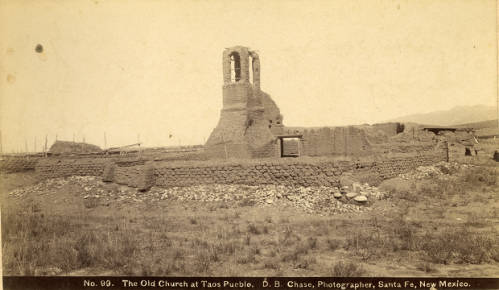
Ruins of the Taos Pueblo church. Source: Palace of the Governors Archives
Four other men—Manuel Miera, Juan Pacheco, Manuel Sandoval, and Rafael Tafoya—were also executed that day. Then, on the following Friday, Juan Antonio Avila was hanged for his role in the insurrection.
Why the week-long delay? There’s no information in the records. I’d love to know the answer to this question, just as I’d like to know why the trials of Trujillo, Barceló, Archuleta, and Vigil were held in Santa Fe and the reasons for the mistrials for latter three men. Was this a procedural issue? Was family pressure brought to bear?
I’m especially curious about the case of Trinidad Barceló. He was the older brother of businesswoman Gertrudes Barceló, who had assisted the U.S. occupiers in suppressing a revolt the previous December. Did her support of the regime play a part in her brother’s release?
What about the other two: Archuleta and Vigil? Were they related to Acting Governor Donaciano Vigil or some other prominent New Mexican who the Americans wanted on their side?
And then there are the stories of the men who died: their reasons for resistance, the impact on their families, the pain or joy they left behind.
Sources: David C. Beyreis, Blood in the Borderlands; Mary J. Straw Cook, Doña Tules; James A. Crutchfield, Revolt at Taos; Mark L. Gardner and Marc Simmons, eds., The Mexican War Correspondence of Richard Smith Elliott; Lewis H. Garrard, Wah-to-ya and the Taos Trail; Lucy Lippard, Pueblo Chico, Land and Lives in Galisteo since 1814; Michael McNierney, ed. Taos 1847, The Revolt in Contemporary Accounts; Alberto Vidaurre in Corina A. Santistevan and JuliaMoore, Taos, A Topical History.
In my March 5 post, I mentioned that one of the things that nineteenth century Americans disparaged when they first arrived in New Mexico was what they called “mud houses.” Newspaper correspondent Matt Field wasn’t the only person to describe Santa Fe as a “mud built city” of one-story buildings that reminded him “of an assemblage of mole hills.”
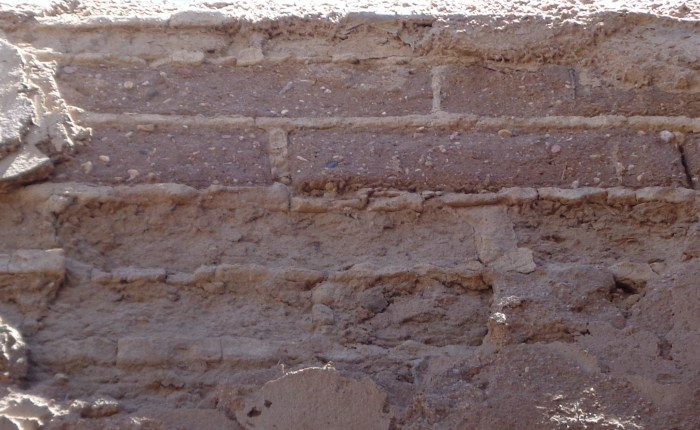
Technically, Field was right. The buildings, even the churches, were in fact built of a mixture of earth and water. These carefully formed bricks had evolved from the indigenous practice of puddled mud construction and by the 1800s were created by packing a stiff, dough-like mud into a rectangular wooden frame that was then lifted away from the resulting block. Two days later, the brick was dry enough to be turned on end and a week later, hard enough to be stacked and cured for another month. To speed up the drying process, adobe makers in the upper Rio Grande region often added straw.
Adobe bricks were used to construct one-story buildings but, with proper buttressing, the walls could be extended higher. Field noted that the Santa Fe parish church was built “as high and quite as large as any of our [U.S.] ordinary size meeting houses.”
He also noted that the adobe walls were strong and durable. In fact, they were so strong and durable that the Fort the invading Americans constructed on the hill overlooking the church in the Fall of 1846 was made of double walls of adobe bricks with a core of rubble between them.
Diagram of Fort Marcy, constructed Fall 1846. Source: Fort Marcy Park interpretive signage.
Early the following year, the Americans got a taste of just how resilient adobe walls could be. After the January 1847 Taos uprising, the U.S. Army hauled four mounted howitzers and a six-pound cannon north to deal with the rebellion. The insurrectos had retreated to the mission church at Taos Pueblo, but the American artillery made little headway against its adobe walls. Lt. Richard Smith Elliott reported later that the walls were so thick, the cannon balls would not go through them.
In fact, the artillery crews made little headway against the pueblo church until they positioned the smallest cannon closer to it and began using grapeshot in a spot already damaged by an axe-wielding soldier. Only then were the attackers able to enter the church.
Not even adobe could withstand the fury and tenacity of Americans with newly acquired land to protect.
Sources: Bainbridge Bunting, Early Architecture in New Mexico; Stella M. Drumm, Down The Santa Fe Trail and Into Mexico, Diary of Susan Shelby Magoffin 1846-1847; Mark L. Gardner and Marc Simmons, eds., The Mexican War Correspondence of Richard Smith Elliott; Michael McNierny, ed., Taos 1847, The Revolt in Contemporary Accounts; Clyde and Mae Reed Porter, Matt Field on the Santa Fe Trail.
The thirty-day countdown to publication of my novel An Unhappy Country has begun!
It’s August 1846. The U.S. army has taken Santa Fe without firing a shot. The Mexican American War is over in New Mexico. Or is it?
Two days after the Army arrives, seventeen-year-old Jessie Milbank and her friends stumble on a man with a knife in his back in the Santa Fe plaza. Then someone close to Jessie’s friend Juanita is murdered. When an insurrection is suppressed in December, Jessie begins to wonder if the three events are linked.
Were the murdered men part of a conspiracy to throw out the invaders? And were they the only ones hoping for a fight? After revolt does finally break out and the Americans suppress it at the battle of Taos Pueblo, yet another man is murdered. Will the reasons for his death provide clues to the earlier ones?
Early readers are raving about Jessie, the book’s insight into these little-known events, and the beautiful writing in this novel.
According to Britannica.com, the practice of placing journalists with a military unit and permitting them to accompany troops into combat zones started in the U.S. during the Iraq War.
While assigning career journalists to specific units may have originated during the 2003-2011 conflict, the concept was almost 150 years old by that point. It had begun with the 1846 Mexican American War.
One of the embedded reporters was Lt. Richard Smith Elliott, who served as a correspondent for the St. Louis Reveille from June 1846 to June 1847. Elliott was posted with General Stephen Watts Kearny’s Army of the West. His reports to the paper provided news of the military conquest and subsequent activities, including first-hand accounts of the news of the Taos revolt.
Elliott’s pen name was John Brown. He had some newspaper experience, as he’d worked as a publisher and printer at small papers in Kentucky and Pennsylvania before giving it up to become a lawyer. But they say newspaper ink gets in your blood, and when the U.S. decided to invade Mexico and Elliott joined up, he also volunteered to report on subsequent events for the Reveille. He began work the day he left St. Louis with the Laclede Rangers, writing about their presentation swords and grand send off.
During the following year, Elliott wrote around seventy items for the paper. Other soldiers wrote for the Reveille, too, but Elliott’s work was the most voluminous.
Farther south, the practice of embedded reporters was also incorporated into the American military activity. One of the embedded correspondents was New Orleans Picayune publisher George Wilkins Kendall, who had been in Mexico in 1841-1842 as part of the ill-fated Santa Fe Texas Expedition. He’d written a scathing three-volume bestseller about his experiences and was apparently anxious to participate in what he saw as payback for his imprisonment.
George Wilkins Kendall, Source: Kendall of the Picayune, F. Copeland
However, Kendall did not participate in the war directly. As what one biographer calls “the first modern war correspondent,” Kendall instead chose to observe from a distance. He set up a systematic program to aggregate the news in his portable “Picayune office” that followed General Zachary Taylor through northern Mexico and General Winfield Scott from Tampico to Mexico City. His employees gathered news, sold subscriptions, and did other business for the paper while Kendall ran the operation and sent editorials back to New Orleans complaining about the slowness of the mail.
So there were different ways one could experience and report on the Mexican American War. All of them embedded in one way or another and each providing yet another way for newspaper readers back home to get a sense of what was happening “on the ground.”
Whether this helped or hindered the war effort is anyone’s guess, but it certainly must have been a boon to newspaper circulation.
Source: Fayette Copeland, Kendall of the Picayune; Marc L. Gardner and Marc Simmons, The Mexican War Correspondence of Richard Smith Elliott; http://www.britannica.com/topic/embedded-journalism, accessed 1/27/25
The name “Taos” conjures many things. An ancient pueblo. A Mexican outpost. Gringo mountain men. A violent revolt. A funky 21st century village. But the village and pueblo are two separate places. There are Spanish villages and Indigenous pueblos side by side all over New Mexico. As far as I know, only in the Taos valley do the two settlements carry the same name.
And where does the name come from and what does it mean? Now there’s a question. According to F.R. Bob Romero in Santistevan and Moore, Taos, A Topical History, it’s been attributed “to an Indian word meaning ‘Red Willow’ or ‘people of the Red Willow.’” But no one knows for sure. All we know is that it’s what the pueblo was called after the Spanish arrived. Romero says it’s likely a “Tiwa Indian term that perhaps began with the T sound and was Hispanicized as Taos.”
So that explains (or doesn’t!) that. But then there’s the question of the name of the village which is three miles southwest. We call it “Taos,” but it was originally called Don Fernando de Taos, San Fernando de Taos, San Fernandez de Taos, and various forms of these three names, such as Don Fernando, San Fernando, San Fernandez, or simply Fernando or Fernandez. Although the latter two don’t appear very often in the historical record. Even then, if the name is shortened, it becomes simply “Taos.”
As far as I know, Don Fernando de Taos is the only location in New Mexico which has the honorific “Don” attached to it. The Don Fernando for whom it was named was actually a Don Fernando Durán y Chávez, who had a hacienda near Taos Pueblo in the late 1600s. He and his son fled south during the Pueblo Revolt of 1680 and didn’t return. In 1795, the grant was ceded to settlers from the nearby Cañon area, but the village didn’t really start to thrive until French-Canadian and American mountain men [post link here] began to trickle in in the 1820s.The village was a restocking and trading point for the fur trappers. Some of them stayed to set up mercantile businesses and intermarry and the community became the center of americano settlement in the valley.
Ironically, the location that developed in response to the American presence became the flash point of resistance to the 1846 American invasion. Maybe the locals just got sick of us.
Sources: Source: Francis L. and Roberta B. Fugate, Roadside History of New Mexico; Robert Julyan, The Place Names of New Mexico, Revised Edition; F.R. Bob Romero in Santistevan and Moore eds., Taos, A Topical History; http://taoscountyhistoricalsociety.org/taoshistory.html, accessed Jan 3, 2017
I’m pleased to announce that my Old New Mexico novel An Unhappy Country will be published in April 2025. A murder mystery, this novel is set during the Mexican American war and focuses on events in New Mexico, which was invaded by the U.S. Army in August 1846. It features Jessie Milbank, an American merchant’s daughter who can’t leave well enough alone. Here’s the book description:
August 1846. The U.S. army has taken Santa Fe without firing a shot. The Mexican American War is over in New Mexico. Or is it?
Two days after the Army arrives, seventeen-year-old Jessie Milbank and her friends stumble on a man with a knife in his back in the Santa Fe plaza. Then someone close to Jessie’s friend Juanita is murdered. When an insurrection is suppressed in December, Jessie begins to wonder if the three events are linked.
Were the murdered men part of a conspiracy to throw out the invaders? Were they the only ones hoping for a fight? After revolt does finally break out and the Americans suppress it at the battle of Taos Pueblo, yet another man is murdered. Will the reasons for his death provide clues to the earlier ones?
By Friday, February 5, 1847, the Taos insurrection against the American occupation of New Mexico was over. All that remained was the formal surrender of Taos Pueblo leader Tomás Romero.
The Americans had conditioned the end of hostilities on Romero’s surrender. And the people at the pueblo were eager for things to end. Their church, where the rebels had made their stand, was in ruins. Any further action put the massive housing complexes in danger.
So, Romero surrendered. But he was never tried for his actions in a court of law. While he made it to the Taos village jail, that’s as far as he got. A U.S. dragoon named Fitzgerald shot and killed the Taos leader that morning, instead.
Fitzgerald later bragged about the killing to seventeen-year-old Lewis Garrard, who reported that Fitzgerald killed Romero and three other men as vengeance for the death of his older brother Archibald Fitzgerald. Archie had been a member of the 1841 Texas Santa Fe Expedition and later died during a prison breakout. Why his younger brother thought the death of Romero and the others avenged him is unclear.
What is clear is that Tomás Romero’s death on February 5 was the last shot fired in the Taos Revolt. Other men would die, but they would do so after a cursory court case and the administration of at least the semblance of law. The Taos leader’s death was simple murder.
Fitzgerald was locked up afterwards in the Taos village courthouse, where he was allowed to escape a month later. On March 18 he was dishonorably discharged from his company at Albuquerque, apparently for desertion. He had fled east by that time and would eventually make his way to Geelong, Australia, become the owner/operator of the Western Sea bathhouse, and die in 1882.
Source: Find-a-Grave.com
Fitzgerald’s action at Taos was one of two links between the revolt and the 1841 Texas Santa Fe Expedition. The Texans had brought along a six-pound cannon which was captured along with them and left behind when they were marched south. The cannon ended up in Santa Fe and was still there when the U.S. Army arrived. They took it with them to Taos, where it was key to the action that breached the pueblo church walls.
While the use of this particular piece of artillery may simply have been convenient, its presence may also have sparked the younger Fitzgerald’s memories of his brother and triggered the subsequent shooting at the Taos village jail. Or maybe he’d planned Romero’s death all along. Or was simply a confused young man with a propensity for killing people.
Like most historical or even current events, it’s doubtful we will ever know why the U.S. dragoon did what he did and why Tomás Romero had to die.
Sources: James A. Crutchfield, Revolt at Taos, The New Mexican and Indian Insurrection of 1847; John Durand, The Taos Massacres; Mark L. Gardner and Marc Simmons, eds., The Mexican War Correspondence of Richard Smith Elliott; Lewis Garrard, Wah-to-yah and the Taos Trail; Ralph Emerson Twitchell, The History of the Military Occupation of the Territory of New Mexico; Alberto Vidaurre,” 1847: Revolt or Resistance?” in Corina A. Santisteven and Julia Moore, Taos, A Topical History.







 Fiction and Fact From Old New Mexico