New Year, New Book!

New Year, New Book!

I’m pleased to announce that my novel The Texian Prisoners will be published in March next year and that the ebook is now available for pre-order!

In Fall 1841, a band of roughly 300 Texans straggled out of the Staked Plains into New Mexico. They had intended to claim everything east of the Rio Grande for Texas. Instead, they were captured and sent south to El Paso del Norte, then on to Mexico City. The largest group of prisoners, which included journalist George Wilkins Kendall, was escorted to El Paso by Captain Damasio Salazar. Five prisoners died on that trek. Kendall would later write a book describing the experience, a book which accused Salazar of food deprivation, mutilation, and murder, and fed the glowing coals that would become the Mexican-American War.

But what really happened on the way to El Paso? The Texian Prisoners tells the story through the eyes of Kendall’s friend George Van Ness, a lawyer burdened with the ability to see his enemy’s point of view, and asks us to consider the possibility that Kendall’s report was not unbiased.

A historically accurate retelling of Larry McMurtry’s Dead Man’s Walk, this fictional memoir will make you question everything you thought you knew about Texas, New Mexico, and the boundary between them.

Available for pre-order from Amazon.com and other ebook retailers.

Book Review: When Cimarron Meant Wild

David Caffey’s recent book When Cimarron Meant Wild fills an important gap in the historiography of northeast New Mexico, specifically Colfax County, a.k.a. Cimarron Country. There are a number of books available about different aspects of the county and the personalities that made it legendary in its time, but up to this point, none of them have tied everything together, as Caffey’s does.

The County is inextricably linked to what became known as the Lucien B. Maxwell Land Grant. But When Cimarron Meant Wild begins long before the grant was established in the 1840s and reminds us that the land was home to indigenous populations well prior to either Spanish or American occupation.

Caffey also explains how these peoples—the Jicarilla Apache and Moache Ute—continued to play a role in the area well into the mid-19th century. Most of the material about Colfax County I’ve seen up to this point has very little to say about the original peoples, their rights to the land, and how they were gradually pushed off of it. I was impressed with the way When Cimarron Meant Wild addresses this issue.

The book also does an excellent job of describing Lucien Maxwell’s rather relaxed approach to exploiting the area’s resources, both agricultural and mineral. The difference between his strategy and that of the British corporation he and his wife sold out to in 1870 is an excellent study in contrasts. The Corporation was intent on wringing every penny out of their new possession, previous arrangements be damned. This shift in attitude created the environment that erupted into what became known as the Colfax County War, a conflict Caffey estimates resulted in 52 deaths over the next 11 years.

When Cimarron Meant Wild builds on Caffey’s previous work on New Mexico’s Santa Fe Ring and details the way the British corporation worked with Ring members, most notably Thomas B. Catron and Thomas Elkins, to eliminate the small-holders and miners who they felt were blocking the way to greater profits. The violence that resulted is documented here in detail but never sinks to a mere record of facts. Quite the opposite. The book’s organization and narrative flow is so masterful that it reads like a novel.

When Cimarron Meant Wild contains the best description I have yet read of the Colfax County War. Caffey not only provides an excellent retelling of both small and large events, he also gives us snapshots of the personalities involved without sentimentality or condemnation something I as a fiction writer find especially compelling.

This book is readable, historically accurate, and fills in important gaps for those of us who know a little about the area and want to learn more. If you aren’t familiar with northeast New Mexico’s or the Maxwell Land Grant’s fascinating history, When Cimarron Meant Wild is definitely the place to start learning about it. I highly recommend this book!

Fever and the Texas Expedition to Santa Fe

Fever and the Texas Expedition to Santa Fe

Subscribe to continue reading

Subscribe to get access to the rest of this post and other subscriber-only content.

Texan Expedition Leaves for Santa Fe!

Texan Expedition Leaves for Santa Fe!

On Friday, June 18, 1841, Texan President Mirabeau Buonaparte Lamar accompanied Texas Santa Fe Expedition on the first leg of their journey to New Mexico.

Lamar sent an open letter with them, printed in both English and Spanish. This missive asserted Texas’s right to New Mexico east of the Rio Grande and said the Republic intended to “admit its remotest citizens to an equal participation of the blessings which have been acquired by our late glorious revolution.” It then went on to invite New Mexico to enter “the doors of the Temple which we have erected to Liberty,” and stated that if they weren’t interested, the Texans would leave quietly.

Mirabeau B. Lamar, courtesy Wikipedia.com

However, Lamar had told the three men he’d appointed to represent him in New Mexico that “upon entering the city of Santa Fe, your first object will be, to endeavor to get into your hands all the public property.” Admittedly, he said to do this without resorting to violence. But ninety percent of the men he’d sent were either current or recent members of the Texas Army. Maybe he thought the mere threat of violence would suffice.

The 300-strong Expedition marched eagerly out of Austin that bright Friday morning in June. On Saturday morning, Lamar reviewed them, delivered a speech, and sent them on their way. Everyone was in good spirits. They’d be home again in a matter of months, and the way to Santa Fe and all its wealth would be open at last. 

The trip wouldn’t go quite as planned, but they didn’t know that yet. For now, adventure awaited.

As did New Mexico Governor Manuel Armijo, who was already marshaling troops and ammunition, and arranging for the Comanches to monitor the Texans’ progress. Lamar’s Expedition would not find New Mexico unprepared.

BOOK REVIEW: The White Sands, The Two Valleys Saga, Book 3

The third book in Mary Armstrong’s Two Valleys saga, The White Sands, takes a further dive into the history of southern New Mexico as it explores the events that led up to the famous feud between  Albert Fountain and Albert Fall. While Fall would go on to be implicated in the Teapot Dome scandal, Fountain would disappear into the White Sands in 1896  with his ten-year-old son Henry.

But I’m getting ahead of myself and Armstrong’s novel The White Sands. In this book, her narrator, Jesús Messi, gets to know the Lee family, the clan that was thought by many to be responsible for the Fountain disappearance. What he discovers is that there are two sides to every story, and more than one way to deal with a problem.

Armstrong uses Messi’s memory loss, suffered at the end of Book 2, to place him in the midst of the Tularosa Basin and the Lee network of family and friends. As part of that group, he comes to understand their perspective, which makes things awkward for him when he returns to Las Cruces. The teenage Jesús is caught between two worlds as he realizes that neither side is totally in the right—or the wrong.

His struggles are thoughtfully portrayed and provide a great way for Armstrong to explore the antagonism between the political parties at the time and the way those political divisions became deeply personal. In fact, the attitudes and events she recounts are eerily echoed in today’s news. They involve strong, opinionated personalities, convoluted legal questions, impatient and potentially coerced witnesses, and much more.

If you’re interested in southern New Mexico history in the late 1800s, the way our past is echoed by our present, or simply want an insightful coming-of-age story about an intelligent and perceptive young man, I highly recommend The White Sands.

BOOK REVIEW: Old Santa Fe Today

There’s only one problem with the fifth edition of the Historic Santa Fe Foundation’s classic Old Santa Fe Today. Every time I dip into it, I get more story ideas. I can’t research and turn them all into fiction! Which is too bad, because there’s a lot of great material in this book.

Old Santa Fe Today was originally conceived as a list of historical properties in Santa Fe. To that end, it still includes a register of properties worthy of preservation, information about efforts to do so, and a brief history of Santa Fe’s built environment. This may sound like a specialist’s book and not something for the average reader. However, the beautifully rendered full-color photos and the details about each entry make it highly accessible.  

Not only do the authors provide architectural and preservation information about the buildings in question, they also include a brief history: who built it, who lived in it, and who those people were associated with. I, of course, am especially interested in the older buildings, in particular those in use during the mid-1800s. However, the entries include structures built as late as the 1940s, including the Dodge-Bailey house designed by John Gaw Meem and adjacent to Meem’s own home on Old Santa Fe Trail.

Old Santa Fe Today also includes properties outside Santa Fe proper, including Las Acequias, a hundred-acre farm on the banks of the Rio Nambe, and non-building structures such as the Acequia Madre that has transported water into Santa Fe from the Sangre de Cristo mountains for over four hundred years.

So, whether you’d like to know more about Santa Fe’s historic structures, are interested in historic preservation, want to learn about Santa Fe area history, or just like beautiful pictures, I highly recommend Old Santa Fe Today. 

BOOK REVIEW: The Iliad of Geronimo

BOOK REVIEW: The Iliad of Geronimo

The full title of W. Michael Farmer’s novel, The Iliad of Geronimo, A Song of Blood and Fire, tells us not only the subject but also the substance of the story. The poetic ring of the subtitle reflects the author’s premise that the events of Geronimo’s life in the ten years prior to his surrender to General Nelson Miles echo the themes of Homer’s Iliad.

They are both definitely stories of blood and of fire in the bones, as well as loyalty, betrayal, frustration, and triumph. My initial reaction to this premise is that the echoes didn’t run very deep. It seemed to me that the Trojans and Greeks of Homer’s epic were more culturally similar than were the Apaches and the Americans and Mexicans they fought. But as I reflected on the two tales, I began to realize that they actually are very alike. In both stories, the two sides cling to their deep antipathy toward the other and rarely acknowledge the pain their enemy has experienced. They also exhibit knee jerk suspicions of each others’ motivations and a deep unwillingness to see their opponents as individuals. In addition, in-fighting among their own subgroups weakens the group’s likelihood of success.

There are also differences between the two sagas. For example, unlike the Greeks and Trojans, the Apache way of life was based on raiding, a concept that looked remarkably like stealing to the Americans and Mexicans, regardless of the fact that they themselves had stolen the Apache homeland. The dissimilarity in perspective is perhaps best illustrated by an incident toward the end of The Iliad of Geronimo. When Geronimo and his band delay their final return from Mexico in order to “collect” a herd of cattle with which to begin their new life on the reservation, the Americans make them give the animals back. Geronimo is furious. It looks to him like the U.S. Army is once again setting the Apache up to live in poverty and subjection. He went to a lot of work to get that herd!

The way Farmer tells this and other events from the ten years covered by this book brings Geronimo vividly to life and helps us see him as a human being who grew up with one set of rules only to have them whipped out from beneath him and replaced with another before he had time to adjust.

I recommend this book. If you’ve already read W. Michael Farmer’s The Odyssey of Geronimo, this novel will help you appreciate the events of that story more fully. If you haven’t read The Odyssey, I recommend you acquire both books and start with this one. The Iliad will show you Geronimo slowly coming to grips with the fact that new rules now apply, whether he wants them to or not. The Odyssey will show you how well he ended up adapting to and using them for his own purposes.

Whether you choose to read the books in sequence or want to plunge right into this one, I heartily recommend The Iliad of Geronimo, A Song of Blood and Fire.

Supreme Court Rules in Land Grant Company’s Favor

Supreme Court Rules in Land Grant Company’s Favor

On Monday, April 18, 1887, the U.S. Supreme Court finally confirmed the Maxwell Land Grant and Railway Company’s right to almost two million acres in northeast New Mexico.

The controversy over the grant’s size had been going on since the early 1870s. A survey when the Company bought the grant identified around 2 million acres, land that  that included much of what is now New Mexico’s Colfax County and stretched north into Colorado.

But there was a problem. Not everyone agreed that the grant was that large. In fact, U.S. General Land Office surveys insisted that grants issued by Mexico were limited to only 22 square leagues—a far cry from the 2 million acres claimed. Based on this judgment, the Land Office declared much of the acreage open to settlement. When its agents began issuing deeds to eager homesteaders and ranchers, trouble ensued. But the Maxwell Grant Company intended that land for its own uses and this was the American West—might made right. People died.

Map of final Maxwell Land Grant and Railway Company boundaries

At the same time it was using guns and intimidation to keep people off its wide-open spaces, the Company also sought legal recourse. It turned to Washington with a request for an official government survey of the grant based on the geographical descriptions in the original 1840s documents. The request was refused.

Then in 1876, the U.S. Supreme Court allowed another New Mexico land grant to encompass more than 22 square leagues. The Maxwell Land Grant and Railway Company swung into action. Three weeks after the decision, the Maxwell grant was being resurveyed. It took another eleven years, four days of oral argument, and 900 pages of testimony, but the Company finally got its land.  

With that ruling, the Colfax County War, which had begun in earnest in September 1875, finally wound down, making it a longer feud than New Mexico’s more famous Lincoln County War, which had lasted a mere three years (1878-1881).

And proving that if you hang in there long enough—and have enough money—you might just get what you want, after all.

Sources: Howard R. Lamar, Reader’s Encyclopedia of the American West, New York: Harper & Row, 1977; Lawrence R. Murphy, Philmont: A history of New Mexico’s Cimarron Country, Albuquerque: University of New Mexico Press, 1972; Stephen Zimmer, For Good or Bad, The People of the Cimarron Country, Santa Fe: Sunstone Press, 1999; Maria E. Montoya, “Maxwell Land Grant”, Encyclopedia of the Great Plains, plainshumanities.unl.edu/encyclopedia/doc/egp.ha.026, accessed 1/20/22.

BOOK REVIEW: Wildest of the Wild West

BOOK REVIEW: Wildest of the Wild West

Howard Bryan’s Wildest of the Wild Westis one of the first books I read when I began to explore the possibility of turning pieces of New Mexico’s history into fiction. While Bryan’s book about the town of Las Vegas is nonfiction, it reads like a story. Certainly, some of the events he retells could be lifted straight from a traditional Western novel.

We find an Italian hermit living in a cave above the Spanish-speaking town and revered as a holy man and miracle worker, Jesse James and Billy the Kid soaking in the nearby hot springs, Doc Holliday opening his final dental practice only to abandon it for a saloon and gambling hall, and Hoodoo Brown, formal justice of the peace and informal protection racketeer. Then there’s the actress/singer/poet/faro dealer known as Monte Verde who was actually the famous Confederate spy Belle Siddons. And the enigmatic “Mysterious Dave” Mather, who seems to have robbed a train while serving as Las Vegas Town Marshal.

The stories of these various characters is woven into a coherent narrative of Las Vegas’s history which Bryan tells with humor and verve. If you like nonfiction that reads like a novel, I highly recommend Wildest of the Wild West.

Book Review: The Odyssey of Geronimo

Book Review: The Odyssey of Geronimo

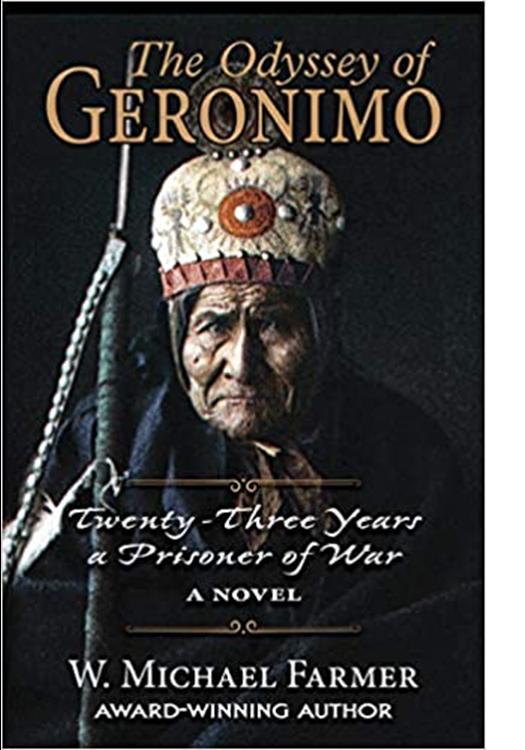
W. Michael Farmer’s The Odyssey of Geronimois one of those rare books, a true biographical fiction that doesn’t sugar-coat the less comfortable characteristics of its protagonist.

I find the title of this book, with its homage to the Odyssey of Homer, especially appealing. Like Homer’s hero, Farmer’s is also a wily man whose actions do not always seem admirable to us today. And yet he lingers in our consciousness. Even though we don’t quite know how to think about it, his story endures. Geronimo, an Apache warrior whose deeds of war made him feared across the American Southwest, continued in captivity and beyond to exert a powerful influence on the American psyche, as Odysseus’s has on the European imagination.

The Odyssey of Geronimo provides context for the old warrior’s actions before, during, and after his capture, and draws an illuminating portrait of a man who spent twenty-three years bridging the gap between his culture and the one he was thrust into by circumstances beyond his control.

This is a book about survival, with all its complexities. I highly recommend it.