Moreno Valley’s Serial Killer Gets Married

kennedy-cortez-marriage-record

On Thursday, February 28, 1867, Charles Kennedy married Gregoria Cortes at the Nuestra Senora de Guadalupe Church in Taos. Gregoria was the fourteen year old daughter of widower José Cortez of La Cordillera del Rancho, about two miles west of Mora. Charles was the 28 year old son of William and Fanny Canady (aka Kennedy) of Tennessee. Gregoria and Charles settled in the Moreno Valley at the foot of Palo Flechado Pass, on the road from Elizabethtown to Taos. There they kept a way station for travelers, and Charles Kennedy became embroiled in a series of lawsuits: one for selling liquor without a license, another for assaulting an Elizabethtown merchant with a deadly weapon, and still another for embezzling an Elizabethtown laborer’s money and goods. Kennedy was suspected of other nefarious activities, but nothing could be proven. Then, one day in the fall of 1870, his then seventeen year old wife appeared in Etown and denounced Kennedy as a serial killer. The subsequent Elizabethtown trial and lynching would make the Santa Fe, Silver City, and Indianapolis newspapers. The Silver City report said Kennedy claimed just prior to his lynching that he’d killed twenty-one men.
Corn Damage, 2 of 3

“The ears probably wouldn’t have ripened before the first snow, anyway,” Gerald said as he studied the deer-damaged cornfield. Beside him, the hired man Ramon nodded sympathetically.

Suzanna’s eyes narrowed. “You don’t know that,” she said. “And if some had, then I would have saved them to plant next spring.”

Gerald shook his head. “It’ll take years to get a strain that’ll grow at this high altitude.”

Her chin lifted. “Then it will take years. You want to stay in this God forsaken valley, don’t you?”

He continued to study the damage. “I just don’t think a fence is going to keep the deer out,” he said mildly. “They can jump pretty much anything you put in front of ’em.”

“Then what would you suggest? Those mongrel dogs of yours have proven themselves useless.”

Gerald shook his head without looking at her.

“There is a man at Mora who has dogs called masteef,” Ramon said. He held out a hand, waist high, palm down. “They are this big and used for hunting.”

Gerald turned his eyes from the corn. “Do you think he would sell?”

Ramon shrugged. “When we were there last month he showed me puppies.”

“Ramon, you are an angel,” Suzanna said.

“We don’t know that this will work,” Gerald warned.

“It’s certainly worth a try.” She gave Ramon a brilliant smile and he grinned back at her sympathetically.

from Moreno Valley Sketches II

Corn Damage, 1 of 3

Outside, the dogs were barking wildly. Indians? Suzanna twitched the window curtain just enough to peek out without being seen.

Then she saw the reason for the barking and sprang from the window to the door. She ran wildly across the yard toward the field of knee-high corn, pulling off her apron as she went. The deer were everywhere and she charged in among them, waving the apron, crying “Shoo! Shoo!”

Both the dogs plunged in after her, rampaging through the corn, and the deer fled. Chest heaving, Suzanna stood in the center of the field and surveyed the damage. Some of the plants were completely uprooted. She wasn’t sure if the deer or the dogs had wreaked the most havoc.

Suzanna lifted her hands to the sky helplessly, then looked down at the dogs, who were lying, panting, at her feet. “You weren’t much help,” she said irritably.

She looked around the field again and her jaw tightened. As soon as Gerald returned, they were building a fence.

from Moreno Valley Sketches II

The Road to Santa Fe–and Taos

santa-fe-trail-map-1826-cropped-small

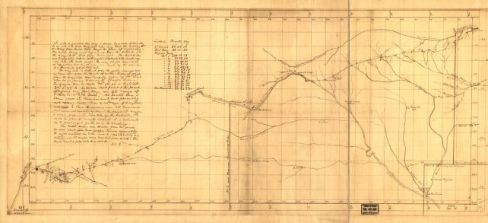
In February 1825, the United States Congress appropriated $25,000 to mark and survey a road between Missouri and Santa Fe. The survey was intended to formalize the informal trail that had been in use since at least 1821. In what would eventually become Colfax County, the “mountain branch” of the Trail crossed Raton Pass and moved directly south through what are now Cimarron and Rayado en route to Santa Fe. However, the Congressional Survey party took what was known as the Cimarron Cut Off, which swung south from the Arkansas River in what is now southwest Kansas to angle southwest until it connected with the mountain branch near Rayado.

At this point, travelers to Taos could decide whether to swing down through Santa Fe and then north or to cut west across the mountains. Taos was an important destination for those Trail travelers who were dealing in beaver fur or looking to outfit men engaged in fur trapping. Travelers headed there could take two different routes, depending on their mode of transportation. If their goods could be packed onto mules, they could follow a well-established mule track across the Cimarron range into the southern part of the Moreno Valley and then over Apache Pass to Valle Escondido. Just north of Valle Escondido, they would hit the San Fernando River, which would lead them into the Taos Valley. But if they needed to get wagons across and into Taos, they would have to find another route, such as the one Santa Fe Road Commissioner George C. Sibley followed. This route swung into the mountains south of Rayado and then north to Taos, where he completed the Santa Fe Road survey maps in late 1825.

Sources: Brown, J. C, and George Champlin Sibley. [Santa Fe route]. 1825. Map. Retrieved from the Library of Congress, <https://www.loc.gov/item/98687168/&gt;.

Schmidt, Steve. Presentation to Santa Fe Trail Association, Cimarron, NM. June 2015.


Save

That Wicked Town, circa 1940

“Don’t you stop in Eagle Nest,” Nelda said sharply. “You just keep right on going through that wicked town, Clifford Earl James.”

“Gotta stop and buy fuel,” Clifford said. “I didn’t fill the tank all the time we were in Red River.”

She frowned darkly.

“What’s wrong with Eagle’s Nest, Mama?”

“Never you mind, Henry,” his father said.

“Gambling and liquor and bad women,” Nelda said. “Sin and more sin. Temptation and evil.”

“Now Nelda,” Clifford said.

“It’s the truth!”

“They’re just people,” he said mildly. “Trying to survive.” He slowed the car at the edge of town and pulled into the first filling station they came to.

“What’s that?” Henry asked. He pointed to the building across the street.

“A saloon,” Nelda said, giving it a hard look. “An awful, evil, dangerous place.”

Henry examined it carefully. Two men came out. They looked pretty normal to him.

from Moreno Valley Sketches II

Decision Point

Three years after the Great Rebellion, Henry still drifted. There was nothing behind him in Georgia and nothing further west than San Francisco. Not that he wanted to go there. The California gold fields were played out.

But he needed to get out of Denver. A man could stand town life only so long and he’d been here three months. The Colorado gold fields were collapsing, anyway. Played out before he even got here.

“Been too late since the day I was born,” he muttered, putting his whisky glass on the long wooden bar.

“I hear tell there’s gold in Elizabethtown,” the bartender said. He reached for Henry’s glass and began wiping it out. He knew Henry’s pockets were empty.

“Where’s Elizabethtown?”

“New Mexico Territory. Near Taos somewheres.”

Henry nodded and pushed himself away from the bar. “Elizabethtown,” he repeated as he hitched up his trousers. “Now there’s an idea.”

 from Moreno Valley Sketches

Misnomer

“Who you callin’ squirt?” The tall young man with the long sun bleached hair moved toward him down the bar, broad shoulders tense under his heavy flannel shirt.

“I didn’t mean anything,” the man said apologetically. The premature wrinkles in his face were creased with dirt.  Clearly a local pit miner. He gestured toward the tables. “I heard them callin’ you that. Thought it was your name.”

“Only my oldest friends call me that,” the young man said.

“Sorry ’bout that,” the other man said. He stuck out his hand. “Name’s Pete. They call me Gold Dust Pete, ’cuz that’s all I’ve come up with so far.”

They shook. “I’m Alfred,” the younger man said. “My grandfather called me Squirt. It kinda got passed down as a joke when I started getting my growth on.”

Pete chuckled. “I can see why it was funny,” he agreed. “Have a drink?”

from Moreno Valley Sketches

Virginia City, New Mexico is Born. And Dies.

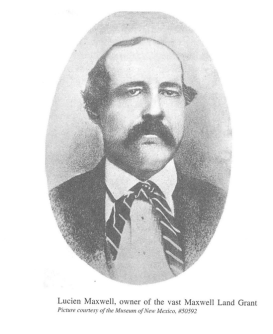
On January 6, 1868 Lucien Bonaparte Maxwell, co-owner of the Maxwell land grant, announced a public auction of 400 lots in Virginia City, a new town six miles east of today’s Elizabethtown. The new town was located along Willow Creek on Baldy Mountain’s southern slopes and  named after Maxwell’s seventeen-year-old daughter, Virginia.

lucien-maxwell

Unfortunately, the town got off to a slow start. Only fifteen houses were in the next two months. Due to poor sales, the town had collapsed by the time Virginia married U.S. Army officer A.S.B Keyes two years later without Maxwell’s permission. What little remains of Virginia City is now on private property.

Sources: Urban, Jack. C.. Lure, Lore, and Legends of the Moreno Valley. Angel Fire, NM: Moreno Valley Writers Guild, 1997: 32.  Murphy, Larry R. Philmont. A History of New Mexico’s Cimarron Country. Albuquerque: UNM Press, 1972: 90. Freiberger, Lucille. Lucien Maxwell: Villain or Visionary. Santa Fe: Sunstone Press, 1999: 103.