THE TIRED DOG

The red-bearded man in the tattered coat and a dirty blue bandana for a hat squatted in the middle of the adobe casita’s single room and scooped the thick stew into his mouth with his fingers, grunting with pleasure. The woman placed a small wooden plate piled high with tortillas beside him. The man sucked his fingers clean, then grabbed a tortilla and used it to shovel more food into his mouth.

The two children perched on the adobe banco in the corner stared silently at the strange americano until their mother motioned at them to go outside. She replenished the man’s stew, then followed them.

“Come como perro amarrado. He eats like a tired dog,” the girl said. She wrinkled her nose. “So rapidly and with no manners.”

Her mother turned from the wood pile, her arms full. “He is our guest,” she said reprovingly. “Come, bring more wood for the fire.”

When they reentered the house, the man had finished his meal.

“More?” the woman asked.

He shook his head. “No, but I thankee. That’s the first meal I’ve et in three days.” He cocked an eyebrow at her. “I’m lookin’ for the wife of Juan Leyba, the one that went to Elizabethtown two years ago t’ find work.”

The woman went still, her lips stiff with fear. She licked them nervously. “I am the wife of Juan Leyba, the one who went to that Elizabethtown to labor in the mines there.” She swallowed hard. “He is well?”

“Oh yes, ma’am!” the americano said. “I’m sorry to frighten you ma’am.” He pulled a small leather bag from a pocket and held it out. “This here’s from him. There’s about two ounces o’ gold in it. He says t’ use it t’ buy that land you wanted, or come to him, whichever seems best t’ you.” As she reached for the bag, he looked at the children and grinned. He shoved his hand into another pocket. “An’ he sent these fer the young uns. Gotta little linty in my pocket, but I think they’re all right.” His fingers opened, revealing a collection of hard candies, enough to keep a careful man going for at least a day and a half.

Copyright © Loretta Miles Tollefson 2017


Reverend McMains Hunts Franklin Tolby’s Killer

In Fall 1875, when Rev. Oscar P. McMains took over for the murdered Rev. Franklin J. Tolby, he provided more than ministerial services. He also played detective, and went to work hunting for Tolby’s killer. Colfax County’s collective finger pointed at Cruz Vega, a Civil War veteran who’d run the mail right past the spot in Cimarron Canyon where Tolby had died September 14th. But Vega hadn’t reported seeing Tolby’s body, which many locals deemed mighty suspicious.

Rev. McMains wanted badly to talk with Vega, but he was having trouble locating him. When he did find him, he was going to have another problem: McMains didn’t speak Spanish, the Mexican-born Vega’s native (and apparently only) language.

10 22 17 illustration.Oscar P. McMains
Source: NM Conference United Methodist History Journal, Nov. 2011

McMains first attempted to locate Vega through Isaiah Rinehart, the rancher that Territorial Governor Samuel Axtell would appoint Colfax County Sheriff the following spring. While Rinehart believed that Vega knew something about Tolby’s death, he declined to get involved: a logical stance for someone who wanted to stay in good standing with the Santa Fe Ring-enmeshed Governor. After all, the Ring was suspected of ordering Reverend Tolby’s execution.

But Reverend McMains was not a man to bow to the mighty or those connected to them, and he didn’t give up. Sometime in the period between October 21 and October 26, he convinced local miner and rancher William Lowe to help him “find” Cruz Vega in Lowe’s Ponil Creek cornfields north of Cimarron. Lowe agreed to hire Vega to watch his fields over the Halloween weekend and McMains arranged to be there with a translator on Saturday, October 30. What happened that night was a story worthy of Halloween. Stay tuned. . .

Sources: David L. Caffey, Chasing the Santa Fe Ring, UNM Press, 2014; Las Vegas Gazette, August 25, 1877; Chuck Parsons, Clay Allison, Portrait of a Shootist, Pioneer Book Publishers, 1983. Will Steinsiek, “O.P. McMains, The Agitator” in New Mexico Conference United Methodist History Journal, Nov. 2011.

FOR SAFETY’S SAKE

As Suzanna rounded the cabin from the garden, she saw Gerald in the yard loading his pistol. Both of the children stood beside him, watching intently.

“What are you doing?” Suzanna asked.

“We’re learning to shoot!” Andrew said gleefully.

Suzanna frowned. “We?” she asked. She looked at Gerald. “Andrew’s one thing, but Alma doesn’t need–”

“But I’m the oldest,” Alma said.

“She’s unfeminine enough,” Suzanna said to Gerald. “Always out fishing when she should be inside with her needlework.”

A smile flitted across his face. “Out here, everyone should know how to shoot,” he said mildly. “For safety’s sake.”

“More reason to move someplace civilized.” She turned and stalked toward the house.

“Can I load it, Papa?” Alma asked.

“Me, too!” Andrew said.

Gerald crouched down to show them again how it was done.

from Moreno Valley Sketches II


THE LOST SOUL

As Jorgé Ruibal wandered up the middle of the road toward Elizabethtown proper, the men outside the taberna watched him sympathetically. “El joven es como alma en pena,” Carlos Otero the jeweler said. “The young man is like a lost soul.”

“Si,” said the boy’s uncle. “He has lost his laborer job with Señor Bergmann. His papá is very angry with him.”

“I heard he was in love and that his love was unrequited,” Eduardo Suaso, the taberna’s musician, said.

María de la Luz, the boy’s cousin, appeared from around the corner of the building. She carried a basket of clean linens for delivery to Henri Lambert’s Etown restaurant and hotel. She gazed at Jorgé, who’d stopped to poke his foot at a stone in the road. “He wants to leave here, but his mamá is unwilling,” she said.

Jorgé, oblivious to these speculations, still stood in the dusty street, poking at the stone with his boot. It was so inert and yet so full of a kind of compressed energy. He looked east, toward the massive bulk of Baldy Mountain. The gullies that swung out from its sides were full of rocks and men scrambling through them looking for gold. Yet the mountain bulked there impassively, impervious to the miners who crawled over it. Jorgé crammed his hands in his pockets and stared upward, drinking in its stony greenness, its lack of engagement with the tiny men poking at its skin.

Outside the taberna, the americano miner called Hobart Mitchell came to the door with a drink in his hand and considered the staring boy. “He looks like’n idiot, standin’ there,” Mitchell said. “Touched in the head.”

The others all nodded noncommittally and continued to gaze sympathetically after Jorgé as he wandered on up the road.

 2017  © Loretta Miles Tollefson

New Mexico Territory’s Chief Justice is Fooled Again

Friday, April 1 was the first day of the Spring 1870 Court session in Colfax County, New Mexico Territory, and Judge Joseph G. Palen must have thought someone had pulled an April Fool’s joke on him. At the end of the 1869 Fall session, he’d made three local men responsible for selecting jurors for the Spring term, but it hadn’t done much good. Only six of the identified grand jury members had showed up, so the Judge ordered Sheriff Andrew J. Calhoun to bring in 15 more potential jurors. Which he did but eleven of them had excuses. The 57-year-old Harvard-educated Judge Palen must have wished he’d never accepted President Ulysses S. Grant’s offer to promote him from Hudson, New York postmaster to Chief Justice of the New Mexico Territorial Court and therefore Judge of the Territory’s First District, which included Colfax County.

April 1 illustration.1870 court transcript.resized

Something similar had happened at the beginning of the Fall 1869 session, Judge Palen’s first in Colfax County, and he’d thought he’d solved the problem by giving E.B. Dennison, Benjamin F. Houx, and John Sutton the task of ensuring there’d be enough jurors for the Spring Session. But even their fellow citizens couldn’t corral the miners and ranchers of Colfax County to do their civic duty.

Late that day, the Sheriff finally brought in enough men to fill out the grand jury panel, none of them with reasons strong enough excuse them from the task. However, Palen still had no petit jury members. It was the morning of Tuesday, April 5 before he had both panels in place. Which wouldn’t have been too much of a problem, except that the court session was scheduled to end on Saturday, April 9. There wasn’t much time to address the over 70 separate actions that came before the court during the week-long Spring 1870 session.

Sources: Chasing the Santa Fe Ring, David L. Caffey, UNM Press, 2014; Colfax County District Court Civil and Criminal Record 1, 1869-1871, Serial No. 14400; The Leading Facts of New Mexico History Vol. II, Ralph E. Twitchell, Sunstone Press, 2007.


Shadows

Dusk was falling on the back country road. The old car rattled on the washboard surface. Susan was driving, giving Carl a break. It had been a long and discouraging day. A shadow moved across the road ahead of her and she slowed. Carl opened his eyes.

“I thought I saw a deer,” she told him. “Up there on the left.”

He leaned forward, scanning the bank. “Stop a minute,” he said. “Look right there, next to the big ponderosa.”

She braked and looked, blinked and looked again. “That’s not a deer,” she whispered.

He shook his head. “It’s a cat. A big one.”

“A cougar,” she said. “Awesome.” And then there was nothing to see but shadows, rocks, and trees.

They grinned at each other. What a great day.

from Moreno Valley Sketches II

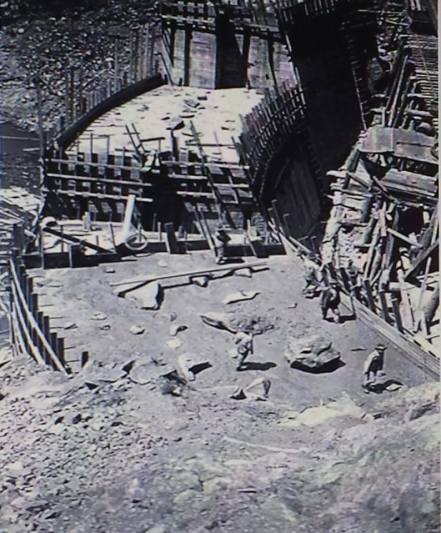
Eagle Nest Dam Finally Begins Construction

11188151_948738271824312_43356579046834581_n
Eagle Nest dam early in the construction process. Source: NM State Engineer’s Office.

On the brink of what would become known as World War I, in March 1917, construction on the Eagle Nest dam and reservoir at the head of the Cimarron Canyon had finally gotten  underway. The project had been held up for nine years while the Cimarron Valley Land Company, under the leadership of Charles Springer, fought to acquire the land that would be flooded by the impounded waters. Long-time Moreno Valley property owner Mary Gallagher had fought valiantly against the project, but when she died in 1916, her eight children seem to have quickly capitulated to the company’s demands. The deeds for the condemned lands were handed over on January 17, 1917, and work commenced. Even with the shortages in material, equipment, supplies, and laborers as a result of the war in Europe, construction proceeded rapidly and the dam was 90 percent complete by mid-December that year.

gallagher-protest-letter-cropped
Mary Gallagher’s 1907 letter protesting the dam and reservoir. Source: Office of the NM State Engineer

Sources: Charles Springer affidavit dated Jan. 29, 1921; Gallagher protest letter dated January 31, 1908.


Fishing

Almost as soon as he woke that morning, he decided to go fishing. There were chores to do, sure, but the sky was slightly overcast and the breeze was light and cool on his skin when he stepped onto the cabin’s porch. Good fishing weather.

He let the chickens out of their pen and gathered the eggs, then cut himself some bread. The cow hadn’t calved yet, so there was no butter, but that was all right.

He collected his pole and headed to the river. As he settled onto his heels just below the beaver ponds, he heard the swoosh of wings overhead. He looked up. A bald eagle was settling itself onto a snag at the head of the pool. A heron stood in the water below, apparently ignoring both eagle and man.

“Why in tarnation would any man want to live in a town?” the man wondered.

from Moreno Valley Sketches

Lucky

As they watched, a wild turkey hen stepped onto the frozen riverbed. She walked carefully up the ice-covered stream, stopping occasionally to peck at a fallen leaf or twig.

Finally, she disappeared into the coyote willow at the river’s edge. Carla let out a long breath and sat back against the Model T’s battered seat. She put her bare hands to her neck to warm them, and looked at her mother. “We’re really lucky,” she said.

“Why do you say that?” Eileen poured thin tea from the thermos into their single mug. She held it for a moment, warming her hands, then handed it to Carla.

“We see wild turkeys on a frozen river in January.” Carla sipped the tea carefully. “Not many people have that.”

Eileen looked out the cracked windshield, up at the bare cottonwoods etched against clear turquoise sky. “Not many do,” she agreed. “Not many do.”

from Moreno Valley Sketches II

Corn Damage, 3 of 3

Suzanna looked doubtfully at the tall, thick-bodied tan dog facing her. The man at Mora had generously loaned Gerald one of his three English mastiffs to test the theory that it would keep the deer from her cornfield.

“His name is Duke,” Gerald said, stroking the black-muzzled head. The dog’s tail wagged slowly as it studied Suzanna with sleepy brown eyes.

“He seems very docile,” she said.

“They were bred to hunt and are said to be very protective.” Gerald shrugged. “I guess we’ll just have to see.”

She nodded and watched as Gerald and the dog headed toward the cornfield, their own two mixed-breed dogs romping alongside. The mastiff majestically ignored the other dogs and Suzanna’s lips twitched. Then she shook her head and went back inside.

The barking began at daylight the next morning: high yips from their own dogs and a deeper, more solid sound. Suzanna rose and went to the window. The mongrels were at the edge of the corn patch, dancing around each other. As she watched, Duke appeared at a steady trot, circling the field.

Suzanna grabbed her shawl and went out onto the cabin porch, where she could see the entire patch. There were no deer in the corn. Duke circled the field again, stopping occasionally to mark its boundary, lift his head toward the hills above, and bark menacingly. There were deer on the hillside, moving steadily upward.

Suzanna turned toward the house. Gerald was standing in the doorway, watching her.

“How long will it take a puppy to grow to Duke’s size?” she asked, and he chuckled triumphantly.

from Moreno Valley Sketches II