CHICKEN FEED

Andrew had pilfered some of the chicken feed and scattered it on the snow for the finches.

Suzanna shook her head as she looked out the window. “That child,” she said.

“What’d he do now?” his father asked. He was sitting near the fire, mending mule harness.

“How did you know it was Andrew I spoke of?”

“You had that tone.” He smiled at her.

A small boy appeared on the ladder from the loft as Suzanna said, “There is chicken feed scattered outside, and the chickens are still penned up against the cold.”

The boy stopped suddenly, then began retreating upward.

“That’s not gonna work, son,” his father said.

“Perhaps next summer you should gather grass seed and set it aside for the birds,” Suzanna said, without turning.

He came to stand beside her. “They’re pretty, aren’t they?”

“And you are incorrigible.” She reached out to ruffle his hair.

from Valley of the Eagles

SALOON CHRISTMAS

María Dolores Quintana paused outside the Etown saloon door and adjusted her reboso over her long black hair, gathering her courage. She pushed tentatively, cracking the door open, then stopped to listen to the voices inside.

“Now that red-headed gal, she’s got a way of twistin’ her hips that’s sure to keep you hard and goin’,” a southern voice drawled.

“And the breasts on her are quite magnificent,” a German voice said. “It is sufficient just to look at them.”

Someone else chuckled from the other end of the room. “All you wanta do is look, huh? Can’t think of anything else to do, Faulk?”

“That is not quite what I intended to say,” the German voice said.

“He was just gettin’ started!” the southern voice laughed.

María took a deep breath. She must accustom herself to words such as these. This was the way men spoke of women who did the work she sought. She straightened her shoulders and pushed through the door.

The saloon was almost empty on this Thursday morning before Christmas. Two men sat at a table, one of them toying with a pack of cards. At the other end of the room, another man stood behind a long counter. This was the man María had been told to talk to. She dropped her reboso to her shoulders and crossed the creaking wooden floor quickly, before her nerve failed. The men at the table looked her over approvingly and her stomach clenched, but she kept moving. If she accomplished her goal, she would need to become used to such looks.

The sandy-haired man behind the bar studied her, unmoving.

Señor Stinson?” she asked.

He nodded, hazel eyes hooded.

“I come—” She paused, then started again. “My friend Carmen Martinez tells me I should speak to you about work.” A chair scraped on the floor behind her and she forced herself not to turn.

“What kind of work?” Stinson asked. “What’re you willing to do?”

“Whatever you ask, señor.”

Cards slapped onto the table behind her. “You’d better grab her right quick, Joe,” the southern voice  said.

“She has the looks that will earn you many dollars,” the German voice agreed.

Stinson frowned at the men at the table, then looked at María, his face carefully blank. “Have you done this kind of work before?”

“No señor, I have never done such a thing.” Behind her, a man chuckled. She focused on the saloon keeper and lifted her chin. “Carmen says I would do well. I have much incentive.”

He raised an eyebrow. Another chair scraped the floor.

Mi papá y mi hermano, they are dead,” she said. “I must find a way to feed mi mamá y mi—How do you say? My sister.”

“And how did these deaths occur?” the German voice asked.

María turned, in spite of herself. “The Maxwell Grant men, they came and told us to leave our land,” she said. “My brother, he was angry and he shot at them, and then they killed both him and mi papá.” She shuddered and turned back to Stinson. “I will do anything you ask, señor.”

Joseph Stinson opened his mouth, but the southern voice interjected. “Hell, Stinson, surely you ain’t gonna ask this sweet thing to do you now, are you? It’s almost Christmas, man!”

Stinson put both his hands on the bar and glowered at the men behind her. “If you gentlemen will hold your questions and opinions the way you hold your cards, you’ll learn what I’m going to do.” He looked at María. “Do you have folks to go to?”

She nodded. “My mother’s familia has moved north to the valley of the San Juan. If it please God, when I have earned what we need, we will go there also.”

“Well, I can’t help you much–” Stinson began.

“Like hell you can’t!” the southern voice said.

“But I’m sure that Mr. Hill and Mr. Faulk would be glad to contribute from their ill-gotten gains to also assist you.”

María turned and looked at the men at the table, who smiled back at her sheepishly. “I am Ernest Faulk,” the short stocky man with the German voice said courteously. “I would be most happy to assist you.”

She shook her head. “But I must earn what I receive.”

“It is almost Christmas,” the sleek, dark-haired man called Mr. Hill said. “And this year the day is especially holy, because it falls on a Sunday.” He glanced at Mr. Faulk. “Ernest and I are gamblers by trade and there is much for which we should repent and atone. Let us begin to redeem ourselves by assisting you.”

Ernest Faulk nodded. “For the sake of the Christ child.” He pulled a small leather bag from his vest pocket, began to open it, then tossed the whole thing on the table. María heard the dull chink of coins.

Mr. Hill considered the bag, then reached into his own pocket. “And I’ll raise you one,” he said. He pulled out two small bags of coins and placed them beside the first one.

Joseph Stinson had come out from behind the bar. He crossed to the table and laid a handful of greenbacks beside the bags. Then he scooped them all up and carried them to the girl. “Merry Christmas,” he said.

“Fröhliche Weihnachten,” echoed Ernest Faulk.

“And a most felicitous New Year,” said Mr. Hill.

Mariá stared at the men, then down at the wealth in her hands. “It is more than I could dream,” she murmured. She looked up, her eyes swimming. “I have no words,” she said.

All three men spread their hands at the same time. “Es nada,” they answered.

Copyright © 2016 Loretta Miles Tollefson


Stephen Elkins Takes Lucrative Federal Position

On Saturday, December 22, 1866, New Mexico Territory’s acting Governor W.F.M. Arny appointed Stephen B. Elkins Territorial Attorney General, putting Elkins into the first of a series of Federal positions that would be extremely beneficial to his bank account.

William Frederick Milton Arny had arrived in New Mexico in 1861 as President Lincoln’s  Indian Agent to the Ute and Jicarilla Apache of northern New Mexico. Stationed at what is now Cimarron, Arny worked to provide agricultural opportunities for the Native Americans for whom he was responsible. However, he was moved out of this position to that of Territorial Secretary in 1862, where he served under Governor Henry Connelly until Connelly’s death in July 1866. Arny served as interim Governor about six months, until Robert B. Mitchell took over. During that period, he appointed Stephen B. Elkins to his new job.

The two men seem to have been quite different in their approach to New Mexico. Even after he was no longer Indian agent, Arny continued to work for what he saw as the good of Native Americans in New Mexico and to express his opinions about Native American issues, even when they weren’t popular. He opposed moving the Navajo people to Bosque Redondo and suffered the political consequences of that stance. He died in Santa Fe in 1881, virtually penniless.

Dec 22 illustration.Arny, W. F. M

Elkins, on the other hand, seems to have always been focused on his own needs. He arrived in New Mexico in 1863, after resigning from his position as Captain in the Union Army in the middle of the Civil War. Elected to the Territorial House of Representatives the following year, he moved from there into Federal positions, beginning with his appointment as Attorney General. When his right to the job was challenged by Governor Mitchell, he negotiated himself into being named the Territorial U.S. District Attorney instead.

While District Attorney, Elkins also practiced law with Thomas Catron. He was elected New Mexico’s Congressional Delegate in 1872 and served two terms, during which he worked to delay New Mexico statehood, an event he and Catron felt would be detrimental to their business activities, which included land grant speculation and other questionable practices.

Elkins left New Mexico in 1877 and moved to West Virginia. There, he served as Secretary of War during the Benjamin Harrison administration and was elected to the U.S. Senate. He remained Senator until his death, all the while continuing to dabble in shady enterprises. These included exploiting the government-owned Alaska fur seal industry and participating in the mail contracts that played into the Star Route mail frauds exposed in 1881.

By the time Elkins died in 1911, he was wealthy enough to have co-founded Davis and Elkins College in Elkins, West Virginia. He left behind a legacy, both financial and educational.

But I’m still inclined to think that Arny was the better man. Even if he did give Elkins a leg up in his political career.

Sources: Don Bullis, New Mexico Biographical Dictionary, Vol. I, Rio Grande Books: Los Ranchos de Albuquerque, 2007; Howard R. Lamar, The Reader’s Encyclopedia of the American West, Harper & Row, New York, 1977; Hal Stratton and Paul Farley, Office Of The Attorney General, State Of New Mexico History, Powers And Responsibilities 1846-1990, State of New Mexico, 1990.


Book Review: But Time And Chance

Chavez.But Time and Chance.cover
by Fray Angelico Chavez
Sunstone Press, 1981
ISBN: 978-0913270950

Padre Antonio Jose Martinez is perhaps  New Mexico’s most famous home-grown priest, and his chroniclers seem to either heartily disapprove of him or love him unconditionally. Fray Angelico Chavez’s But Time And Chance appears to try to fall somewhere between the two, striving for neutrality. I’m not sure he succeeds, but I believe this is still a valuable book for students of New Mexico history.

But Time And Chance provides a good overview of Martinez’s life and his conflict with Bishop Lamy and also describes Martinez’s background, and his relationship with his constituents and the Americanos who were so prevalent in Taos during his lifetime. Certainly, this book helped me to get a better feel for Martinez’s role in the politics of the day.

However, I do feel that Chavez spends more time than necessary in this book sifting through the Taos baptismal records to attempt to identify possible children Martinez may have fathered. Some of the evidence Chavez presents in this endeavor seems a little thin. I also question the idea that a mental health issue lay at the heart of the Padre’s actions in his later years, after he was excommunicated by Bishop Lamy.

However, despite my disagreements with Fray Chavez, I still found this book helpful in providing insight into Padre Martinez’s character and the times in which he lived. At the very least, it’s certainly a more well-rounded depiction of him than is Willa Cather’s Death Comes to the Archbishop.

I believe But Time and Chance is a book that anyone interested in Padre Martinez’s life and works should definitely include in their list of items to read.


Land Grant Controversy Begins!!!!

On Friday, December 8, 1843, Taos residents Ceran St. Vrain and Cornelio Vigil asked the Governor of New Mexico to grant them the equivalent of 922 square leagues (over four million acres) of land in what is now southern Colorado. The acreage in question included the valleys of the Greenhorn, Huerfano, Apishapa, Cucharas, and Purgatoire Rivers. St. Vrain and Vigil said they intended to use it to “encourage the agriculture of the country to such a degree as to establish its flourishing condition” and to raise cattle and sheep south of the Arkansas River and opposite Bent’s Fort.

They got what they wanted. By January 4 of the following year, they were in possession.

And they did raise cattle and sheep on the land. Between 1844 and 1847, fifteen to sixteen hundred head of cattle grazed there.

But then the Americans showed up. After things settled down following the Mexican-American War, the new government informed the owners of all the land grants in New Mexico that they needed to prove their right to the property in question.

Vigil had died in the Taos revolt in 1847, and by this time the land had been sold to or inherited by various parties, but they were all interested in pursuing title to the grant. On June 4, 1857, thirteen and a half years after Vigil and St. Vrain took possession, the owners presented the required documentation and waited for an answer.

Things went smoothly enough at first. On September 17, Surveyor General William Pelham approved what was now being called the Las Animas grant and recommended that Congress confirm it.

The first sign of trouble was during the review by the House’s Committee on Private Land Claims. The committee was taken aback when they realized the land grant documents didn’t identify the number of acres involved. Instead, it laid out the grant boundaries, which included a spot “one and one-half leagues below the junction of the San Carlos River . . . thence following in a direct line to the south, until it reaches the foot of the first mountain, two leagues west of the Huerfano River…” The committee stalled for a while on this traditional terminology, but eventually did recommend approval.

And then the Bill reached the Senate. Here the boundaries description wasn’t the problem. The grant simply contained too much land to be handed over to private control. The Senate was willing to approve 22 square leagues (97,514.53 acres), but not over four million. Donaciano Vigil and the others protested, but the Civil War broke out right about then and the case was set aside for more pressing concerns.

Dec 8 illustration.Colorado Land Grants

When Congress finally returned to the issue in 1869, it confirmed its original 22 square league decision, but granted the owners the right to choose which part of the land to retain.

However, in the meantime, grant owners had sold parcels to other people, people whose land was now in danger of being considered public domain. There would be further court battles and examinations of evidence until the United States Supreme Court handed down a final ruling on December 3, 1900, almost exactly 57 years after Ceran St. Vrain and Cornelio Vigil first requested the land.

The answer was still “no.” Sometimes it’s just not worth it to keep pressing your case.

Sources: J.J. Bowden, “Las Animas Grant,” New Mexico State Record Center and Archives, accessed via  dev.newmexicohistory.org/ filedetails.php? fileID=25012, 11/4/19; Marc Simmons, Kit Carson and His Three Wives, University of New Mexico Press, Albuquerque, 2003; Ralph E. Twitchell The Leading Facts of New Mexican History, Vol. 2, Cedar Rapids: Torch Press; Victor Westphall, Mercedes Reales, Hispanic Land Grants of the Upper Rio Grand Region, University of New Mexico Press, Albuquerque, 1983.


MISNOMER

“Who you callin’ squirt?” The tall young man with the long sun bleached hair moved toward him down the bar, broad shoulders tense under his heavy flannel shirt.

“I didn’t mean anything,” the man said apologetically. The premature wrinkles in his face were creased with dirt.  Clearly a local pit miner. He gestured toward the tables. “I heard them callin’ you that. Thought it was your name.”

“Only my oldest friends call me that,” the young man said.

“Sorry ’bout that,” the other man said. He stuck out his hand. “Name’s Pete. They call me Gold Dust Pete, ’cuz that’s all I’ve come up with so far.”

They shook. “I’m Alfred,” the younger man said. “My grandfather called me Squirt. It kinda got passed down as a joke when I started getting my growth on.”

Pete chuckled. “I can see why it was funny,” he agreed. “Have a drink?”

from Valley of the Eagles

Top New Mexico Republican Murdered!!!!

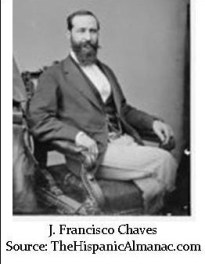
Early on Sunday morning, November 27, 1904, news reached Santa Fe that J. Francisco Chaves was dead. Chaves had been eating dinner at a friend’s house at Pino’s Wells in Torrance County when a lone gunman shot through the window of the room he was in, then escaped on horseback.

The murder was shocking both because of its Wild West nature and because of the victim’s status in New Mexico. Born at Los Padillas in what is now Valencia County, the 71-year-old Chaves was considered the father of the Territory’s Republican party. He was a veteran of the battle of Valverde and subsequently commander at Fort Wingate. The was followed by service as Territorial Delegate to Congress from 1865 to 1871 and also as New Mexico’s Superintendent of Public Instruction. By 1904, he’d served in the Territorial Legislature for almost 30 years and was a longtime friend and political ally of Governor Miguel Otero.

Nov 27 illustration.Chaves

But political power had apparently given Chaves a sense that he wasn’t obliged to abide by other men’s rules. He was a strong supporter of the idea that New Mexico should be made a state as soon as possible and had been working hard at the territorial and national levels to make that happen. When Bernard Rodey, New Mexico’s delegate to Congress, came out in opposition to immediate statehood, Chaves was furious.
But he didn’t confront Rodey, who was up for reelection. Instead, he publicly supported Rodey’s candidacy, while quietly arranging for another man to get the Republican nomination to the position.

Chaves’s candidate would win that election and proceed to Congress, but Chaves wouldn’t live to see his success. He was dead by then, killed in a way that contributed to the idea that New Mexico Territory was still a violent frontier and not ready yet for statehood.

The behavior of the new Delegate didn’t help matters. Within seven weeks of his arrival in Washington, D.C., scandal engulfed him, raising further questions about New Mexico’s right to become a full-fledged state. It would be another eight years before the cloud lifted and New Mexico achieved Chaves’ desire. One has to wonder if Statehood would have happened sooner if Chaves hadn’t tried to hurry it along.

Sources: David V. Holtby, Forty-Seventh Star, New Mexico’s Struggle For Statehood, University of Oklahoma Press, Norman, 2012.; Frank H. H. Roberts and Ralph E. Twitchell, History and Civics of New Mexico, Robert O. Law Company, Chicago, 1914; Jerry D. Thompson, A Civil War History of the New Mexico Volunteers and Militia, University of New Mexico Press, Albuquerque, 2015; Ralph E. Twitchell, The Leading FActs of New mexican History Vol. III, The Torch Press, Cedar Rapids, 1917.

WINTER STOP, MORENO VALLEY

There was no grass visible, covered as it was by three feet of snow. Clouds obscured Aqua Fria Peak, meaning there’d be more snow in the night. The lower branches of the aspens had clearly felt the teeth of hungry deer and elk. There’d no doubt be wolves shadowing their flanks.

Old Pete cut branches for the two pack mules and created a feeding pile. They came eagerly to investigate.

What they left would clearly indicate the passing of a stranger, but he didn’t expect anyone was watching for him, anyhow. And by midday tomorrow the pile would be just another white-mounded windfall.

He added wood to the fire and pulled the buffalo robe tighter around his shoulders. He wished he had some coffee or Taos lightning. The snow-melt water was hot enough to warm him, but something with a kick in it would feel mighty handy right about now.


Mail Escort Survives October Snow

Captain Louis Felsenthal and the men of New Mexico’s Fort Union’s Company C were out in the field in September and October 1864, escorting mail-and-passenger stagecoaches between Fort Lyon and Fort Union. This should have been pleasant enough duty on the Plains in the fall of the year—the heat reduced, plenty of grass for the mules pulling the supply wagons, golden trees lining the rivers that crossed the open prairie.

But the duty wasn’t pleasant. The weather that fall was unusually cold. By October 20, Felsenthal and his men were experiencing snowstorms every few days. They hadn’t expected these kinds of conditions and didn’t have winter clothing with them. They must have been glad when their two-month rotation ended and they could head back to Fort Union.

They were en route to the Fort, on the north side of Raton Pass, when they were caught in the worst snowstorm they’d seen to date. The company and its animals struggled up and over the Pass, then down to Red River Station, where they sheltered as snow continued to fall all that night and through the next morning.

At that point, the snow on level ground was over a foot and a half deep. And still coming down. It fell steadily snow for two more days until Felsenthal, worried about the lack of forage for the mules, decided to break for Fort Union.

Oct 29 post illustration.Felsenthal

Four days later, after marching through snow that reached to their waists, men, wagons, and mules arrived at Lucien B. Maxwell’s ranch in what is today’s Cimarron). By the time they got there, many of the men had frostbitten feet and most of them were snow blind from the glare of the sun on the snow. But they’d all made it.

One reason Felsenthal and his men survived their trek is that a herd of cattle destined for Fort Union was also marooned by the storm at Red River Station. As a result, the Captain was able to buy 378 pounds of beef to feed his men, giving them the fuel they needed for their coming journey.

They were also fortunate to reach Red River Station when they did. The storm that closed in after Company C arrived there extended north and east across the Colorado plains, creating deep drifts on the stage route between Bent’s Old Fort and Denver and making the divide between the Arkansas and the Platte Rivers particularly treacherous.

You can just never tell what the weather’s going to do on the Western Plains.

Sources: Jacqueline Dorgan McKenna, Louis Felsenthal, Citizen Soldier of Territorial New Mexico, Albuquerque: University of New Mexico Press, 1982; Morris F. Taylor, First Mail West, stagecoach lines on the santa fe trail, Albuquerque: University of New Mexico Press, 1971.

THIS HORRID WIND

The boy woke in the night to wind howling through the rafters and down the rock-and-mortar chimney. The chimney stack passed through the cabin loft and the boy’s sleeping pallet lay next to one end of the stack. He reached to touch the chimney. The stones were icy cold. The boy grimaced. The morning fire would take an extra-long time to light. The kindling itself would be cold. He scrunched farther into the blankets, seeking his own warmth.

At the other end of the chimney, his sister stirred. “Is that wind?” she asked sleepily.

“Banshees,” he said.

She made a chuckling sound and he grinned, more awake now, and suddenly cheerful. “Elk on the roof, bugling,” he said.

“Wolves at the door,” she suggested.

“Wolves in the fireplace.”

“Werewolves howling.”

“La llorona weeping for her children.”

The wind gusted sharply. The cabin shuddered, then a sustained high-pitched howl set up under the roof overhang outside.

“La llorona screeching for her children!” the girl giggled, trying to stifle her voice, and then the boy was laughing too, not so quietly.

The wind dropped abruptly and there was a rustle of movement at the base of the ladder. “What in tarnation are you two doing up there?” their father called softly from below. “Your mother is trying to sleep.”

“But not succeeding,” their mother’s voice said. Lamplight flared from the dark space at the edge of the loft. “You two might as well come on down,” she said. “This horrid wind is keeping us all awake.”

Loretta Miles Tollefson © 2017