Let The Evictions Begin!!!

In the summer of 1870, the Maxwell Land Grant and Railway Company closed their sale with Lucien B. and Luz Maxwell for the Beaubien-Miranda Land Grant and the Company began moving to take full possession of the land. This move began with sending notices to anyone who hadn’t arranged with Maxwell for formal title to their land, including miners who had paid Maxwell for the privilege of working their mines or farmers who had been providing produce in lieu of cash money. These “squatters” were informed that they must either make arrangements with the Company or leave. When they didn’t the Company initiated ejectment proceedings. Conveniently, Stephen B. Elkins, a member of the Company Board and the company’s attorney, also happened to be New Mexico Territory’s U.S. Attorney General at the time. None of these cases appeared before the court in the Fall 1870 session, so it appears that there was some time provided to the persons in question who had the resources to make the necessary “arrangements.”

The process was not a smooth or a simple one and the Company’s actions reverberated as far as the East Coast. By the summer of 1875, a series of articles had appeared in a New York newspaper criticizing Santa Fe ring members Elkins, Catron, Palen and others. One of the authors was the Reverend Franklin Tolby, who used his pulpit as a platform for preaching against the Land Grant Company’s eviction process and advocating that the government buy at least of a portion of the grant  as a reservation for the local bands of Utes and Arapahos—a solution to the “Indian problem” that Kit Carson and Indian Agent William Frederick Milton Arny  had proposed prior to the sale of the grant. After all, they’d been here first. This, of course, didn’t happen and local settlers would continue to be evicted and tensions would continue to rise throughout the first half of the 1870’s, beginning with a riot in Etown in 1870 and reaching a crescendo in 1875 with Reverend Tolby’s death and the lynching of a (possibly) innocent man. Stay with me as I look at Reverend Tolby’s activities and death, and the resulting lynching, in the months to come….

Sources: David L. Caffey, Chasing the Santa Fe Ring, University of New Mexico Press, 2014; Stephen Zimmer, For Good or Bad, People of the Cimarron Country, Sunstone Press, 1999; Victor Westphall, Thomas B. Catron and His Era, University of Arizona Press, 1973.

THE SERIAL KILLER NOVEL

Pain and Sorrow cover.framed

My novel about New Mexico Territory’s serial killer Charles Kennedy and the teenage wife who turned him in is now available for pre-order!

The Pain and the Sorrow is set in the 1860’s in Taos, New Mexico Territory and the mountains east of Taos. It tells the story of a teenage Hispanic girl who marries an American man who turns out to . . . . Click here or on the cover image to find out more!

Published by Sunstone Press, The Pain and the Sorrow will be available on or before August 1.

Eagle Nest Lake Application Goes to NM Territorial Engineer

150 years ago today, on June 12, 1907, Colfax County rancher and businessman Charles Springer submitted an application to the New Mexico Territorial Engineer to build a dam at the head of the Cimarron River, thereby creating what would become known as Eagle Nest Lake.

June 12.illustration.b

The application called for impounding 113,700 acre feet of what it called “surplus flood waters”  from the Cimarron and its tributaries: Cieneguilla, Moreno, and other creeks in the Cimarron watershed.  The water would be “used for power plants as it goes down Cimarron canyon and for irrigation, for supplying cities and towns and water users generally, . . . for irrigating, mining power and other purposes.”

June 12.illustration

Charles Springer, who had arrived in the Territory in 1878, was brother to Frank Springer, one-time attorney for the Maxwell Land Grant Company. The Springer application to dam the headwaters of the Cimarron was approved in August 1907. Due to a variety of issues, including lack of capital and the need to buy the lands to be flooded from the people who owned them, construction of the impound dam did not get underway until Spring 1917.


Source: Anderson, History of New Mexico Its Resources and People, Pacific States Publishing, 1907; June and August 1907 application for NM State Engineer permit #71


HOLLOW

Lucien Maxwell, single largest landowner in New Mexico Territory, stepped from the Middaugh Mercantile porch into early June sunlight and gazed unseeing across the green valley. On the flanks of Baldy Mountain, construction workers scurried like ants around a long wooden aquaduct-like structure. When finished, the flume it held would carry water from the Red River’s source to Baldy Mountain’s base. Then high pressure hoses would spray the sides of the gulches that drained the mountain, flushing out gravel and the gold the miners hoped it contained.

They were calling the flume the Big Ditch. It was a first for New Mexico Territory. Maxwell was a major investor, likely to make a substantial return both from water sales and from men wanting to buy mining rights. Yet all he could see was the letter in his hand.

Kit Carson was dead. Kit, the companion of so many of Lucien’s wilderness adventures, always so full of energy, so confident in his quiet-spoken way, with his sixth sense for trouble and how to meet it. Yes, Kit had been ill, but it was still incomprehensible that he could be gone. Lucien Maxwell gazed at the men scrambling across the hillside opposite and could feel no joy in their activity and its outcomes. It all seemed rather hollow, somehow.


Copyright © 2016 Loretta Miles Tollefson

Timber Rail Moves Out From Cimarron

150 years ago this month, in the middle of June 1907, the Cimarron & Northwestern Railroad Company began laying track out of Cimarron, west toward the Ponil timber country, in what is today part of the Valle Vidal Unit of the Carson National Forest.

Work on the tracks had begun earlier that year. The Cimarron & Northwestern was a wholly-owned subsidiary of the Continental Tie and Lumber Company, whose president, T.A. Schomburg was a former Maxwell Land Grant Co. employee. The sole purpose of the Cimarron  & Northwestern line was to get timber out of the canyons of the Ponil. This timber would be turned into railroad ties for freight and passenger rail lines such as the Santa Fe and Colorado & Southern, red spruce mining props for the coal fields in the region, and building lumber.

Mining camps and small sawmills to pre-process the lumber grew up along the rail tracks which moved up the branches of the Ponil. Independent logging crews spread out into the forest and were remarkably efficient considering that they were felling the trees by hand. They could often bring in as many as 100 trees per day. The most effective way of doing this was to clearcut, leaving only diseased or deformed trees and the slash from the felled ones behind.

June 3 illustration.news article

Some of the timber was milled right there in the Ponil. Others were taken to East Cimarron, where it was dried, planed, treated, and packaged before being shipped out. Between the mill, the train staff, and the loggers coming into Cimarron for supplies, the lumber industry was an important boost to the town’s economy.

Even with a slump in lumber prices in the first few years, the project still did well financially, with the Continental Company paying a $6,000 royalty to the Maxwell Company in 1907, $16,000 in 1908, and $87,943 in 1910. For the next ten years, the forest continued to provide wealth to the area, but gradually the supply of usable timber thinned and, almost exactly 23 years after track construction got underway in Cimarron, on June 3, 1930, the company notified the New Mexico Interstate Commerce Commission that they wanted to abandon what was left of the track between Cimarron and the South Ponil. Due to the Depression, demand for timber had dropped sharply and capital wasn’t available for more construction. Even if there’d been a market, much of the land had been sold to private owners and large-operation logging was no longer feasible. The rails that were removed are thought to have been shipped to San Francisco, where they were sold to a Japanese industrialist.

Sources: Lawrence R. Murphy Philmont, A History of New Mexico’s Cimarron Country, UNM Press, 1972; Stephen Zimmer and Steve Lewis, It Happened in Cimarron Country, Eagle Trail Press, 2013.

Baldy Mountain Mining Problems Solved!!!!

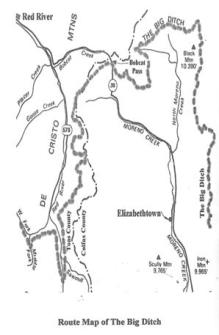
May 28 illustration.Big Ditch route map
Source: Red River Museum pamphlet

The miners in the Elizabethtown, New Mexico area were mighty frustrated. There just wasn’t enough water to satisfy their need to wash the gold out of the flanks of Baldy Mountain. They were willing to pay, but there was no one selling. But on May 28, 1868, their problem appeared to be on the way to being solved, because construction began on the Big Ditch.

Designed by a East Coast-educated former Army Engineer Capt. N.S. Davis, the Big Ditch project would employ over 400 men to construct a 41-mile system of reservoirs, dams, and wooden trestles that would funnel Red River’s headwaters to the placer mines on Baldy Mountain’s western flanks. About 7.6 million gallons per day (600 miner’s inches) were anticipated, water enough to supply all the miners in the district.

Or so they thought. The problem was that, as the water sat in the three reservoirs, then flowed through the landscape and the primarily wooden flumes on its 41 mile route to the mines, leakage in the flume and evaporation into the dry New Mexico air sucked much of the anticipated liquid right out of the system. When the water bean to flow the following July, only about 1/6 of the expected amount actually reached its destination. Just over one million gallons a day, or about 100 miners inches, remained for the miners to use.

May 28 illustration.Big Ditch flume

Not only was there not enough water, selling what there was wouldn’t return the $280,000 cost of construction to the original investors. The price of 50 cents per miner’s inch simply didn’t cover the amount invested. The Big Ditch changed hands several times until it was eventually sold to Irish-born Matthew Lynch, who jerry-rigged the system sufficiently to provide for his own hydraulic mining operations and leave a small surplus to sell. So the Big Ditch did turn out to be useful, just not to the level originally projected.

Sources: Red River City, A history of northern New Mexico, J. Rush Pierce, JRP Publications, Red River, NM, 2008; The Leading Facts of New Mexican History, Ralph Emerson Twitchell, Sunstone Press, 2007.


Obsession

“Did you know the Maxwell Land Grant Company is evicting people who’ve been farming here for decades?” the Reverend Franklin Tolby demanded.

At the other end of the small pine table, Mary Tolby moved a raised biscuit from the chipped ceramic platter to her plate. “That’s terrible,” she said. “These biscuits are quite good this time. I think I’ve finally gotten used to that stove. Ruthie, eat your peas or there’ll be no dessert.”

Her husband picked absently at his food. “It’s a moral outrage,” he said. “They have no right.”

Mary looked anxiously at his pale face. Since they’d arrived in Cimarron, Franklin had been on horseback constantly, west to Elizabethtown, south to Fort Union and beyond, yet his cheeks showed no evidence of windburn or sun.

“I’ve made strawberry pie for desert,” she said. “An Indian girl came by selling berries. They’re very sweet. The result should be quite tasty.”

Franklin’s eyes focused on her for a split second, then his head snapped up, as if he were listening to something outside the house. “And the Indians,” he said. “With this much land, there’s room for them also.” He paused for a long moment, fork in the air, then said, “Excuse me,” dropped his frayed linen napkin onto the table, and hurried from the room. She heard him scrabbling through the papers on his desk as he prepared to write down whatever had just come to him.

Mary sighed and reached to cover the food on his half-empty plate with a clean napkin. “Ruthie, eat your peas,” she said absently.

Copyright © 2016 Loretta Miles Tollefson

Valley of the Eagles

It was spring in the valley of the eagles, which meant it had been raining off and on for three weeks and the usually adobe-hard clay soil was soft enough to be dug. Once Old Bill had selected a likely spot for caching the packs of beaver fur, Pepe set to work. Old Bill stood farther up the hillside, chanting in a mixture of Osage and Ute. The prayers would help keep varmints away, Bill had said: both the two-footed and four-footed kind.

It was a good location for a cache, Pepe reflected: tucked under the hillside pines and marked by a massive sandstone boulder that would be easy to identify when they returned. After the Taos alcalde had decided that the few beaver plews they’d set aside to show him were truly Old Bill’s entire winter haul,  Pepe and Old Bill would slip back into the valley with a Taos trader to turn the cached furs into coin. Then Pepe would have a nice amount to take home to his wife while Old Bill gambled his own portion away.

Pepe chuckled and paused his digging to wipe his forehead with his cotton sleeve. He was always surprised at how warm it could get in this valley, as high up in the mountains as it was.

Small stones rattled past him and Old Bill came down the hillside. “War’s th’ other shovel?” he demanded in his nasal twang. “We ain’t got th’ rest o’ eternity!”

Copyright © 2016 Loretta Miles Tollefson

The Fourth Time

She could be incandescently angry and Gerald’s trip to Santa Fe and back had taken a week longer than he’d told her it would, so he braced himself as he opened the cabin door. But Suzanna barely raised her head from the rocking chair by the fire. She wasn’t rocking. Her shawl was clutched to her chest, her face drawn and gray under the smooth, creamy-brown skin. She glanced at Gerald, then turned her face back to the flames, her cheeks tracked with tears.

Gerald’s stomach clenched. “What is it?” he asked. “The children?”

Suzanna shook her head without looking at him. “The children are fine,” she said dully. She moved a hand from the shawl and placed it on her belly. The tears started again and she looked up at him bleakly. “This is the fourth time,” she said. “There will—” She closed her eyes and shook her head. “There will be no third child,” she choked, and he crossed the room, knelt beside her, and wordlessly took her into his arms.

Copyright © 2016 Loretta Miles Tollefson

Outsiders Buy Maxwell Land Grant

May 9 illustration.Maxwell Land Grant 1870In May 1870, the newly-incorporated Maxwell Land Grant and Railway Corporation, with a capital stock of $5 million, began the process of taking possession of what had been the Beaubien/Miranda Land Grant, and what formed the majority of New Mexico’s Colfax County. A $1.35 million contract to purchase the grant from Lucien Bonaparte Maxwell and Maria de la Luz Beaubien Maxwell had been signed in late April. However, there’d been a small glitch in the process because the investors purchasing were English. Only Americans were allowed to hold property in New Mexico Territory. So a corporation board of Americans was assembled. Even then, most of the men on the board would have been considered “outsiders” by anyone who’d been born and raised in New Mexico. Only one of them was originally from New Mexico and only two of them would die here.

The most prominent member of the board was William A. Pile, New Mexico Territorial Governor. Pile hailed from Indiana and would go on to represent the U.S. in Venezuela—and Venezuela in the U.S.—before his death in California in 1889.

Dr. Thomas Rush Spencer, Territorial Surveyor General, was originally from Ontario County, New York. Besides his participation in the Maxwell Land Grant and Railway Corporation board, Spencer also owned a 20 percent interest in the Mora Land grant. He died in Santa Fe two years after the board incorporated.

John S. Watts, former New Mexico Chief Justice and Territorial delegate to Congress, had been in New Mexico almost twenty years. Originally from Indiana, he would return there within the next few years and be buried there in 1876.

General William Jackson Palmer, Pennsylvania-born Colorado real estate magnate and railroad builder, seems to have never actually lived in New Mexico, although he was prominent in Colorado Territory, co-founding the Denver & Rio Grande Railroad and founding Colorado Springs, where he passed away in 1909.

May 9 illustration.Miguel Antonio Otero I.from Twitchell Leading Facts
Source: Ralph Emerson Twitchell, The Leading Facts of New New Mexican History

The only “native” member of the Maxwell Land Grant and Railway Corporation board was Miguel Antonio Otero, the father of future Territorial Governor Miguel Otero (1897-1906). The elder Otero was born in Valencia County in 1829 and educated in the eastern United States as a lawyer. He returned home to serve as the Territorial Delegate to Congress from 1855 to 1861 and to participate in various mercantile, banking, and railroad ventures, including the Maxwell Land Grant & Railway Corporation. He died in Las Vegas, New Mexico in 1882.

Sources: The Government of New Mexico by Thomas C. Donnelly, UNM Press, 1953; Lucien Maxwell, Villain or Visionary, Harriet Freiberger, Sunstone Press, SF, 1999; Roadside History of Colorado, Candy Moulton, Mountain Press, Missoula, 2006; The Leading Facts of New Mexican History, Ralph Emerson Twitchell Vol. II, Sunstone Press, 2007; Telling New Mexico, Marta Weigle, Ed., Museum of NM Press, Santa Fe, 2009; The Public Domain in New Mexico, 1854-1891, Victor Westphall, U of NM Press, Albuquerque, 1965; Thomas Benton Catron and His Era, Victor Westphall, U of AZ Press, Tucson, AZ, 1973;  http://newmexicohistory.org/people/william-a-pile accessed 3/27/17;  http://www.findagrave.com/thomas rush spencer accessed 3/27/17; http://cozine.com/2011-june/william-jackson-palmer-1836-1909.