“Me and Joe didn’ come alla way out here jus’ to cook for no white men,” Frank Edwards grumbled as he slammed dirty dishes into the hotel sink. “You’d think we was still slaves in Kentucky.”
“You be only eighteen,” Louis the cook said. He positioned a pan of potatoes on the wooden table and picked up the pealing knife. “And what’s Joe, twenty three? You all have plenty o’ time.”
Joe Williams came in the door with an armload of firewood. “I here tell there’s a gold claim for sale in Humbug Gulch,” he told Frank as he dumped the wood into the bin next to the stove. “They askin’ seventy-five dollars.”
Frank’s hands stopped moving in the dishwater. “You reckon we got enough?”
Louis looked up from his potatoes. “You two listen to me and you listen good,” he said sharply. “You go to minin’ and you’re gonna lose every penny you have. Miners gotta eat, even when they so broke they sellin’ their claims. Stick to feedin’ ’em and you’ll do better in th’ long run.”
Frank and Joe looked at each other and shrugged. “We don’t got enough anyway,” Joe said. He jerked his head sideways, toward Louis. “An’ the old man has a point.”
“You better watch who you callin’ an old man,” Louis said gruffly. “And that wood box ain’t full enough yet, neither. Not by a long shot.”
On Wednesday, December 4, 1861, Governor Henry Connelly issued his first proclamation as New Mexico’s governor. Ironically, his message came almost exactly fifteen years after he’d been arrested south of Mesilla by Mexican authorities and taken to Chihuahua.
In 1846, Connelly has been suspected of being part of the invading American Army, which was sweeping south across New Mexico, en route to the Sonora desert, California, and possession of the entire continent.
Now, in 1861, Connelly’s proclamation warned of another invasion, this one moving north from the Mesilla area into the rest of New Mexico. This time, the invasion was from Texas, which had recently joined the Confederate States of America. The Governor’s proclamation called for volunteers to fight the invading forces.
Near Mesilla, at Fort Bliss, the former commander of New Mexico’s Fort Union, Confederate General Henry H. Sibley, was preparing his own proclamation to the citizens of New Mexico. It was addressed to his “old comrades in arms” and declared that his troops’ goal was to free New Mexicans from the “yoke of military despotism.”
But the thought of Texas trying yet again to invade New Mexico, as they had in 1841, swayed the Territory’s citizens more powerfully than Sibley’s reminder that they lived under a rule enforced from Washington DC.
Governor Connelly’s rhetoric was more convincing. “The enemy is Texas and the Texans,” he declared. That was enough for New Mexico’s citizens. The Territory raised five regiments of volunteers and one of militia, as well as three independent militia companies and four independent cavalry companies with three-month enlistments. In all, 3,500 New Mexicans fought for the Union—and against Texas—in the War Between the States.
Sources: Rubén Sálaz Márquez, New Mexico, a brief multi-history, Cosmic House, Albuquerque, 1999; Jerry D. Thompson, A Civil War History of the New Mexico Volunteers and Militia, UNM Press, Albuquerque, 2015.
“Make it stop,” the little boy moaned. He rubbed his ears with his fingers and rocked himself back and forth in his mother’s lap. “Mama, please make it stop.”
“I wish I could,” Alma said, stroking his golden hair. She pulled him closer to her chest, then began moving the rocking chair rhythmically back and forth.
“It hurts,” he whimpered.
“I know.” She gazed out the window at the clouds scudding across the Moreno Valley sky. The spring winds had always been a sign to her of coming warmth and green things sprouting. Until now. Until the pain from the changing air pressure had reduced her energy-filled child into a whimpering puppy hiding in her lap.
The rocking chair’s rhythm and the warmth of her arms was relaxing him into sleep. She stroked his head gently and he snuggled closer. Alma smiled. She had planned to start turning the garden soil today. It could wait until tomorrow, she decided. Until the wind had subsided at least a little.
In mid November, 1875, the Utes and Apaches gathered at New Mexico’s Cimarron Indian agency for their treaty-mandated weekly distribution of food, and their patience ran out.
Both tribes had been complaining for several years that the flour doled out to them was hardly fit for anything and that the distributed meat was from worn-out Santa Fe Trail oxen too tough to eat. But the meat they were offered in mid November 1875 was worse than anything they’d seen yet. It was rotten.
This was the last straw. The Apaches, at least, had had enough, and shots rang out. The agency employees retreated into the agency office, in what is now Cimarron’s Old Mill Museum.
With Indians firing into the mill, and agency staff firing outside, several people, including Indian agent Alexander G. Irvine, were injured.
Aztec Grist Mill, Cimarron, New Mexico. J.S. Pierce Collection
Eventually, the Apaches withdrew. In spite of his wounds, Irvine headed to the telegraph office and wired Fort Union for reinforcements, which arrived the next day. The troop officer went to the Apache camp and talked them into a meeting in Cimarron. But the gathering wasn’t a productive one. Irvine was interested only in who’d fired a gun, not the quality of the food he’d been distributing. He issued an ultimatum: If the Apaches didn’t hand over Juan Barilla, Juan Julian, and a man named Chico, he’d stop distributions entirely.
The Apaches refused this proposal and headed back to camp. But somewhere along the way, Juan Barilla was unlucky enough to get himself arrested and thrown into the Cimarron jail. On Tuesday, November 23, he attempted to break out and was killed in the ensuing scuffle.
The Apaches were furious. They wanted someone to pay for what they viewed as Barilla’s murder.
Irvine just wanted out. He resigned his position and suggested that the Army take over. The authorities at Fort Union not only agreed to this proposition but wired General Nelson A. Miles in Kansas for help.
As a well-known Indian fighter, General Miles could have been expected to move immediately into action against the Apaches in the Cimarron area. Instead, he took the time to do a little investigating and concluded that the government had failed miserably in its responsibilities toward the Native Americans assigned to the Agency. He put a military man in charge at the Mill, established new procedures, and left town satisfied that he’d averted serious hostilities.
Whether Juan Barilla’s friends and families were satisfied is another question entirely. But at least they had better food distributed to them after his death.
Source: Lawrence R. Murphy, Philmont, a history of New Mexic’s Cimarron Country, UNM Press, Albuquerque, 1972.
In mid October 1862, troops led by Captain James “Paddy” Graydon of Fort Stanton killed at least eleven Mescalero Apaches at Gallinas Springs, on the west slopes of New Mexico’s Gallinas Peak. The circumstances were murky, but Graydon was thought to have gotten the Mescaleros drunk and then shot them down in cold blood.
Whatever had occurred, Graydon’s fellow officer Major Arthur Morrison believed Graydon had acted improperly. He demanded an official investigation. But when Colonel Christopher “Kit” Carson took command at the Fort Stanton later that month, he declined to get involved. After all, he wasn’t sure what had actually happened at Gallinas Springs.
However, Carson knew what happened next. Dr. John Marmaduke Whitlock of Las Vegas and Santa Fe arrived at Fort Stanton in early November and he wasted no time forming an opinion about Gallinas Springs. He heard all about it from Major Morrison, who he knew from Las Vegas. Whitlock was outraged at the news of the purported massacre, and he wasted no time in jumping into action. He excoriated Graydon at the Fort and also wrote a letter to the Santa Fe Gazette condemning the Captain.
Major Arthur Morrison, Museum of New Mexico Photo Collection
Graydon was not pleased, to put it mildly. On the evening of Thursday, November 4, he confronted Whitlock and demanded an explanation. Whitlock put him off, saying he’d give Graydon the “satisfaction you desire” in the morning.
They were both apparently ready to render ‘satisfaction’ the next morning. The two men fired simultaneously. Although they were just yards apart, neither was hit. They continued to exchange shots, with Graydon behind a wagon and Whitlock crouched behind a nearby soldier’s tent in true gunfight style. Eventually, they managed to hit each other at the same time. Graydon was wounded in the chest and Whitlock took bullets in his side and his hand.
Soldiers carried Graydon into a nearby tent while Whitlock retreated into the sutler’s store, pursued by thirty of Graydon’s men, Lt. Philip Morris in the lead. When bullets started breaking through the store windows and door, Whitlock exited through the back door toward headquarters and Colonel Carson’s protection.
He didn’t make it. He was shot down, thrown into an icy ditch, and then shot some more. Lt. Morris was so beside himself with rage that when he ran out of bullets, he began pelting Whitlock’s body with rocks.
Three days later, 31-year-old Captain Graydon was also dead. One of Whitlock’s bullets had pierced his left lung.
In Carson’s opinion, the men responsible for Whitlock’s death deserved to “swing before sunset.” They got a court-martial instead, a somewhat pedestrian outcome to a bloody deed, especially the one at Gallinas Springs that precipitated the whole episode.
Source: Jerry D. Thompson, A Civil War History of the New Mexico Volunteers and Militia, UNM Press, Albuquerque, 2015.
“No, don’t go out there now,” Maria said. “It is late and there is no moon. El es oscuro como boca de lobo.”
“How d’you know how dark it is inside a wolf’s mouth?” Alvin Little grumbled as he put on his boots. “Leave me be.” He paused again, listening. The sound came again, the rattle of sticks tumbling off the pile of kindling just outside the door. “I spent two hours yesterday cuttin’ that kindling and I’m damned if someone’s gonna go stealin’ it.”
“El noche es más mala que Judas,” she protested. “It is unsafe.”
He reached for the door latch, then turned to look at her. “More evil than who? Judas, you say? Where d’you get this stuff?”
He stopped on the sill and shook his head as he peered into the darkness. A pale sliver of moon and no starlight. Heavy clouds blanketing the sky. He chuckled. So this was what a wolf’s mouth looked like. He leaned forward and peered at the wood piled alongside the cabin. He could just see the once neatly stacked kindling. Sticks lay haphazardly at the foot of the pile, as if someone had tried to climb it. Alvin scowled and stepped into the yard to gather them up.
A slight scratching sound came from the wooden roof, but Alvin didn’t have time to do more than lift his head before the mountain lion was on top of him, or hear more than Maria’s single scream before the big cat’s teeth found his throat.
“It’s s’posed to be August, dadburn it.” Julius Fairfield looked gloomily out the door of the long, narrow log cabin that served as the Quartz Mill & Lode Mining Company barracks outside of Elizabethtown. “This fog is thicker’n snot.”
In one of the iron beds lining the walls behind him, somebody sneezed. “And there’s the snot for ye,” Edward Kelly, the company’s lone Irishman, chortled as he added more wood to the pot belly stove halfway down the room.
A door opened at the far end and the chief engineer came out. He ignored the men in the beds as he walked down the room to peer over Fairfield’s shoulder. “That fog’ll lift shortly,” he said. He clapped Fairfield on the back. “Be thankful it’s not rain.”
“That was yesterday’s gift to us all,” Fairfield said gloomily. He shook his head. “And here I thought New Mexico Territory’d be drier than New York.” He grinned and glanced at the engineer. “When’d you say payday was?”
Behind them, Kelly began to sing a song praising Ireland and its green hills, and a chorus of voices yowled at him to be still. The engineer chuckled and turned. “That’s enough now!” he said.
Three years after the Great Rebellion, Henry still drifted. There was nothing behind him in Georgia and nothing further west than San Francisco. Not that he wanted to go there. The California gold fields were played out.
But he needed to get out of Denver. A man could stand town life only so long and he’d been here three months. The Colorado gold fields were collasping, anyway. Played out before he even got here.
“Been too late since the day I was born,” he muttered, putting his whisky glass on the long wooden bar.
“I hear tell there’s gold in Elizabethtown,” the bartender said. He reached for Henry’s glass and began wiping it out. He knew Henry’s pockets were empty.
“Where’s Elizabethtown?”
“New Mexico Territory. Near Taos somewheres.”
Henry nodded and pushed himself away from the bar. “Elizabethtown,” he repeated as he hitched up his trousers. “Now there’s an idea.”
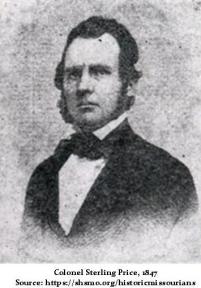
On Tuesday, Sept. 22, 1846, just over a month after Brigadier General Stephen Watts Kearny seized New Mexico for the United States, he appointed Virginia-born Taos businessman Charles Bent as New Mexico’s first American civil governor. When Kearny and the majority of his 1700-man force headed on to California to participate in acquiring it as well, Colonel Sterling Price, as senior U.S. Army officer in New Mexico, became its military governor.
Bent had been in Nuevomexico since 1829, first as a fur trapper, then as a Santa Fe trail trader based in Taos. He occupied his post as Governor less than four months. In mid-January 1847, he died at the hands of a New Mexican mob protesting the American occupation.
Two-and-a-half weeks later, Colonel Price, supported heavily by American businessmen and trappers in New Mexico, crushed that rebellion and assured that New Mexico would remain part of the United States.
Ironically, Price’s own career would include participation in an even larger rebellion against the nation he had helped to force on New Mexico. Following a term as Governor of Missouri, he joined the Confederate Army, rising to the level of General. He died on September 29, 1867, almost exactly 21 years after he took over as military governor of New Mexico.
Sources: Leroy R. Hafen, Ed., Fur Trappers and Traders of the Far Southwest, Logan: Utah State UP, 1977; Marc Simmons, New Mexico, an interpretive history, Albuquerque, UNM Press, 1988
Judge Palen flattened his palms against the rough wooden table that served as the Court bench and scowled at Sheriff Calhoun. “Are you telling me that you called twenty-one men for jury duty and only seven showed up?”
Calhoun was a big man, but he fingered the broad-brimmed hat in his hands like a schoolboy. “Yes, sir.”
“Well, go get fourteen more.”
The Sheriff nodded, turned, and crossed the creaking wooden floor.
Palen turned his attention to his seven potential jury members. “All right,” he said. “Now how many of you are going to have good excuses for not fulfilling your civic duty?”
Three of them sheepishly raised their hands. Palen nodded to his court clerk to begin taking their excuses and closed his eyes. And he’d thought this appointment as Chief Justice of New Mexico Territory and Judge of its First Judicial District was a logical step up from postmaster of Hudson, New York. He suppressed a sigh. How he missed the broad sweep of the river, the bustle of the town’s port. He grimaced and opened his eyes. Only four jurymen left. Damn this town, anyway. The whole of New Mexico Territory, for that matter.


 Fiction and Fact From Old New Mexico