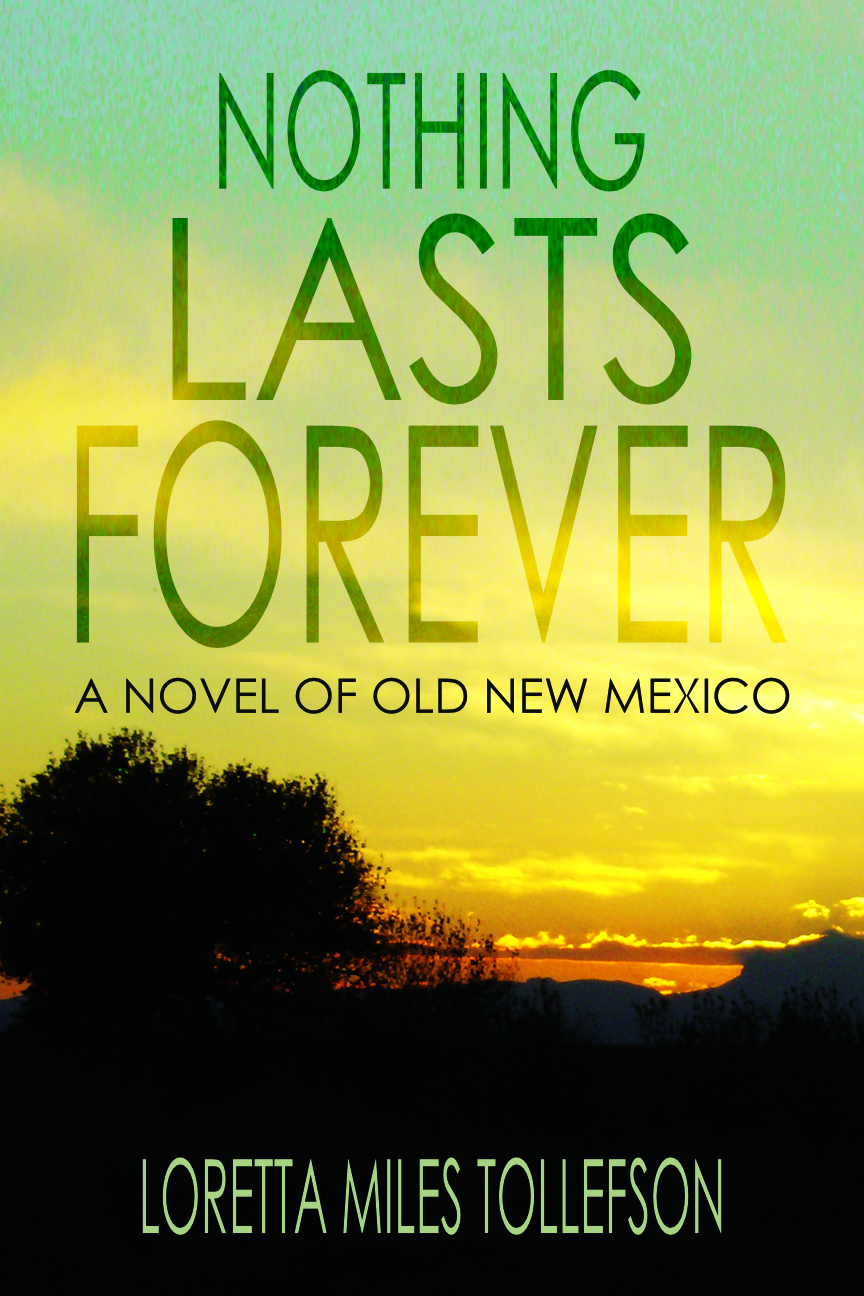
I am pleased to announce the publication of Nothing Lasts Forever, my latest Old New Mexico novel and the fourth volume of my Locke Family Saga series.
This book continues my emphasis on deeply researched historical fiction set in mid-1800s New Mexico and finds Alma Locke in Taos in late 1846/early 1847. Here’s the book description:
On Thursday, January 19, 1847, long-simmering tensions erupted in bloodshed in Taos, New Mexico, brought to a head by the recent American takeover during the Mexican American War. Within 24 hours, almost all the Americans in Taos were dead, including Governor Charles Bent.
The insurrection was eventually crushed by American forces in a final battle that destroyed the Taos Pueblo church. The trials that followed are renowned for their biased juries, foregone conclusions, and speed of execution.
Nothing Lasts Foreverexplores the tensions that fed the 1847 rebellion from the point of view of the fictional Alma Locke, in Taos to bury her mother, and Governor Bent’s five-year-old daughter, Teresina.
A heartbreaking novel of love, loss, and conflicting loyalties, Nothing Lasts Forever explores the personal conflicts behind the rebellion and how two families coped with their losses and struggled to make sense of unimaginable tragedy.
Although this is Book 4 of the Locke Family Saga, it can be read as a stand-alone novel.
Preparations for war were in full swing in Santa Fe that second week of August, 1846. Rumors of the approaching American army under Stephen Watts Kearny had been swirling all summer and became more concrete as time went on. New Mexico’s governor, Manuel Armijo, had fired letters off to the officials in Mexico City pleading for help and warning of the possibility that his paisanos would capitulate to the invaders without a fight.
Early in August, American trader Eugene Leitensdorfer arrived in Santa Fe with news. The U.S. Army was at Bent’s Fort. Armijo consulted with his council on Sunday, August 9, then sent out a call to New Mexico’s militia to assemble in Santa Fe. When they arrived, they headed for Apache Pass, east of the city, where they began digging trenches, throwing up barricades, and positioning cannon in. Things in Santa Fe were so tense that some of the American merchants there barricaded themselves in a store on the plaza, expecting to be arrested or even killed when the fighting began.
In the meantime, U.S. Army Capt. Philip St George Cooke and James Magoffin arrived in town on Wednesday, August 12. They carried a letter from Kearny and, rumor has it, a considerable amount of gold. They also brought news. Kearny’s army was not at Bent’s Fort any longer. It was already on New Mexican soil. In fact, Cooke was due to meet up with them at Las Vegas in the next couple days.
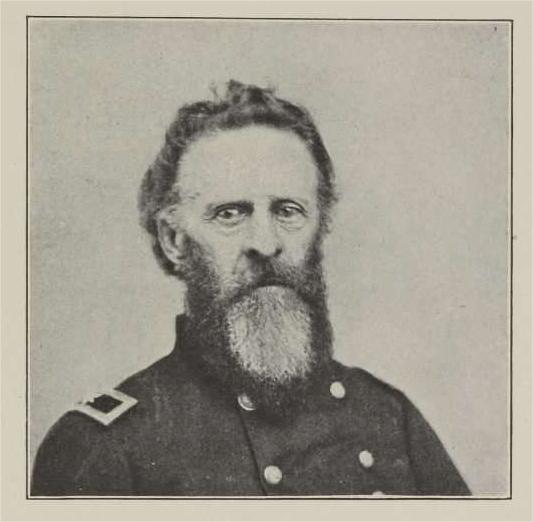
Philip St. George Cooke, circa 1860s. Courtesy of encyclopediavirginia.org
By the time that happened, on Saturday, August 15, it was clear to New Mexican officials that Governor Armijo was no longer anxious to defend the region from the invaders. He had gone from firing off letters, issuing bellicose proclamations, marshaling troops, and positioning cannon, to asking his officers whether he should really try to fight. When several of them said a vehement “yes!”, Armijo began complaining that the defenses he’d thrown up weren’t strong enough and that the men behind them were cowards who would run at the first shot.
Maybe word of Kearny’s takeover of Las Vegas and the number of U.S. troops had reached Armijo and he’d given up the idea of fighting. Or maybe he’d made his decision the night of August 12, during his conversation with Cooke and Magoffin. The only thing certain is that by the end of August 16th, the last Mexican governor of New Mexico had headed south toward Albuquerque and ultimately the interior of Mexico.
When Kearny and his men reached Apache Pass, they found it empty, although at least one of his officers thought the location could have been used effectively to at least slow them down.
But by then it was too late. The U.S. Army was in control of New Mexico and would quickly set up a new government to replace the old. All that excitement and fear had been for nothing. The New Mexicans had been completely cowed by America’s military might. Or so it seemed.
Sources: William A. Kelleher, Turmoil in New Mexico, 1846-1868; Marc Simmons, New Mexico; Howard R. Lamar, The Far Southwest; Ralph Emerson Twitchell, The Military Occupation of New Mexico.
In a recent post about the Santa Fe plaza, I included a set of maps. If you look closely, you’ll notice that even the oldest of them identifies a small building on the south side of the square as the “military chapel.”
More properly called the Military Chapel of Our Lady of Light, and commonly referred to as La Castrense, this building was centered in the buildings on the south side of the Plaza and faced the Governor’s Palace on the north. The word Castrense means “belonging to the military profession,” so its nickname was appropriate, because the little church was built specifically for use by the members of the Santa Fe garrison.
The original chapel was completed in 1717 and then rebuilt and rededicated in 1761. The reconstruction was funded by Governor Francisco Antonio Marin del Valle and his wife, Dona Maria Ignacia Martinez de Ugarte. This power couple also donated a new altar piece, or reredo, which was carved from large pieces of limestone quarried north of Santa Fe near Pojoaque. Said to be the largest and most ambitious piece of artistic work ever attempted in New Mexico to that point, the piece filled the entire altar end of the building.
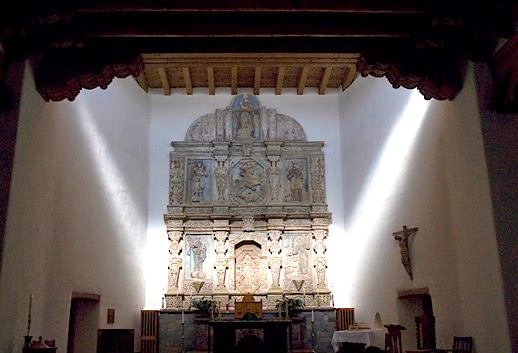
La Castrense altar piece today, courtesy El Cristo Rey Catholic Church, Santa Fe
The chapel received further decorations around 1813, when Pedro Bautista Pino, New Mexico’s representative to the Spanish Cadiz, returned from Europe with two marble bas-reliefs which were mounted on the outside wall above the door from the plaza. Colonel Francisco Perea remembered years later that one of them represented “Santa Gertrudes wrapped in the coils of a large serpent, while the other, I believe, represented the mother of Jesus, Nuestra Senora de la Luz (Our Lady of Light), recuing a human being from Satan.”
The military troops stationed in Santa Fe attended services in the chapel monthly as well as on special occasions. During Governor Manuel Armijo’s first two administrations, he and the full garrison attended regularly, with the officers in full uniform. However, it seems unlikely that they continued to do so during his third term (July 1845 to August 1846) as the roof had fallen in. At least, that’s what Lt. James W. Abert reported in early October 1846. He also said the building contained “some handsome carved work behind the altar,” and that at least one of the bas-reliefs still remained over the door, the one that showed Our Lady of Light.
Abert had entered Santa Fe in the Fall of 1846 with the occupying U.S. army. Five and a half years later, in Spring 1851, newly appointed Chief Justice Grafton Baker, needed a place to hold his court and decided to use La Castrense.
The building, apparently repaired by this time, was set up with the necessary furniture and the grand jury was called. Unfortunately for Judge Baker, the grand jury members included Santa Fe native and former Mexican soldier, Donaciano Vigil. Vigil and his wife had been married in the chapel, and his father and an infant son were buried there. As former provisional governor under the U.S. rule, he had enough political clout to risk protesting the use of the chapel for civil purposes and enough connections in the city to rally public opinion behind him.
Baker threatened to hold court anyway and to have Vigil arrested, but when a crowd began to assemble outside and the commanding officer of the American troops rallied behind Vigil, the Judge gave way. He ordered the court moved across the plaza to the Governor’s palace. The men responsible for shifting the furniture didn’t have to actually remove it from the building. The crowd had already dumped most of it in the plaza.
The building doesn’t seem to have been immediately converted back to being a chapel. According to the 1891 Silver City Enterprise, in the 1850s, it was instead used to store captured cannons, including the Lone Star of Texas which had come into New Mexico in 1841 with the ill-fated Texas Santa Fe Expedition.
The guns must not have stayed there for long, because in 1859 Bishop Lamy exchanged the building for $2000 and land in the vicinity of the Parish church. The money went to repairs for church and the land became the site of St. Michael’s College and the Loreto Chapel.
La Castrense itself was demolished by its new owner, but not until the altar piece was preserved and carefully removed. It is now in El Cristo Rey, which offers a brochure about the reredos on its website. It’s nice to know that, even though the building itself had to give way to “progress,” at least some of its contents were preserved and still survive.
Sources: James W. Abert, Western America in 1846-47; https://www.cristoreyparish.org/; Roland F. Dickey, New Mexico Village Arts; Francois-Marie Patorni, The French in New Mexico; Colonel Francisco Perea in Allison, “Santa Fe in 1837-1838”, Old Santa Fe Magazine, Vol. II; Silver City Enterprise, Oct. 9, 1891; Marc Simmons, Spanish Government in New Mexico; Francis Stanley, Giant in Lilliput; Maurilio Vigil and Helene Boudreau, Donaciano Vigil.
When Stephen W. Kearny’s Army of the West marched from Missouri to New Mexico in Summer 1846, they were trailed by a number of non-military wagons, most of them driven by merchants. One of these men was Samuel Magoffin, who brought along his wife of seven months, Susan Shelby Magoffin.
Once they reached Santa Fe, the Magoffins rented an adobe house that Susan called “quite a nice little place” with four rooms that included the kitchen, “our own chamber, [a] storage room, and the reception room,” or sala, which Susan described as a combination parlor, dining room, and “room of all work.”
She also said the house entrance opened into a courtyard with portals all around, so apparently this was the typical four-sided square with doors opening into a plazuela. The portals around this space provided shaded workspaces as well as areas for resting and relaxing.
The Magoffins’ reception room was long and narrow, typical of a sala, and had a dirt floor, plank ceiling, and white-washed walls. The lower part of the walls was covered with calico cloth, which protected the occupants from getting whitewash on their clothes. The parlor end of the room contained cushioned benches and woven black-and-white“Mexican carpeting,” probably jerga. The “naked floor” at the end of the room held a dining table and chairs.
Susan described the bedroom as “a nice cool little room, with two windows, which we can darken, or make light at pleasure.” I take this to mean the windows had shutters which could be opened and shut from inside. She doesn’t say whether the windows had glass in them. Glazed windows were pretty rare in New Mexico at the time, though it seems likely that a Kentucky-bred young woman would have been startled by the lack of them and mentioned her surprise. The fact that the house ceilings were plank, not perpendicular or herring-bone pattern latillas, indicates the building may have been constructed with American sensibilities in mind. If that’s the case, there very well might have been glass in the window openings.
A latilla ceiling, still seen in New Mexico homes. Photo courtesy of OlquinsSawmill.com
The flat roof did leak at one point. On Tuesday, September 22, Kearney and a couple officers had come for a visit and were about to leave when a thunderstorm hit. Rather than brave the storm, the visitors remained in their seats and “we continued in pleasant and merry chat,” Susan reports, “when suddenly the rain came pating onto the General, from the ceiling … Soon we were leaking all around, the mud roof coming with the water.” The damage must have not been too terrible. Young Mrs. Magoffin was out and about with the General the next day, taking a tour of Fort Marcy.
The little house would be Susan’s home for another couple weeks, until the Magoffins headed south on October 7, leaving the “nice little place” behind. Susan would not live anywhere for long, until 1852, when she and Samuel settled in Kirkwood, Missouri, where she died after giving birth to her third child.
Sources: Audra Bellmore, Old Santa Fe Today; Bainbridge Bunting, Early Architecture in New Mexico; Sheila Drumm, editor, Down the Santa Fe Trail and Into Mexico, Diary of Susan Shelby Magoffin, 1846-1847; John E. Sunder, ed., Matt Field on the Santa Fe Trail; El Rancho de los Golondrinas Guidebook; Chimayo Museum, Chimayo, New Mexico.
Shortly after American troops invaded New Mexico in Autumn 1846, they discovered four pieces of Mexican artillery in a village south of Santa Fe. Apparently, Governor Manuel Armijo had taken the guns with him when he fled, but abandoned them at Galisteo. One of these pieces was of special interest to the Americans because it had arrived in New Mexico by way of Texas.
The cannon, made in Springfield, MA, had accompanied the ill-fated 1841 Texan expedition to New Mexico. A brass six pounder, it had been cast with a Texas star on its breach and paid for by “patriotic ladies” of the newly formed republic. When the Texans straggled into eastern New Mexico in Fall 1841, they still had the gun with them, despite its weight and their exhaustion.
New Mexico Governor Manuel Armijo confiscated the cannon, of course, and reportedly displayed it in the Santa Fe plaza after he sent the captured Texans on to Mexico City. It was still there in 1846, when it and other artillery pieces were transferred to Apache Pass during the runup to the impeding American invasion.
When Armijo decided to flee instead of fight, he took the Texan gun and other artillery with him. Three of the gun carriages apparently broke down at Galisteo, and the governor was forced to abandon them as well as the weapons they carried. This included the Texan six-pounder, which the American troops dubbed the “Lone Star of Texas.”
Six pound cannon from the 1840-1860s period. Courtesy: U.S. Library of Congress
They transported the gun back to Santa Fe, where it was apparently once again placed on the plaza. Lt. Richard Smith Elliott says it was used in early November to assemble the officers for training drill.
We have no official record of the Texas cannon again until Brigadier General Sterling Price took it with him to Chihuahua. There, it saw action at Santa Cruz de Rosales, the last battle of the Mexican war, on March 16, 1848.
However, there is a possibility that this was not the first battle in which the Texan cannon was fired. A six-pound cannon played a conclusive role in the February 1847 battle at Taos Pueblo, when it was used to breach the walls of the church where the insurrectos were holed up. This gun may well have been the Lone Star.
After the battle at Santa Cruz de Rosales, the Texan cannon was returned to Santa Fe, where it was stored alongside other Mexican artillery pieces in La Castrense, the old military church on the south side of the plaza. It and the other guns were presumably cleared out when the Americans decided to use the building as a courtroom. What happened to it after that remains a mystery.
Sources: Mark L. Gardner and Marc Simmons, Eds., The Mexican War Correspondence of Richard Smith Elliott; Silver City New Mexico Enterprise, October 9th 1891, courtesy Silver City Library.
In mid April 1847, the Taos Valley was still experiencing the aftermath of theJanuary 20 rebellion.
The U.S. Army had captured a total of 45 rebels. They released 24 for lack of evidence and tried 21. The trials were over, but the executions weren’t. Seventeen men would hang, one of them for high treason.
The high treason charge was questionable. An argument could be made that a person couldn’t rebel against a country to which they had not pledged allegiance. The war with Mexico wasn’t over. New Mexico was still officially part of occupied Mexico, and its people were still citizens of that country. There’d been a trial in early January which had found the high treason charge suspect. But that didn’t stop 26-year-old prosecuting attorney Francis P. Blaire, Jr. from continuing to use it.
In early March, Blaire filed the charge against three men: Antonio Maria Trujillo, Pantaleon Archuleta, Trinidad Barceló, and Pedro Vigil. Apparently the only rebel trials held in Santa Fe, the charges against Archuleta, Barceló, and Pedro Vigil were eventually dropped after the proceedings ended in a mistrial.
Trujillo was found guilty, but because he was elderly and unwell, the jury and judge requested that the sentence be commuted. Military GovernorSterling Price granted the pardon, and Santa Fe was spared a demonstration of the effectiveness of the gallows.
Taos wasn’t. Of the eighteen prisoners tried there, all were convicted and hung.
There had been a single execution on February 7 of Pablo Montoya, one of the rebellion leaders, but the remainder waited until April, when the formal trials began.
These hangings started on Friday, April 9, when Hipolito (Polo) Salazar, Jose Manuel Garcia, Pedro Lucero, Juan Ramon Trujillo, and the Romero brothers Ysidro and Manuel, age sixteen, were executed two days after their trials. Salazar had been convicted of high treason, but the rest of these men were found guilty of killing American-appointed Governor Charles Bent.
The eleven remaining convicted rebels had to wait to meet their end. Most of them would die three weeks later, on Friday, April 30. These executions seem to have occurred in two batches. The six men from Taos Pueblo—Francisco Naranjo, Jose Gabriel Romero (or Samora), Juan Domingo Martin, Juan Antonio Lucero, and a man called El Cuervo—were apparently hanged at the same time. They were buried at the Pueblo at the church which had been destroyed by the Americans in early February.
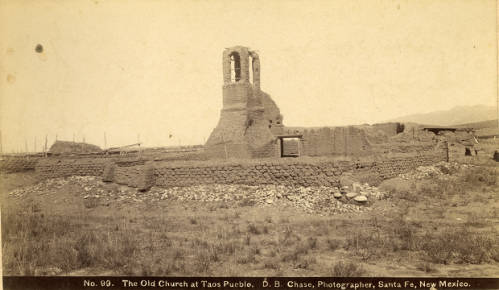
Ruins of the Taos Pueblo church. Source: Palace of the Governors Archives
Four other men—Manuel Miera, Juan Pacheco, Manuel Sandoval, and Rafael Tafoya—were also executed that day. Then, on the following Friday, Juan Antonio Avila was hanged for his role in the insurrection.
Why the week-long delay? There’s no information in the records. I’d love to know the answer to this question, just as I’d like to know why the trials of Trujillo, Barceló, Archuleta, and Vigil were held in Santa Fe and the reasons for the mistrials for latter three men. Was this a procedural issue? Was family pressure brought to bear?
I’m especially curious about the case of Trinidad Barceló. He was the older brother of businesswoman Gertrudes Barceló, who had assisted the U.S. occupiers in suppressing a revolt the previous December. Did her support of the regime play a part in her brother’s release?
What about the other two: Archuleta and Vigil? Were they related to Acting Governor Donaciano Vigil or some other prominent New Mexican who the Americans wanted on their side?
And then there are the stories of the men who died: their reasons for resistance, the impact on their families, the pain or joy they left behind.
Sources: David C. Beyreis, Blood in the Borderlands; Mary J. Straw Cook, Doña Tules; James A. Crutchfield, Revolt at Taos; Mark L. Gardner and Marc Simmons, eds., The Mexican War Correspondence of Richard Smith Elliott; Lewis H. Garrard, Wah-to-ya and the Taos Trail; Lucy Lippard, Pueblo Chico, Land and Lives in Galisteo since 1814; Michael McNierney, ed. Taos 1847, The Revolt in Contemporary Accounts; Alberto Vidaurre in Corina A. Santistevan and JuliaMoore, Taos, A Topical History.
The recent suggestion that the U.S. should annex Canada and Greenland sounds strikingly familiar. The same argument—that the land masses in question are strategically important and therefore must become part of the U.S.—was used in the runup to what we now call the Mexican American War.
Throughout the 1840s public sentiment grew in support of seizing what was “rightfully ours.” It was our manifest destiny to own everything to the Pacific Ocean. And it would be easy enough to do. After all, as Sam Houston put it “Mexicans are no better than Indians,” and we’d seized indigenous lands easily enough. Besides, Mexican leadership was corrupt and cowardly. George Wilkins Kendall had asserted this in his book about the 1841 Texas Santa Fe Expedition. So it must be true.
The only question was how to make the war Mexico’s fault. First, we needed to elect a President who was committed to the Big Steal. This was accomplished when James A. Polk was elected. Then, we needed to aggravate Mexico into an angry response. This was initiated at Polk’s March 4, 1845 inauguration when he promised to annex Texas, the “Republic” which Mexico still considered in rebellion and not independent from it at all.
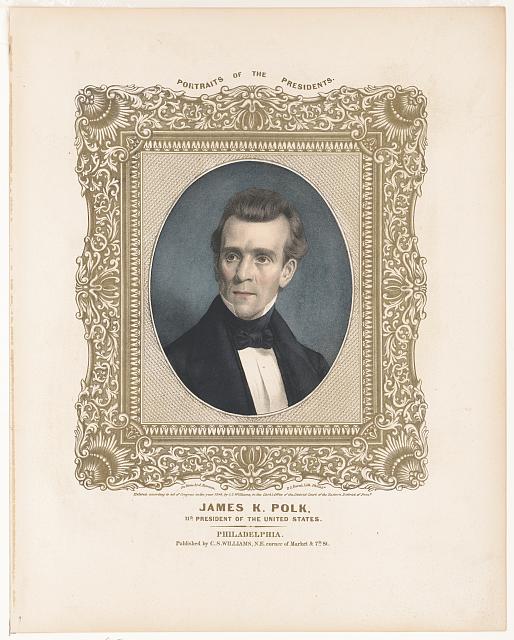
James K. Polk, Source: Library of Congress
In reply to Polk’s pronouncement, Mexico’s minister to Washington lodged a formal objection, closed his mission, and left for home. Mexico City severed ties. This gave Polk the excuse he was looking for. He ordered General Zachary Taylor to move his troops to the southern border and then into the Nueces Strip, which both Texas and Mexico claimed.
While Taylor was doing that, the President sent John Fremont to find a western route to California. He also ordered Major Richard B. Lee to Santa Fe. Lee’s subsequent September 1845 report to Washington included an invasion route, pertinent distances, recommended rendezvous points, estimated costs, and the proposed composition of the necessary military forces.
But the Mexicans still weren’t cooperating. They still hadn’t declared war. So, in December 1845, Polk upped the stakes by overseeing the formal annexation of Texas to the U.S. That did it. Four months later, Mexican soldiers crossed the Rio Grande and killed American troops. This and other bloody encounters gave the President the excuse he needed to present the U.S. House of Representatives with a declaration of war.
The bill he sent them wasn’t just a declaration of war. It also authorized funding for General Taylor’s men. A vote against the war was a vote against the troops on the ground. This was the first coercive declaration/funding bill combination in American history. Former President and now Congressman John Quincy Adams was one of the courageous 14 who voted against the proposal. Everyone else caved. It took them two hours.
Polk still had to get the legislation through the U.S. Senate. The powerful Thomas Hart Benton, who agreed that the country should expand westward, was opposed to taking the land by force, at least not “without full discussion and much more consideration”. However, after much arm-twisting, he eventually voted in favor. Senator John C. Calhoun of South Carolina didn’t. He abstained. Polk was “pregnant with evil,” he declared later, and what the Executive Branch had done by combining the two bills would “enable all future Presidents to bring about a state of things, in which Congress shall be forced, … to declare war, regardless of its justice or expediency.”
They called it “Mr. Polk’s War.” Not everyone supported it, of course. There were letters to the editor and other resistance, especially in abolitionist New England. In Concord, Massachusetts, abolitionists Henry David Thoreau and Bronson Alcott (Louisa May Alcott’s father) both refused to pay taxes because they saw what Polk and his faction were doing as a bid to expand slavery into the Southwest.
U.S. and Mexico Boundaries, 1846
None of the vituperations and protests did any good, though. The drive west continued, taking everything before it. In the end, President Polk had his way, and the U.S. annexed the land mass that became what is today the states of New Mexico, Arizona, Utah, Nevada, and California as well of parts of Colorado, Wyoming, Kansas, and Oklahoma.
I’m not sure what the events of 1846/47 suggest regarding the current proposal to annex Canada and Greenland. That resistance is futile? That resistance is important even if it’s ultimately unsuccessful? Or, that we should try to make every effort to ensure that history doesn’t repeat itself?
All I know is, this isn’t the first time an American President has pushed forward with his agenda regardless of the question of right or wrong. There are, of course, plenty of other examples of this approach to U.S. political life, though the runup to the Mexican War is perhaps the most explicit correlation to current events. Will we add the acquisition of Canada and Greenland to the list of sins we need to expiate? Only time will tell.
Sources: James A. Crutchfield, Revolt at Taos, the New Mexican and Indian Insurrection of 1847; Amy S. Greenberg, A Wicked War: Polk, Clay, Lincoln, and the 1846 U.S. Invasion of Mexico; W. Eugene Hollon, The Southwest: Old and New; Wilson in David Grant Noble, Santa Fe, History of an Ancient City; historyofmassachusetts.org/henry-david-thoreau-arrested-for-nonpayment-of-poll-tax
In myforthcoming novel set in Santa Fe, New Mexico, the young people at the heart of the story don’t go home after church. They go to the plaza. They aren’t the only ones. In fact, American newcomers to the city were often shocked at what they saw as a desecration of the Sabbath. People weren’t merely walking. They were shopping, dancing, and gambling, and probably drinking as well.
This Sunday ritual didn’t change after the U.S. Army invaded in 1846. Lt. Abert tells us that “in the square all the people congregate to sell their marketing and one constantly sees objects to interest and amuse. It is filled with donkeys laden with immense packs of wood, fodder, melons, and other articles. The soldiers too are constantly passing and mingling in a motley group.”
Part of the reason for this activity on the plaza was that it was a pleasant place to be. Even Susan Magoffin, who had little else good to say about New Mexico, found that the square made for “a fine walk.” “The Plaza or square is very large,” she reported. The Governor’s Palace, or palacio, with a wide portal in front, formed the north side of the square, while a church and dwelling houses faced it on the south. “The two remaining sides are fronted by stores and dwellings, all with portals,” she added. “In rainy weather there is no use for an umbrella.”
The portales, or verandas, Magoffin mentioned provided shade for the buildings and were shaded themselves by what Magoffin described as a circle of trees around the square. These were cottonwoods which had been planted only a couple years before, probably using the pole planting method. A small irrigation ditch, or acequia, ran alongside the trees.
Under the portales, vendors sold everything from pottery to sweet onions. There were plenty of other ways to spend one’s money as well, namely gambling. One didn’t have to go indoors to indulge in this pastime. Out-of-doors games included pitarria, which was played on smooth ground inside a marked square, with short sticks of two colors. Quoit pitching, using pegs driven into the ground, was also available.
Those who wanted to gamble could play monte, both with a full deck of Spanish cards, and a three-card version. Roulette was also popular, as were various games of dice.
Later, if one liked, someone in town was apt to be holding a dance, and everyone was welcome, from the priest to the criminal released from jail for the evening. Everybody danced, the lady with the ragged farm worker, the old man with the little girl.
Newcomers also disapproved of the city’s open door dancing policy. Matt Fields tells us of a ball given by the Governor in 1839 which “all the beauty and fashion attended, and also all the rabble,” adding, “the dances, as well as all the manners and customs in Santa Fe, are of a demi-barbarian character”. Nineteenth century Americans, whose country was founded on democratic principles, were certainly quick to make negative social distinctions.
Sources: W.H.H. Allison, Old Santa Fe Magazine, 2:2, “Santa Fe During the Winter of 1837-1838”; Sheila Drumm, Down the Santa Fe Trail and Into Mexico, Diary of Susan Shelby Magoffin 1846-1847; Janet LeCompte in Joan M. Jensen and Darlis M. Miller, New Mexico Women, Intercultural Perspectives; Clyde and Mae Reed Porter, Matt Field on the Santa Fe Trail.
In my March 5 post, I mentioned that one of the things that nineteenth century Americans disparaged when they first arrived in New Mexico was what they called “mud houses.” Newspaper correspondent Matt Field wasn’t the only person to describe Santa Fe as a “mud built city” of one-story buildings that reminded him “of an assemblage of mole hills.”
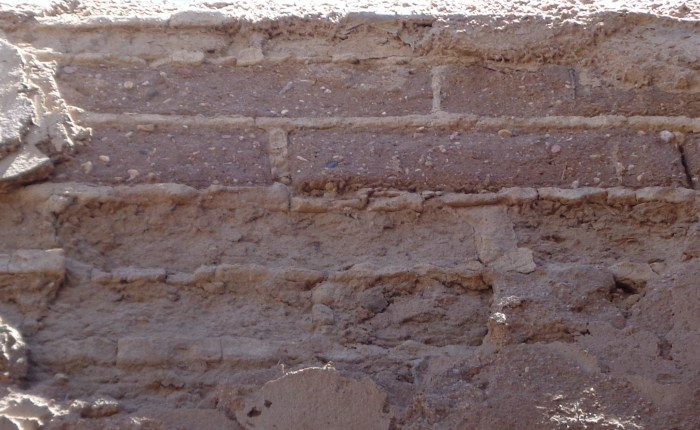
Technically, Field was right. The buildings, even the churches, were in fact built of a mixture of earth and water. These carefully formed bricks had evolved from the indigenous practice of puddled mud construction and by the 1800s were created by packing a stiff, dough-like mud into a rectangular wooden frame that was then lifted away from the resulting block. Two days later, the brick was dry enough to be turned on end and a week later, hard enough to be stacked and cured for another month. To speed up the drying process, adobe makers in the upper Rio Grande region often added straw.
Adobe bricks were used to construct one-story buildings but, with proper buttressing, the walls could be extended higher. Field noted that the Santa Fe parish church was built “as high and quite as large as any of our [U.S.] ordinary size meeting houses.”
He also noted that the adobe walls were strong and durable. In fact, they were so strong and durable that the Fort the invading Americans constructed on the hill overlooking the church in the Fall of 1846 was made of double walls of adobe bricks with a core of rubble between them.
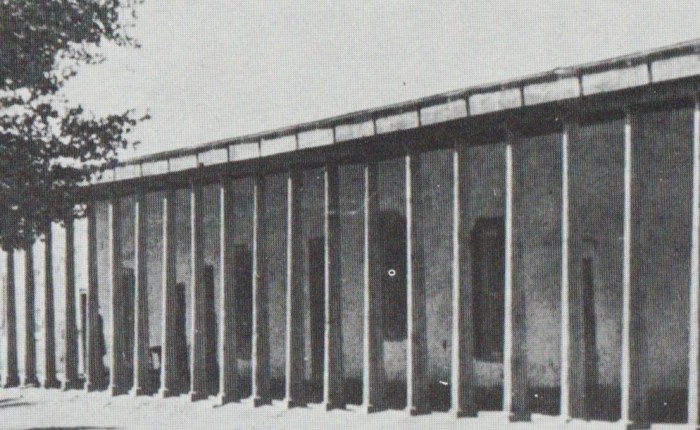
Diagram of Fort Marcy, constructed Fall 1846. Source: Fort Marcy Park interpretive signage.
Early the following year, the Americans got a taste of just how resilient adobe walls could be. After the January 1847 Taos uprising, the U.S. Army hauled four mounted howitzers and a six-pound cannon north to deal with the rebellion. The insurrectos had retreated to the mission church at Taos Pueblo, but the American artillery made little headway against its adobe walls. Lt. Richard Smith Elliott reported later that the walls were so thick, the cannon balls would not go through them.
In fact, the artillery crews made little headway against the pueblo church until they positioned the smallest cannon closer to it and began using grapeshot in a spot already damaged by an axe-wielding soldier. Only then were the attackers able to enter the church.
Not even adobe could withstand the fury and tenacity of Americans with newly acquired land to protect.
Sources: Bainbridge Bunting, Early Architecture in New Mexico; Stella M. Drumm, Down The Santa Fe Trail and Into Mexico, Diary of Susan Shelby Magoffin 1846-1847; Mark L. Gardner and Marc Simmons, eds., The Mexican War Correspondence of Richard Smith Elliott; Michael McNierny, ed., Taos 1847, The Revolt in Contemporary Accounts; Clyde and Mae Reed Porter, Matt Field on the Santa Fe Trail.
The thirty-day countdown to publication of my novel An Unhappy Country has begun!
It’s August 1846. The U.S. army has taken Santa Fe without firing a shot. The Mexican American War is over in New Mexico. Or is it?
Two days after the Army arrives, seventeen-year-old Jessie Milbank and her friends stumble on a man with a knife in his back in the Santa Fe plaza. Then someone close to Jessie’s friend Juanita is murdered. When an insurrection is suppressed in December, Jessie begins to wonder if the three events are linked.
Were the murdered men part of a conspiracy to throw out the invaders? And were they the only ones hoping for a fight? After revolt does finally break out and the Americans suppress it at the battle of Taos Pueblo, yet another man is murdered. Will the reasons for his death provide clues to the earlier ones?
Early readers are raving about Jessie, the book’s insight into these little-known events, and the beautiful writing in this novel.











 Fiction and Fact From Old New Mexico