Contested Space: The Military Chapel of Santa Fe

Contested Space: The Military Chapel of Santa Fe

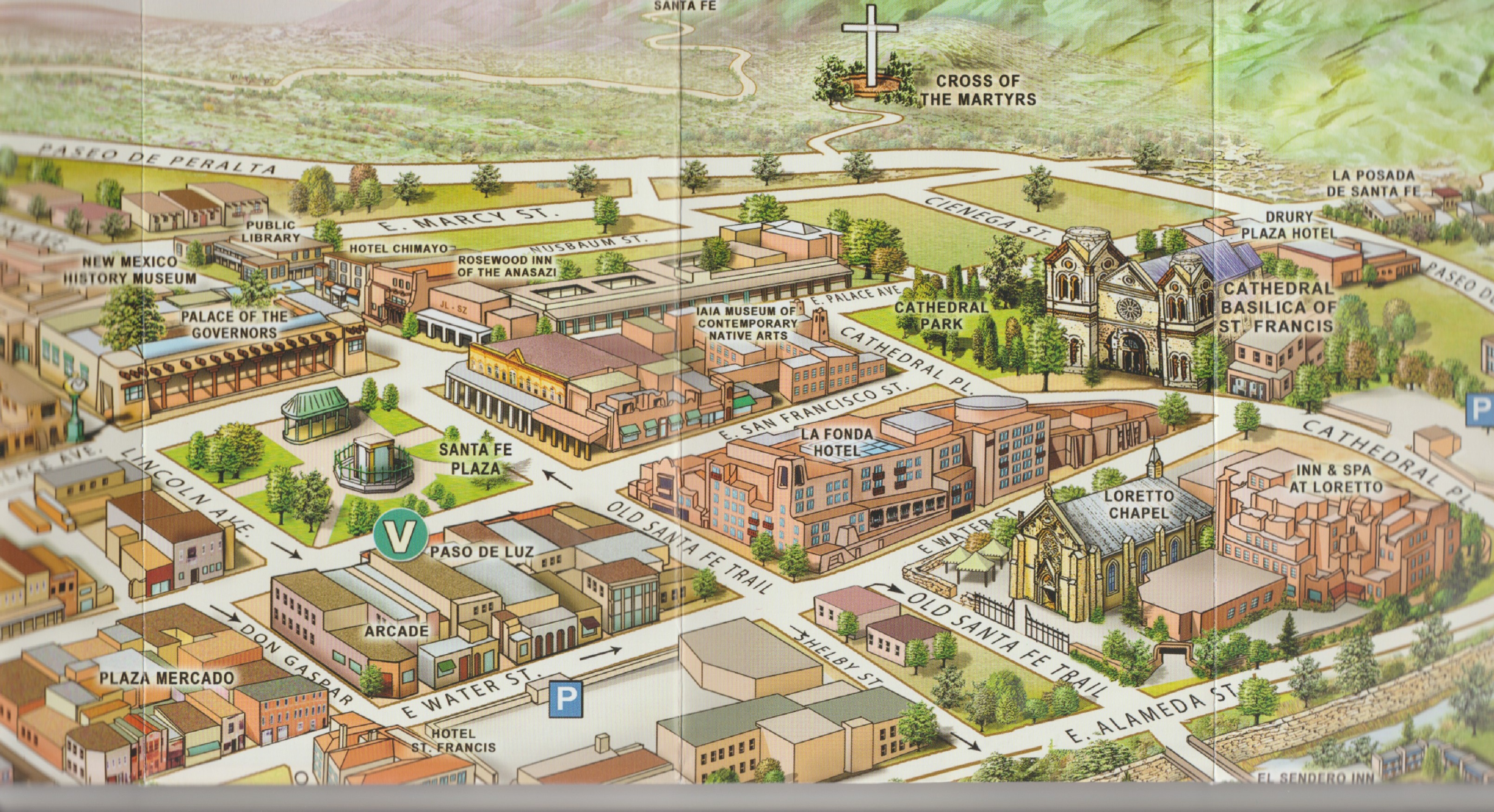
In a recent post about the Santa Fe plaza, I included a set of maps. If you look closely, you’ll notice that even the oldest of them identifies a small building on the south side of the square as the “military chapel.”

More properly called the Military Chapel of Our Lady of Light, and commonly referred to as La Castrense, this building was centered in the buildings on the south side of the Plaza and faced the Governor’s Palace on the north. The word Castrense means “belonging to the military profession,” so its nickname was appropriate, because the little church was built specifically for use by the members of the Santa Fe garrison. 

The original chapel was completed in 1717 and then rebuilt and rededicated in 1761. The reconstruction was funded by Governor Francisco Antonio Marin del Valle and his wife, Dona Maria Ignacia Martinez de Ugarte. This power couple also donated a new altar piece, or reredo, which was carved from large pieces of limestone quarried north of Santa Fe near Pojoaque. Said to be the largest and most ambitious piece of artistic work ever attempted in New Mexico to that point, the piece filled the entire altar end of the building. 
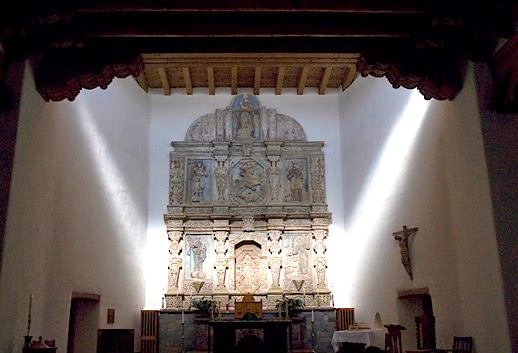
La Castrense altar piece today, courtesy El Cristo Rey Catholic Church, Santa Fe

The chapel received further decorations around 1813, when Pedro Bautista Pino, New Mexico’s representative to the Spanish Cadiz, returned from Europe with two marble bas-reliefs which were mounted on the outside wall above the door from the plaza. Colonel Francisco Perea remembered years later that one of them represented “Santa Gertrudes wrapped in the coils of a large serpent, while the other, I believe, represented the mother of Jesus, Nuestra Senora de la Luz (Our Lady of Light), recuing a human being from Satan.”

The military troops stationed in Santa Fe attended services in the chapel monthly as well as on special occasions. During Governor Manuel Armijo’s first two administrations, he and the full garrison attended regularly, with the officers in full uniform.  However, it seems unlikely that they continued to do so during his third term (July 1845 to August 1846) as the roof had fallen in. At least, that’s what Lt. James W. Abert reported in early October 1846. He also said the building contained “some handsome carved work behind the altar,” and that at least one of the bas-reliefs still remained over the door, the one that showed Our Lady of Light.  

Abert had entered Santa Fe in the Fall of 1846 with the occupying U.S. army. Five and a half years later, in Spring 1851, newly appointed Chief Justice Grafton Baker, needed a place to hold his court and decided to use La Castrense.

The building, apparently repaired by this time, was set up with the necessary furniture and the grand jury was called. Unfortunately for Judge Baker, the grand jury members included Santa Fe native and former Mexican soldier, Donaciano Vigil. Vigil and his wife had been married in the chapel, and his father and an infant son were buried there. As former provisional governor under the U.S. rule, he had enough political clout to risk protesting the use of the chapel for civil purposes and enough connections in the city to rally public opinion behind him.

Baker threatened to hold court anyway and to have Vigil arrested, but when a crowd began to assemble outside and the commanding officer of the American troops rallied behind Vigil, the Judge gave way. He ordered the court moved across the plaza to the Governor’s palace. The men responsible for shifting the furniture didn’t have to actually remove it from the building. The crowd had already dumped most of it in the plaza.

The building doesn’t seem to have been immediately converted back to being a chapel. According to the 1891 Silver City Enterprise, in the 1850s, it was instead used to store  captured cannons, including the Lone Star of Texas which had come into New Mexico in 1841 with the ill-fated Texas Santa Fe Expedition.

The guns must not have stayed there for long, because in 1859 Bishop Lamy exchanged the building for $2000 and  land in the vicinity of the Parish church. The money went to repairs for  church and the land became the site of St. Michael’s College and the Loreto Chapel.

La Castrense itself was demolished by its new owner, but not until the altar piece was preserved and carefully removed. It is now in El Cristo Rey, which offers a brochure about the reredos on its website. It’s nice to know that, even though the building itself had to give way to “progress,” at least some of its contents were preserved and still survive.

© Loretta Miles Tollefson July 2025

Sources: James W. Abert, Western America in 1846-47; https://www.cristoreyparish.org/; Roland F. Dickey, New Mexico Village Arts; Francois-Marie Patorni, The French in New Mexico; Colonel Francisco Perea in Allison, “Santa Fe in 1837-1838”, Old Santa Fe Magazine, Vol. II; Silver City Enterprise, Oct. 9, 1891; Marc Simmons, Spanish Government in New Mexico; Francis Stanley, Giant in Lilliput; Maurilio Vigil and Helene Boudreau, Donaciano Vigil.

The Evolution of the Santa Fe Plaza

The Evolution of the Santa Fe Plaza

When the Spanish settlers created the Santa Fe, New Mexico plaza in 1610, it was roughly twice the size it is today, even though they didn’t have sufficient buildings to surround it. That would come later. Certainly the newcomers had high ambitions for their new town “square.” We can see from the map created by José de Urrutia about 150 years later that it extended from the church (la parroquia) to about where the western boundary is today.

The plaza was laid out in an approximate ratio of 2 to 3, width to length, as prescribed in Spanish law. It had a number of uses—military drills, mustering livestock, small-scale trading, and general commerce, as well as social and public events. Although there’s no sign of it on the 1776 map, in the early 1600’s an acequia ran along the north side.

The acequia may have been used to water trees in the plaza. We have written documentation of at least two plantings, one prior to 1837, when Jose Francisco Perea tells us there were three cottonwoods “of the mountain variety” in what was then the northeast corner. In the mid-1840s, Governor Mariano Martinez had more cottonwoods put in, although we don’t know what type. By the time he was done, trees circled the square and additional ones had been placed along the Santa Fe river.

The square had shrunk considerably by then, to the size it is today. The 1846 map created by U.S. Corps of Engineers Lts. W.H. Emory and J.F. Gilmer reveals that the eastern half of the plaza had been filled in with buildings by that point. It had apparently been this shape for at least the last ten years. Jose Francisco Perea tells us it hadn’t changed much during that period, except for the new trees. And the fact that the square was now seldom used as a camping place and stock corral.

According to James Josiah Webb, in the 1840s the northeast corner of the plaza contained the old Mexican customs warehouse. The eastern side of the square was lined with government buildings and anchored at the southern end by a store run by Don Juan Sena.

The Pino family lived across the street, on the south side of the plaza, alongside a couple more stores, including the one rented by Leitensdorfer and Company. The crumbling adobe military chapel lay in the center of this row of buildings.

The west side of the plaza was nearly all residences, except for the old Mexican post office, and the north side was defined, as it is today, by the long low adobe structure that had been there since the beginning. The compound it fronted had served over the years as a fort, barracks for the Presidio troops, local jail, housing for the civil governor, treasury, and other functions.

Known as “el palacio” by the locals, the Americans retained the building’s basic functions after they invaded in 1846. By 1857, it included the chamber for the territorial legislature, offices for the Secretary of the Treasury and Superintendent of Indian Affairs, the post office, and (still!) the calabozo, or jail.

The building, which is still called “el palacio,” has been renovated a number of times, most recently a few years ago, and now anchors the New Mexico History Museum. It’s well worth a visit if you happen to be in town. As is the plaza. It changed once again in the 1860s, when a bandstand was added, along with walkways that crisscrossed the space. This layout has been retained ever since then. You can see it in the birds-eye view map from 1882 as well as the current map.

As you can see from the map, the plaza in Santa Fe is still walkable. Trees still shade the paths, and there are still small-scale traders, most often now only under the palacio house portal. It’s the perfect place to spend a few hours on Sunday afternoon or any other time.

The Lone Star of Texas in Mexico

The Lone Star of Texas in Mexico

Shortly after American troops invaded New Mexico in Autumn 1846, they discovered four pieces of Mexican artillery in a village south of Santa Fe. Apparently, Governor Manuel Armijo had taken the guns with him when he fled, but abandoned them at Galisteo. One of these pieces was of special interest to the Americans because it had arrived in New Mexico by way of Texas.

The cannon, made in Springfield, MA, had accompanied the ill-fated 1841 Texan expedition to New Mexico. A brass six pounder, it had been cast with a Texas star on its breach and paid for by “patriotic ladies” of the newly formed republic. When the Texans straggled into eastern New Mexico in Fall 1841, they still had the gun with them, despite its weight and their exhaustion.

New Mexico Governor Manuel Armijo confiscated the cannon, of course, and reportedly displayed it in the Santa Fe plaza after he sent the captured Texans on to Mexico City. It was still there in 1846, when it and other artillery pieces were transferred to Apache Pass during the runup to the impeding American invasion.

When Armijo decided to flee instead of fight, he took the Texan gun and other artillery with him. Three of the gun carriages apparently broke down at Galisteo, and the governor was forced to abandon them as well as the weapons they carried. This included the Texan six-pounder, which the American troops dubbed the “Lone Star of Texas.”

Six pound cannon from the 1840-1860s period. Courtesy: U.S. Library of Congress

They transported the gun back to Santa Fe, where it was apparently once again placed on the plaza. Lt. Richard Smith Elliott says it was used in early November to assemble the officers for training drill.

We have no official record of the Texas cannon again until Brigadier General Sterling Price took it with him to Chihuahua.  There, it saw action at Santa Cruz de Rosales, the last battle of the Mexican war, on March 16, 1848.

However, there is a possibility that this was not the first battle in which the Texan cannon was fired. A six-pound cannon played a conclusive role in the February 1847 battle at Taos Pueblo, when it was used to breach the walls of the church where the insurrectos were holed up. This gun may well have been the Lone Star.

After the battle at Santa Cruz de Rosales, the Texan cannon was returned to Santa Fe, where it was stored alongside other Mexican artillery pieces in La Castrense, the old military church on the south side of the plaza. It and the other guns were presumably cleared out when the Americans decided to use the building as a courtroom. What happened to it after that remains a mystery.

Sources: Mark L. Gardner and Marc Simmons, Eds., The Mexican War Correspondence of Richard Smith Elliott; Silver City New Mexico Enterprise, October 9th 1891, courtesy Silver City Library.

© Loretta Miles Tollefson

What to Believe?

What to Believe?

If you’ve been reading my blog posts, you’ve probably noticed that I sometimes quote Lewis Garrard, the seventeen-year-old American who visited New Mexico in 1847.  His book about his adventures there, Wah-to-yah and the Taos Trail, was published in 1850. It doesn’t seem to have made much of a hit at the time, but it’s now often used as a primary source for everything from how to make coffee on the trail to the April 1847 trials after the Taos insurrection was suppressed. In fact, Garrard’s report of the trials and subsequent hangings is the only firsthand account of them that we have.

Title page of Lewis H. Garrard’s 1850 edition, courtesy of archive.org

But Wah-to-yah also contains secondhand accounts. Of the insurrection itself and the battle at Taos Pueblo, as well as of the death of Taos leader Tomás Romero afterward. And this is where things get complicated.

The circumstances around Romero’s assassination are of particular interest to me because his death plays a role in my novel An Unhappy Country. Based on U.S. military records this is what we know about what happened:

  1. People from Taos pueblo sued for an end to hostilities the morning of Friday, February 5, 1847. Colonel Price agreed on condition that the remaining insurrection leaders be turned over to him.
  2. The only uncaptured leader alive and in the Taos area was Tomás Romero, who turned himself in later that day.
  3. Romero was taken to the jail in the village of Taos, where he was shot and killed by a U.S. Army dragoon private named Fitzgerald.
  4. Fitzgerald was arrested and jailed.
  5. About six weeks later, on March 18, 1847, Fitzgerald was dishonorably discharged from the U.S. Army. This was well before the expiration of his term of enlistment.

And that’s all we know from the official accounts.

According to Lewis Garrard, he met Fitzgerald in the second half of March, while Garrard and his party were camped roughly 55 miles east of Taos in the vicinity of today’s village of Cimarron, New Mexico. He says Fitzgerald told him that he’d come to New Mexico specifically to wreak vengeance on “the Mexicans” for the death of his older brother, who’d been a member of the 1841 Texas Expedition to Santa Fe.

According to Garrard, the older Fitzgerald had been killed by Damasio Salazar, the militia captain who supervised the Texans’ removal from New Mexico. The younger Fitzgerald boasted that he accomplished his mission when “in the fight at the Pueblo, three Mexicans fell by his hand; and, the day following, he walked up to [Romero] and deliberately shot him down.”  

Whether Fitzgerald did kill three men in addition to Tomás Romero is anyone’s guess. But Garrard’s report of Fitzgerald’s motivation raises a number of issues. Either he was confused, or Fitzgerald was.

You see, the only Fitzgerald with the 1841 Texas Santa Fe Expedition was an Irish/Anglo man whose first name was Archibald. And Archibald Fitzgerald didn’t die in New Mexico. He survived the trek under Captain Salazar as well as imprisonment in Mexico and was released in late February 1842.

Instead of returning home to Ireland, Archibald Fitzgerald went back to Texas. There, he joined the young republic’s forces and fought with them at the December 1842 battle of Mier. According to historian Noel Loomis, Fitzgerald was captured there and thrown into prison at Salado. He and his fellow Texans staged a successful breakout, but Fitzgerald was killed in the aftermath.

So, either Archibald’s younger brother didn’t know what happened to him, Private Fitzgerald told Lewis Garrard a tall tale in order to justify what he’d done, or Garrard misremembered/embroidered the story when he retold it in 1850. In any case, this is one portion of Wah-to-yah which does not hold up to verification by other sources.

The younger Fitzgerald apparently also told Lewis he’d escaped from his Taos prison one night by breaking through the roof of his cell, noiselessly creeping to the edge of the roof, and waiting until the guard pacing below turned his back. Then Fitzgerald swung to the ground and “with as much ease as possible” walked to a mess fire where his waiting friends provided him with a pistol and clothing. Fitzgerald headed into the mountains east of Taos and “when day broke,” Garrard says, “The town lay far beneath him.”

Whether this is what actually happened is open to question. I have to admit I’m skeptical. It sounds a little too much like something out of an Alexander Dumas novel.

But then, Garrard also says Fitzgerald told him he was one of five men who breached the wall of the Taos Pueblo church and that during this event the man ahead of him was killed. Somebody is conflating two events here: the first being the attempt to enter the church that resulted in the death of Captain John H.K. Burgwin, and the second successful assault later that day, when no one was killed.

I have incorporated a variation on Garrard’s report of Fitzgerald’s version of events into An Unhappy Country, but whether it reflects what actually happened is anyone’s guess.  But then, that’s why my novels are labeled “historical fiction.” Because no one knows for sure.

Sources: James A. Crutchfield, Revolt at Taos; John Durand, The Taos Massacres; Lewis H. Garrard, A.B. Guthrie, Jr., Ed., Wah-to-yah and the Taos Trail; Noel Loomis, The Texan-Santa Fe Pioneers; Michael McNierney, Ed., Taos 1847, The Revolt in Contemporary Accounts.

© Loretta Miles Tollefson

Not As Simple As They Look

Not As Simple As They Look

If you’ve been fortunate enough to tour an adobe home here in New Mexico, you may have noticed the corner fireplaces which are a signature element in these houses.

Often built in a corner, the traditional fireplace, or fogón, had a low hearth, between six and eight inches high. The structure was usually roughly a quarter round with a narrow opening of about twenty inches. The firebox was relatively shallow. In fact, the wood was usually placed upright and leaned against the back of the space, instead of flat on the hearth.

Corner fireplace. Source: Bainbridge Bunting, Early Architecture in New Mexico

If one fireplace couldn’t warm the room sufficiently or wasn’t large enough to cook a meal for the entire family, there were several options. One was to build another cooking area in the opposite corner. Another was to build a larger bell-shaped one, up to four feet, four inches wide, that could accommodate more wood. A third alternative, especially useful when there was more than one cook, was to construct a double-arched bell-shaped structure.

Double arched fireplace. Source: Bainbridge Bunting, Of Earth and Timber Made

In every case, the arched opening was constructed using two large specially shaped adobe bricks. The chimney was usually a rectangular cuboid roughly 10 x 10 inches in diameter and made of thin adobe bricks set on edge with their ends fit into channels cut into the supporting walls

Not all adobe fireplaces were placed in the corner of a room. If a heat source was needed elsewhere, a “spur” of adobe would be extended out from the wall in the desired location and then a fireplace was constructed in the resulting corner.

As the Americans began to pour into New Mexico after 1846, they began remaking the traditional adobe houses to meet their Eastern expectations. This included encasing the adobe fireplaces with wooden chimney breasts and mantel shelves.

Source: Bainbridge Bunting, Early Architecture in New Mexico

Personally, I prefer the older style. All the little indentations in those fake pillars would have just collected dust. And probably soot. Give me the clean lines of traditional adobe anytime!

© Loretta Miles Tollefson

Sources: Bainbridge Bunting, Early Architecture in New Mexico and Of Earth and Timbers Made, New Mexico Architecture.

Aftermath of a Rebellion

Aftermath of a Rebellion

In mid April 1847, the Taos Valley was still experiencing the aftermath of the January 20 rebellion.

The U.S. Army had captured a total of 45 rebels. They released 24 for lack of evidence and tried 21. The trials were over, but the executions weren’t. Seventeen men would hang, one of them for high treason.

The high treason charge was questionable. An argument could be made that a person couldn’t rebel against a country to which they had not pledged allegiance. The war with Mexico wasn’t over. New Mexico was still officially part of occupied Mexico, and its people were still citizens of that country. There’d been a trial in early January which had found the high treason charge suspect. But that didn’t stop 26-year-old prosecuting attorney Francis P. Blaire, Jr. from continuing to use it.

In early March, Blaire filed the charge against three men: Antonio Maria Trujillo, Pantaleon Archuleta, Trinidad Barceló, and Pedro Vigil. Apparently the only rebel trials held in Santa Fe, the charges against Archuleta, Barceló, and Pedro Vigil were eventually dropped after the proceedings ended in a mistrial.

Trujillo was found guilty, but because he was elderly and unwell, the jury and judge requested that the sentence be commuted. Military Governor Sterling Price granted the pardon, and Santa Fe was spared a demonstration of the effectiveness of the gallows.

Taos wasn’t. Of the eighteen prisoners tried there, all were convicted and hung.

There had been a single execution on February 7 of Pablo Montoya, one of the rebellion leaders, but the remainder waited until April, when the formal trials began.

These hangings started on Friday, April 9, when Hipolito (Polo) Salazar, Jose Manuel Garcia, Pedro Lucero, Juan Ramon Trujillo, and the Romero brothers Ysidro and Manuel, age sixteen, were executed two days after their trials. Salazar had been convicted of high treason, but the rest of these men were found guilty of killing American-appointed Governor Charles Bent.

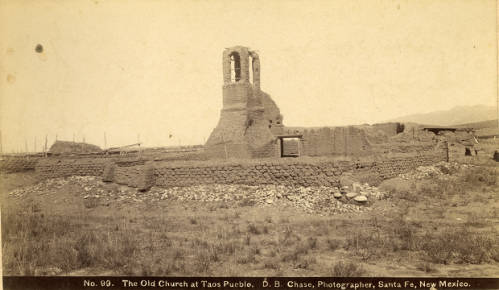
The eleven remaining convicted rebels had to wait to meet their end. Most of them would die three weeks later, on Friday, April 30. These executions seem to have occurred in two batches. The six men from Taos Pueblo—Francisco Naranjo, Jose Gabriel Romero (or Samora), Juan Domingo Martin, Juan Antonio Lucero, and a man called El Cuervo—were apparently hanged at the same time. They were buried at the Pueblo at the church which had been destroyed by the Americans in early February.

Ruins of the Taos Pueblo church. Source: Palace of the Governors Archives

Four other men—Manuel Miera, Juan Pacheco, Manuel Sandoval, and Rafael Tafoya—were also executed that day. Then, on the following Friday, Juan Antonio Avila was hanged for his role in the insurrection.

Why the week-long delay? There’s no information in the records. I’d love to know the answer to this question, just as I’d like to know why the trials of Trujillo, Barceló, Archuleta, and Vigil were held in Santa Fe and the reasons for the mistrials for latter three men. Was this a procedural issue? Was family pressure brought to bear?

I’m especially curious about the case of Trinidad Barceló. He was the older brother of businesswoman Gertrudes Barceló, who had assisted the U.S. occupiers in suppressing a revolt the previous December. Did her support of the regime play a part in her brother’s release?

What about the other two: Archuleta and Vigil? Were they related to Acting Governor Donaciano Vigil or some other prominent New Mexican who the Americans wanted on their side?

And then there are the stories of the men who died: their reasons for resistance, the impact on their families, the pain or joy they left behind.

So many stories, so little time.

© Loretta Miles Tollefson

Sources: David C. Beyreis, Blood in the Borderlands; Mary J. Straw Cook, Doña Tules; James A. Crutchfield, Revolt at Taos; Mark L. Gardner and Marc Simmons, eds., The Mexican War Correspondence of Richard Smith Elliott; Lewis H. Garrard, Wah-to-ya and the Taos Trail; Lucy Lippard, Pueblo Chico, Land and Lives in Galisteo since 1814; Michael McNierney, ed. Taos 1847, The Revolt in Contemporary Accounts; Alberto Vidaurre in Corina A. Santistevan and JuliaMoore, Taos, A Topical History.

Shopping, Gambling, and Dancing, Oh My

Shopping, Gambling, and Dancing, Oh My

In my forthcoming novel set in Santa Fe, New Mexico, the young people at the heart of the story don’t go home after church. They go to the plaza. They aren’t the only ones. In fact, American newcomers to the city were often shocked at what they saw as a desecration of the Sabbath. People weren’t merely walking. They were shopping, dancing, and gambling, and probably drinking as well.

This Sunday ritual didn’t change after the U.S. Army invaded in 1846. Lt. Abert tells us that “in the square all the people congregate to sell their marketing and one constantly sees objects to interest and amuse. It is filled with donkeys laden with immense packs of wood, fodder, melons, and other articles. The soldiers too are constantly passing and mingling in a motley group.”

Part of the reason for this activity on the plaza was that it was a pleasant place to be. Even Susan Magoffin, who had little else good to say about New Mexico, found that the square made for “a fine walk.” “The Plaza or square is very large,” she reported. The Governor’s Palace, or palacio, with a wide portal in front, formed the north side of the square, while a church and dwelling houses faced it on the south. “The two remaining sides are fronted by stores and dwellings, all with portals,” she added. “In rainy weather there is no use for an umbrella.”

The portales, or verandas, Magoffin mentioned provided shade for the buildings and were shaded themselves by what Magoffin described as a circle of trees around the square. These were cottonwoods which had been planted only a couple years before, probably using the pole planting method. A small irrigation ditch, or acequia, ran alongside the trees.

Under the portales, vendors sold everything from pottery to sweet onions. There were plenty of other ways to spend one’s money as well, namely gambling. One didn’t have to go indoors to indulge in this pastime.  Out-of-doors games included pitarria, which was played on smooth ground inside a marked square, with short sticks of two colors. Quoit pitching, using pegs driven into the ground, was also available.

Those who wanted to gamble could play monte, both with a full deck of Spanish cards, and a three-card version.  Roulette was also popular, as were various games of dice.

Later, if one liked, someone in town was apt to be holding a dance, and everyone was welcome, from the priest to the criminal released from jail for the evening. Everybody danced, the lady with the ragged farm worker, the old man with the little girl.

Newcomers also disapproved of the city’s open door dancing policy. Matt Fields tells us of a ball given by the Governor in 1839 which “all the beauty and fashion attended, and also all the rabble,” adding, “the dances, as well as all the manners and customs in Santa Fe, are of a demi-barbarian character”. Nineteenth century Americans, whose country was founded on democratic principles, were certainly quick to make negative social distinctions.

Some things never change. 

© Loretta Miles Tollefson

Sources: W.H.H. Allison, Old Santa Fe Magazine, 2:2, “Santa Fe During the Winter of 1837-1838”; Sheila Drumm, Down the Santa Fe Trail and Into Mexico, Diary of Susan Shelby Magoffin 1846-1847; Janet LeCompte in Joan M. Jensen and Darlis M. Miller, New Mexico Women, Intercultural Perspectives; Clyde and Mae Reed Porter, Matt Field on the Santa Fe Trail.

Houses Made of Mud

Houses Made of Mud

In my March 5 post, I mentioned that one of the things that nineteenth century Americans disparaged when they first arrived in New Mexico was what they called “mud houses.” Newspaper correspondent Matt Field wasn’t the only person to describe Santa Fe as a “mud built city” of one-story buildings that reminded him “of an assemblage of mole hills.”

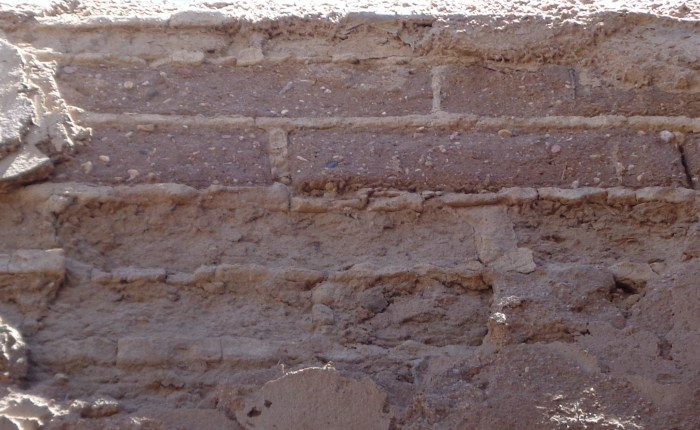
Technically, Field was right. The buildings, even the churches, were in fact built of a mixture of earth and water. These carefully formed bricks had evolved from the indigenous practice of puddled mud construction and by the 1800s were created by packing a stiff, dough-like mud into a rectangular wooden frame that was then lifted away from the resulting block. Two days later, the brick was dry enough to be turned on end and a week later, hard enough to be stacked and cured for another month. To speed up the drying process, adobe makers in the upper Rio Grande region often added straw.

Adobe bricks were used to construct one-story buildings but, with proper buttressing, the walls could be extended higher. Field noted that the Santa Fe parish church was built “as high and quite as large as any of our [U.S.] ordinary size meeting houses.”

He also noted that the adobe walls were strong and durable. In fact, they were so strong and durable that the Fort the invading Americans constructed on the hill overlooking the church in the Fall of 1846 was made of double walls of adobe bricks with a core of rubble between them.  

Diagram of Fort Marcy, constructed Fall 1846. Source: Fort Marcy Park interpretive signage.

Early the following year, the Americans got a taste of just how resilient adobe walls could be. After the January 1847 Taos uprising, the U.S. Army hauled four mounted howitzers and a six-pound cannon north to deal with the rebellion. The insurrectos had retreated to the mission church at Taos Pueblo, but the American artillery made little headway against its adobe walls.  Lt. Richard Smith Elliott reported later that the walls were so thick, the cannon balls would not go through them.

In fact, the artillery crews made little headway against the pueblo church until they positioned the smallest cannon closer to it and began using grapeshot in a spot already damaged by an axe-wielding soldier. Only then were the attackers able to enter the church.

Not even adobe could withstand the fury and tenacity of Americans with newly acquired land to protect.

© Loretta Miles Tollefson

Sources: Bainbridge Bunting, Early Architecture in New Mexico; Stella M. Drumm, Down The Santa Fe Trail and Into Mexico, Diary of Susan Shelby Magoffin 1846-1847; Mark L. Gardner and Marc Simmons, eds., The Mexican War Correspondence of Richard Smith Elliott; Michael McNierny, ed., Taos 1847, The Revolt in Contemporary Accounts; Clyde and Mae Reed Porter, Matt Field on the Santa Fe Trail.

Chintz and Coffee in New Mexico

Chintz and Coffee in New Mexico

The Americans in Santa Fe before the U.S. invasion in 1846 were almost all merchants. These men brought a range of goods into New Mexico. Fabric, from calico to cashmere. Butcher and other types of knives. Ready-made clothes, including neckties. And also apothecary scales, snuff, turpentine, canned oysters, champagne, claret, and chintz mugs.

Chintz mugs were not made of fabric, as the term “chintz” would imply, but of china. That these pieces of fragile tableware made it from Missouri to New Mexico is a testament to the shippers’ packing ability. The cups were decorated with an all-over flower pattern copied from 18th century fabric designs. Entire dish sets were and are still being made using these patterns, though only the mugs seemed to have made it to New Mexico in the mid1800s.

Chintz mug. Image courtesy of Replacements.org

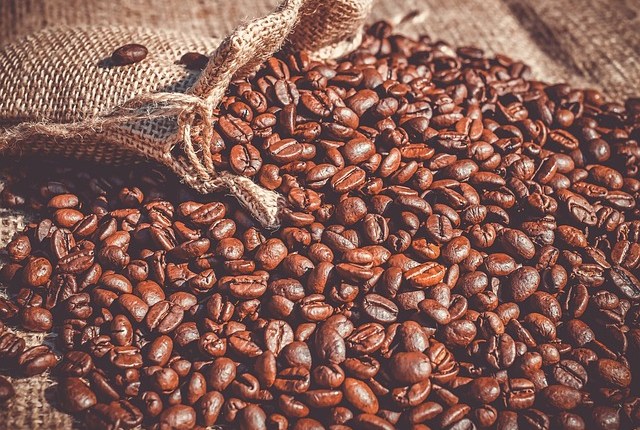
The mugs were undoubtedly used to drink the coffee which was also imported. Although a luxury item in the eastern United States, the beverage seems to have been considered by New Mexico’s Anglo travelers to be an essential, regardless of the cost. And it was expensive: 50 cents a pound in 1846, at a time when a typical male wage earner brought in $2 to $5 a month.

The coffee would have travelled in bean form, probably green beans, as they can be stored up to twelve months in comparison to about thirty days for roasted beans. So purchasers had to roast and grind the beans themselves. Lewis Garrard provided a vivid description of how this was done in on the road.

AWe selected two flat stones from the [water] channel at hand, twenty-five to thirty inches in diameter, which we placed on the fire ’til heated; then one was taken off, the coffee [beans] poured on, and stirred with a stick. The stones served alternately as they became cool. When the coffee was sufficiently burned, a piece of skin was laid on the ground, and a clean stone, a foot in diameter, rested on the knees of the grinder, with one edge on the skin. A smaller stone, held in the hand, reduced the grains between it and the larger one to powder by a rotary motion.@

The resulting grind was poured into boiling milk, where it sank to the bottom of the pan. When the grounds resurfaced, the coffee was ready. “How we feasted!” Garrard reported. “It was splendid!”

It’s unlikely Garrard and his friends drank from chintz mugs that night. They were still on their way to New Mexico. Any china would have been safely packed away. But I’m willing to bet that coffee served in chintz mugs accompanied the September 1846 oyster and champagne supper James Magoffin served his brother and sister-in-law to celebrate their safe arrival in Santa Fe.

Life in New Mexico in 1846-1847 could be quite civilized, for those who could afford it.

© Loretta Miles Tollefson

Sources: David C. Beyreis, Blood in the Borderlands, Conflict, Kindship, and the Bent Family, 1821-1920; Stella M. Drumm, ed., Down the Santa Fe Trail and Into Mexico, Diary of Susan Shelby Magoffin, 1846-1847; Lewis H. Garrard, Wah-to-yah and the Taos Trail; http://www.antiquesandteacups.com/collections/chintz, accessed 2/14/25

Reporter Soldiers in the Mexican American War

Reporter Soldiers in the Mexican American War

According to Britannica.com, the practice of placing journalists with a military unit and permitting them to accompany troops into combat zones started in the U.S. during the Iraq War.

While  assigning career journalists to specific units may have originated during the 2003-2011 conflict, the concept was almost 150 years old by that point. It had begun with the 1846 Mexican American War.  

One of the embedded reporters was Lt. Richard Smith Elliott, who served as a correspondent for the St. Louis Reveille from June 1846 to June 1847. Elliott was posted with General Stephen Watts Kearny’s Army of the West. His reports to the paper provided news of the military conquest and subsequent activities, including first-hand accounts of the news of the Taos revolt.

Elliott’s pen name was John Brown. He had some newspaper experience, as he’d worked as a publisher and printer at small papers in Kentucky and Pennsylvania before giving it up to become a lawyer.  But they say newspaper ink gets in your blood, and when the U.S. decided to invade Mexico and Elliott joined up, he also volunteered to report on subsequent events for the Reveille. He began work the day he left St. Louis with the Laclede Rangers, writing about their presentation swords and grand send off.

During the following year, Elliott wrote around seventy items for the paper.  Other soldiers wrote for the Reveille, too, but Elliott’s work was the most voluminous.

Farther south, the practice of embedded reporters was also incorporated into the American military activity. One of the embedded correspondents was New Orleans Picayune publisher George Wilkins Kendall, who had been in Mexico in 1841-1842 as part of the ill-fated Santa Fe Texas Expedition. He’d written a scathing three-volume bestseller about his experiences and was apparently anxious to participate in what he saw as payback for his imprisonment.

George Wilkins Kendall, Source: Kendall of the Picayune, F. Copeland

However, Kendall did not participate in the war directly. As what one biographer calls “the first modern war correspondent,” Kendall instead chose to observe from a distance. He set up a systematic program to aggregate the news in his portable “Picayune office” that followed General Zachary Taylor through northern Mexico and General Winfield Scott from Tampico to Mexico City. His employees gathered news, sold subscriptions, and did other business for the paper while Kendall ran the operation and sent editorials back to New Orleans complaining about the slowness of the mail.  

So there were different ways one could experience and report on the Mexican American War. All of them embedded in one way or another and each providing yet another way for newspaper readers back home to get a sense of what was happening “on the ground.”

 Whether this helped or hindered the war effort is anyone’s guess, but it certainly must have been a boon to newspaper circulation.

© Loretta Miles Tollefson

Source: Fayette Copeland, Kendall of the Picayune; Marc L. Gardner and Marc Simmons, The Mexican War Correspondence of Richard Smith Elliott; http://www.britannica.com/topic/embedded-journalism, accessed 1/27/25