On Monday, August 27, 1827 American traders Henry Connelly, Alphonso Wetmore, and James Erwin Glenn received written permission to travel El Camino Real de Tierra Adentro from Santa Fe to Chihuahua on a trading venture. Although Wetmore was an established Santa Fe trader at the time, then 27-year-old Henry Connelly would become the most well-known of the three men on this expedition, with the most influence on New Mexico.
A medical doctor, Connelly settled in Chihuahua at the end of his 1827 trip, and engaged in the mercantile trade there. However, he didn’t abandon his Santa Fe connections or his links to the United States. When General Stephen Watts Kearny’s army invaded New Mexico in 1846, Connelly had been in Mexico almost 20 years and had influential friends in Santa Fe.
In fact, Connelly’s connections may have been critical to the success of Kearny’s mission. He is believed to have been Governor Manuel Armijo’s agent during the negotiations that resulted in the bloodless handoff of New Mexico to the U.S.
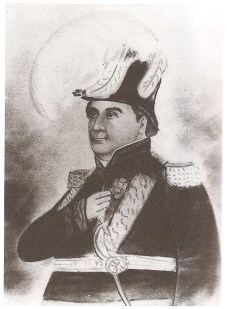
By 1849, Connelly’s heart was definitely in New Mexico as opposed to Chihuahua. That year, he married Dolores Perea de Chavez of Peralta and subsequently became officially involved in New Mexico Territorial politics. In 1851, he became a member of the Territorial Council. Ten years later, President Abraham Lincoln named him Governor of New Mexico Territory.
Connelly was ill during much of his tenure as governor and actually left the Territory in Fall 1862 to try to recover. He returned in May 1863 and finally retired in mid-July 1866. He died less than a month later, in mid-August 1866, almost exactly 39 years after he first ventured south on the Camino Real.
Sources: Don Bullis, New Mexico, a Biographical Dictionary, 1540-1980, Los Ranchos de Albuquerque: Rio Grande Books, 2007; Julie L. Pool, editor, Over the Santa Fe Trail to Mexico, the travel diaries and autobiography of Doctor Rowland Willard. Norman: University of Oklahoma Press, 2015; Jerry D. Thompson, A Civil War History of the New Mexico Volunteers and Militia, Albuqerque: UNM Press, 2015; Ralph Emerson Twitchell, The Leading Facts of New Mexico History, Vol. II, The Torch Press: Cedar Rapids, 1912; web.archive.org/web/20120406161610/http://www.newmexicohistory.org/filedetails.php?fileID=23527
On Sunday, August 14, 1720 Santa Fe Presidio Garrison Lieutenant Pedro de Villasur died on the Platte River during an altercation with Pawnee Indians. Villasur was the leader of a force of Spanish soldiers, Pueblo Indian militia, and several citizens who’d set out that spring on an expedition to the Platte River in what is today’s Nebraska. The expedition was following up on reports that large numbers of Frenchmen were trading with the Pawnee, a tribe which dominated the central plains. This made Mexican officials nervous. Not only did Spanish mercantile policy forbid foreigners from trading within her empire, but the traders from French Louisiana could be providing the Plains Indians with arms and ammunition that could then be used against New Mexico’s settlements.
To find out what was going on, Villasur and his men were dispatched on a fact-finding mission. the reached the plains east of what is today Colorado’s Front Range in mid-August. When they found a large village of Pawnee, Villasur sent a note in to ask for a parlay.
It’s unclear whether there were any Frenchmen in the village to translate the note, which was in French, but the Pawnee didn’t waste any time responding to it. They attacked the next morning.
Villasur was among the first to fall and among the forty-five who died. The few expedition members who survived the battle carried the news back to Santa Fe and seem to have provided the details subsequently recorded in a unique artwork, one of two painted hides that eventually came into the hands of Jesuit priest Philipp von Segesser von Brunegg.
In 1758 Segesser von Brunegg sent these artifacts to family members in Switzerland. They were eventually sold to the Palace of the Governors Museum in Santa Fe, New Mexico and returned to thecity that Villasur and his men departed from over 300 years ago. They are officially known as the Segesser hides.
There’s documentary evidence of other reposteros, or artwork painted on tanned hides, created in Santa Fe during the 1700s and some scholars believe the Segesser pieces were also produced there. Because of the details in the Segesser II hide, the painting that reflects contemporary accounts of the Villasur debacle, it seems clear that the painting was done by people who were familiar with the events.
The other fascinating thing about this artwork is the way it combines pictorial elements characteristic of indigenous or folk-art paintings while also reflecting influences from European battle tapestries of the late 1600s and early 1700s. The wide borders on the hide painting contain flower and leaf designs similar to of those works.
If you’d like to know more about these unique historical artifacts and the Villasur expedition, the Segesser hides are on display in Albuquerque, New Mexico through October 20, 2019 as part of a larger exhibit titled A Past Rediscovered. If you can’t make it to Albuquerque, you can view portions of the hide paintings here.
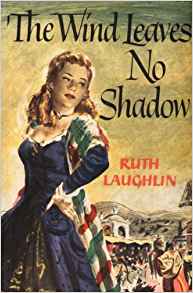
by Ruth Laughlin Caxton Printers, 1951 ISBN-13: 978-0870040832
Doña Tules Barceló was one of New Mexico’s most colorful 19th century characters, andThe Wind Leaves No Shadow is, as far as I know, the only fictional or non-fictional treatment of her life.
From humble origins, which Ruth Laughlin imagines effectively, Doña Tules became owner of a Santa Fe gambling establishment where political opponents could meet to arrange accommodations that worked for everyone involved. She also acted as a kind of informal bank, lending money to key actors at critical junctures in New Mexico’s history. Because her gambling house gave her access to information not available everywhere, she was a valuable resource for both the Mexican and the American officials. She is said to have provided information in late 1846 to Governor Bent’s administration about the incipient rebellion against the U.S. occupation, the one that would result in his death a couple months later.
Not much is known about Doña Tules’ life, and Laughlin uses this fact to her advantage, weaving a story that places her in Santa Fe by the mid-1820’s and keeps her there until her death in 1852. The result is a story that not only imagines Doña Tules’ life but also provides the opportunity for an inside look at events (the 1837 Tax Revolt, the 1846 U.S. invasion, the 1847 death of Charles Bent) and people (the fur trappers, the ricos, the Santa Fe merchants, the priests) in Santa Fe during this period.
The Wind Leaves No Shadow was originally published in 1951 and reflects the historical information available to the author at the time as well as the prejudices that period. Although I didn’t always agree with Laughlin’s interpretation of historical events, she does a really great job of incorporating them into an effective story line. I was also uncomfortable with her insistence on Doña Tules’ white skin, red hair, and green eyes. In Laughlin’s interpretation, her coloring sounds more Irish than Spanish. In spite of these caveats, I believe this is still a useful book. If you’d like to get some idea of the life and trials of New Mexico’s famous lady gambler might have been like, or you’d like a fictional interpretation of New Mexico’s history in the 1820-1850 time frame, I recommend this book.
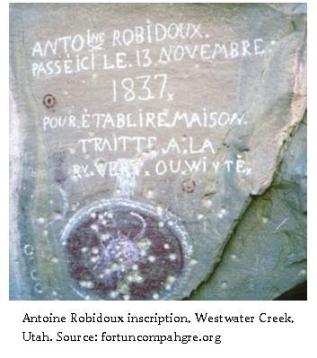
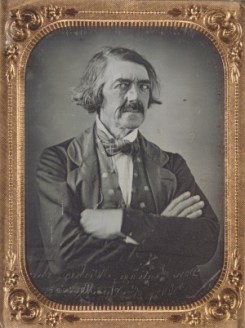
On Friday, July 17, 1829, Antoine and Louis Robidoux of Missouri became naturalized citizens of Mexico, thus beginning a long and somewhat fruitful association.
Antoine and Louis were two of six brothers, all of them involved in one aspect or another of the Rocky Mountain fur trade. Becoming Mexican citizens made good business sense, because trapping licenses for non-citizens were at times non-existent.
Antoine, who was 35 years old in 1829, had been in New Mexico since 1822. He’d spent the previous two years trapping and trading with the Sioux and his application for citizenship may have been prompted by the fact that he’d married a New Mexican woman in 1828 and it was time to settle down. Or he may have wanted to get involved in local politics. Antoine’s citizenship made him eligible to be elected 1st alcalde and regidor (councilman) of Santa Fe in late 1830 and three years later to serve as 3rd alcalde of Santa Fe and a member of the Santa Fe Commission for forming election districts.
He was also busy making money. During the 1830s, Antoine purchased a mine in the Santa Fe area. He also built Fort Uinta (aka Fort Robidoux) and Fort Uncompahgre in what is now Colorado and used them as a base for trade with the Indians and the trappers in the area.
However, in 1844, both forts were attacked by Utes and a number of men were killed and women captured. These events seem to have curbed Antoine’s enthusiasm for the frontier life. He left for Missouri shortly thereafter.
But he came back. Eschewing his Mexican citizenship, Antoine served with Col. Stephen Watts Kearny as an interpreter during the 1846 U.S. advance on New Mexico and remained with him during the California campaign which followed. After the war, Antoine returned to Missouri, where he died in 1860.
Louis Robidoux, on the other hand, seems to have remained loyal to his Mexican citizenship. Much of his early career mirrored Antoine’s. He arrived in New Mexico about the same time (probably 1823), married a New Mexican woman (Guadalupe Garcia in 1834), and participated in Santa Fe politics, where he served as first alcalde in 1839. He also participated in various moneymaking schemes, including operating a grist mill and iron works in Santa Fe.
And he also left New Mexico. But instead of heading back to Missouri, Louis went to California, a move reportedly bankrolled by a $30,000 win in a Santa Fe card game. He arrived in California with a group of Mexican traders in 1843 and remained there until his death in 1868.
He settled in what would become San Bernardino County, where he set up a large livestock operation and planted orchards, wine vineyards, and a grist mill. He was also involved in politics, becoming the first San Bernardino County Supervisor. The City of Rubidoux, the Louis Robidoux Library, various streets, and Mount Rubidoux are all named after him.
Leroy R. Hafen, Fur Traders and Trappers of the Far Southwest, Logan: Utah State University Press, 1997; David J. Weber, The Taos trappers, the fur trade in the far Southwest, 1540-1846, Norman: University of Oklahoma Press, 1971.
On Tuesday, July 5, 1825 Irish-born Taos resident James Kirker became a Mexican citizen. Given Kirker’s history up to this point, this was probably not the most optimum citizenship decision the Mexican government ever made.
Kirker had left Ireland at sixteen in order to avoid being drafted by the British during the Napoleonic wars. Ironically, shortly after he arrived in New York City Kirker signed on with the Black Joke, a privateer whose mission was to raid and harass the British fleet.
This didn’t work out too well. The Black Joke was captured by the British. Fortunately for Kirker, the crew was rescued by the USS Hornet and the USS Constitution (later renamed Old Ironsides), and Kirker was returned to New York. When he got there, Kirker headed to the grocery store where he’d been working before he became a privateer, married the young widow who owned the store, and settled down and had a son.
However, Kirker was still in his late teens at this point and he wasn’t really ready to settle down. In 1817 he abandoned his family and headed to St. Louis with some Irish cousins. There, he started another grocery.
But Kirker soon got wanderlust again and in 1823, signed on with Major Andrew Henry to go up the Missouri River. This didn’t last long. Kirker quit in a dispute over terms of employment and headed to Santa Fe.
Mexico seems to have been more to Kirker’s liking. He got involved with managing the Santa Rita copper mines near what is today Silver City, New Mexico and trapped with George Yount and James Ohio Pattie and his father.
But he still wasn’t ready to settle into a routine. In 1835, Kirker obtained a license from New Mexico Governor Albino Perez to trade with the Apaches. But he couldn’t stick to the rules for trading, either. He began illegally providing weapons and ammunition to the Apaches and participating in their raids into Texas and central Mexico.
When the Mexican officials got wind of Kirker’s activities, Governor Perez rescinded his license, ordered him arrested, and placed a $800 bounty on his head. Kirker fled north across the Mexican/American boundary to Bent’s Fort.
This was shortly before Perez’s death during the tax revolt of 1837 (which some people believe Kirker machinated) and by early 1838, newly appointed New Mexican governor Manuel Armijo had invited Kirker back into the country. Kirker went. And immediately returned to his old ways, only this time (at least theoretically) on the side of the establishment.
In early 1838, he was invited to help the Santa Rita mine operators combat the Apache activities that had forced the mines to close. Kirker gathered a couple dozen men and struck an Apache village headed by Mangus Colorado near what is today Cook’s Peak. The attack was brutal but effective, and Chihuahuan officials asked Kirker to lead a full-scale follow-up campaign against the Apaches.
Kirker agreed to their proposal but his first battle was, oddly enough, at Rancho de Taos, not Chihuahua. He lured a band of Apaches into Ranchos with some unguarded horses, then ambushed them after they’d captured the animals and were heading back into the mountains.
This is where the story turns sour. Instead of attacking the Apaches and retrieving the horses, Kirker and his men forced them back into Ranchos, into the walled square around the church there, and picked them off one by one, killing them at leisure. After this ‘success,’ Kirker’s band ranged across New Mexico, Chihuahua, Sonora, and West Texas, killing Apaches and organizing local militia against them.
James Kirker. Source: Missouri History Society
A change in governance in Chihuahua put a stop to his activities, but unfortunately also brought an increase in Apache attacks. Kirker was eventually redrafted. His attacks on the Apaches would result in the undying hatred of Cochise and probably actually increased the intensity of the Apache attacks until the last bands were finally subdued in the 1880s.
But Kirker wasn’t satisfied with killing Apaches. Just as he’d turned traitor to them, he also turned traitor to his adopted country. When Colonel Alexander Donovan marched his Missouri Volunteers into northern Mexico in 1846, Kirker provided Donovan with valuable information about the location, strength, and best strategies for capturing the Mexican gun emplacements at Chihuahua. He was familiar with the fortifications there because of his work for Chihuahua officials against the Apaches.
After the war, Kirker returned to Santa Fe after the war, where he participated in at least one campaign against the Utes. Eventually he headed to California, where he settled and died in early 1853. He seems to have been a model citizen there. Maybe by that time (he was in his mid-50s), he’d decided that there was more to life than adventure.
Richard Batman, James Pattie’s West, the dream and the reality. Norman: University of Oklahoma press, 1986; Leroy R. Hafen, Fur Traders and Trappers of the Far Southwest, Logan: Utah State University Press, 1997; David J. Weber, The Taos trappers, the fur trade in the far Southwest, 1540-1846, Norman: University of Oklahoma press, 1971
Suzanna’s eyes narrowed and her lips tightened. “I did not come to this god forsaken valley to live in a cave,” she snapped. The toddler on her hip started fussing but Suzanna only shifted impatiently and continued to glare at her husband on the other side of the room. “You promised me glass windows. You also said you wanted to farm, that you were finished with trapping.”
Gerald gestured at the beaver pelts lying just inside the cabin door. “I was finding the means to buy glass,” he said mildly.
Suzanna turned away. “The money will just go to something else.” Alma fussed again and Suzanna bent to place her on the floor. “The mule will go lame or cougars will take down a couple more calves.”
“Suzanna sweet–”
“Don’t you ‘sweet’ me!” She straightened, hands on her hips. “I will not be sweet-talked out of this! You can’t expect me to live in a cabin with just shutters at the windows, sitting in the dark whenever it rains!”
“We have lamps.”
“It’s not the same and you know it!”
Alma had toddled to her father. She clung to his leg, looking up at him. “Papa stay home?” she asked. “Mama ang’y.” She shook her dark curly head. “Me don’ like Mama ang’y.”
Gerald and Suzanna stared at each other for a long moment. Then Gerald scooped Alma into his arms and Suzanna threw her hands in the air helplessly and crossed the room. She leaned her head against his shoulder. “I had no idea when you would return,” she said into his sleeve.
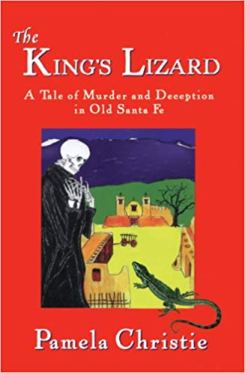
The almost-invisible lizard sunning himself on a rock or a log is a common occurrence in New Mexico. I almost stepped on one in the garden this morning. However, I would never have thought to use a lizard as a metaphor for a detective and “fixer.” But Pamela Christie did, and the resulting books are a fascinating look at New Mexico in the 1780s.
In The King’s Lizard,Christie introduces us to the Old New Mexico version of the invisible person—the half-Ute, half-Spanish Fernando “Nando” Aguilar who lives in a kind of limbo between his Spanish and Native origins. This liminal status makes Nando easy to overlook. But it also gives him access to both the Native and Spanish worlds, an access which makes him a valuable tool for Governor Juan Bautista de Anza.
Governor Anza has been tasked with creating a lasting peace with the Comanche. But there are men in New Mexico who don’t want peace. Unsettled conditions give them access to human contraband. And contraband sales fund a more-than-comfortable lifestyle. Nando becomes part of these men’s merchandise and then, after he escapes their clutches, the key to destroying the slave network as well as providing the Governor with a path to peace.
In Dead Lizard’s Dance,Nando once again saves the day, sorting out a plot that not only threatens the Governor, but also his own family’s security. Rumors of witchcraft go hand in hand with the struggle to control the caravan of goods to and from Mexico that is the colony’s lifeline.
This particular novel also highlights the status of women in the colony, and it isn’t a particularly pretty picture. But Nando protects the women he can, including those who’ve exacted revenge on a man who’s made a life’s work of abuse and betrayal.
Lizard’s Killappears to be the end of the road for Nando’s work for Anza, because the Governor’s term of office has ended.
He’s on his way back to Mexico and retirement. But Anza has one more service he hopes to perform for New Mexico and only Nando Aguilar has the skills to achieve the impossible.
Christie brings a deep knowledge of a complex bygone world to these three books, a knowledge that seems to expand with each story. Her writing and her observations about New Mexico life and politics in the 1780s grows more deft with each novel. If you’d like to know more about this period and are looking for a good mystery series to dive into I recommend these books.
Long live lizards!
P.S. All of these books are also available directly from Pamela Christie, who says she prefers direct contact with her readers. And she’ll also cut deals! You can contact her at christiepr@gmail.com.
In February 1815, a group of St. Louis trappers led by Joseph Philibert left Taos for the Arkansas River and on to St. Louis. After five months under arrest in Taos, they were returning to the U.S. with a healthy load of beaver plews.
The entire group had been arrested by Spanish soldiers the previous September and charged with crossing the international boundary illegally. The furs they had with them were confiscated to cover the costs of their incarceration over the course of the winter. It’s not clear where they collected the furs they took back East the following spring. But they seem to have gathered enough plews to make the whole expedition worthwhile.
And to make them want to try the same stunt again. When Philibert headed to St. Louis, he went with the hope of arranging financial backing for yet another venture into New Mexico.
Under Spanish law, what Philibert had done and was proposing to do again was flatly illegal. Foreigners weren’t allowed across the New Spain/U.S. border without explicit permission from Spanish officials. In fact, in the five months the Philibert group was in Taos, at least four other illegal foreigners were arrested and sent to New Spain’s interior. Why Philibert’s group was allowed to remain is as much of a mystery as the source of the furs they took back to St. Louis.
What’s clear is that the border between the two countries was already extremely porous. It was almost inevitable that American trappers would continue to filter into Spanish territory. The furs there, and the money they were worth in the U.S., were just too tempting. New Mexico’s officials may have simply been bowing to the inevitable when they allowed Joseph Philibert and his band of men to remain in Taos the winter of 1814/15.
Sources: Leroy R. Hafen, editor, Fur Trappers and Traders of the Far Southwest, Utah State University press, Logan, 1997; David J. Weber, The Taos Trappers, University of Oklahoma press, Norman, 1971.
On Monday, February 13, 1826, William Workman of Taos, New Mexico sent a letter to his brother David in Franklin, Missouri. William asked David to have two 80-gallon stills shipped to him from St. Louis. Copper stills were essential in the production of hard liquor like the wheat-based Taos Lightning that William produced and sold.
Not only did William Workman’s letter ensure that Taos residents would have more liquor available to them, it also may have triggered one of the American West’s most famous runaway stories.
David Workman, a saddle and harness maker, had a teenage apprentice named Christopher “Kit” Carson. The letter from New Mexico may have reminded the young Kit that there were more exciting ways to earn a living. When he took off for New Mexico that August, he may well have traveled in the same wagon train as the stills that William Workman had ordered.
Workman manufactured Taos Lightning until 1841, when he himself had to run away, this time from—rather than to—New Mexico. Workman and his distillery partner John Rowland fled Taos for California that September, after rumors spread that they were collaborating with a Republic of Texas expedition to annex New Mexico.
William Workman, 1855. MNM 13492
While Carson stayed in New Mexico and made him name for himself, Workman, in California and still partnering with John Rowland, obtained a Mexican land grant of over 48,000 acres and founded Rancho de la Puente, now a cultural landmark in Southern California.
In both cases, running away seems to have been the best move either Workman or Carson could have made. They both made a name for themselves as a result.
Sources: Samuel P. Arnold, Eating up the Santa Fe Trail, University Press of Colorado, Niwot, 1990; Leroy R. Hafen, editor, Fur Trappers and Traders of the Far Southwest, Utah State University Press, Logan, 1997; Hampton Sides, Blood and Thunder, Doubleday, New York, 2006; Marc Simmons, Kit Carson, and His Three Wives, University of New Mexico Press, Albuquerque, 2003.
Ewing Young had thirteen 90-pound packs of beaver fur in his possession in early May 1827, and he wasn’t interested in having them confiscated. According to the rumors, outgoing Governor Narbona was cracking down on trappers without the proper permissions and incoming Governor Manuel Armijo was likely to be even stricter than Narbona.
So Young did the only sensible thing an American trapper could do. He hid his furs at the Pena Blanca home of his associate Luis Maria Cabeza de Baca.
But he had neglected to realize that some of the men with him might have different ideas about the most sensible approach to government mandates. A member of his trapping party, Ignacio Sandoval, told officials in Santa Fe what Young was up to.
From that point on, things took a turn for the worse. Governor Narbona ordered soldiers to Pena Blanca to confiscate the furs and, in the process, Luis Maria Cabeza de Baca was killed. Then Manuel Armijo became governor on May 20 and signed an order for Young’s arrest for illegal trapping. Young seems to have talked his way out of that predicament and instead got permission to clean the confiscated furs. He and the Santa Fe alcalde were in front of the governor’s long adobe palace, shaking out and inventorying the furs, when another member of Young’s trapping party appeared on the scene. Milton Sublette grabbed a bundle of pelts and made off with them.
When Sublette and the furs disappeared, the governor blamed Ewing Young. He called Young to the palace and threatened him with jail. Young turned on his heel and walked out of Armijo’s office, but he wasn’t free for long. And when the soldiers did catch up with him, he was thrown in the calaboza, where he languished until he became ill and was finally released.
Source: Illustrated History of New Mexico, Reed
But he didn’t get his furs back. Many of them had been badly damaged by rain leaking through the roof of the building where they were stored, so they were sold for about two-thirds what they would have brought in good condition. The total was still a decent amount, about $3500. But it’s not clear who received the resulting funds. After all, the plews were government-confiscated property.
Sources: Carl P. Russell, Firearms, Traps, and Tools of the Mountain Men, Skyhorse Publishing, 2010; David J. Weber, The Taos Trappers, University of Oklahoma Press, 1970.







 Fiction and Fact From Old New Mexico