Fur Catch Causes Nothing But Trouble

Ewing Young had thirteen 90-pound packs of beaver fur in his possession in early May 1827, and he wasn’t interested in having them confiscated. According to the rumors, outgoing Governor Narbona was cracking down on trappers without the proper permissions and incoming Governor Manuel Armijo was likely to be even stricter than Narbona.

So Young did the only sensible thing an American trapper could do. He hid his furs at the Pena Blanca home of his associate Luis Maria Cabeza de Baca.

But he had neglected to realize that some of the men with him might have different ideas about the most sensible approach to government mandates. A member of his trapping party, Ignacio Sandoval, told officials in Santa Fe what Young was up to.

From that point on, things took a turn for the worse. Governor Narbona ordered soldiers to Pena Blanca to confiscate the furs and, in the process, Luis Maria Cabeza de Baca was killed. Then Manuel Armijo became governor on May 20 and signed an order for Young’s arrest for illegal trapping. Young seems to have talked his way out of that predicament and instead got permission to clean the confiscated furs. He and the Santa Fe alcalde were in front of the governor’s long adobe palace, shaking out and inventorying the furs, when another member of Young’s trapping party appeared on the scene. Milton Sublette grabbed a bundle of pelts and made off with them.

When Sublette and the furs disappeared, the governor blamed Ewing Young. He called Young to the palace and threatened him with jail. Young turned on his heel and walked out of Armijo’s office, but he wasn’t free for long. And when the soldiers did catch up with him, he was thrown in the calaboza, where he languished until he became ill and was finally released.
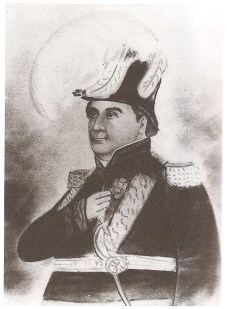
May 15 blog illustration.Armijo, Manuel.illustrated history of nm
Source: Illustrated History of New Mexico,
Reed

But he didn’t get his furs back. Many of them had been badly damaged by rain leaking through the roof of the building where they were stored, so they were sold for about two-thirds what they would have brought in good condition. The total was still a decent amount, about $3500. But it’s not clear who received the resulting funds. After all, the plews were government-confiscated property.

Sources: Carl P. Russell, Firearms, Traps, and Tools of the Mountain Men, Skyhorse Publishing, 2010; David J. Weber, The Taos Trappers, University of Oklahoma Press, 1970.

MAXWELL BEFORE THE BAR, 2 of 3

“You have an interest in a number of cases before this court,” Judge Palen said sharply.

Lucien Maxwell nodded and tilted his head toward the old lawyer beside him. “Mr. Wheaton is my designated attorney.” He raised an eyebrow. “I believe that releases me from the need to be present.” He adjusted his right foot higher on his left knee.

“You have been indicted on a serious charge.” Palen leaned forward. “That indictment requires your attendance.”

“The Probate Court issue?” Maxwell lifted a shoulder. “We have an excellent probate court clerk. As you’ll see from his records, there was no need to hold formal court.”

Palen’s lips thinned. “You committed to appearing on the first day of this session in regard to the indictment against you. It is now the fourth day.”

“I was unexpectedly detained.”

Palen stared at him for a long moment, then turned to the court clerk. “Let the record show that Mr. Maxwell has appeared and apologized for his failure to appear, and that we are satisfied no contempt was intended.”

Maxwell’s jaw tightened, then he nodded slightly and readjusted his right foot on his knee.

Moreno Valley Sketches II

MAXWELL BEFORE THE BAR, 1 of 3

Lucien Bonaparte Maxwell, richest man in northern New Mexico Territory, sat on one of the mismatched chairs in Elizabethtown’s makeshift Colfax County courtroom and studied the man sitting behind the Judge’s table. He’d sat at such tables himself, though he doubted he’d ever looked so uncomfortable. Joseph Palen looked out of place here in this rough mining town and angry that it had the audacity to call itself a county seat. Apparently disapproved of Nuevo Mexico, too, for that matter.

Maxwell felt the impulse to laugh, but instead lifted his right foot to his left knee and watched the crowd gather. Most of the men nodded to him politely, touching their foreheads in a kind of salute, and he nodded back. They were good people, he mused. Knew what they wanted, had no pretense about them.

Beside him, the old attorney Wheaton muttered, “Here we go,” and Judge Palen gaveled the room to attention.

“Apparently, Mr. Maxwell has deigned to honor us with his presence,” Palen said, glaring at Lucien.

Maxwell resisted the impulse to straighten his spine and put both feet on the floor. “I believe you asked to see me,” he said coolly.

Moreno Valley Sketches II

Mexico Establishes Citizenship Requirements

On Monday, April 14, 1828, Mexico’s Congress spelled out the conditions under which foreigners could become Mexican citizens. The rules were simple: They had to have lived in Mexico at least two years and be Roman Catholic, employed, and well-behaved. If these conditions were met, the governor of the Deparment could issue a certificate of citizenship.

It seems to have taken a while for word about the new law to get to New Mexico, but once it did, at least twelve French-Canadians and Americans applied for citizenship the following year. One of these men was John Rowland, trapper, trader, and owner of both a Taos flour mill and a Taos Lightning distillery.

April 14 illustration.John Rowland.Hafen Vol IV
John Rowland. Source: Mountain Men and the Fur Trade of the Southwest, Vol. IV, Leroy R. Hafen

Rowland didn’t remain in New Mexico, although he did remain a Mexican citizen. In 1840, he and his England-born distillery partner William Workman, supposedly without their knowledge or consent, were named temporary commissioners for the Republic of Texas. Feelings against Texas were strong in northern New Mexico and the two men’s apparent support for Texas and the hated 1841 Texas-Santa Fe expedition was enough to make New Mexico too hot for them. In 1841, they emigrated to California.

Both men did well in California. Workman became an important figure in the Los Angeles business community and Rowland became one of California’s most important wine manufacturers while continuing his work to produce both flour and distilled spirits. He died in 1873 and was buried in the cemetary of the Catholic church built on the 48,790 acre Rancho la Puente, which he co-owned with Workman.

Sources: Mountain Men and the Fur Trade of the Far West, Vol. IV, Leroy Hafen, Arthur H. Clarke Company, Spokane, 1966; The Taos Trappers, David J. Weber, U of Oklahoma, Norman, 1971.  www.homesteadmuseum.org

INHERITANCE

In the middle of the night, the baby began wailing frantically.

“¡A redo vaya! Good heavens!” Ramona said, sitting up in bed. As she slipped from the blankets, Carlos grunted but didn’t open his eyes. Ramona paused to look down at him, and shook her head. How a man could sleep through that much crying was beyond her comprehension. He must be very tired from the digging he did for the Baldy Mountain miners every day.

As she crossed the room to the baby, she rubbed her ears with her fingers. The Spring wind was howling, which always made them uncomfortable.

She lifted Carlito from his blankets and opened her nightdress. He began suckling eagerly, whimpering a little as he did so, and rubbing his free hand against the side of his head.

So his ears were uncomfortable, too. She looked down at him as she walked the floor, and sighed. He had a lifetime of discomfort before him and there was nothing she could do about it.

Moreno Valley Sketches II

TRAPPER IN LOVE

“I had me a little señorita once,” the old trapper said. “She was a real firecracker, that one. I never did learn Spanish real good and she could pull herself up all royal like and tighter’n a beaver trap all set to snap and not near as useful. She’d start spittin’ Spanish at me like some kinda wildcat and I didn’ know what she was sayin’ but I knew enough to let her be ’til she got over her fuss. She’d push her black hair away from her fire-flashin’ eyes and let out with ‘Es más feo que un dolor de estómago!’ and then she’d yell ‘Es más sabio que Salomón!’ I didn’t know a word o’ what she was sayin’ but I could tell from her tone that it was high time to skedaddle on outa there and go huntin’.”

The old man shook his head. “Guess I went huntin’ one too many times, ’cuz one day I come back with a nice big cougar pelt and she was done gone. Too bad. That was the prettiest skin I ever saw.”

He leaned forward. “What’s that you say? I was uglier’n a stomach ache and thought I was smarter’n King Solomon? That’s all she was sayin’? Here I was sure she was ready t’ take a knife t’ me or send her brother Sol t’ do it for her. An’ all she was doin’ was grumblin’? Hah! Well, if I’da known that I mighta stuck around more and tried lovin’ her back into some kinda reason. She sure sounded god awful unreasonable at the time.”

The old man sat back, clicked his tongue against his teeth, and shook his head. “Huh, ” he said. “You don’t say.”


Copyright © 2017 Loretta Miles Tollefson

More Victims of Fremont Expedition Die

By the middle of February, 1849, mountain man Bill Williams and the two men who’d survived the failure of the Fremont expedition in the Sangre de Cristos with him, were in Taos recovering. Before the end of the month was out, the 62-year old Williams and the Fremont expedition medical doctor Benjamin Kern headed back out into the snow-covered wilderness. Their mission was to retrieve Dr. Kern’s medical equipment and supplies and his two brothers’ art materials and papers. The goods were in a cache on the Continental Divide near the Rio Grande headwaters, where they’d been placed after the expedition’s pack mules succumbed to starvation and cold. Williams and Kerns were accompanied by a handful of Mexican assistants, who managed the pack outfit.

It was a fateful trip for the two Americans.  While they made it back to the cache, they did not make it out alive.

The Utes in the region had been in war mode since the previous summer. Since then, they’d been raiding the settlements up and down the Southern Rockies and the plains to the east. When they combined with the Apaches to clash with U.S. troops in the Raton mountains, the U.S. military leaders started getting concerned. Lt. Joseph H. Whittlesey was ordered out to bring the tribe into line.

Whittlesey started north from Taos on March 11 with 37 men and four scouts, one of them Lucien B. Maxwell. The next day, about fifteen miles north of Red River, his forces attacked a Ute village and forced those they hadn’t killed into the cold and snow.  About a dozen Utes fled toward the Rio Grande. When they happened on the Williams/Kerns encampment on the Continental Divide, they saw an opportunity to revenge what Whittlesey had done.

The Utes shot Old Bill Williams and Dr. Kern, ordered the men with them to stay put, and carried off the supplies and pack mules as partial payment for the destruction of their winter camp. It is said that when the Utes realized they’d killed Williams, they gave him a chief’s burial. If this is true, it’s more respect than he received from Fremont, whose family later blamed Williams for the failure of Fremont’s expedition and the subsequent death of so many of his men, an accusation that seems to have no basis in fact.


SOURCES: Robert G. Cleland, This Reckless Breed of Man, UNM Press, 1976; Alpheus H. Favour, Old Bill Williams, mountain man, U of Oklahoma Press, Norman, 1962; Leroy R. Hafen, Ed., Fur Trappers and Traders in the Far Southwest, Utah State UP, Logan, 1997.

Alexis Godey Rescues Fremont’s Men

On Friday, February 9, 1849 eight of the original 33 in Colonel John C. Fremont’s Fourth Expedition rode into the settlement of Little Pueblo on the Colorado River. They were frostbitten, hungry, and unable to walk, but they were alive, thanks to Alexis Godey.

The Fremont expedition was supposed to identify a railroad route across the Rocky Mountains. Instead, virulent winter conditions brought it to a standstill. They’d started from the eastern slopes in November, but by mid-January it was apparent even to Fremont that they couldn’t go any farther.

With men and supplies giving out, Fremont, Alexis Godey, topographer Charles Preus and two other men went for help. However, by the time they got to Taos on January 13, Fremont was in no condition to return for the rest of his men, who by that time had broken into scattered groups, each trying desperately to survive.

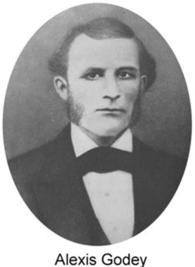
Feb 9 illustration.Alexis Godey.Find a grave


Alexis Gody, originally hired as the expedition’s hunter, almost immediately headed back into the mountains for his companions. He fought his way north with 30 animals and four Mexican assistants. The first group he located consisted of the three Kern brothers, Captains Cathcart and Taplin, Missourian Micajah McGehee, and J.L. Steppenfeldt, all of them close to dying from starvation. He loaded them onto the mules and headed for the closest settlement. It took another three days, through yet more snow and ice, but they when they reached Little Pueblo on February 9, they were all still alive.

Godey was about 30 years old in 1849. He’d been with John Fremont during the Bear Flag Revolt in California and was cited for valor after the Battle of San Pasqual. He was known for his courage,  coolness under pressure, and stubborn resolution: courage and resolution he’d need to rescue the men Fremont had left behind.

Godey would go on to act as the head guide for another railroad survey expedition, this one Lt. Robert William’s 1853identification of a route from Texas to California along the 32nd parallel. Godey wasn’t the only member of William’s team who’d been in the mountains with Fremont. Williams’ cartographer was none other than Charles Preuss, Godey’s and Fremont’s companion on that initial January escape to Taos.

Sources: Alpheus H. Favour, Old Bill Williams, Mountain Man, U of Oklahoma Press, Norman, 1962; Leroy Hafen, Fremont’s Fourth Expedition, Arthur H. Clark Co., 1960; https://www.findagrave.com/memorial/15547524 1/2/18; http://www.longcamp.com/godey.html  1/2/18

New Mexico’s Rep Issues Warning About Americans

In January 1826, Santiago Abreú, New Mexico’s representative in Mexico City, sent a letter to the government officials in Santa Fe. In it, he cautioned them to be wary of the Americans in the province, especially those who wanted to settle, buy land, and marry without first obtaining the appropriate citizenship papers. In addition, the letter asked officials to record the activities of all non-Mexicans in New Mexico. This governmental policy of monitoring the Americans continued into the next decade, including after Abreú himself was appointed Governor in 1831. His duties included enforcing the laws that governed the americanos’ activities, including the regulations related to trapping and trading.

Jesus G. Abreu.Meketa
Jesus Abreu, Santiago Abreu’s son and Lucien B. Maxwell brother-in-law Source: Louis Felsenthal by J. D. Meketa

Ironically, Governor Abreú  was the father of Jesús Abreú, the man who would become Lucien Bonaparte Maxwell’s brother-in-law and fellow heir (through their wives) of a substantial portion of the Beaubien-Miranda land grant east of Taos. Although Canadian-born Carlos Beaubien, Jesus Abreú’s and Lucien Maxwell’s respective wives, had become a naturalized Mexican citizen prior to the grant’s being made, there is no record that Lucien Maxwell, ultimate owner of most of the land, was ever a naturalized Mexican citizen. However, by the time Beaubien died in 1864, Maxwell’s citizen was a moot point. The thing Santiago Abreú had feared, that the Americans would eventually take over, had occurred 18 years before and many of his countrymen were in eminent danger of losing their patrimony to the men who were flooding in from the eastern States.


Sources:   J. Rush Pierce, Red River City: A history of Northern New Mexico 1800-2000, JRP Publications, 2008; Marc Simmons, Kit Carson and His Three Wives, UNM Press, 2008; Jerry D. Thompson, A Civil War History of the New Mexico Volunteers and Militia, UNM Press, 2015; David J. Weber, The Taos Trappers, U of Oklahoma, 1971; Stephen Zimmer, ed., For Good or Bad, People of the Cimarron Country, Sunstone Press, 1999.

ICY MORNING

At first, the girl thought it was snowing, the tiny flakes glinting in the early morning sun. Then she saw they were miniscule ice crystals, floating from the cabin’s cedar-shake roof and the long green needles of the ponderosas looming above it: sparkling flecks of ice drifting through the air like frozen sunlight. She held her breath for a long moment, taking it in.

Then her mother opened the heavy wood-plank cabin door behind her. “It’s freezing out there!” she exclaimed. “What are you doing? You’ll catch your death!” And the girl turned reluctantly toward the house.

from Moreno Valley Sketches II