INDECISION

Billy Dupre pulled his ivory-handled Colt pistol from its holster and laid it beside him on the granite boulder. He looked at the revolver thoughtfully, then twisted away to gaze at the valley below. The morning light was just beginning to turn the tops of the western mountains a pinkish-orange. He sighed and shook his head.

“You backin’ and fillin’ again?” a sleepy voice asked from the other side of the burnt-out fire.

Billy glanced around. “I can’t help it, Johnny,” he said. “I just can’t get to makin’ up my mind to killin’ a man just cuz I’m paid to do it. A man who never did nothin’ to me or mine. Someone I don’t even know.”

“You were in the army, same as me,” Johnny Kemp said. “You did it then, didn’t ya?”

“That was war. This is different.”

“And you’re from Missouri, same as me,” Kemp persisted. “Weren’t there no bushwhackers where you come from?”

“Yep, and I shot my share. But that was defendin’ my family and my home, same as when I joined up.” Billy looked toward the sunlit mountain peaks. “Not that it did me much good. By the time I got back, my ma was dead, my pa was half-crazy, and that Sally Ann–” He stood abruptly and nudged at the ashes in the fire ring with his booted toe. “There’s no embers left. You got a match?”

“That girl done and gone, didn’t she?” Johnny sat up and reached for his knapsack. “That Sally Ann?”

“It’s all done and gone.” Billy turned and began moving around the edge of the campsite, collecting small pieces of downed aspen branches. “All of it’s right done and gone.”

“So you should be wrathful enough to shoot just about any varmint that crosses your path.” Kemp stood, stretched, and began buckling his pants. “Cuz there’s no one left back there and no one here neither.” He grinned. “No one ’sides me.” He crossed to the boulder and hefted the Colt, then flipped it expertly, feeling the balance of the thing. “Nice gun,” he said.

“No, you can’t have it,” Billy said. He dropped an armload of wood beside the fire ring.

Kemp grinned, put the pistol back on the rock, and crossed to the firewood. “So what’re you gonna do if you don’t go to shootin’ for pay?” He crouched down, took out his knife, and began shaving bark into a small pile. “You gonna go back to laborin’ at one of those Etown sawmills? Become a mine flunky?”

“I might.” Billy went back to the big rock. He stared down at the valley as he reholstered the pistol. “We had us a farm in Missouri,” he said thoughtfully.

Johnny Kemp rocked back on his heels. An incredulous grin split his face. “You gonna be a farmer? A bug-ridden land-rich cash-poor dirt grubber?”

Billy Dupre stared at the sunlight touching the grasses below and glinting off the small streams that meandered across the valley toward the canyon of the Cimarron. “I might,” he said. “I just might.”

from Old One Eye Pete

Over The Trail to Mexico: Book Review


Over The Santa Fe Trail to Mexico cover
Joy L. Poole, editor
ISBN: 9780806157511
University of Oklahoma press, 2017

Early in the summer 1825, yet another young man joined a wagon train headed over the Santa Fe Trail to New Mexico.

This particular traveler’s name was Doctor Rowland Willard. Dr. Willard’s diary during his time on the Trail and afterwards in New Mexico, Chihuahua, and Durango has now been published with detailed notes and provides a fascinating look at life in Mexico in the second half of the 1820s.

As a medical doctor, Doctor Willard’s perspective was slightly different from other Americans on the Trail and in Mexico. However, in some ways it was very much the same — he was there to make money.

He spent less than six months in New Mexico and did not find there the financial success he was looking for. However, he did find it in Chihuahua. He returned to the States in 1828 with $7000 in cash.

Willard’s diary has actually been published before. Excerpts were included in the Western Travel Review in 1829 and two years later the entire diary was added as an appendix to The Personal Narrative of James Ohio Pattie. The physical diary disappeared into Willard family archives and didn’t resurface until  2005, when it began its journey to publication as Over The Santa Fe Trail To Mexico, the travel diaries and autobiography of Doctor Rowland Willard

This edition provides not only the diary but also Joy L. Poole’s extensive notes and Willard’s autobiography, published here for the first time. This book is worth its price for Poole’s notes alone, which provide the context for fully appreciating Willard’s experiences and observations.

If you’re a student of the Santa Fe trail or of New Mexico history in the late 1820s, Over the Santa Fe Trail to Mexico  will be a valuable addition to your library. If you’re simply looking for a good read about old New Mexico— or old Mexico— I would definitely recommend it.

New Mexico’s First Protestant Church

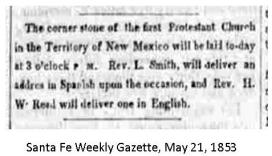
On Saturday, May 21, 1853, Baptist missionaries in Santa Fe began construction of the first Protestant church in New Mexico, located on the corner of what is now Grant and Griffin Street. The Reverend Henry W. Reed and the Reverend L. Smith officiated.

May 21 illustration

Henry Reed had arrived in Santa Fe in Summer 1846 and opened a school. Smith arrived several years later. They seem to have been focused on converting New Mexicans to Protestantism rather than serving the Anglo population. In 1851, Reade reported to his constituency back East that he’d been in Taos to share information about his Baptist school curriculum with Padre Martinez and had attended the Catholic services there. He disapprovingly described the mass as “not above a whisper and in Latin.”

The Baptist church services in Santa Fe were apparently in Spanish and English. At the cornerstone-laying ceremony on May 21, Reverend Smith spoke in Spanish and Reverend Read in English. This bilinqual approach doesn’t seem to have been enough to attract a large congregation. The adobe brick building was sold to the Presbyterians in 1866, at the end of the Civil War.

The Presbyterians eventually pulled the adobe building down and replaced it in 1882 with a brick structure. That building was replaced in 1939 with a Pueblo Revival building designed by John Gaw Meem, which is still in use today.

Sources: Thomas Harwood, The History of New Mexico Spanish and English Missions of the Methodist Episcopal Church, 1850 to 1910, Vol. I. Albuquerque: El Abogado Press, 1908; E. A. Mares, ed., Padre Martinez: New Perspectives From Taos, Taos: Millicent Rogers Museum, 1988; Ralph Emerson Twitchell, The Leading Facts of New Mexican History, Vol. II. Cedar Rapids: The Torch Press, 1912.

REPRIEVE

“Please don’t shoot him, Papa.”

Gerald lowered the gun and looked down at the boy. “Coyote’ve been nipping at the elk all spring and they left tracks by that half-eaten calf up the hill.”

Andrew shook his head. “He didn’t kill that calf, Papa.”

Gerald frowned. “You know that for a fact?”

Andrew hesitated, then nodded. “I’ve been watching him. He lets me get mighty close. He’s not as skittish as the others.”

“You’ve been following that coyote around?”

The boy scuffed the muddy ground with his boot. “I was curious.” He lifted his head. “The calf was dead when he ate off it.”

Gerald shook his head. “You are something else,” he said. He scanned the valley. The coyote was still visible. It trotted purposefully across the far side of the grassy slope beyond the meandering creek. “We’d best head back,” he said. “They’ll be waiting dinner on us.”

Copyright © 2015 Loretta Miles Tollefson

May Snow in New Mexico!

New Mexico’s weather so far this year has reflected the weather patterns across the nation—unpredictable, to put it kindly. To put the snow, rain, hail, and general nastiness into perspective, take a look at this May 9, 1907 article from the Cimarron News and Press.

May 9 illustration

The winter had been a dry one. The stockmen’s herds hadn’t been buffeted by much cold, so they were healthy, over all. But the dry conditions meant the summer was going to bring sparse summer grasses. Until early May. When it rained and snowed!

The Cimarron News and Press tended to be very upbeat, so I question just how positively the stockmen felt about the loss of their calves and lambs to the recent storms.

But we can take comforting in noting know that storms this late in the year are not a new phenomenon.


PROTECTION 3 of 3

“She threw a stick at a mountain cat that was goin’ after the boy and it run off?” the old man who was visiting asked. “Mid-lunge?” The two men sat on stools in front of the cabin fire, a whisky jug between them.

“That’s what she says.”

They both turned to look at Gina, who sat on the bed in the corner, singing a lullaby to the child, crooning him to sleep.

“Hard to believe,” the old man said, stroking his stringy white beard.

“Old cat,” Charles said.

“Maybe.” The old man took a sip from the jug. “Coulda been a young one, though. A woman’s protective instincts can be almighty strong.”

There was a disbelieving grunt at the fire and then silence.

“Stranger things’ve happened,” the old man observed. “And she does take kindly to that child.”

“She does that,” her husband said grudgingly.

from Old One Eye Pete

PROTECTION 2 of 3

When Charles came in from the mountainside pasture, they were huddled on the cabin’s only bed, Gina curled around the child until he was almost invisible. She raised a tear-stained face.

Charles glanced at her and turned to hang his coat on a peg.

Cuguar,” she said.

“Cougar?” Then he was beside her, pulling Charlie from her arms, looking him over.

“He is unhurt,” she said, a hand on the child’s small leg. “I threw a stick. It ran away.”

Charles dumped him back into her arms. “Mountain lion don’t run off.” He crossed to the fire. “Don’t tell me stories.”

“It is true.” Gina smoothed the boy’s hair. “Mamá saved you,” she said. “She did.”

Charles grunted at the fire. “You sittin’ there with him all day?” he demanded. “Where’s my food?”

She lowered the child gently to the bed and went to prepare the evening meal.

from Old One Eye Pete

Texas Stage Route Is Better In Winter Months

On April 8, 1853, the readers of the Santa Fe Weekly Gazette were reminded that winter wasn’t truly over in New Mexico—the mail and passengers to and from Texas were still being transported under the “winter arrangement.”

There really wasn’t any difference between the summer and winter time schedule. Each month, the stage left Santa Fe on the 15th and arrived in El Paso six to eight days later. The next leg of the trip was from El Paso to San Antonio, where it  arrived on the 14th or 15th of the following month. So it took about a week to get from Santa Fe to El Paso, a trip which takes about five hours today. Interestingly, the fare from Santa Fe to El Paso was $30, only about $10 more than the cost of gas for the same route today. In fact, if wear and tear on one’s vehicle is factored in, it might have been cheaper to travel between Santa Fe and El Paso in 1853 than it is now. That is, of course, if you have seven or eight days for the trip.

April 8 illustration

On the other hand, the cost to travel from Santa Fe to San Antonio was significantly higher in 1853 than it is today—$125 as opposed to $48 in fuel costs. The timeframe for the trip is also considerably less now—about 12 hours as opposed to 30 days.

One thing has remained the same. The advertisement in the Gazette points out that the trip to and from “the States” via the San Antonio route was considerably more pleasant during the winter months than was travel via the Santa Fe Trail to Independence, Missouri. The southern route was, and is still likely to be, “entirely free from the intense cold and heavy snows that so frequently obstruct” the northern Trail.

There was another advantage to taking the stage to San Antonio. Passengers were not required to stand guard.

Sources: Santa Fe Weekly Gazette, April 8, 1853, first page; MapQuest.com, accessed March 5, 2019.


PROTECTION, 1 of 3

Charlie was playing near the edge of the forest while Gina knelt in the small garden. She glanced occasionally toward the log cabin at the other end of the clearing. Charles would return soon. The setting sun sent shadows across the grass. Charlie poked at the brown earth with a stick.

A cougar slunk forward between scrub oak branches and watched carefully, ears forward. Her tail twitched.

As the cougar crouched into position to spring, Gina’s head snapped up. Her hand reached for a thick stick lying nearby. As the cat sprang, so did she; the woman was faster.

“No!” she shrieked as the animal lunged toward the child. “No!” The stick flew through the air, hitting the cat’s side. It arched away in mid-spring, missing its quarry. Charlie let out a cry and the cougar snarled. Then it was gone.

“Mamá?” the child whimpered.

She reached for him wordlessly.

from Old One Eye Pete

The Battle of Glorieta Pass

On Saturday, March 22, 1862, Colorado Militia Colonel John Potts Slough led his troops out of Fort Union to meet the Texan Confederate army that had seized Santa Fe twelve days earlier—the same day Slough and his Colorado Militia, or Pike’s Peakers, had arrived at Fort Union. The irascible and rather arrogant Slough, who’d virtually seized command of the Fort when he arrived, had about 1500 men at his disposal, a combination of Pike’s Peakers, New Mexico Militia, and Army infantry and cavalry.

On Sunday, Slough’s Union forces camped overnight at Las Vegas, then on Monday swung west  toward Santa Fe. Tuesday was another day of slowly moving forward and into the mountains. Santa Fe must have seemed a long way away, especially to the Colorado militiamen, who’d already trekked over 300 miles from Denver to Fort Union.

But then on Wednesday, Union scouts clashed with a small Confederate force in Apache Canyon, at the west end of Glorieta Pass and less than twenty miles from Santa Fe.

Both sides pulled back. The Confederates—about 200 men under Major Charles L. Pyron—headed to Johnson’s Ranch at Canoncito, where they were joined by the main Confederate force, which had just arrived via a trail through the mountains north east of Albuquerque.

march 26 illustration

The Union men moved to Kozlowski’s ranch, at the eastern end of the Pass. When the rest of Slough’s forces joined them on Friday morning, everything went into high gear.

Most of Slough’s men headed on into the Pass. But Colonel Manuel Antonio Chaves, of the New Mexico First Infantry, led Major John M. Chivington and 530 men (New Mexico Militia, two Pike’s Peakers infantry columns, and a detachment of Third U.S. Cavalry) into the mountains south of the Pass. Their goal was to circle south and west around the Confederates and hit them from behind while the main body met the Texans head on.

And the Union and Confederate troops did meet head on, at Pigeon’s Ranch, a trail hostelry in the middle of the Pass owned by Frenchman Alexander Valle. It was a hard-fought, all-day battle between evenly-matched combatants. When the fighting ground to a halt late in the day, the two sides agreed to a truce so they could tend their wounded and dying. But both sides saw the break in fighting as temporary. They were confident they’d ultimately win the Battle of Glorieta Pass.

Until that evening, when news arrived from the western end of the Pass.

Instead of Confederate troops, Colonel Chavez and Major Chivington had found a weakly-defended supply train. Chivington ordered his men down from the bluffs above the camp and set them to attacking, pillaging, and then burning the Texan wagons and everything they contained: food, clothing, equipment, ammunition, and medical supplies.

The Confederates had stationed the majority of their horses and mules with the train—as many of 500 animals. Chivington ordered his men to destroy them, as well. It’s not clear what actually happened to all the animals in question, though. At least some were driven off into the mountains and presumably into the hands of citizens for whom they were more useful alive than dead.

Wherever the Confederate livestock ended up, they certainly weren’t going to help the Texans. With their supplies, wagons, and animals gone, Sibley’s men forfeited the Battle of Glorieta Pass and beat a retreat for Santa Fe and, ultimately, Texas.

Most of the Coloradans headed home, too, although at least one of them returned a few years later. In 1865, John Potts Slough was named chief justice of the New Mexico Territorial Court.

Although Slough was an able judge—he would announce the 1867 legal decision that declared Pueblo Indians to be United States citizens—Slough was still as thin-skinned and greedy for honor and position as he’d been five years before. His furious response to New Mexico legislative political intrigues and Capt. William L. Rynerson’s role in them culminated in a December 1867 shootout in what is now Santa Fe’s La Fonda Hotel. Slough died as a result.

At the ensuing trial, Rynerson was found to have drawn his gun in self-defense.

It’s likely Slough would have insisted on a different opinion.


Sources: Howard Bryan, Wildest of the Wild West, Santa Fe: Clear Light Publishing, 1988; David L. Caffey, Chasing the Santa Fe Ring, Albuquerque: UNM Press, 2014; Jacqueline D. Meketa, Louis Felsenthal, Citizen-Soldier of Territorial New Mexico, Albuquerque: UNM Press, 1982; David Grant Noble, Pueblos, Villages, Forts & Trails: A guide to New Mexico’s past. Albuquerque: UNM Press, 1994; Jerry D. Thompson, A Civil War History of the New Mexico Volunteers and Militia¸ Albuquerque: UNM Press, 2015; Ralph Emerson Twitchell, The Leading Facts of New Mexico History, Vol. II. Cedar Rapid: Torch Press, 1912; https://www.ohiocivilwarcentral.com/entry.php?rec=125 Accessed 1/10/19