Supreme Court Rules in Land Grant Company’s Favor

Supreme Court Rules in Land Grant Company’s Favor

On Monday, April 18, 1887, the U.S. Supreme Court finally confirmed the Maxwell Land Grant and Railway Company’s right to almost two million acres in northeast New Mexico.

The controversy over the grant’s size had been going on since the early 1870s. A survey when the Company bought the grant identified around 2 million acres, land that  that included much of what is now New Mexico’s Colfax County and stretched north into Colorado.

But there was a problem. Not everyone agreed that the grant was that large. In fact, U.S. General Land Office surveys insisted that grants issued by Mexico were limited to only 22 square leagues—a far cry from the 2 million acres claimed. Based on this judgment, the Land Office declared much of the acreage open to settlement. When its agents began issuing deeds to eager homesteaders and ranchers, trouble ensued. But the Maxwell Grant Company intended that land for its own uses and this was the American West—might made right. People died.

Map of final Maxwell Land Grant and Railway Company boundaries

At the same time it was using guns and intimidation to keep people off its wide-open spaces, the Company also sought legal recourse. It turned to Washington with a request for an official government survey of the grant based on the geographical descriptions in the original 1840s documents. The request was refused.

Then in 1876, the U.S. Supreme Court allowed another New Mexico land grant to encompass more than 22 square leagues. The Maxwell Land Grant and Railway Company swung into action. Three weeks after the decision, the Maxwell grant was being resurveyed. It took another eleven years, four days of oral argument, and 900 pages of testimony, but the Company finally got its land.  

With that ruling, the Colfax County War, which had begun in earnest in September 1875, finally wound down, making it a longer feud than New Mexico’s more famous Lincoln County War, which had lasted a mere three years (1878-1881).

And proving that if you hang in there long enough—and have enough money—you might just get what you want, after all.

Sources: Howard R. Lamar, Reader’s Encyclopedia of the American West, New York: Harper & Row, 1977; Lawrence R. Murphy, Philmont: A history of New Mexico’s Cimarron Country, Albuquerque: University of New Mexico Press, 1972; Stephen Zimmer, For Good or Bad, The People of the Cimarron Country, Santa Fe: Sunstone Press, 1999; Maria E. Montoya, “Maxwell Land Grant”, Encyclopedia of the Great Plains, plainshumanities.unl.edu/encyclopedia/doc/egp.ha.026, accessed 1/20/22.
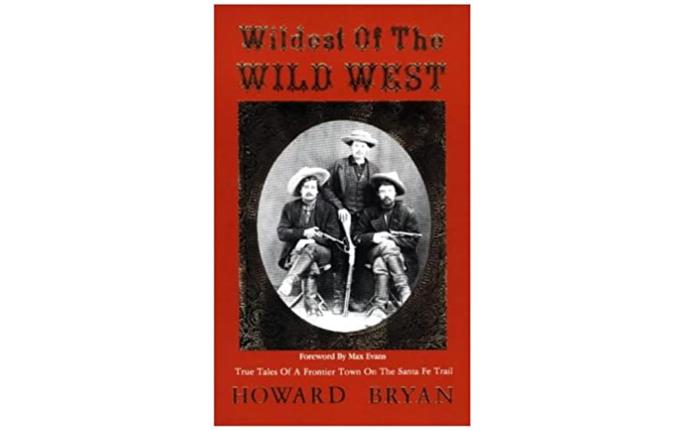
BOOK REVIEW: Wildest of the Wild West

BOOK REVIEW: Wildest of the Wild West

Howard Bryan’s Wildest of the Wild Westis one of the first books I read when I began to explore the possibility of turning pieces of New Mexico’s history into fiction. While Bryan’s book about the town of Las Vegas is nonfiction, it reads like a story. Certainly, some of the events he retells could be lifted straight from a traditional Western novel.

We find an Italian hermit living in a cave above the Spanish-speaking town and revered as a holy man and miracle worker, Jesse James and Billy the Kid soaking in the nearby hot springs, Doc Holliday opening his final dental practice only to abandon it for a saloon and gambling hall, and Hoodoo Brown, formal justice of the peace and informal protection racketeer. Then there’s the actress/singer/poet/faro dealer known as Monte Verde who was actually the famous Confederate spy Belle Siddons. And the enigmatic “Mysterious Dave” Mather, who seems to have robbed a train while serving as Las Vegas Town Marshal.

The stories of these various characters is woven into a coherent narrative of Las Vegas’s history which Bryan tells with humor and verve. If you like nonfiction that reads like a novel, I highly recommend Wildest of the Wild West.

Governor Pérez Heads to Santa Fe!

Governor Pérez Heads to Santa Fe!

In early April 1835, Mexican Army Colonel Albino Pérez left Chihuahua for his new post as Governor of New Mexico. He arrived in Santa Fe with 1000 pesos “for the needs of that office,” and a strong reputation as a military man. A “man of fine presence … privileged and well-to-do,” Pérez began his administration with a brisk efficiency that boded well.

However, once New Mexicans got a closer look at the governor, they were less impressed. The funds he brought were depleted fairly quickly. Also, Pérez seemed to think his 3,000-peso-a-year salary was insufficient, even though it was high for New Mexico. He borrowed large gilded mirrors from former governor Francisco Sarracino, a chest of drawers from Justice Santiago Abréu, and a large table clock from Judge Juan Estevan Pino. And local transport options weren’t good enough for him. He ordered an American-made two-wheeled carriage and two horses worth 800 pesos from Santa Fe trader Jesse Sutton.

The new governor also lived an immoral life. Although he was believed to have a wife in Mexico City, he became involved in a relationship with his housekeeper, Trinidad Trujillo, and fathered her child.

New Mexicans might have merely muttered at all this and gone on with their lives, but Federal politics began to exacerbate already-negative feelings.

On October 3, 1835, a decree by President Santa Anna’s centralist Congress abolished Mexico’s State and Territorial legislatures and replaced them with five-member Councils with no decision-making powers. Instead, they were subordinate to the president-appointed—and therefore controlled—governor. This gave Governor Pérez much more authority than he’d had when he arrived.

In addition, and perhaps more importantly, New Mexico’s tax exemption was about to run out. There was no assurance it would be renewed. New Federal decrees made the governor responsible for supervising collections, a potentially lucrative job. He didn’t have much incentive to ask for a continued exemption.

Rumors swirled. The governor was about to impose exorbitant tariffs. Thing never taxed before—like water, wood, and pasture—would be now. It was even whispered that men would be taxed for laying with their wives. Some people believed the new rates were actually being levied by the governor, not Mexico City, as a way to fund his lifestyle. When Pérez called a July 10 meeting to discuss the process for collecting the new revenues, the pot of rebellion began to heat up.

A month later, the governor’s naked body would lie headless in the road south of Santa Fe. All the efficiency and fine presence in the world couldn’t save him from the consequences of his lifestyle choices and Congressional mandates.

For more about what happened in New Mexico before, during, and after August 1837, check out my novel There Will Be Consequences, which is available from your favorite brick and mortar storeBookshop.orgebook retailerAmazon, and Barnes and Noble.

Sources: Lansing B. Bloom, “New Mexico Under Mexican Administration,” Old Santa Fe Magazine, Vol. II, Santa Fe: Old Santa Fe Press, 1914-1915; Paul Kraemer, An Alternative View of New Mexico’s 1837 Rebellion, Los Alamos Historical Society, 2009; Janet Lecompte, Rebellion in Río Arriba 1837, Albuquerque: University of New Mexico Press, 1985; Benjamin M. Read, Illustrated History of New Mexico, Santa Fe: New Mexican Printing Company, 1912; Ralph E. Twitchell, The Leading Facts of New Mexico History, Vol. 2, Cedar Rapids: Torch Press, 1912; David J. Weber, The Mexican Frontier, 1821-1846, Albuquerque: University of New Mexico Press, 1982.