The Battle of Glorieta Pass

On Saturday, March 22, 1862, Colorado Militia Colonel John Potts Slough led his troops out of Fort Union to meet the Texan Confederate army that had seized Santa Fe twelve days earlier—the same day Slough and his Colorado Militia, or Pike’s Peakers, had arrived at Fort Union. The irascible and rather arrogant Slough, who’d virtually seized command of the Fort when he arrived, had about 1500 men at his disposal, a combination of Pike’s Peakers, New Mexico Militia, and Army infantry and cavalry.

On Sunday, Slough’s Union forces camped overnight at Las Vegas, then on Monday swung west  toward Santa Fe. Tuesday was another day of slowly moving forward and into the mountains. Santa Fe must have seemed a long way away, especially to the Colorado militiamen, who’d already trekked over 300 miles from Denver to Fort Union.

But then on Wednesday, Union scouts clashed with a small Confederate force in Apache Canyon, at the west end of Glorieta Pass and less than twenty miles from Santa Fe.

Both sides pulled back. The Confederates—about 200 men under Major Charles L. Pyron—headed to Johnson’s Ranch at Canoncito, where they were joined by the main Confederate force, which had just arrived via a trail through the mountains north east of Albuquerque.

march 26 illustration

The Union men moved to Kozlowski’s ranch, at the eastern end of the Pass. When the rest of Slough’s forces joined them on Friday morning, everything went into high gear.

Most of Slough’s men headed on into the Pass. But Colonel Manuel Antonio Chaves, of the New Mexico First Infantry, led Major John M. Chivington and 530 men (New Mexico Militia, two Pike’s Peakers infantry columns, and a detachment of Third U.S. Cavalry) into the mountains south of the Pass. Their goal was to circle south and west around the Confederates and hit them from behind while the main body met the Texans head on.

And the Union and Confederate troops did meet head on, at Pigeon’s Ranch, a trail hostelry in the middle of the Pass owned by Frenchman Alexander Valle. It was a hard-fought, all-day battle between evenly-matched combatants. When the fighting ground to a halt late in the day, the two sides agreed to a truce so they could tend their wounded and dying. But both sides saw the break in fighting as temporary. They were confident they’d ultimately win the Battle of Glorieta Pass.

Until that evening, when news arrived from the western end of the Pass.

Instead of Confederate troops, Colonel Chavez and Major Chivington had found a weakly-defended supply train. Chivington ordered his men down from the bluffs above the camp and set them to attacking, pillaging, and then burning the Texan wagons and everything they contained: food, clothing, equipment, ammunition, and medical supplies.

The Confederates had stationed the majority of their horses and mules with the train—as many of 500 animals. Chivington ordered his men to destroy them, as well. It’s not clear what actually happened to all the animals in question, though. At least some were driven off into the mountains and presumably into the hands of citizens for whom they were more useful alive than dead.

Wherever the Confederate livestock ended up, they certainly weren’t going to help the Texans. With their supplies, wagons, and animals gone, Sibley’s men forfeited the Battle of Glorieta Pass and beat a retreat for Santa Fe and, ultimately, Texas.

Most of the Coloradans headed home, too, although at least one of them returned a few years later. In 1865, John Potts Slough was named chief justice of the New Mexico Territorial Court.

Although Slough was an able judge—he would announce the 1867 legal decision that declared Pueblo Indians to be United States citizens—Slough was still as thin-skinned and greedy for honor and position as he’d been five years before. His furious response to New Mexico legislative political intrigues and Capt. William L. Rynerson’s role in them culminated in a December 1867 shootout in what is now Santa Fe’s La Fonda Hotel. Slough died as a result.

At the ensuing trial, Rynerson was found to have drawn his gun in self-defense.

It’s likely Slough would have insisted on a different opinion.


Sources: Howard Bryan, Wildest of the Wild West, Santa Fe: Clear Light Publishing, 1988; David L. Caffey, Chasing the Santa Fe Ring, Albuquerque: UNM Press, 2014; Jacqueline D. Meketa, Louis Felsenthal, Citizen-Soldier of Territorial New Mexico, Albuquerque: UNM Press, 1982; David Grant Noble, Pueblos, Villages, Forts & Trails: A guide to New Mexico’s past. Albuquerque: UNM Press, 1994; Jerry D. Thompson, A Civil War History of the New Mexico Volunteers and Militia¸ Albuquerque: UNM Press, 2015; Ralph Emerson Twitchell, The Leading Facts of New Mexico History, Vol. II. Cedar Rapid: Torch Press, 1912; https://www.ohiocivilwarcentral.com/entry.php?rec=125 Accessed 1/10/19
SOFT WOOD

Samuel stroked the narrow piece of old cottonwood thoughtfully, absorbing its smoothness. It called out to be carved.

He was one of only a handful of boys living in Elizabethtown, New Mexico Territory, in this year of 1871. Almost all the other children were girls. Even worse, he was the only boy in a house full of overly-particular and opinionated sisters. Samuel scowled at the wood and dug his dirty fingernail into it, cutting a rough zigzag. It felt good to mark up something that they couldn’t complain about, even if he did have to hide behind the woodshed to do it, and didn’t have a knife to cut it proper-like.

“What are you doing?” a young female voice inquired.

Samuel looked up warily. A girl with long honey-brown curls and large gray eyes stood at the corner of the shed, staring at the wood in Samuel’s hands. She moved closer, her eyes still on the old stick. “How’d you mark it like that?” she asked. “All the wood around this town is too twisted and tough to cut into.”

“This here’s cottonwood,” he said. “It’s softer than the pine and other stuff hereabouts.”

“Where’d you get it?”

He stiffened, remembering he was talking to a girl, one who was bound to boss him around. “What’s it to you?” he asked.

“Well, never mind,” she said. She shoved her hands into her pinafore pockets and turned to go, her head down. Her curls covered her face.

“I’m sorry,” Samuel said contritely. He flung the stick away.

The girl crossed the yard to the piece of wood and bent to pick it up. She ran her fingers down the side he hadn’t marked. “It’s very soft,” she said.

“I have a lot of sisters and they’re always bossing me,” Samuel said apologetically.

The girl lifted her head and grinned. “I only have one brother, but he’s always bossing me.”

“What’d you want to know about the wood for?”

“I want to learn how to carve,” she said. “My brother knows but he won’t teach me. He says carving’s only for boys. I was going to try to teach myself but I couldn’t find anything soft enough.”

“I found that stick in our woodpile,” Samuel said. “There’s more in there but I’ll have to dig through the stack in order to get at it.”

“When you do find some, could I have a piece?”

“Sure. Why not?” He looked at her thoughtfully. “You have a knife?”

She smiled triumphantly and pulled a penknife from her pinafore pocket. They grinned at each other. Then she stuck out her hand, ready to shake. “I’m Charlotte,” she said.

from Valley of the Eagles


Pike’s Peakers Arrive At Fort Union!!

Tuesday, March 10, 1862 was a momentous day for New Mexico. That morning, Confederate troops from Texas seized control of Santa Fe. Led by Brigadier General Henry Hopkins Sibley, the Texans had moved steadily north through New Mexico since the previous July, receiving little opposition and clashing with Union forces in only one major battle, which they’d won.

By this time, the Texans must have been feeling pretty confident about making it to Denver and its gold fields. The idea was to seize those resources and use them to restore the Confederacy’s fortunes (literally). Then Sibley and his men would press on to California and the Pacific, opening its ports to Confederate shipping and sidestepping the Union blockades on the Eastern seaboard.

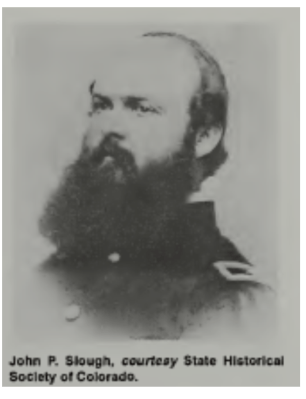
But late on March 10, Colonel John Potts Slough and his 950-man First Regiment of Colorado Volunteers (aka the Pike’s Peakers)  arrived at New Mexico’s Fort Union, more than doubling the number of men available in New Mexico to face down the Confederates.

Slough abruptly assumed command of the Fort. Although the Denver attorney had been in the military for only six months, he’d been a Colonel longer than twenty-seven-year veteran Colonel G.B.  Paul, who was in charge before the Pike’s Peakers arrived. But Slough, ever concerned about his rights and privileges, pulled rank, and Paul conceded his position as Commander, albeit unwillingly. Then Slough got busy outfitting his Pike’s Peakers with clothing, arms, and ammunition from the Fort Union supply depot.

march 10 illustration.john slough

Meanwhile in Santa Fe, Sibley’s Confederates  were also looking to their supplies. Their lines had been stretched thin on the march north and the Union supplies in Santa Fe had either been moved west to Las Vegas with the Governor’s baggage or skillfully hidden.

The Confederates’ stores were dangerously low. Although getting to Santa Fe had been quite an accomplishment, they badly needed Fort Union’s supplies if they were going to make it all the way to Denver.

But on March 10, they didn’t have a lot more time to worry about their situation. In less than two weeks, the thin-skinned and arrogant Slough would begin moving his men south out of Fort Union, then west toward Santa Fe. What would become known as the Battle of Glorieta or, more dramatically, the Gettysburg of the West, was about to begin.

Sources: Howard Bryan, Wildest of the Wild West, Santa Fe: Clear Light Publishing, 1988; Jacqueline D. Meketa, Louis Felsenthal, Citizen-Soldier of Territorial New Mexico, Albuquerque: UNM Press, 1982; David Grant Noble, Pueblos, Villages, Forts & Trails: A guide to New Mexico’s past. Albuquerque: UNM Press, 1994; Leo E. Oliva, Fort Union and the Frontier Army of the Southwest, Santa Fe: Southwest Cultural Resources Center Professional Papers No. 41, Division of History, National Park Service, 1993; Jerry D. Thompson, A Civil War History of the New Mexico Volunteers and Militia¸ Albuquerque: UNM Press, 2015.

VALLEY OF THE EAGLES

It was spring in the valley of the eagles, which meant it had been raining off and on for three weeks and the usually adobe-hard clay soil was soft enough to be dug. Once Old Bill had selected a likely spot for caching the packs of beaver fur, Pepe set to work. Old Bill stood farther up the hillside, chanting in a mixture of Osage and Ute. The prayers would help keep varmints away, Bill had said: both the two-footed and four-footed kind.

It was a good location for a cache, Pepe reflected: tucked under the hillside pines and marked by a massive sandstone boulder that would be easy to identify when they returned. After the Taos alcalde had decided that the few beaver plews they’d set aside to show him were truly Old Bill’s entire winter haul,  Pepe and Old Bill would slip back into the valley with a Taos trader to turn the cached furs into coin. Then Pepe would have a nice amount to take home to his wife while Old Bill gambled his own portion away.

Pepe chuckled and paused his digging to wipe his forehead with his cotton sleeve. He was always surprised at how warm it could get in this valley, as high up in the mountains as it was.

Small stones rattled past him and Old Bill came down the hillside. “War’s th’ other shovel?” he demanded in his nasal twang. “We ain’t got th’ rest o’ eternity!”

from Valley of the Eagles