By the Judge in His Sternness

On Thursday, March 28, 1861, in Las Vegas, New Mexico Territory, Judge Kirby Benedict sentenced Sapello resident Paula Angel to hang for murdering her lover Juan Miguel Martin after he broke off the relationship. Inexplicably, Judge Benedict granted Angel’s lawyer, Spruce M. Baird, permission to appeal the verdict, but then ordered that the appeal could not be used as to delay her execution. In addition, Benedict ordered Angel to pay the cost for her trial and hanging.

While this sounds unfair, territorial law called for cost to be “recovered” from a convicted defendant. It was common for the property of convicted defendants to be auctioned off and the proceeds used to pay court costs. The Territory paid a convicted defendants prosecution costs only if the Sheriff certified that they weren’t able to pay and had no salable property.
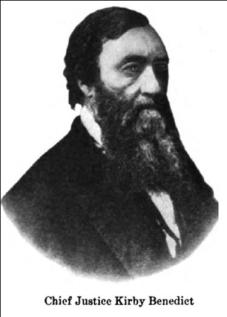
March 28.Kirby Benedict.Twitchell Leading Facts Vol II
Source: Leading Facts of New Mexico History,
R. E. Twitchell

Paula Angel was hanged on April 26, 1861. She is believed to be the only woman hanged in New Mexico Territory. But she hasn’t been forgotten partly because popular poet, and her cousin, Juan Angel wrote a long folk ballad about her crime and death. Here are a few of the lines.

To Las Vegas I was taken

by the judge in his sternness;

in the jail. I was placed,

surrounded by a thousand fears,

like a disgraced woman

in the town of Sorrows.

The jurors judged me

according to my crime;

to death. They sentenced me

because I killed Miguelitio. . .

Goodbye, pious women,

those of you who know how to feel;

look closely, do not become entangled,

do not allow yourself to be seduced.

Open your eyes, do not desire

a death like mine.

Sources: Howard Bryan, Wildest of the Wild West, Clear Light Publishers, Santa Fe, 1991; Aurelio M. Espinosa, The Folklore of Spain in the American Southwest, U of Oklahoma Press, Norman, 1985; Robert J. Torrez, Myth of the Hanging Tree, U of NM Press, Albuquerque, 2008.
 

INHERITANCE

In the middle of the night, the baby began wailing frantically.

“¡A redo vaya! Good heavens!” Ramona said, sitting up in bed. As she slipped from the blankets, Carlos grunted but didn’t open his eyes. Ramona paused to look down at him, and shook her head. How a man could sleep through that much crying was beyond her comprehension. He must be very tired from the digging he did for the Baldy Mountain miners every day.

As she crossed the room to the baby, she rubbed her ears with her fingers. The Spring wind was howling, which always made them uncomfortable.

She lifted Carlito from his blankets and opened her nightdress. He began suckling eagerly, whimpering a little as he did so, and rubbing his free hand against the side of his head.

So his ears were uncomfortable, too. She looked down at him as she walked the floor, and sighed. He had a lifetime of discomfort before him and there was nothing she could do about it.

Moreno Valley Sketches II

Every Man for Himself

In March 1867 Larry Bronson, Peter Kinsinger, and R.P. Kelley returned to Willow Creek and the gold they found there the previous fall. Now they were back, even though others were there before them. But even though they weren’t first on the scene, they still managed to do well by themselves, with five 200 foot claims near their original discovery point.

It’s not clear whether anyone had yet contacted the man who owned the land that they were so busily excavating. Willow Creek ran from Baldy Mountain into the canyon of the Cimarron River. All of the land in question was part of the Maxwell land grant owned by Lucien Bonaparte Maxwell and his wife Maria de la Luz Beaubien, whose inheritance it was.

Bronson, Kinsinger, and Kelly took out 14 ounces of gold that summer alone, then contracted for water rights from Bear and Willow Canyons so they could proceed on a larger scale. This involved moving from gold pan mining to hydraulic equipment. With 40 inches of water and 6 inch hoses to spray the rocks out of the hillsides, the company they formed became one of most productive operations on Willow Creek.

In the end, even Lucien Maxwell and his wife did well, partly as a result of the value of the Baldy Mountain area mining. In early 1870, they sold the entire land grant to a consortium of European investors, while retaining key portions of the grant, including mining claims on the east side of Baldy and water rights along Willow Creek. The men who bought the grant seem to have been confident that they also would do well from the gold and silver mines. However, things didn’t pan out quite as they’d hoped. The Maxwell Land Grant and Railway Company was in default by the early 1880s.

But then again, right from the beginning, mining in the area had been based on “every man for himself.”

Sources: Moreno Valley Writers Guild, Lure, Lore and Legends of the Moreno Valley, Columbine Books, Angel Fire, 1997; Larry R. Murphy, Philmont, A History of New Mexico’s Cimarron Country, UNM Press, 1972; Leo E Oliva, Fort Union and the Frontier Army in the Southwest, Division of History, National Park Service, Santa Fe, 1993; J. Rush Pierce, Red River City, JRP Publications, Red River, 2008; 1870 U.S. Census Records, Elizabeth City precinct; 1880 U.S. Census Records, Baldy/Ute Park precinct.


Spring Equals Trappers in Taos

It happened every spring in the early 1800s: Taos was invaded by trappers, either future or current. It made law enforcement rather complicated

In 1817, Jules DeMun didn’t even make it to Taos before he was headed off by a contingent of Spanish soldiers, who had been sent out in response to rumors in Taos that DeMun and his partner Pierre Chouteau had 20,000 Americans camped on the Purgatoire River, set to invade New Mexico. Even though the rumors weren’t true, DeMun and Chouteau were ordered to return to St. Louis. Somehow, they talked the soldiers into allowing them to travel north before heading east, ostensibly to avoid the Pawnee. Of course, they didn’t head directly to St. Louis. They trapped, supposedly outside of the boundaries of New Spain.

When news of Mexico’s independence from Spain reached the United States in 1821, things only got worse. Trappers and merchants could now enter New Mexico legally, but they still had trouble following Mexico’s rules. Up to this point, the Sangre de Cristo mountains had provided a protective barrier between Taos and incursions from the eastern plains. But they didn’t stop the Americans. In fact, the mountains were a great place to cache furs before smuggling them east to Missouri without paying export taxes. And Taos was still the favorite way to enter, especially if you were doing something slightly illegal. There were just so many ways to get there from the Santa Fe trail, which paralleled the mountains between it and Taos.

March 8 Illustration.Dick Wootton.Twitchell vol 2 source
“Uncle Dick” Wootton, Source: Leading Facts of New Mexico History, R.E. Twitchell

It got so bad that Mexico Customs Officer Juan Bautista Vigil y Alarid had to deputize Rafael Luna as Taos’ border guard. Even that wasn’t enough. Eventually, Alarid authorized Luna and Taos Alcalde Severino Martinez to use the militia to intercept the Americans.

Calling out the militia seems like overkill until you realize how valuable the furs in question were. In 1837, “Uncle Dick” Wootton brought furs worth $25,000 into Taos. And that’s just what he was willing to pay the tax on. The trappers had incentive to skirt the law. And the Mexican authorities had incentive to try to keep them from doing so.

And so each spring the dance began again….

Sources: Den Galbraith, Turbulent Taos, Sunstone Press, Santa Fe, 1983; Leroy R. Hafen, Fur Trappers and Traders of the Far Southwest, Utah State UP, Logan, 1997; Joy L. Poole, editor, Over the Santa Fe Trail to Mexico, U of Oklahoma Press, Norman, 2015; David J. Weber, The Taos Trappers, U of Oklahoma Press, Norman, 1971.

HILLTOP VIEW

Alma turned at the top of the hill, sat down on the golden-brown grass, and pulled her knees to her chest. She hugged her skirts against her legs and gazed across the valley. How she loved this place.  Each mountain peak was an old friend. Each narrow stream snaking through the long grasses toward the marsh below held memories. She smiled and watched a coyote loiter around the clutch of elk browsing on the ridge to her left. A swarm of geese came honking in and settled at the edge of the marsh.

It would be only her and old José in the cabin now. She hadn’t asked Andrew to stay–she knew his heart wasn’t in it, that he needed a broader scope. José would remain as long as she did, out of loyalty to her long-dead father. But was it fair to ask that of him? She frowned and watched the sun edge westward, toward the other side of the valley.

The grass behind her rustled and Alma turned her head. José nodded to her, pushed his hat away from his thin, weathered face, and gazed at the elk beyond. “Might wanta bring in another one,” he said. “So we’ll have plenty for winter.”

“Winter will be cold,” she observed.

“It’s a good cold,” he said. “Best cold in the Territory.”

Alma smiled up at him, then turned back to watch the valley below.

Moreno Valley Sketches II