Refugees in Santa Fe!

The fall of 1837 was a tense time for the people of Santa Fe. Not only was the capitol invaded by rebels in August, but there was another threat in late September. Then after former Governor Manuel Armijo fended that off, a different kind of incursion began. Refugees started arriving in town.

Most of the newcomers came from down river, following the militia, men who were ordinarily tasked with keeping the settlements there safe. With the militia now in Santa Fe, these villages were susceptible to raids from the First Nation groups New Mexicans called the “wild tribes”—primarily Apache in the south and Navajo in the west­.

While the Apache seem to have contented themselves with raiding Chihuahua-bound merchant caravans, the Navajo went after the settlements, venturing as close to Albuquerque as Bernalillo and as far northeast as the Taos Valley. New Mexico’s unrest was a great opportunity for the Navajo warriors to supplement their sheep herds and perhaps pick up a few captives to replace people taken by New Mexicans in earlier raids. In response to the danger, New Mexican families who could afford to do so headed to Santa Fe.

Almost 75 years later, one of those refugees, a boy who turned eight that winter, left behind a record of what the capitol was like during that time. Jose Francisco Perea’s family arrived in early October from Bernalillo. “We found the place full of soldiers, citizens, and a miscellaneous gathering of humanity,” he recalled. The plaza was “crowded with all kinds of vehicles, beginning with the cart that was made entirely of wood . . . to the well-constructed wagon that had brought a consignment of merchandise over the Santa Fe Trail; together with teamsters, camp-cooks, roustabouts, horses, mules, burros, pigs and goats. Some were about their camp-fires, preparing their food, while others were feeding and caring for their animals. Near the northeast corner of the plaza, which was then surrounded on its four sides with flat-roofed one-story buildings, with portals (porches) in front of them, were three cottonwood trees of the mountain variety, and opposite the Palace (the capital) stood a flagstaff (pirome), from the top of which was displayed the Mexican flag in all its glory: and the four entrances at the corners of the square were guarded, each with a single cannon of small caliber.”

What seems to have fascinated him even more was the entertainment available. “Dancing was much indulged in,” he reported. “Particularly during Sunday nights and evenings following marriages, baptisms, and feast days. Theatricals, principally rudely constructed  after the writings of Cervantes (Don Quixote de la Mancha) and Gil Blas, were occasionally played. . . Some of these were played with figures and images hung on strings, to be moved about when required.”
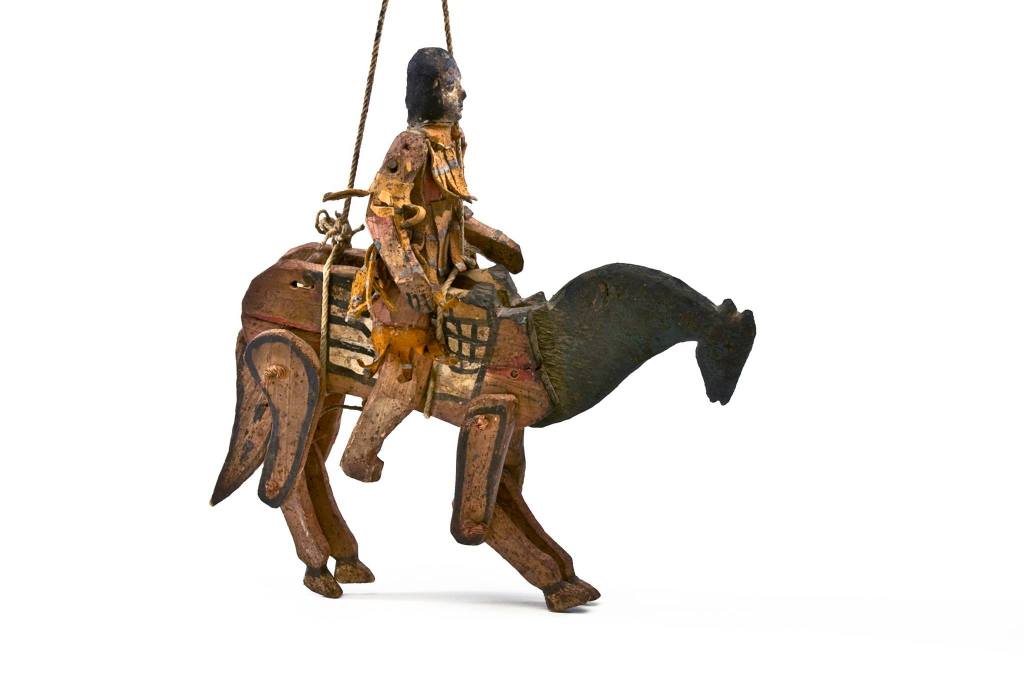
A marionette from Old New Mexico. Source: New Mexico History Museum

He also apparently peaked into establishments “where wine and other liquors were sold by the drink” and gambling occurred. These games of chance included Spanish monte, three-card monte, roulette, and dice. For boys Francisco’s age, there were outside games such as pitarria, played on smooth ground inside a marked square with short sticks of two colors, and quoit pitching at pegs driven into the ground. When he tired of games, he could watch dancers from the nearby pueblos perform on the plaza.

It was all quite an education for the young Perea, one supplemented by three months of classroom experience. Some time in January 1838, he and his younger brother began attending a school run by a Captain Sena and his wife. This ended when the Perea family returned to Bernalillo in late April, but his Santa Fe adventures were only the beginning of Jose Francisco Perea’s experience of the world beyond his family’s hacienda. As an adult, he would return to Santa Fe to sit on the New Mexico Territorial Council. During the Civil War, he would fight for the Union as a Lieutenant Colonel and would later serve as New Mexico’s Congressional representative in Washington, D.C.

He would also leave behind an evocative glimpse of Santa Fe in the winter of 1837/38, one for which we storytellers are quite thankful.     

Sources: W.H.H. Allison as narrated by Col. Francisco Perea, “Santa Fe During the Winter of 1837/38.” Old Santa Fe Magazine, Vol. II, Santa Fe: Old Santa Fe Press, 1914-1915; James F. Brooks, Captives and Cousins: Slavery, Kinship and Community in the Southwest Borderlands, Chapel Hill: U of North Carolina Press, 2002; Janet Lecompte, Rebellion in Rio Arriba, 1837, Albuquerque: UNM Press, 1985; F. Stanley, Giant in Lilliput, The Story of Donaciano Vigil, Pampa, TX: Pampa Print Shop, 1963.

Manuel Armijo’s Verbal Skills Save Santa Fe!

On Monday, September 18, 1837, word reached Santa Fe that the rebels who had been so successful in August were approaching the capital again. The threat of Manuel Armijo’s troops wasn’t enough to keep them away.

And Armijo had a crises of confidence. He who’d been named head of the New Mexico militia by his rico compatriots asked Judge Juan Estevan Pino to take command.  When Pino declined, Armijo’s political skills kicked in. He might not know military tactics, but he did know people.

He sent word to the rebels that he wanted to negotiate. Pablo Montoya, now head of the rebels, took the bait. The insurgents camped five miles north of the capitol and negotiations commenced via correspondence.

Sept 28 illustration.Manuel Armijo
New Mexico Governor Manuel Armijo

Eventually, Armijo invited Montoya to come into town to talk. The talks, though somewhat contentious, were ultimately successful. The rebels agreed to dissolve their organization, turn over four of the initial instigators, and recognize Armijo as New Mexico’s political and military leader.

The negotiations were undoubtedly facilitated by the fact that the rebels were short on guns and ammunition, and—without Jose Angel Gonzales’ presence—military organization and discipline. In addition, not all of them considered Armijo an enemy. He had a track record as a former governor who did what he could for the people of New Mexico, even if it meant bending or judiciously ignoring Mexican law.

The treaty was signed on Thursday, September 21, and the rebels disbanded. The conflict was over. But not really. As part of the deal, Jose Angel Gonzales was released from the Santa Fe jail where he’d been lingering the last couple weeks. He was back in Chimayo with his wife and family by the end of the month.

It was a decision Armijo would live to regret. Rebellion still stirred in northern New Mexico. It wouldn’t break out again in full force until the following January, but it would break out. Armijo’s political and verbal skills delayed the conflict, but they didn’t end it.


Sources: Lansing B. Bloom, “New Mexico Under Mexican Administration,” Old Santa Fe Magazine, Vol. II, Santa Fe: Old Santa Fe Press, 1914-1915; Fray Angelico Chavez, But Time And Chance, The Story of Padre Martinez of Taos, 1793-1867, Santa Fe: Sunstone Press, 1981; Janet Lecompte, Rebellion in Rio Arriba, 1837, Albuquerque: UNM Press, 1985; Rubén Sálaz Márquez, New Mexico, A Brief Multi-History, Albuquerque: Cosmic House, 1999; F. Stanley, Giant in Lilliput, The Story of Donaciano Vigil, Pampa, TX: Pampa Print Shop, 1963.
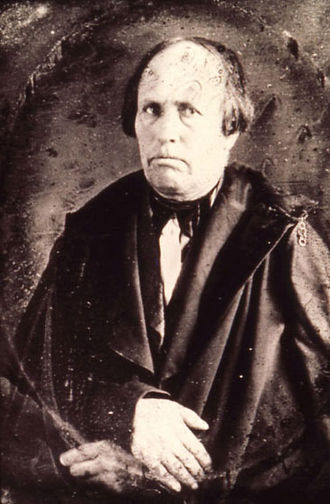
Manuel Armijo Marches Into Santa Fe

On Thursday, September 14, 1837, former New Mexico governor Manuel Armijo and his combined troops, about 1000 men, marched into Santa Fe to begin the push against the rebels who’d captured the city in early August.

The rebels had already left town. They’d installed Jose Angel Gonzales as governor and returned to their homes in Santa Cruz de la Canada, Chimayo, Truchas, and Taos. After all, it was the harvest season. They had wheat and other crops to harvest in preparation for the coming winter.

In Santa Fe, Manuel Armijo faced a similar lack of resources at the governmental level, but he was apparently less uncomfortable requisitioning what he needed.  This included seizing three large wagons to carry  provisions and also soliciting contributions from American merchants Jesse Sutton, John Scully, Luis and Antonio Robidoux, and David Waldo as well as New Mexico’s ricos, especially those who lived south of Santa Fe.

Money even came from Padre Antonio Jose Martinez in Taos. Martinez was probably feeling particularly anxious that the rebels be quelled. Even though he’d returned to Taos earlier in the month at the rebels’ request and come to terms with them, they still weren’t happy.

Not only did they want him to perform marriages, baptisms, and burials for alms, rather than the customary fees, they also wanted their dead buried inside the church. Martinez refused, saying he didn’t have the authority to do so and warning that anyone who undertook such a burial faced excommunication.

Sept 14 illustration.wheat

Nothing he said made a difference. The rebels seized the Los Ranchos de Taos chapel and buried a corpse by the chancel steps. When the Padre remonstrated, they gave him a document saying they took full responsibility.

By doing this, the rebels denied the priest’s authority in this and other areas of their lives.  While Manuel Armijo, in Santa Fe, was preparing physically for the coming altercation, the rebels in Taos were preparing mentally, establishing themselves and their comrades as the arbiters of their temporal and spiritual destinies.

They would need that self-assurance in the weeks to come.

Sources: Fray Angelico Chavez, But Time And Chance, The Story of Padre Martinez of Taos, 1793-1867, Santa Fe: Sunstone Press, 1981; Paul Kraemer, An Alternative View of New Mexico’s 1837 Rebellion, Los Alamos Historical Society, 2009; Janet Lecompte, Rebellion in Rio Arriba, 1837, Albuquerque: UNM Press, 1985; David J. Weber, The Mexican Frontier, 1821-1846, Albuquerque: UNM Press, 1982.

Padre Martinez and His Brother Flee Taos!

Early the morning of Saturday, September 2, 1837 someone got news to Padre Antonio Jose Martinez in Taos that his life was in danger. Even though the rebels had taken over New Mexico’s government in August, they were still after anyone who hadn’t complained loudly enough about the men they’d killed on their way to power.

In Taos, that included Padre Martinez and his brother Santiago, a local judge appointed by the authorities in Santa Fe. Apparently, Santiago had been appointed by former Governor Albino Perez. His position and his life were now at risk.

As the oldest of the Martinez siblings, Antonio Jose took charge. The brothers fled south to Santa Fe, probably along the rocky but shorter route that skirted the Rio Grande river. It seems to have been a harrowing journey. By the time they reached Santa Fe on Sunday, Padre Martinez was ready to flee all the way south to Durango and the bishop, perhaps even to give up his Taos ministry.

Sept 3 illustration.Martinez, Antonio José
Padre Antonio Jose Martinez

But then his other brother, Jose Maria Martinez, arrived with a message from the rebels. They begged the Padre to return to help restore order in Taos and promised that if he did, they would receive him, and presumably Santiago, well.

So he turned around and headed back, but this time with protection. The rebel-appointed governor, Jose Angel Gonzalez, accompanied him.

Even Gonzales’ presence didn’t smooth the way completely. The rebels had conditions. If Padre Martinez didn’t appear before them and retract his approval of the previous administration, he would still be at risk.

Negotiating with the rebels took time, and Governor Gonzales stayed in Taos several days while they and the Padre reached an agreement: Martinez would disavow his previous allegiances and also promise not to ask for fees for baptisms, marriages, and other church ceremonies.

Then Governor Gonzales headed back to the capital. While he’d been away, the leaders of the counter-revolutionaries had met in Tomé, organized their own men, and issued their own set of ultimatums. Their representatives met Gonzales at the door of the Governor’s palacio and took him into custody. Padre Martinez’ refusal to immediately give in to the Taos rebels’ demands had cost their leader his freedom.

 Sources: Fray Angelico Chavez, But Time And Chance, The Story of Padre Martinez of Taos, 1793-1867, Santa Fe: Sunstone Press, 1981; Paul Kraemer, An Alternative View of New Mexico’s 1837 Rebellion, Los Alamos Historical Society, 2009; Janet Lecompte, Rebellion in Rio Arriba, 1837, Albuquerque: UNM Press, 1985; David J. Weber, The Mexican Frontier, 1821-1846, Albuquerque: UNM Press, 1982.

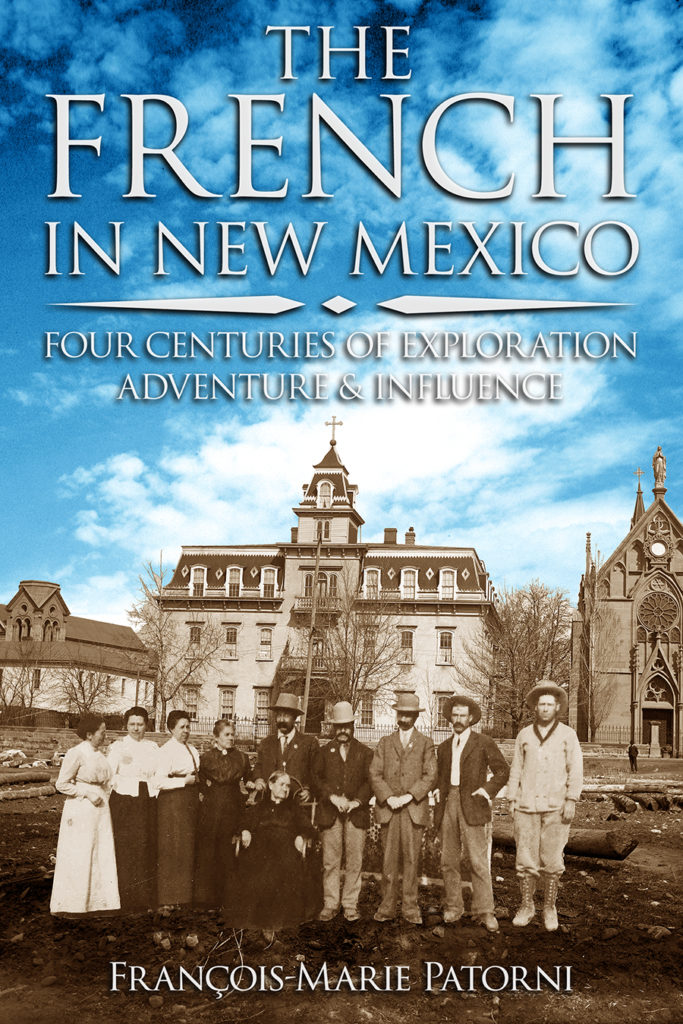
Book Review: The French in New Mexico

Patorni.The French in NM.Cover
French In America Press, 2020
ISBN: 9780578631158

While it’s fairly common knowledge that people with French surnames trapped and traded in New Mexico during the mountain man era, The French In New Mexico identifies many other French connections in the American Southwest. In fact, Francois-Marie Patorni points out that Franciscan priest Marco de Nice—the man whose report of cities of gold prompted the Spanish incursion into what is today the American Southwest—was French. He may have been in New Spain and subject to the Spanish church there, but he was born in Nice.

This is where The French in New Mexico begins. But it doesn’t end there. Patorni walks his reader through four centuries of New Mexico history, establishing links to France every step of the way.  Patorni covers major figures as well as minor ones and groups his material in easily-accessible headings, by topic (wine growing, the church, merchants, etc.) as well as location (Santa Fe, Mora, the lower Pecos, etc.). This makes the book great for both a comprehensive overview of events in New Mexico from a French perspective as well as for locating material about a particular topic or location.

This book is a fascinating read with a new approach to the history of New Mexico. The information it provides reflects both Patorni’s scholarship and his enthusiasm. This is a well-written, well documented, and unique take on New Mexican history. If you’re interested in New Mexico’s history and/or the contribution of the French people to the American Southwest, I recommend The French In New Mexico.

First Legal Americans Arrive in Santa Fe

When William Becknell and his companions reached Santa Fe, New Mexico on Wednesday, November 16, 1821, they experienced a very different reception then they would have received a year before.

In the fall of 1820, Becknell could have easily faced jail time for entering New Mexico. But by November 1821, Mexico had completed its break from Spain and the new government welcomed the Americans it had previously shunned. Travelers from the eastern part of the continent were no longer illegal aliens and subject to arrest at any time. Instead, they and their goods were welcomed.

Becknell had about 17 men with him. Their original intent had been to trade with the Indians and catch “wild animals of every description.” However, trading in Santa Fe was a lot easier. Becknell disposed of his goods and started back to Missouri for more. Most of the men with him liked New Mexico so much that they decided to stay and spend the winter trapping.

Nov. 16 illlustration.Santa Fe Trail map.1826.cropped

Becknell may have left many of his men behind, but he returned to Missouri with someone who hadn’t made the outgoing trip with him. David Kirker, a member of the John McKnight and Thomas James party, which had followed Becknell across the plains but were going to Mexico to retrieve members of a previous expedition, was sent back to Missouri with Becknell. Kirker had put his party in danger by surrendering himself and his weapons to a threatening Comanche war party instead of standing up to them. The men he was with wanted nothing more to do with him.

David did not return to New Mexico, but his cousin James Kirker must have been inspired by what he heard about it. He arrived a few years later and would eventually become a byword in New Mexico and Chihuahua for a trouble-making American.

Becknell’s appearance in Santa Fe that November day was definitely the beginning of a more complex relationship with New Mexico’s neighbor to the east than had been possible in the past.

Sources: Robert Glass Cleland, Alfred A. Knopf, New York, 1950; Leroy R. Hafen, Fur Trappers and Traders of the Far Southwest, Utah State University Press, Logan, 1997; Marc Simmons, New Mexico, An Interpretive History, University of New Mexico Press, Albuquerque, 1988; David J. Weber, The Taos Trappers, University of Oklahoma Press, Norman, 1971.

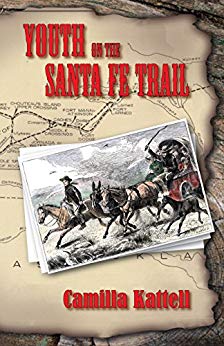
Book Review: Youth on the Santa Fe Trail


Kattell.Youth On The Santa Fe Trail cover
Youth on the Santa Fe Trail
by Camilla Kattell
Light Horse Publishing, November 2015
ISBN-13: 978-0996675406

We tend to forget just how young many of the travelers on the Santa Fe Trail were. I suppose this is because we associate the Trail with merchant caravans more than we do with family settler groups.

In Youth On The Santa Fe Trail, Camilla Kattell reminds us that some of the most famous voices from that famous road were not yet twenty when they travelled it. In addition to Christopher “Kit” Carson, these young people included the soon-to-be mountain man Richens Lacey Wootton, future authors Francis Parkman, Jr. and Hector Lewis Garrard, diarist Susan Shelby Magoffin, and—youngest of them all at age seven—Marian Sloan Russell.

One of the things I especially appreciate about this book is that Kattell includes information about travelers I was unfamiliar with, including James Ross Larkin, an early health seeker on the Trail, sportsman William B. Napton, and New Mexico native José Librado Gurulé.

But Youth on the Santa Fe Trail does more than provide a concise biography of these travelers. It also provides context for their particular story and, in doing so, helps us to understand their world. For example, Kattell’s portrayal of Susan Shelby Magoffin helped me to see this young woman in a way I hadn’t before.

When I read the Magoffin diary a number of years ago, I was frustrated by what I saw as her very narrow view of the world. Youth on the Santa Fe Trail reminded me that Magoffin’s strict, rather puritanical, upbringing would naturally make her look askance at women smoking cigarettes and church hymns set to apparent dance tunes. What I saw as a narrow mindedness can also be viewed as a difference in cultures which Magoffin was doing her best to assimilate. Kattell expanded my view of this young woman’s perspective.

While Youth On The Santa Fe Trail is about the youth who traversed the Santa Fe Trail, it is certainly not only for young readers. It will give you a new appreciation for the Trail’s travelers, the impact they had on both their destination, and the way their experiences on the trail shaped that impact. I recommend it for anyone interested in the history of the Trail and of New Mexico.


Santa Fe Trail Mail Contractor Changes!

Throughout the month of September, 1855, the Santa Fe Weekly Gazette informed its readers that the U.S. mail contract had recently been transferred to Hockaday and Hall and was providing mail and passenger transport to and from Independence, Missouri for a mere $125 per passenger.

Packages and extra baggage could also be sent via the Hockaday and Hall coaches, at a cost of 25 cents per pound, although there was a minimum charge of $1.00 and the contractors could not be held responsible for anything worth more than $50.

These rates remained the same two years later, even when service increased to twice monthly. This may have been because, no matter how often the mail left Santa Fe, it took about the same length of time to travel  to or from its destination. Round trip to St. Louis was still about three months and delivery from the Atlantic seaboard to Santa Fe remained around six weeks. Letters and packages continuing from Santa Fe on to El Paso were transferred to George H. Gidding’s service south and could take an additional week to ten days.

Sept 22 illustration

Interestingly, the front page items about the new contractors and their service are not set off in a box or with any other markings to indicate that they’re advertisements. They’re treated like news items. Repeating news items—the same language shows up in every September 1855 issue of the Gazette.

While news of the mail was critical to the functioning of business and politics in New Mexico Territory, the decision to promote its service and fees in this way may have been the result of other factors. The Hockaday and Hall agent in Santa Fe just happened to be W. W. H. Davis, the newspaper’s editor.

Sources:  Santa Fe Weekly Gazette, September 1, 8, 15, 22, 29, 1855; Morris F. Taylor, First Mail West, stagecoach lines on the santa fe trail, Albuquerque: UNM Press, 1971.

The Excitement of Politics—Some Things Never Change

On Saturday, September 15, 1855, the political atmosphere of New Mexico was so tense that a group of political operatives took it upon themselves to steal the Rio Arriba County poll books at gunpoint. The poll books in question contained the county records of the recent election for New Mexico’s territorial delegate to Congress. The two candidates for the post were Jose Manuel Gallegos and Miguel Antonio Otero.

In Rio Arriba County, a Gallegos stronghold, Probate Court Clerk Ellis T. Clark was responsible for getting the vote results to Santa Fe. He stashed the records in his saddlebags and, accompanied by Territorial Attorney General Theodore Wheaton, headed south.

About 25 miles north of Santa Fe, near Pojoaque Creek, Wheaton and Clark happened to meet five men from Otero’s party. The meeting seemed innocent enough. According to the Santa Fe Weekly Gazette account of the incident, the two groups  “halted and passed the usual compliments, the former not suspecting the object of the latter.” During the ensuing conversation, one of Otero’s partisans asked Clark if he had the poll books and he said he did. The men continued to chat.

Then suddenly the mood changed. As their companions pulled out six shooters, two of Otero’s friends grabbed Clark’s and Wheaton’s arms and demanded the voting records. Then one of them pilfered  Clark’s saddle-bags and grabbed the books.

The thieves didn’t take off immediately. They paused long enough to explain that they planned to hold the records hostage until the votes for Otero’s home county, Valencia, were tallied. They’d heard that there were plans afoot to “disappear” the Valencia poll books and hand Gallegos the election. If Valencia’s votes were “lost”, the records for Rio Arriba would also disappear.

Then the five rode off, heading north. Clark and Wheaton continued south. They arrived in Santa Fe around 10 o’clock that night and told the Sheriff what had happened. He, Clark, and a posse immediately headed north after the thieves. A duplicate set of the Rio Arriba poll books were in Clark’s house. They figured the Otero partisans would want to acquire those as well.

Sept 15 illustration

They were right. In fact, when the posse arrived at Clark’s house the next day, they learned that three of the thieves had already been there. They’d tried to bully Clark’s wife into giving them the records and, when she refused, went in search of a lawman who’d force her to do what they wanted. There’s no record of who they found to play that role. When the Otero men returned to the house, the posse was waiting and the thieves were arrested.

They’d actually had good reason to be concerned about the election results. When all the votes were counted,  Gallegos had won by 99 votes. However, Otero contested the results, alleging illegal activities related to the vote, and was ultimately awarded the Delegate seat. He served in that position until 1861, when he lost a re-election bid to John S. Watts.

As for the theft, the Gazette expressed its editorial sorrow “that men, in the excitement of politics, should commit acts their judgment will condemn in their sober moments,” and called for more stringent laws related to election fraud.

Ironically, we’re still expressing the same kind of sorrow and calling for the same kind of laws today. Some things never change.

Sources: Don Bullis, New Mexico, A Biographical Dictionary, 1540-1980, Vol. 1. Los Ranchos de Albuquerque: Rio Grande books, 2007; Santa Fe Weekly Gazette, September 22, 1855, page 2.

Spanish Soldiers Killed on the Plains!

On Sunday, August 14, 1720 Santa Fe Presidio Garrison Lieutenant Pedro de Villasur died on the Platte River during an altercation with Pawnee Indians. Villasur was the leader of a force of Spanish soldiers, Pueblo Indian militia, and several citizens who’d set out that spring on an expedition to the Platte River in what is today’s Nebraska. The expedition was following up on reports that large numbers of Frenchmen were trading with the Pawnee, a tribe which dominated the central plains. This made Mexican officials nervous. Not only did Spanish mercantile policy forbid foreigners from trading within her empire, but the traders from French Louisiana could be providing the Plains Indians with arms and ammunition that could then be used against New Mexico’s settlements.

To find out what was going on, Villasur and his men were dispatched on a fact-finding mission. the reached the plains east of what is today Colorado’s Front Range in mid-August. When they found a large village of Pawnee, Villasur sent a note in to ask for a parlay.

It’s unclear whether there were any Frenchmen in the village to translate the note, which was in French, but the Pawnee didn’t waste any time responding to it. They attacked the next morning.

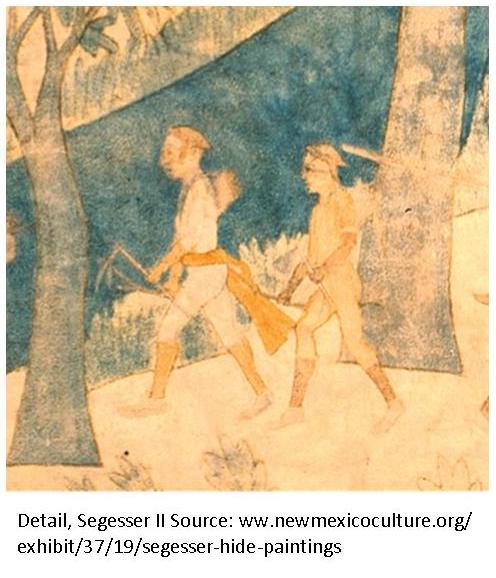
Villasur was among the first to fall and among the forty-five who died. The few expedition members who survived the battle carried the news back to Santa Fe and seem to have provided the details subsequently recorded in a unique artwork, one of two painted hides  that eventually came into the hands of Jesuit priest Philipp von Segesser von Brunegg.

In 1758 Segesser von Brunegg sent these artifacts to family members in Switzerland. They were eventually sold to the Palace of the Governors Museum in Santa Fe, New Mexico and returned to thecity that Villasur and his men departed from over 300 years ago. They are officially known as the Segesser hides.

There’s documentary evidence of other reposteros, or artwork painted on tanned hides, created in Santa Fe during the 1700s and some scholars believe the Segesser pieces were also produced there. Because of the details in the Segesser II hide, the painting that reflects contemporary accounts of the Villasur debacle, it seems clear that the painting was done by people who were familiar with the events.

Augst 14 post ilustration.Segesser detail

The other fascinating thing about this artwork is the way it combines pictorial elements characteristic of indigenous or folk-art paintings while also reflecting influences from European battle tapestries of the late 1600s and early 1700s. The wide borders on the hide painting contain flower and leaf designs similar to of those works.

If you’d like to know more about these unique historical artifacts and the Villasur expedition, the Segesser  hides are on display in Albuquerque, New Mexico through October 20, 2019 as part of a larger exhibit titled A Past Rediscovered. If you can’t make it to Albuquerque, you can view portions of the hide paintings here.

Sources: Marc Simmons, New Mexico, an Interpretive History, Albuquerque: University of New Mexico Press, 1988; Ruben Salaz Marquez, New Mexico, a brief multi-history, Albuquerque: Cosmic House, 1999; https://www.cabq.gov/culturalservices/albuquerque-museum/exhibitions/a-past-rediscovered