Contested Space: The Military Chapel of Santa Fe

Contested Space: The Military Chapel of Santa Fe

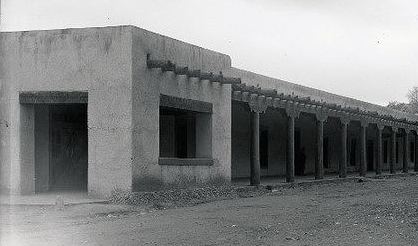
In a recent post about the Santa Fe plaza, I included a set of maps. If you look closely, you’ll notice that even the oldest of them identifies a small building on the south side of the square as the “military chapel.”

More properly called the Military Chapel of Our Lady of Light, and commonly referred to as La Castrense, this building was centered in the buildings on the south side of the Plaza and faced the Governor’s Palace on the north. The word Castrense means “belonging to the military profession,” so its nickname was appropriate, because the little church was built specifically for use by the members of the Santa Fe garrison. 

The original chapel was completed in 1717 and then rebuilt and rededicated in 1761. The reconstruction was funded by Governor Francisco Antonio Marin del Valle and his wife, Dona Maria Ignacia Martinez de Ugarte. This power couple also donated a new altar piece, or reredo, which was carved from large pieces of limestone quarried north of Santa Fe near Pojoaque. Said to be the largest and most ambitious piece of artistic work ever attempted in New Mexico to that point, the piece filled the entire altar end of the building. 
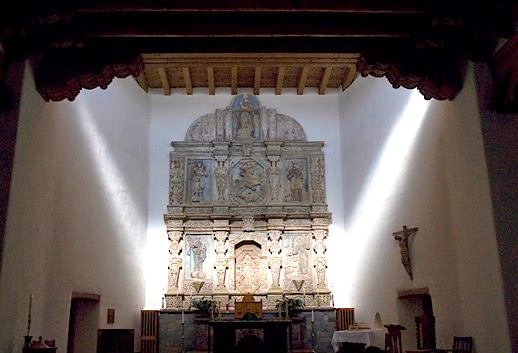
La Castrense altar piece today, courtesy El Cristo Rey Catholic Church, Santa Fe

The chapel received further decorations around 1813, when Pedro Bautista Pino, New Mexico’s representative to the Spanish Cadiz, returned from Europe with two marble bas-reliefs which were mounted on the outside wall above the door from the plaza. Colonel Francisco Perea remembered years later that one of them represented “Santa Gertrudes wrapped in the coils of a large serpent, while the other, I believe, represented the mother of Jesus, Nuestra Senora de la Luz (Our Lady of Light), recuing a human being from Satan.”

The military troops stationed in Santa Fe attended services in the chapel monthly as well as on special occasions. During Governor Manuel Armijo’s first two administrations, he and the full garrison attended regularly, with the officers in full uniform.  However, it seems unlikely that they continued to do so during his third term (July 1845 to August 1846) as the roof had fallen in. At least, that’s what Lt. James W. Abert reported in early October 1846. He also said the building contained “some handsome carved work behind the altar,” and that at least one of the bas-reliefs still remained over the door, the one that showed Our Lady of Light.  

Abert had entered Santa Fe in the Fall of 1846 with the occupying U.S. army. Five and a half years later, in Spring 1851, newly appointed Chief Justice Grafton Baker, needed a place to hold his court and decided to use La Castrense.

The building, apparently repaired by this time, was set up with the necessary furniture and the grand jury was called. Unfortunately for Judge Baker, the grand jury members included Santa Fe native and former Mexican soldier, Donaciano Vigil. Vigil and his wife had been married in the chapel, and his father and an infant son were buried there. As former provisional governor under the U.S. rule, he had enough political clout to risk protesting the use of the chapel for civil purposes and enough connections in the city to rally public opinion behind him.

Baker threatened to hold court anyway and to have Vigil arrested, but when a crowd began to assemble outside and the commanding officer of the American troops rallied behind Vigil, the Judge gave way. He ordered the court moved across the plaza to the Governor’s palace. The men responsible for shifting the furniture didn’t have to actually remove it from the building. The crowd had already dumped most of it in the plaza.

The building doesn’t seem to have been immediately converted back to being a chapel. According to the 1891 Silver City Enterprise, in the 1850s, it was instead used to store  captured cannons, including the Lone Star of Texas which had come into New Mexico in 1841 with the ill-fated Texas Santa Fe Expedition.

The guns must not have stayed there for long, because in 1859 Bishop Lamy exchanged the building for $2000 and  land in the vicinity of the Parish church. The money went to repairs for  church and the land became the site of St. Michael’s College and the Loreto Chapel.

La Castrense itself was demolished by its new owner, but not until the altar piece was preserved and carefully removed. It is now in El Cristo Rey, which offers a brochure about the reredos on its website. It’s nice to know that, even though the building itself had to give way to “progress,” at least some of its contents were preserved and still survive.

© Loretta Miles Tollefson July 2025

Sources: James W. Abert, Western America in 1846-47; https://www.cristoreyparish.org/; Roland F. Dickey, New Mexico Village Arts; Francois-Marie Patorni, The French in New Mexico; Colonel Francisco Perea in Allison, “Santa Fe in 1837-1838”, Old Santa Fe Magazine, Vol. II; Silver City Enterprise, Oct. 9, 1891; Marc Simmons, Spanish Government in New Mexico; Francis Stanley, Giant in Lilliput; Maurilio Vigil and Helene Boudreau, Donaciano Vigil.
Shopping, Gambling, and Dancing, Oh My

Shopping, Gambling, and Dancing, Oh My

In my forthcoming novel set in Santa Fe, New Mexico, the young people at the heart of the story don’t go home after church. They go to the plaza. They aren’t the only ones. In fact, American newcomers to the city were often shocked at what they saw as a desecration of the Sabbath. People weren’t merely walking. They were shopping, dancing, and gambling, and probably drinking as well.

This Sunday ritual didn’t change after the U.S. Army invaded in 1846. Lt. Abert tells us that “in the square all the people congregate to sell their marketing and one constantly sees objects to interest and amuse. It is filled with donkeys laden with immense packs of wood, fodder, melons, and other articles. The soldiers too are constantly passing and mingling in a motley group.”

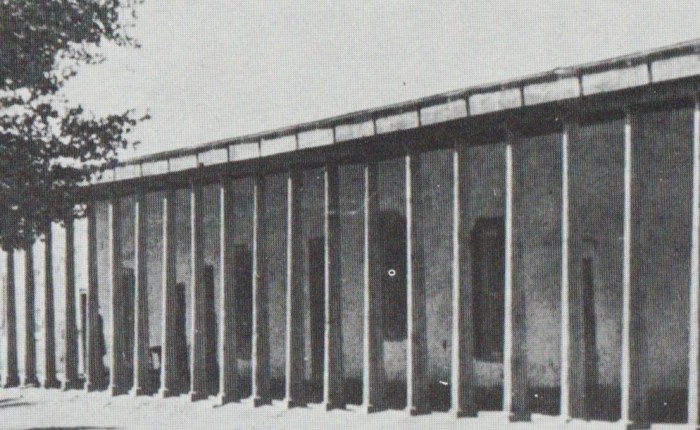
Part of the reason for this activity on the plaza was that it was a pleasant place to be. Even Susan Magoffin, who had little else good to say about New Mexico, found that the square made for “a fine walk.” “The Plaza or square is very large,” she reported. The Governor’s Palace, or palacio, with a wide portal in front, formed the north side of the square, while a church and dwelling houses faced it on the south. “The two remaining sides are fronted by stores and dwellings, all with portals,” she added. “In rainy weather there is no use for an umbrella.”

The portales, or verandas, Magoffin mentioned provided shade for the buildings and were shaded themselves by what Magoffin described as a circle of trees around the square. These were cottonwoods which had been planted only a couple years before, probably using the pole planting method. A small irrigation ditch, or acequia, ran alongside the trees.

Under the portales, vendors sold everything from pottery to sweet onions. There were plenty of other ways to spend one’s money as well, namely gambling. One didn’t have to go indoors to indulge in this pastime.  Out-of-doors games included pitarria, which was played on smooth ground inside a marked square, with short sticks of two colors. Quoit pitching, using pegs driven into the ground, was also available.

Those who wanted to gamble could play monte, both with a full deck of Spanish cards, and a three-card version.  Roulette was also popular, as were various games of dice.

Later, if one liked, someone in town was apt to be holding a dance, and everyone was welcome, from the priest to the criminal released from jail for the evening. Everybody danced, the lady with the ragged farm worker, the old man with the little girl.

Newcomers also disapproved of the city’s open door dancing policy. Matt Fields tells us of a ball given by the Governor in 1839 which “all the beauty and fashion attended, and also all the rabble,” adding, “the dances, as well as all the manners and customs in Santa Fe, are of a demi-barbarian character”. Nineteenth century Americans, whose country was founded on democratic principles, were certainly quick to make negative social distinctions.

Some things never change. 

© Loretta Miles Tollefson

Sources: W.H.H. Allison, Old Santa Fe Magazine, 2:2, “Santa Fe During the Winter of 1837-1838”; Sheila Drumm, Down the Santa Fe Trail and Into Mexico, Diary of Susan Shelby Magoffin 1846-1847; Janet LeCompte in Joan M. Jensen and Darlis M. Miller, New Mexico Women, Intercultural Perspectives; Clyde and Mae Reed Porter, Matt Field on the Santa Fe Trail.

What’s the Big Deal About the Santa Fe Trail?

This Fall marks the 200th anniversary of the opening of the Santa Fe Trail from Missouri to New Mexico. I was going to write a piece about why the Trail was important to the U.S., then I found this. I think it pretty much covers everything I was going to say…..

https://www.nps.gov/articles/000/becknell-s-1821-journey-to-santa-fe.htm

Albino Pérez Arrives in New Mexico!

Albino Pérez Arrives in New Mexico!

Newly appointed Governor Albino Pérez arrived in New Mexico in May 1835 to general relief. The previous governor, Francisco Sarracino, was generally viewed as inept and Pérez was a breath of energetic fresh air. He brought funds for the Presidio troops and immediately set out on a tour that included visits to outlying communities as well as a successful action against the Navajo, who’d been picking off sheep and other prizes. When Pérez returned to Santa Fe, he gave an inaugural address in which he praised New Mexicans’ peaceful habits, love of order, and obedience to justice, among other virtues.

However, the longer Pérez was in office, the more complicated things became. The money he’d brought was spent and more was needed. Sarracino, now New Mexican Treasurer, was accused of embezzling funds. The Navajo were active again and another campaign was necessary. And Pérez’s idea of paying for it with forced loans from the region’s ricos was not met with universal acclaim.

The Governor’s Palace in Santa Fe. Courtesy: NM History Museum

Then New Mexico’s exemption from the national sales tax expired. The governing council asked Pérez to forward a petition for its renewal to Mexico City, but he didn’t do so right away. Instead, he started talking about how to collect the tax.

This didn’t go well with the populace. In fact, it may have been the spark that ignited  what is popularly known as the Chimayó revolt, the rebellion that resulted in Pérez’s death in early August 1837. The good feeling surrounding Pérez’s arrival had disappeared completely by the time he lost his life and his head on the road outside the village of Agua Fría south of Santa Fe.

Which is a good reminder that no matter how an official begins their term, it’s what they do afterwards—and how their time in the sun ends—that people are most likely to remember.

Sources: Lansing B. Bloom, “New Mexico Under Mexican Administration,” Old Santa Fe Magazine, Vol. 2. Santa Fe: Old Santa Fe Press, 1914-1915; Janet Lecompte, Rebellion in Río Arriba 1837, Albuquerque: University of New Mexico Press, 1985; Read, Benjamin M. Illustrated History of New Mexico, Santa Fe: New Mexican Printing Company, 1912; Joseph P. Sanchez, “It happened in Old Santa Fe, The Death of Governor Albino Pérez, 1835-1837,” All Trails Lead to Santa Fe, Santa Fe: Sunstone Press, 2010; F. Stanley, Giant in Lilliput, the Story of Donaciano Vigil, Pampa, TX: Pampa Press Shop, 1963.

Manuel Armijo’s Verbal Skills Save Santa Fe!

On Monday, September 18, 1837, word reached Santa Fe that the rebels who had been so successful in August were approaching the capital again. The threat of Manuel Armijo’s troops wasn’t enough to keep them away.

And Armijo had a crises of confidence. He who’d been named head of the New Mexico militia by his rico compatriots asked Judge Juan Estevan Pino to take command.  When Pino declined, Armijo’s political skills kicked in. He might not know military tactics, but he did know people.

He sent word to the rebels that he wanted to negotiate. Pablo Montoya, now head of the rebels, took the bait. The insurgents camped five miles north of the capitol and negotiations commenced via correspondence.

Sept 28 illustration.Manuel Armijo
New Mexico Governor Manuel Armijo

Eventually, Armijo invited Montoya to come into town to talk. The talks, though somewhat contentious, were ultimately successful. The rebels agreed to dissolve their organization, turn over four of the initial instigators, and recognize Armijo as New Mexico’s political and military leader.

The negotiations were undoubtedly facilitated by the fact that the rebels were short on guns and ammunition, and—without Jose Angel Gonzales’ presence—military organization and discipline. In addition, not all of them considered Armijo an enemy. He had a track record as a former governor who did what he could for the people of New Mexico, even if it meant bending or judiciously ignoring Mexican law.

The treaty was signed on Thursday, September 21, and the rebels disbanded. The conflict was over. But not really. As part of the deal, Jose Angel Gonzales was released from the Santa Fe jail where he’d been lingering the last couple weeks. He was back in Chimayo with his wife and family by the end of the month.

It was a decision Armijo would live to regret. Rebellion still stirred in northern New Mexico. It wouldn’t break out again in full force until the following January, but it would break out. Armijo’s political and verbal skills delayed the conflict, but they didn’t end it.


Sources: Lansing B. Bloom, “New Mexico Under Mexican Administration,” Old Santa Fe Magazine, Vol. II, Santa Fe: Old Santa Fe Press, 1914-1915; Fray Angelico Chavez, But Time And Chance, The Story of Padre Martinez of Taos, 1793-1867, Santa Fe: Sunstone Press, 1981; Janet Lecompte, Rebellion in Rio Arriba, 1837, Albuquerque: UNM Press, 1985; Rubén Sálaz Márquez, New Mexico, A Brief Multi-History, Albuquerque: Cosmic House, 1999; F. Stanley, Giant in Lilliput, The Story of Donaciano Vigil, Pampa, TX: Pampa Print Shop, 1963.

Manuel Armijo Marches Into Santa Fe

On Thursday, September 14, 1837, former New Mexico governor Manuel Armijo and his combined troops, about 1000 men, marched into Santa Fe to begin the push against the rebels who’d captured the city in early August.

The rebels had already left town. They’d installed Jose Angel Gonzales as governor and returned to their homes in Santa Cruz de la Canada, Chimayo, Truchas, and Taos. After all, it was the harvest season. They had wheat and other crops to harvest in preparation for the coming winter.

In Santa Fe, Manuel Armijo faced a similar lack of resources at the governmental level, but he was apparently less uncomfortable requisitioning what he needed.  This included seizing three large wagons to carry  provisions and also soliciting contributions from American merchants Jesse Sutton, John Scully, Luis and Antonio Robidoux, and David Waldo as well as New Mexico’s ricos, especially those who lived south of Santa Fe.

Money even came from Padre Antonio Jose Martinez in Taos. Martinez was probably feeling particularly anxious that the rebels be quelled. Even though he’d returned to Taos earlier in the month at the rebels’ request and come to terms with them, they still weren’t happy.

Not only did they want him to perform marriages, baptisms, and burials for alms, rather than the customary fees, they also wanted their dead buried inside the church. Martinez refused, saying he didn’t have the authority to do so and warning that anyone who undertook such a burial faced excommunication.

Sept 14 illustration.wheat

Nothing he said made a difference. The rebels seized the Los Ranchos de Taos chapel and buried a corpse by the chancel steps. When the Padre remonstrated, they gave him a document saying they took full responsibility.

By doing this, the rebels denied the priest’s authority in this and other areas of their lives.  While Manuel Armijo, in Santa Fe, was preparing physically for the coming altercation, the rebels in Taos were preparing mentally, establishing themselves and their comrades as the arbiters of their temporal and spiritual destinies.

They would need that self-assurance in the weeks to come.

Sources: Fray Angelico Chavez, But Time And Chance, The Story of Padre Martinez of Taos, 1793-1867, Santa Fe: Sunstone Press, 1981; Paul Kraemer, An Alternative View of New Mexico’s 1837 Rebellion, Los Alamos Historical Society, 2009; Janet Lecompte, Rebellion in Rio Arriba, 1837, Albuquerque: UNM Press, 1985; David J. Weber, The Mexican Frontier, 1821-1846, Albuquerque: UNM Press, 1982.

New Mexico’s Casa Real

This video is a good overview of the Casa Reale, or Palace of the Governors, in Santa Fe, New Mexico, and of some of the major personalities who governed from it.

Spanish Soldiers Killed on the Plains!

On Sunday, August 14, 1720 Santa Fe Presidio Garrison Lieutenant Pedro de Villasur died on the Platte River during an altercation with Pawnee Indians. Villasur was the leader of a force of Spanish soldiers, Pueblo Indian militia, and several citizens who’d set out that spring on an expedition to the Platte River in what is today’s Nebraska. The expedition was following up on reports that large numbers of Frenchmen were trading with the Pawnee, a tribe which dominated the central plains. This made Mexican officials nervous. Not only did Spanish mercantile policy forbid foreigners from trading within her empire, but the traders from French Louisiana could be providing the Plains Indians with arms and ammunition that could then be used against New Mexico’s settlements.

To find out what was going on, Villasur and his men were dispatched on a fact-finding mission. the reached the plains east of what is today Colorado’s Front Range in mid-August. When they found a large village of Pawnee, Villasur sent a note in to ask for a parlay.

It’s unclear whether there were any Frenchmen in the village to translate the note, which was in French, but the Pawnee didn’t waste any time responding to it. They attacked the next morning.

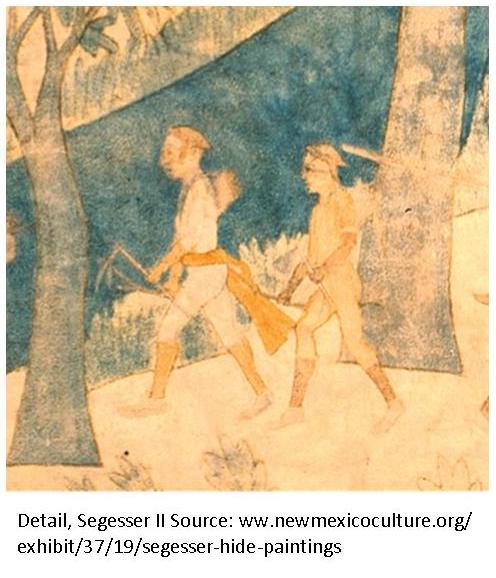
Villasur was among the first to fall and among the forty-five who died. The few expedition members who survived the battle carried the news back to Santa Fe and seem to have provided the details subsequently recorded in a unique artwork, one of two painted hides  that eventually came into the hands of Jesuit priest Philipp von Segesser von Brunegg.

In 1758 Segesser von Brunegg sent these artifacts to family members in Switzerland. They were eventually sold to the Palace of the Governors Museum in Santa Fe, New Mexico and returned to thecity that Villasur and his men departed from over 300 years ago. They are officially known as the Segesser hides.

There’s documentary evidence of other reposteros, or artwork painted on tanned hides, created in Santa Fe during the 1700s and some scholars believe the Segesser pieces were also produced there. Because of the details in the Segesser II hide, the painting that reflects contemporary accounts of the Villasur debacle, it seems clear that the painting was done by people who were familiar with the events.

Augst 14 post ilustration.Segesser detail

The other fascinating thing about this artwork is the way it combines pictorial elements characteristic of indigenous or folk-art paintings while also reflecting influences from European battle tapestries of the late 1600s and early 1700s. The wide borders on the hide painting contain flower and leaf designs similar to of those works.

If you’d like to know more about these unique historical artifacts and the Villasur expedition, the Segesser  hides are on display in Albuquerque, New Mexico through October 20, 2019 as part of a larger exhibit titled A Past Rediscovered. If you can’t make it to Albuquerque, you can view portions of the hide paintings here.

Sources: Marc Simmons, New Mexico, an Interpretive History, Albuquerque: University of New Mexico Press, 1988; Ruben Salaz Marquez, New Mexico, a brief multi-history, Albuquerque: Cosmic House, 1999; https://www.cabq.gov/culturalservices/albuquerque-museum/exhibitions/a-past-rediscovered

The Quickest Fort in the West

In late July 1851 Fort Union, New Mexico came into being very quickly. There had been nothing at the location at the beginning of the month, but after Colonel Edwin Vose Sumner reached Santa Fe on July 19, it was only a matter of time, and not very much of that.

The search for a new U.S. Army quartermaster depot site east of Santa Fe had already been. The Army needed a convenient point for receiving supplies in bulk from Fort Leavenworth and then distributing them to posts throughout New Mexico.

When Colonel Sumner saw the location chosen for the depot, he realized it was also an excellent spot for a new military post and Department headquarters. Known as Los Pozos (“the pits” or “the potholes”) the site had several spring-fed pools of water, something of a rarity on the plains east of the Sangre de Cristo mountains.

July 29 illustration.Fort Union Plan.1853.Oliva 72

Not only would the new Fort be supplied with water in an otherwise arid land, but the location was near the junction of the Santa Fe Trail Cimarron and Mountain routes, near the trail through Mora to the Rio Grande valley, and also near settlements such as Rayado and Las Vegas, which were being threatened by the Jicarilla Apaches.

Once Sumner made the decision, things moved quickly. By the end of July, the number of civilians employed by the quartermaster department in Santa Fe was reduced to three clerks and one carpenter and moved to the new site along with the soldiers who had been stationed in Santa Fe and in Las Vegas. New Mexico’s Fort Union was born.

Sources: Ruben Cobos, A Dictionary of New Mexico and Southern Colorado Spanish, Santa Fe: Museum of New Mexico Press, 2003; Lawrence R. Murphy, Philmont: a history of New Mexico’s Cimarron country, Albuquerque: University of New Mexico Press, 1972; Leo Olivas, Fort Union and the Frontier Army in the Southwest, Division of History, National Park Service, Southwest Cultural Resources Center, 1993; Marc Simmons, Kit Carson and His Three Wives, Albuquerque: University of New Mexico Press, 2003.

The Battle of Glorieta Pass

On Saturday, March 22, 1862, Colorado Militia Colonel John Potts Slough led his troops out of Fort Union to meet the Texan Confederate army that had seized Santa Fe twelve days earlier—the same day Slough and his Colorado Militia, or Pike’s Peakers, had arrived at Fort Union. The irascible and rather arrogant Slough, who’d virtually seized command of the Fort when he arrived, had about 1500 men at his disposal, a combination of Pike’s Peakers, New Mexico Militia, and Army infantry and cavalry.

On Sunday, Slough’s Union forces camped overnight at Las Vegas, then on Monday swung west  toward Santa Fe. Tuesday was another day of slowly moving forward and into the mountains. Santa Fe must have seemed a long way away, especially to the Colorado militiamen, who’d already trekked over 300 miles from Denver to Fort Union.

But then on Wednesday, Union scouts clashed with a small Confederate force in Apache Canyon, at the west end of Glorieta Pass and less than twenty miles from Santa Fe.

Both sides pulled back. The Confederates—about 200 men under Major Charles L. Pyron—headed to Johnson’s Ranch at Canoncito, where they were joined by the main Confederate force, which had just arrived via a trail through the mountains north east of Albuquerque.

march 26 illustration

The Union men moved to Kozlowski’s ranch, at the eastern end of the Pass. When the rest of Slough’s forces joined them on Friday morning, everything went into high gear.

Most of Slough’s men headed on into the Pass. But Colonel Manuel Antonio Chaves, of the New Mexico First Infantry, led Major John M. Chivington and 530 men (New Mexico Militia, two Pike’s Peakers infantry columns, and a detachment of Third U.S. Cavalry) into the mountains south of the Pass. Their goal was to circle south and west around the Confederates and hit them from behind while the main body met the Texans head on.

And the Union and Confederate troops did meet head on, at Pigeon’s Ranch, a trail hostelry in the middle of the Pass owned by Frenchman Alexander Valle. It was a hard-fought, all-day battle between evenly-matched combatants. When the fighting ground to a halt late in the day, the two sides agreed to a truce so they could tend their wounded and dying. But both sides saw the break in fighting as temporary. They were confident they’d ultimately win the Battle of Glorieta Pass.

Until that evening, when news arrived from the western end of the Pass.

Instead of Confederate troops, Colonel Chavez and Major Chivington had found a weakly-defended supply train. Chivington ordered his men down from the bluffs above the camp and set them to attacking, pillaging, and then burning the Texan wagons and everything they contained: food, clothing, equipment, ammunition, and medical supplies.

The Confederates had stationed the majority of their horses and mules with the train—as many of 500 animals. Chivington ordered his men to destroy them, as well. It’s not clear what actually happened to all the animals in question, though. At least some were driven off into the mountains and presumably into the hands of citizens for whom they were more useful alive than dead.

Wherever the Confederate livestock ended up, they certainly weren’t going to help the Texans. With their supplies, wagons, and animals gone, Sibley’s men forfeited the Battle of Glorieta Pass and beat a retreat for Santa Fe and, ultimately, Texas.

Most of the Coloradans headed home, too, although at least one of them returned a few years later. In 1865, John Potts Slough was named chief justice of the New Mexico Territorial Court.

Although Slough was an able judge—he would announce the 1867 legal decision that declared Pueblo Indians to be United States citizens—Slough was still as thin-skinned and greedy for honor and position as he’d been five years before. His furious response to New Mexico legislative political intrigues and Capt. William L. Rynerson’s role in them culminated in a December 1867 shootout in what is now Santa Fe’s La Fonda Hotel. Slough died as a result.

At the ensuing trial, Rynerson was found to have drawn his gun in self-defense.

It’s likely Slough would have insisted on a different opinion.


Sources: Howard Bryan, Wildest of the Wild West, Santa Fe: Clear Light Publishing, 1988; David L. Caffey, Chasing the Santa Fe Ring, Albuquerque: UNM Press, 2014; Jacqueline D. Meketa, Louis Felsenthal, Citizen-Soldier of Territorial New Mexico, Albuquerque: UNM Press, 1982; David Grant Noble, Pueblos, Villages, Forts & Trails: A guide to New Mexico’s past. Albuquerque: UNM Press, 1994; Jerry D. Thompson, A Civil War History of the New Mexico Volunteers and Militia¸ Albuquerque: UNM Press, 2015; Ralph Emerson Twitchell, The Leading Facts of New Mexico History, Vol. II. Cedar Rapid: Torch Press, 1912; https://www.ohiocivilwarcentral.com/entry.php?rec=125 Accessed 1/10/19