A Pretty Little House

A Pretty Little House

When Stephen W. Kearny’s Army of the West marched from Missouri to New Mexico in Summer 1846, they were trailed by a number of non-military wagons, most of them driven by merchants. One of these men was Samuel Magoffin, who brought along his wife of seven months, Susan Shelby Magoffin.

Once they reached Santa Fe, the Magoffins rented an adobe house that Susan called “quite a nice little place” with four rooms that included the kitchen, “our own chamber, [a] storage room, and the reception room,” or sala,  which Susan described as a combination parlor, dining room, and “room of all work.”

She also said the house entrance opened into a courtyard with portals all around, so apparently this was the typical four-sided square with doors opening into a plazuela. The portals around this space provided shaded workspaces as well as areas for resting and relaxing.

The Magoffins’ reception room was long and narrow, typical of a sala, and had a dirt floor, plank ceiling, and white-washed walls. The lower part of the walls was covered with calico cloth, which protected the occupants from getting whitewash on their clothes. The parlor end of the room contained cushioned benches and woven black-and-white“Mexican carpeting,” probably jerga. The “naked floor” at the end of the room held a dining table and chairs.

Susan described the bedroom as “a nice cool little room, with two windows, which we can darken, or make light at pleasure.” I take this to mean the windows had shutters which could be opened and shut from inside. She doesn’t say whether the windows had glass in them. Glazed windows were pretty rare in New Mexico at the time, though it seems likely that a Kentucky-bred young woman would have been startled by the lack of them and mentioned her surprise. The fact that the house ceilings were plank, not perpendicular or herring-bone pattern latillas, indicates the building may have been constructed with American sensibilities in mind. If that’s the case, there very well might have been glass in the window openings.

A latilla ceiling, still seen in New Mexico homes. Photo courtesy of OlquinsSawmill.com

The flat roof did leak at one point. On Tuesday, September 22, Kearney and a couple officers had come for a visit and were about to leave when a thunderstorm hit. Rather than brave the storm, the visitors remained in their seats and “we continued in pleasant and merry chat,” Susan reports, “when suddenly the rain came pating onto the General, from the ceiling … Soon we were leaking all around, the mud roof coming with the water.” The damage must have not been too terrible. Young Mrs. Magoffin was out and about with the General the next day, taking a tour of Fort Marcy.

The little house would be Susan’s home for another couple weeks, until the Magoffins headed south on October 7, leaving the “nice little place” behind. Susan would not live anywhere for long, until 1852, when she and Samuel settled in Kirkwood, Missouri, where she died after giving birth to her third child.  

            © Loretta Miles Tollefson, June 2025

Sources: Audra Bellmore, Old Santa Fe Today; Bainbridge Bunting, Early Architecture in New Mexico; Sheila Drumm, editor, Down the Santa Fe Trail and Into Mexico, Diary of Susan Shelby Magoffin, 1846-1847; John E. Sunder, ed., Matt Field on the Santa Fe Trail; El Rancho de los Golondrinas Guidebook; Chimayo Museum, Chimayo, New Mexico.

The Evolution of the Santa Fe Plaza

The Evolution of the Santa Fe Plaza

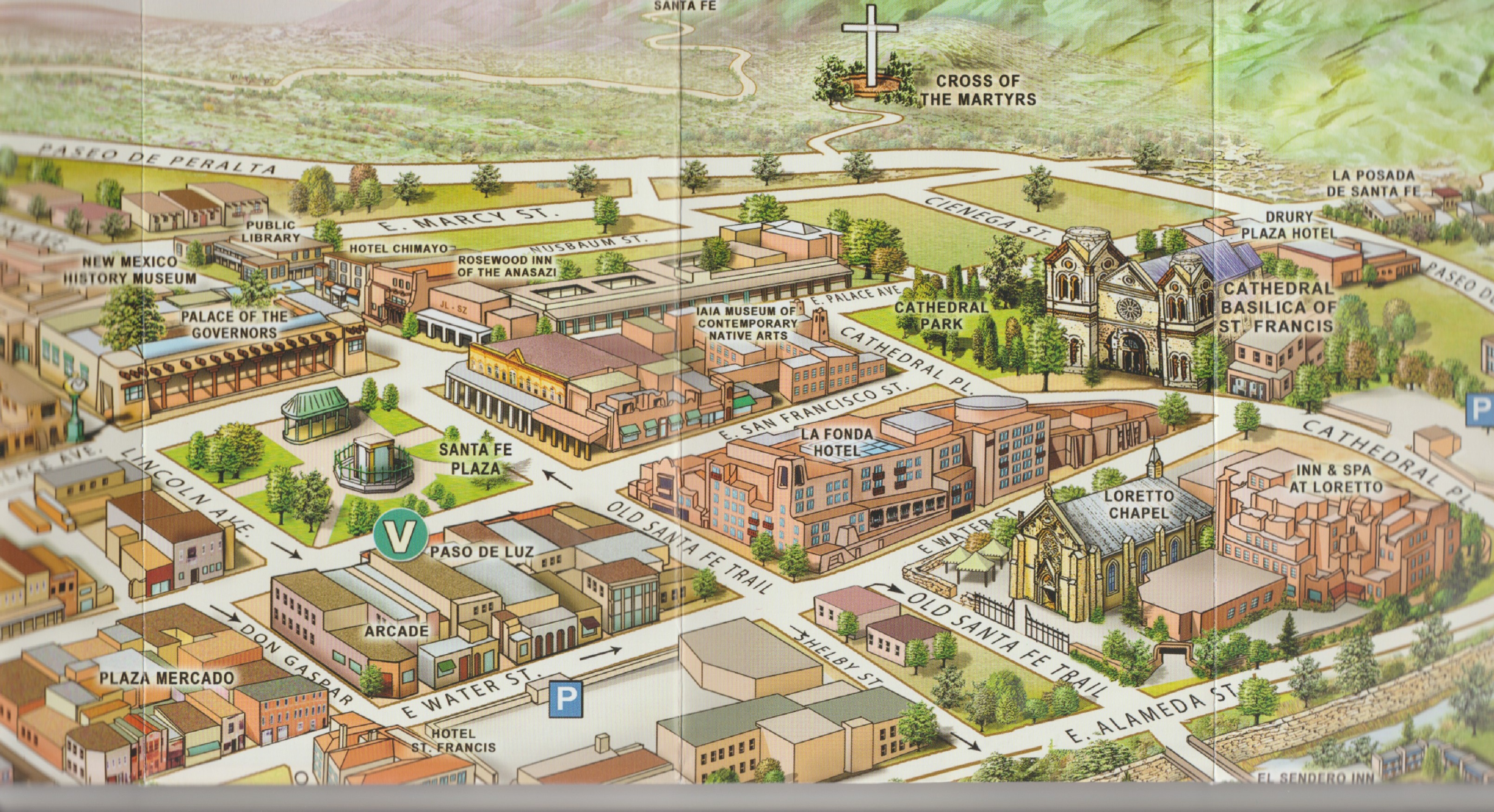
When the Spanish settlers created the Santa Fe, New Mexico plaza in 1610, it was roughly twice the size it is today, even though they didn’t have sufficient buildings to surround it. That would come later. Certainly the newcomers had high ambitions for their new town “square.” We can see from the map created by José de Urrutia about 150 years later that it extended from the church (la parroquia) to about where the western boundary is today.

The plaza was laid out in an approximate ratio of 2 to 3, width to length, as prescribed in Spanish law. It had a number of uses—military drills, mustering livestock, small-scale trading, and general commerce, as well as social and public events. Although there’s no sign of it on the 1776 map, in the early 1600’s an acequia ran along the north side.

The acequia may have been used to water trees in the plaza. We have written documentation of at least two plantings, one prior to 1837, when Jose Francisco Perea tells us there were three cottonwoods “of the mountain variety” in what was then the northeast corner. In the mid-1840s, Governor Mariano Martinez had more cottonwoods put in, although we don’t know what type. By the time he was done, trees circled the square and additional ones had been placed along the Santa Fe river.

The square had shrunk considerably by then, to the size it is today. The 1846 map created by U.S. Corps of Engineers Lts. W.H. Emory and J.F. Gilmer reveals that the eastern half of the plaza had been filled in with buildings by that point. It had apparently been this shape for at least the last ten years. Jose Francisco Perea tells us it hadn’t changed much during that period, except for the new trees. And the fact that the square was now seldom used as a camping place and stock corral.

According to James Josiah Webb, in the 1840s the northeast corner of the plaza contained the old Mexican customs warehouse. The eastern side of the square was lined with government buildings and anchored at the southern end by a store run by Don Juan Sena.

The Pino family lived across the street, on the south side of the plaza, alongside a couple more stores, including the one rented by Leitensdorfer and Company. The crumbling adobe military chapel lay in the center of this row of buildings.

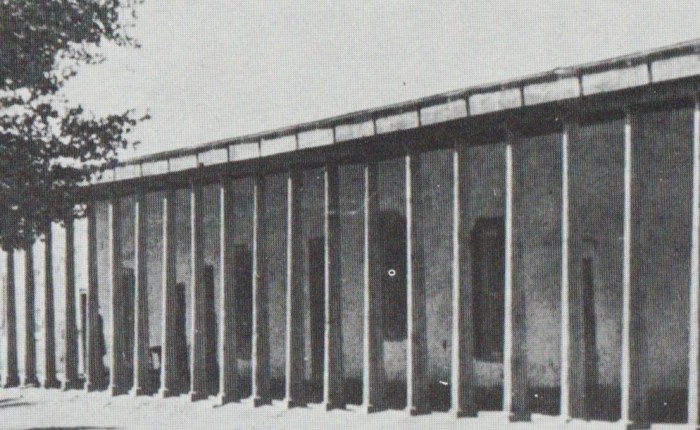
The west side of the plaza was nearly all residences, except for the old Mexican post office, and the north side was defined, as it is today, by the long low adobe structure that had been there since the beginning. The compound it fronted had served over the years as a fort, barracks for the Presidio troops, local jail, housing for the civil governor, treasury, and other functions.

Known as “el palacio” by the locals, the Americans retained the building’s basic functions after they invaded in 1846. By 1857, it included the chamber for the territorial legislature, offices for the Secretary of the Treasury and Superintendent of Indian Affairs, the post office, and (still!) the calabozo, or jail.

The building, which is still called “el palacio,” has been renovated a number of times, most recently a few years ago, and now anchors the New Mexico History Museum. It’s well worth a visit if you happen to be in town. As is the plaza. It changed once again in the 1860s, when a bandstand was added, along with walkways that crisscrossed the space. This layout has been retained ever since then. You can see it in the birds-eye view map from 1882 as well as the current map.

As you can see from the map, the plaza in Santa Fe is still walkable. Trees still shade the paths, and there are still small-scale traders, most often now only under the palacio house portal. It’s the perfect place to spend a few hours on Sunday afternoon or any other time.

An Unhappy Country Has Arrived

An Unhappy Country Has Arrived

Aaaaaand. Drumrolls please! It’s here! My novel An Unhappy Country is now available wherever books are sold. And I’m celebrating with a sale!

It’s August 1846. The U.S. army has taken Santa Fe without firing a shot. The Mexican American War is over in New Mexico. Or is it?

Two days after the Army arrives, seventeen-year-old Jessie Milbank and her friends stumble on a man with a knife in his back in the Santa Fe plaza. Then someone close to Jessie’s friend Juanita is murdered. When an insurrection is suppressed in December, Jessie begins to wonder if the three events are linked. 

Were the murdered men part of a conspiracy to throw out the invaders? And were they the only ones hoping for a fight? After revolt does finally break out and the Americans suppress it at the battle of Taos Pueblo, yet another man is murdered. Will the reasons for his death provide clues to the earlier ones?

Early readers are raving about Jessie, the book’s insight into these little-known events, and the beautiful writing in this novel.

As I said, I’m celebrating with a sale.

The ebook is $.99 through the end of April. This is over 80% off its $5.99 list price. You can purchase it from your favorite e-reader outlet, including BarnesandNoble and Amazon.

The paperback is currently priced at $13.99. This is 26% off its $18.99 list price. You can order it through your local bookstore or from Bookshop.org, BarnesandNoble, and Amazon.

© Loretta Miles Tollefson

Shopping, Gambling, and Dancing, Oh My

Shopping, Gambling, and Dancing, Oh My

In my forthcoming novel set in Santa Fe, New Mexico, the young people at the heart of the story don’t go home after church. They go to the plaza. They aren’t the only ones. In fact, American newcomers to the city were often shocked at what they saw as a desecration of the Sabbath. People weren’t merely walking. They were shopping, dancing, and gambling, and probably drinking as well.

This Sunday ritual didn’t change after the U.S. Army invaded in 1846. Lt. Abert tells us that “in the square all the people congregate to sell their marketing and one constantly sees objects to interest and amuse. It is filled with donkeys laden with immense packs of wood, fodder, melons, and other articles. The soldiers too are constantly passing and mingling in a motley group.”

Part of the reason for this activity on the plaza was that it was a pleasant place to be. Even Susan Magoffin, who had little else good to say about New Mexico, found that the square made for “a fine walk.” “The Plaza or square is very large,” she reported. The Governor’s Palace, or palacio, with a wide portal in front, formed the north side of the square, while a church and dwelling houses faced it on the south. “The two remaining sides are fronted by stores and dwellings, all with portals,” she added. “In rainy weather there is no use for an umbrella.”

The portales, or verandas, Magoffin mentioned provided shade for the buildings and were shaded themselves by what Magoffin described as a circle of trees around the square. These were cottonwoods which had been planted only a couple years before, probably using the pole planting method. A small irrigation ditch, or acequia, ran alongside the trees.

Under the portales, vendors sold everything from pottery to sweet onions. There were plenty of other ways to spend one’s money as well, namely gambling. One didn’t have to go indoors to indulge in this pastime.  Out-of-doors games included pitarria, which was played on smooth ground inside a marked square, with short sticks of two colors. Quoit pitching, using pegs driven into the ground, was also available.

Those who wanted to gamble could play monte, both with a full deck of Spanish cards, and a three-card version.  Roulette was also popular, as were various games of dice.

Later, if one liked, someone in town was apt to be holding a dance, and everyone was welcome, from the priest to the criminal released from jail for the evening. Everybody danced, the lady with the ragged farm worker, the old man with the little girl.

Newcomers also disapproved of the city’s open door dancing policy. Matt Fields tells us of a ball given by the Governor in 1839 which “all the beauty and fashion attended, and also all the rabble,” adding, “the dances, as well as all the manners and customs in Santa Fe, are of a demi-barbarian character”. Nineteenth century Americans, whose country was founded on democratic principles, were certainly quick to make negative social distinctions.

Some things never change. 

© Loretta Miles Tollefson

Sources: W.H.H. Allison, Old Santa Fe Magazine, 2:2, “Santa Fe During the Winter of 1837-1838”; Sheila Drumm, Down the Santa Fe Trail and Into Mexico, Diary of Susan Shelby Magoffin 1846-1847; Janet LeCompte in Joan M. Jensen and Darlis M. Miller, New Mexico Women, Intercultural Perspectives; Clyde and Mae Reed Porter, Matt Field on the Santa Fe Trail.

When is a Rebel Not a Traitor?

When is a Rebel Not a Traitor?

In 1846, early in the Mexican American War, General Stephen Watts Kearny led his Army of the West from Missouri to Santa Fe. He received no resistance in New Mexico and raised the American flag over the Santa Fe plaza in mid-August. By early November, he had moved on to assist in the subjugation of California, leaving troops behind to hold New Mexico. Local leaders laid plans to kick out the remaining troops, but the plot was discovered in mid-December and the most of them were apprehended.

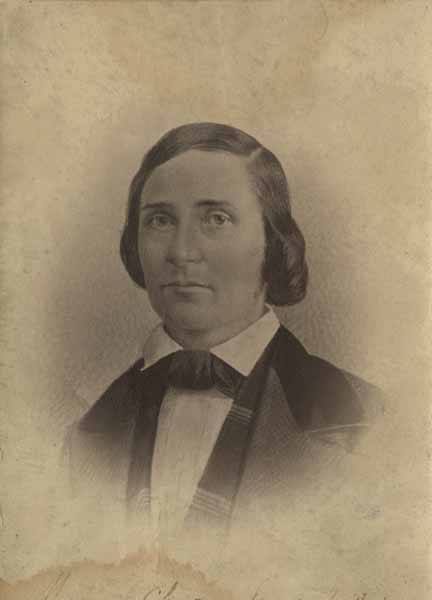
One of the men jailed was Manuel Antonio Chaves, who seems to have been the only one who went to court for his activities. Maybe his was the first and last case at this time because his American lawyer, Captain William Z. Angney, got him off.

Manuel Antonio Chaves, courtesy of Gill Chaves, 2019

Angney’s arguments were powerful. Chaves had been charged with treason against the United States. Angney argued that, since the war was still in progress, New Mexico was technically still part of the country of Mexico, and therefore Chaves was not an American citizen. You can’t try someone for treason against a country they don’t belong to. In fact, it was not treason, but patriotism, that motivated his actions.

Chaves was acquitted and released. His experience with Angney and in the courtroom seems to have permanently changed his view of Americans. Six months earlier, he’d argued fiercely that New Mexico ought to fight the invaders. The month after his release, he was fighting alongside the Americans to suppress the New Mexican revolt that broke out in Taos. He went on to serve in the Civil War on the side of the Union, rising to the rank of Lieutenant Colonel and playing a key role in the pivotal battle of Glorieta Pass. All because his perceived enemy (Captain Angney) defended Chaves’s right to rebel.

Sources: Mark L. Gardner and Marc Simmons, eds., The Mexican War Correspondence of Richard Smith Elliott; Rubén Sálaz Márquez, New Mexico, A Brief Multi-History; Marc Simmons, The Little Lion of the Southwest, a life of Manuel Antonio Chaves; Ralph Emerson Twitchell, The History of the Military Occupation of the Territory of New Mexico.

© Loretta Miles Tollefson, 2025

George Wilkins Kendall Reaches New Mexico

George Wilkins Kendall Reaches New Mexico

After a torturous journey, George Wilkins Kendall and a small group of fellow Texans finally reached New Mexico in mid-September 1841. And were under lock and key.


The approximately 300 men of the Texas Expedition to Santa Fe had divided into two groups at the end of August and sent 100 (including Kendall) ahead to find provisions for the rest, who waited with the wagons.


On Tuesday, September 14, 1841 Kendall and three other men rode into Anton Chico, New Mexico looking for food. When it became clear that the little village couldn’t supply what was needed, they headed across country toward San Miguel del Bado. They made it, but not quite the way they’d planned. By the time they reached town, they were in the custody of Mexican militia under Captain Damasio Salazar.


Kendall and his group spent just over a month incarcerated at San Miguel del Bado, where flirted with the women, engaged in shooting contests, and observed village life while they waited for word of their comrades. News finally came on Monday, September 20, when the group of 100 (less four) marched through on the way to Mexico City.


The larger group who’d been left farther behind wouldn’t arrive until October 12. After a three-day rest, they also would head south, along with Kendall and his comrades, under the supervision of Captain Salazar.


San Miguel del Bado was a logical place to incarcerate Kendall et al, as it was America’s port of entry into Mexico at the time. The town included barracks for the presidio soldiers stationed there, as well as mercantiles and other services for the 2000-plus residents. It even provided a space west of the church where in-bound merchant trains could wait for the customs official to survey their goods and calculate the import fees necessary to go on to Santa Fe or farther south to Chihuahua.

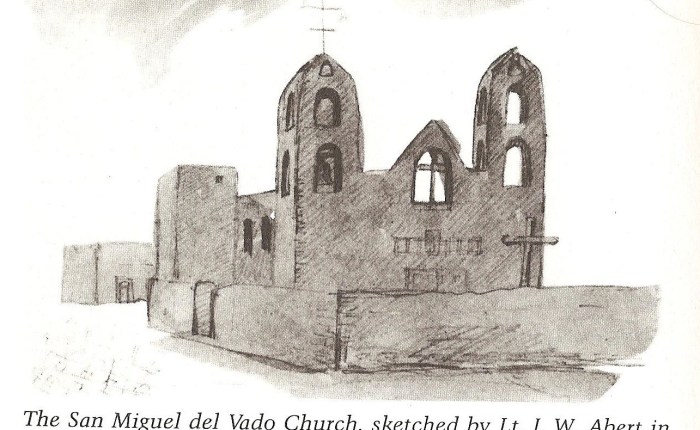
There isn’t much left of 1840s San Miguel del Bado today, except for the church with its three-foot-thick stone walls topped with adobe bricks and its twin bell towers. In Fall 1841, this building was the starting point for at least two religious processions that celebrated and gave thanks for the capture of the Texan Expedition. Kendall sneered at them both, describing the second one as “nonsensical mummeries.” He would have much to learn in the weeks to come.

BOOK REVIEW: Matt Field on the Santa Fe Trail

BOOK REVIEW: Matt Field on the Santa Fe Trail

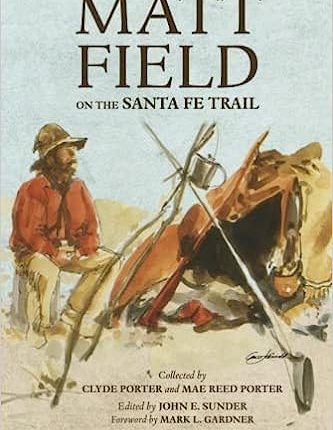
In 1839, a former actor named Matt Field decided to go to Santa Fe, New Mexico to regain his health. Although he failed to recover his physical well-being, Field did collect impressions and notes throughout his journey. After he returned to the U.S., he got a job at what is now the Time-Picayune/New Orleans Advocate and converted his jottings into a series of newspaper articles. The pieces were popular and were reprinted in papers as far away as London. I believe their positive reception inspired Picayune editor George Wilkins Kendall to make his own attempt to reach Santa Fe, a journey he would record in his Narrative of an Expedition Across the Great Southwestern Prairies from Texas to Santa Fé, which I discussed in June.

Over a hundred years after his trip, Matt Field’s articles were collected and published as Matt Field on the Santa Fe Trail. The young actor turned reporter definitely reflected the attitudes of his day, and some readers may find those biases upsetting, but there is also much to enjoy and to learn from this book. Field’s views of Santa Fe specifically and New Mexico in general are excellent examples of how Americans viewed the land and people that blocked their access to the Pacific Ocean. The book is a mixture of admiration for the women’s beauty, fascination with everything from Taos Lightning (wheat-based whiskey) to the New Mexican custom of community dances, and shock at the idea of priests and women who gamble and make money at it.

Matt Field on the Santa Fe Trail can be an exasperating book. His description of Governor Manuel Armijo’s wife as an elephant dancing is just rude and his misunderstanding of the role of Gertrudes Barceló as a business woman is a clear example of one society’s gender expectations being loaded onto another culture. However, these and other passages are precisely why I keep this book in my library. Matt Field on the Santa Fe Trail reminds me that we do not always see ourselves and our biases as clearly as we think we do. Even when we believe we’re open to new experiences, our unexpanded frames of references can still distort our perceptions.

And that is why I recommend Matt Field on the Santa Fe Trail to anyone interested in history in general and New Mexico in particular. It’s a fascinating historical document in itself and can also help keep us honest about our own take on the world around us and remind us that we may also possess attitudes we haven’t completely examined. And may not want others to know about a hundred years from now.

George Wilkins Kendall Sails for New Mexico

On Monday, May 17, 1841 journalist George Wilkins Kendall sailed from New Orleans, Louisiana to join an expedition the Texas Republic was sending to Santa Fé, New Mexico.

Santa Fé had been a major destination of Americans heading west from Missouri for the past twenty years. Many had returned home wealthy. The Texans wanted to break a trail from Austin that would move that trade south to them instead. The resulting profits could prove critical to the Texan coffers, which were verging on empty.

If the Texans had only intended to trade, the reception the Texas Santa Fe Expedition received might have been different. But five years before, their Legislature had declared that Santa Fé and all its wealth was inside Texan borders. This was followed by President Mirabeau Bonaparte Lamar’s open letter in Spring 1840 telling the New Mexicans the Rio Grande was “the natural and convenient boundary” of Texas and that “we shall take great pleasure in hailing you as fellow citizens.”  

Lamar promised to send an expedition in September 1840, with commissioners who would “cement the perfect union” of Santa Fé and Texas. These men would “be accompanied by a military escort for the purpose of repelling any hostile Indians that may infest the passage.”

George Wilkins Kendall, circa 1837. Source: Kendall of the Picayune, by Fayette Copeland

The Expedition he sent, which was comprised of three Commissioners, their staff members and companions, roughly ten merchants, and around 270 soldiers, was a little late getting started. It left Austin in June 1841. In the meantime, New Mexico Governor Manual Armijo had been busy gathering his resources while keeping a close eye on the Americans in New Mexico.

Although the Texans had been led to believe they would be welcomed to Santa Fé with open arms, they would find the situation a little more complicated than they assumed. George Kendall had estimated his journey would take a pleasant four months. It would actually be twelve, the majority of them uncomfortable, including time in a Mexican prison. 

All because he didn’t take the time before he left New Orleans to check whether Mexico agreed with the Texan desire to take over the Santa Fé trade.  

Loretta Miles Tollefson, copyright 5/15/23

BOOK REVIEW: Old Santa Fe Today

There’s only one problem with the fifth edition of the Historic Santa Fe Foundation’s classic Old Santa Fe Today. Every time I dip into it, I get more story ideas. I can’t research and turn them all into fiction! Which is too bad, because there’s a lot of great material in this book.

Old Santa Fe Today was originally conceived as a list of historical properties in Santa Fe. To that end, it still includes a register of properties worthy of preservation, information about efforts to do so, and a brief history of Santa Fe’s built environment. This may sound like a specialist’s book and not something for the average reader. However, the beautifully rendered full-color photos and the details about each entry make it highly accessible.  

Not only do the authors provide architectural and preservation information about the buildings in question, they also include a brief history: who built it, who lived in it, and who those people were associated with. I, of course, am especially interested in the older buildings, in particular those in use during the mid-1800s. However, the entries include structures built as late as the 1940s, including the Dodge-Bailey house designed by John Gaw Meem and adjacent to Meem’s own home on Old Santa Fe Trail.

Old Santa Fe Today also includes properties outside Santa Fe proper, including Las Acequias, a hundred-acre farm on the banks of the Rio Nambe, and non-building structures such as the Acequia Madre that has transported water into Santa Fe from the Sangre de Cristo mountains for over four hundred years.

So, whether you’d like to know more about Santa Fe’s historic structures, are interested in historic preservation, want to learn about Santa Fe area history, or just like beautiful pictures, I highly recommend Old Santa Fe Today. 

Governor Pérez Heads to Santa Fe!

Governor Pérez Heads to Santa Fe!

In early April 1835, Mexican Army Colonel Albino Pérez left Chihuahua for his new post as Governor of New Mexico. He arrived in Santa Fe with 1000 pesos “for the needs of that office,” and a strong reputation as a military man. A “man of fine presence … privileged and well-to-do,” Pérez began his administration with a brisk efficiency that boded well.

However, once New Mexicans got a closer look at the governor, they were less impressed. The funds he brought were depleted fairly quickly. Also, Pérez seemed to think his 3,000-peso-a-year salary was insufficient, even though it was high for New Mexico. He borrowed large gilded mirrors from former governor Francisco Sarracino, a chest of drawers from Justice Santiago Abréu, and a large table clock from Judge Juan Estevan Pino. And local transport options weren’t good enough for him. He ordered an American-made two-wheeled carriage and two horses worth 800 pesos from Santa Fe trader Jesse Sutton.

The new governor also lived an immoral life. Although he was believed to have a wife in Mexico City, he became involved in a relationship with his housekeeper, Trinidad Trujillo, and fathered her child.

New Mexicans might have merely muttered at all this and gone on with their lives, but Federal politics began to exacerbate already-negative feelings.

On October 3, 1835, a decree by President Santa Anna’s centralist Congress abolished Mexico’s State and Territorial legislatures and replaced them with five-member Councils with no decision-making powers. Instead, they were subordinate to the president-appointed—and therefore controlled—governor. This gave Governor Pérez much more authority than he’d had when he arrived.

In addition, and perhaps more importantly, New Mexico’s tax exemption was about to run out. There was no assurance it would be renewed. New Federal decrees made the governor responsible for supervising collections, a potentially lucrative job. He didn’t have much incentive to ask for a continued exemption.

Rumors swirled. The governor was about to impose exorbitant tariffs. Thing never taxed before—like water, wood, and pasture—would be now. It was even whispered that men would be taxed for laying with their wives. Some people believed the new rates were actually being levied by the governor, not Mexico City, as a way to fund his lifestyle. When Pérez called a July 10 meeting to discuss the process for collecting the new revenues, the pot of rebellion began to heat up.

A month later, the governor’s naked body would lie headless in the road south of Santa Fe. All the efficiency and fine presence in the world couldn’t save him from the consequences of his lifestyle choices and Congressional mandates.

For more about what happened in New Mexico before, during, and after August 1837, check out my novel There Will Be Consequences, which is available from your favorite brick and mortar storeBookshop.orgebook retailerAmazon, and Barnes and Noble.

Sources: Lansing B. Bloom, “New Mexico Under Mexican Administration,” Old Santa Fe Magazine, Vol. II, Santa Fe: Old Santa Fe Press, 1914-1915; Paul Kraemer, An Alternative View of New Mexico’s 1837 Rebellion, Los Alamos Historical Society, 2009; Janet Lecompte, Rebellion in Río Arriba 1837, Albuquerque: University of New Mexico Press, 1985; Benjamin M. Read, Illustrated History of New Mexico, Santa Fe: New Mexican Printing Company, 1912; Ralph E. Twitchell, The Leading Facts of New Mexico History, Vol. 2, Cedar Rapids: Torch Press, 1912; David J. Weber, The Mexican Frontier, 1821-1846, Albuquerque: University of New Mexico Press, 1982.