I’m pleased to announce that Not My Father’s House, the sequel to Not Just Any Man, will be published October 1 and is now available for pre-order.
Not My Father’s House follows Gerald and Suzanna into New Mexico’s Sangre de Cristo mountains.
Suzanna hates pretty much everything about the place. The isolation. The short growing season. The critters after her corn. The long snow-bound winters in a dimly-lit cabin.
But she loves Gerald, who loves this valley.
So she does her best to adjust, even when the babies come, both of them in the middle of winter. Her postpartum depression, the cold, and the lack of sunlight push her to the edge.
But the Sangre de Cristos contain a menace far more dangerous than Suzanna’s internal struggles. The man Gerald killed in the mountains of the Gila two years ago isn’t as dead as everyone thought.
And his lust for Suzanna may be even stronger than his desire for Gerald’s blood.
You can pre-order the ebook now at Amazon, Barnes and Noble, and Books2Read. Paperbacks will be available October 1 from on-line retailers or by your favorite brick-and-mortar bookstore.
In late July 1851 Fort Union, New Mexico came into being very quickly. There had been nothing at the location at the beginning of the month, but after Colonel Edwin Vose Sumner reached Santa Fe on July 19, it was only a matter of time, and not very much of that.
The search for a new U.S. Army quartermaster depot site east of Santa Fe had already been. The Army needed a convenient point for receiving supplies in bulk from Fort Leavenworth and then distributing them to posts throughout New Mexico.
When Colonel Sumner saw the location chosen for the depot, he realized it was also an excellent spot for a new military post and Department headquarters. Known as Los Pozos (“the pits” or “the potholes”) the site had several spring-fed pools of water, something of a rarity on the plains east of the Sangre de Cristo mountains.
Not only would the new Fort be supplied with water in an otherwise arid land, but the location was near the junction of the Santa Fe Trail Cimarron and Mountain routes, near the trail through Mora to the Rio Grande valley, and also near settlements such as Rayado and Las Vegas, which were being threatened by the Jicarilla Apaches.
Once Sumner made the decision, things moved quickly. By the end of July, the number of civilians employed by the quartermaster department in Santa Fe was reduced to three clerks and one carpenter and moved to the new site along with the soldiers who had been stationed in Santa Fe and in Las Vegas. New Mexico’s Fort Union was born.
Sources: Ruben Cobos, A Dictionary of New Mexico and Southern Colorado Spanish, Santa Fe: Museum of New Mexico Press, 2003; Lawrence R. Murphy, Philmont: a history of New Mexico’s Cimarron country, Albuquerque: University of New Mexico Press, 1972; Leo Olivas, Fort Union and the Frontier Army in the Southwest, Division of History, National Park Service, Southwest Cultural Resources Center, 1993; Marc Simmons, Kit Carson and His Three Wives, Albuquerque: University of New Mexico Press, 2003.
New Mexico’s weather so far this year has reflected the weather patterns across the nation—unpredictable, to put it kindly. To put the snow, rain, hail, and general nastiness into perspective, take a look at this May 9, 1907 article from the Cimarron News and Press.
The winter had been a dry one. The stockmen’s herds hadn’t been buffeted by much cold, so they were healthy, over all. But the dry conditions meant the summer was going to bring sparse summer grasses. Until early May. When it rained and snowed!
The Cimarron News and Press tended to be very upbeat, so I question just how positively the stockmen felt about the loss of their calves and lambs to the recent storms.
But we can take comforting in noting know that storms this late in the year are not a new phenomenon.
I’m pleased to announce that Not Just Any Man, my mountain man novel set in New Mexico, is now available in paperback and ebook. Here are the details:
Just a man. Known for his character, not the color of his skin. That’s all Gerald, son of a free black man and and Irish servant girl, wants to be. It’s an impossible goal in slave-holding Missouri, but in the West, mountain men and villagers alike seem to accept him without question.
New Mexico is all that Gerald hoped for, but shortly after he arrives in Taos, he realizes he wants more than he’d thought: A girl with her own complex ancestry and a high mountain valley with intriguing potential.
To make either dream possible, Gerald needs to earn something more than a scratch living. The only way to do that is to trap beaver. It’s a tough way to earn cash and the wilderness is an unforgiving place.
Can Gerald survive the Sangre de Cristo mountains, the Mohave Indians, and the arid south rim of the Grand Canyon as well as the fellow trapper who hates him for the color of his skin? Can he prove to himself and the girl he loves that he is, after all, not just any man?
Not Just Any Man is set in the late 1820s in Old New Mexico and is filled with historical characters and events.
You can order it from Amazon, Barnes and Noble, and other online outlets, or from your favorite brick-and-mortar bookstore.
“I don’ keer if you don’ believe me,” the old trapper said as he pushed his matted brown hair away from his eyes. He shifted the Harpers Ferry 1803 rifle impatiently. “If’n yer too smart for yer own good, it ain’t none o’ my doin’.” He stroked the maple half-stock with its short barrel, looked balefully at the younger man, and turned to place the rifle next to his pack. The metal rib brazed to the underside of the barrel glinted in the firelight. “Thinks he’s smarter’n the rest o’ us,” the trapper muttered to the wagon master, who was sitting on his heels on the other side of the fire, smoking a carved cottonwood pipe.
“I didn’t say that I disbelieved you,” the young man in the black broadcloth coat said evenly. He brushed a piece of ash from his sleeve. “I simply stated that I was unaware of any unique characteristic of the 1803 issued to Lewis and Clark’s Corps of Discovery, other than the half-stock and its excellent balance.” He shrugged a shoulder. “My father was issued an 1803 during the 1812 conflict. He recollected it quite fondly and frequently. However, he never mentioned an unusually short barrel.”
“Jest cuz yer Daddy didn’ say it, don’ mean it weren’ so,” the old trapper grumbled.
“That may be the case,” the young man said stiffly. “I was unaware that I was contradicting you. I understood that we were merely exchanging some particularly intriguing information.”
“Ten dollar words.” The old man rubbed his matted hair, unfolded himself upward without looking at the others, and stalked off into the night.
The young man in the black coat looked across the firelight at the wagon master. “I didn’t intend to offend him,” he said uneasily.
The wagon master took his pipe from his mouth. “Oh, I wouldn’t worry ’bout it,” he said. “Ol’ Matt gets himself worked up like that sometimes. But he’s like a garden snake, all fizz an’ no real fury.” He glanced into the darkness. “But don’t say I said so. Not where he can hear. He wants ya t’ think he’s a rattler.”
On this day June 3, 1787, one of the West’s most memorable mountain men, William Sherley Williams, was born in North Carolina. The fourth of nine children, he was called “Will” by family members, although before he was 40, his fellow mountain men were calling him “Old Bill.”
The Williams family moved to Missouri when Bill was 9 years old. Seven years later, at 16, Bill left home to live among the Osage Indians. Twenty-one years later, after the death of his ostrich wife and the dissolution of the reservation, Bill headed west. He would become a legendary mountain man, known as much for his eccentricities as his prowess in the wilderness.
The lean, 6’1”, red-headed Williams was based in Taos and had a propensity for hunting beaver on his own, or with only a camp-follower as a companion. Where he went was anyone’s guess–he also had a propensity for keeping his hunting grounds secret.
Before he left home, Williams had received an education that included training in Greek and Latin. This, along with excellent hunting and tracking skills and a gift for languages, gave him a self-confidence that didn’t suffer fools gladly. Especially people who doubted his geographic knowledge of the West.
This strong personality was bound to get Williams in trouble when he encountered someone with a similar character. In Williams’ case, this was former Army Colonel John C. Fremont.
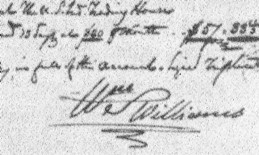
Bill Williams signature. Source: Old Bill Williams, A. H. Favour
In late 1848, Fremont hired Williams as guide for an expedition into the Rocky Mountains to identify an all-season railroad route to California. When Williams insisted that the expedition should veer from the route Fremont had already identified, Fremont relieved Williams of his guide duties and gave them to others.
Unfortunately, Williams was right. Fremont’s route was a mistake. Winter set in with a vengeance and Fremont’s men were trapped in the Rockies. Only 21 men of Fremont’s original 32 made it out alive. Although this would include Williams, he would die a couple months later, trying to retrieve valuable records and medical equipment that had been left behind.
So, while Williams’ vivid personality and self-confidence made him a legend in his own time, it also cut his time short. But the stories of his exploits would live on, and some of us still wonder just where those secret beaver hunting grounds actually were.
Sources: Robert Glass Cleland, This Reckless Breed of Men, UNM Press, Albuquerque, 1976; Leroy R. Hafen, Ed., Fur Trappers and Traders of the Far Southwest, Utah State UP, Logan, 1997; Alpheus H. Favour, Old Bill Williams, Mountain Man, U of Oklahoma P, Norman, 1962
The girl lifted her skirts away from her feet and eased toward the small brown-mottled duck on the creek bank. It was busily investigating a small marshy area where water had seeped past the bank. Alma wished she’d brought her bow and arrows, but she’d been sent out to collect greens, not meat.
The duck had its back to her. Alma eased forward and crouched, getting into position. Her right foot pressed her skirt into the mud, but she didn’t notice.
The duck turned slightly. Alma lunged forward. As her hands touched the bird’s smooth feathers, her foot ground into her skirt, yanking her off balance. The duck flew off with a panicked series of quacks and Alma pitched foward into the mud.
“Hell and damnation!” she said angrily. “I hate dresses!”
She got to her feet and looked down ruefully. Her mother was not going to be happy.
On Wednesday, November 10, 1875 Manuel Cardenas was shot and killed by an unknown gunman in the short distance between the Colfax County jail and courtroom in Cimarron, New Mexico Territory. Cardenas had been on his way to tell the justice of the peace what he knew about the mid-September death of Methodist missionary Franklin J. Tolby. Because Cardenas died when he did, the mystery of who shot Reverend Tolby, and why, was never solved.
Tolby had been a bur under the Maxwell Land Grant Company’s saddle since he’d arrived in the Territory in early 1874. He pointed out that Congress had thrown the grant land was open to homesteaders and objected strenuously to the Company’s program against the settlers they called “squatters.” Because of Tolby’s status as a minister of the gospel, people listened to him and resisted the Land Gant Company’s enforcers.
When Tolby was killed in the Cimarron canyon in September, many thought Civil War veteran Cruz Vega was responsible. As a result, Vegas was tortured and killed, but before he died, Vega fingered Manuel Cardenas as the man who’d shot Tolby.
Cardenas, in turn, claimed that the now-dead Vega had killed the minister. More importantly, he asserted that three prominent members of the community—men who were believed to be part of the Santa Ring—had ordered the killing. Since members of the Ring had a controlling interest in the Maxwell Land Grant Company, Cardenas’ claim made a lot of sense to many Colfax county residents.
However, Cardenas had yet to make his accusations before the County Court. And he died before he could do so. Since his killer was never identified, questions about Tolby’s killing and its aftermath remain to this day: Who killed Manuel Cardenas and why? Was it a Cruz Vega adherent, revenging the aspersion on his good name? Was it Clay Allison or a member of the vigilante group that killed Cruz Vega, seeking vengeance for Reverend Tolby’s death? Or did the Santa Fe Ring send out a killer to take out their killer before he could officially name names? For that matter, who killed Reverend Tolby? Was it Cruz Vega or Manuel Cardenas? And did members of the Santa Fe Ring really put them up to it? If so, how far did the conspiracy go? The Governor’s office? Unless new evidence shows up now, 142 years later, we’ll never know for sure.
And so the saga of Reverend Tolby’s death ends with more questions raised than answered. This is the stuff that novels are made of!
Sources: Chuck Parsons, Clay Allison, portrait of a shootist, Pioneer Book Publishers, 1983; David L. Caffey, Chasing the Santa Fe Ring, UNM Press, 2014.
On Thursday, February 28, 1867, Charles Kennedy married Gregoria Cortes at the Nuestra Senora de Guadalupe Church in Taos. Gregoria was the fourteen year old daughter of widower José Cortez of La Cordillera del Rancho, about two miles west of Mora. Charles was the 28 year old son of William and Fanny Canady (aka Kennedy) of Tennessee. Gregoria and Charles settled in the Moreno Valley at the foot of Palo Flechado Pass, on the road from Elizabethtown to Taos. There they kept a way station for travelers, and Charles Kennedy became embroiled in a series of lawsuits: one for selling liquor without a license, another for assaulting an Elizabethtown merchant with a deadly weapon, and still another for embezzling an Elizabethtown laborer’s money and goods. Kennedy was suspected of other nefarious activities, but nothing could be proven. Then, one day in the fall of 1870, his then seventeen year old wife appeared in Etown and denounced Kennedy as a serial killer. The subsequent Elizabethtown trial and lynching would make the Santa Fe, Silver City, and Indianapolis newspapers. The Silver City report said Kennedy claimed just prior to his lynching that he’d killed twenty-one men.
Outside, the dogs were barking wildly. Indians? Suzanna twitched the window curtain just enough to peek out without being seen.
Then she saw the reason for the barking and sprang from the window to the door. She ran wildly across the yard toward the field of knee-high corn, pulling off her apron as she went. The deer were everywhere and she charged in among them, waving the apron, crying “Shoo! Shoo!”
Both the dogs plunged in after her, rampaging through the corn, and the deer fled. Chest heaving, Suzanna stood in the center of the field and surveyed the damage. Some of the plants were completely uprooted. She wasn’t sure if the deer or the dogs had wreaked the most havoc.
Suzanna lifted her hands to the sky helplessly, then looked down at the dogs, who were lying, panting, at her feet. “You weren’t much help,” she said irritably.
She looked around the field again and her jaw tightened. As soon as Gerald returned, they were building a fence.



 Fiction and Fact From Old New Mexico