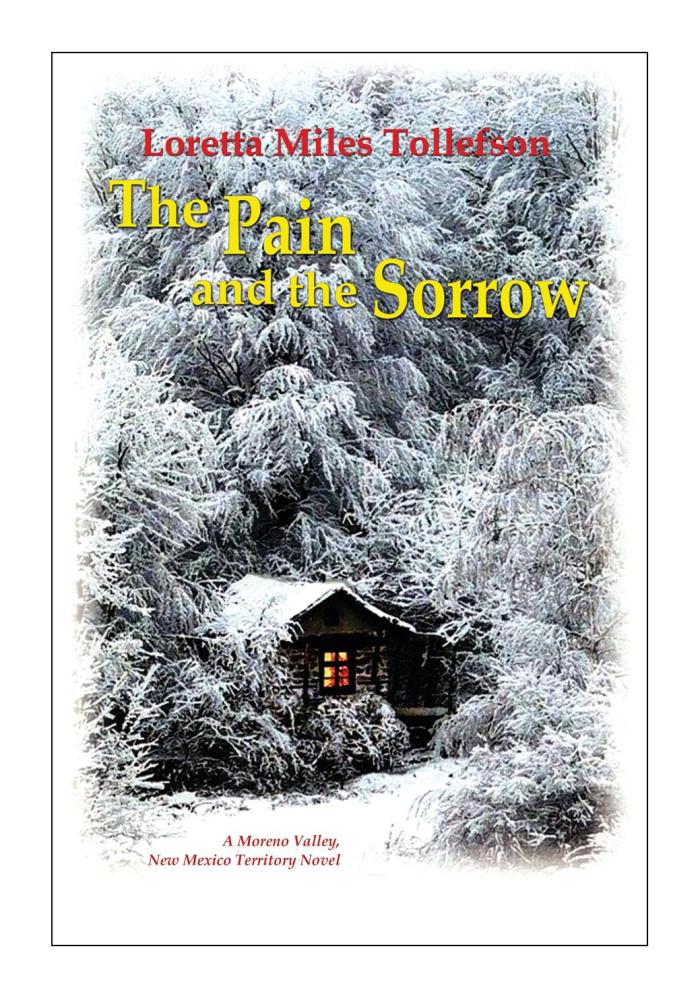
I’m pleased to announce that The Pain and The Sorrow is now available as an ebook from Amazon (for Kindle users) and Barnes and Noble (for Nook users).
This novel about Old New Mexico serial killer Charles Kennedy and the wife who turned him in was published by Sunstone Press last summer and has not been available in ebook form until now.
On this day June 3, 1787, one of the West’s most memorable mountain men, William Sherley Williams, was born in North Carolina. The fourth of nine children, he was called “Will” by family members, although before he was 40, his fellow mountain men were calling him “Old Bill.”
The Williams family moved to Missouri when Bill was 9 years old. Seven years later, at 16, Bill left home to live among the Osage Indians. Twenty-one years later, after the death of his ostrich wife and the dissolution of the reservation, Bill headed west. He would become a legendary mountain man, known as much for his eccentricities as his prowess in the wilderness.
The lean, 6’1”, red-headed Williams was based in Taos and had a propensity for hunting beaver on his own, or with only a camp-follower as a companion. Where he went was anyone’s guess–he also had a propensity for keeping his hunting grounds secret.
Before he left home, Williams had received an education that included training in Greek and Latin. This, along with excellent hunting and tracking skills and a gift for languages, gave him a self-confidence that didn’t suffer fools gladly. Especially people who doubted his geographic knowledge of the West.
This strong personality was bound to get Williams in trouble when he encountered someone with a similar character. In Williams’ case, this was former Army Colonel John C. Fremont.
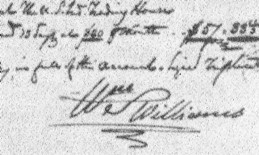
Bill Williams signature. Source: Old Bill Williams, A. H. Favour
In late 1848, Fremont hired Williams as guide for an expedition into the Rocky Mountains to identify an all-season railroad route to California. When Williams insisted that the expedition should veer from the route Fremont had already identified, Fremont relieved Williams of his guide duties and gave them to others.
Unfortunately, Williams was right. Fremont’s route was a mistake. Winter set in with a vengeance and Fremont’s men were trapped in the Rockies. Only 21 men of Fremont’s original 32 made it out alive. Although this would include Williams, he would die a couple months later, trying to retrieve valuable records and medical equipment that had been left behind.
So, while Williams’ vivid personality and self-confidence made him a legend in his own time, it also cut his time short. But the stories of his exploits would live on, and some of us still wonder just where those secret beaver hunting grounds actually were.
Sources: Robert Glass Cleland, This Reckless Breed of Men, UNM Press, Albuquerque, 1976; Leroy R. Hafen, Ed., Fur Trappers and Traders of the Far Southwest, Utah State UP, Logan, 1997; Alpheus H. Favour, Old Bill Williams, Mountain Man, U of Oklahoma P, Norman, 1962
In March 1867 Larry Bronson, Peter Kinsinger, and R.P. Kelley returned to Willow Creek and the gold they found there the previous fall. Now they were back, even though others were there before them. But even though they weren’t first on the scene, they still managed to do well by themselves, with five 200 foot claims near their original discovery point.
It’s not clear whether anyone had yet contacted the man who owned the land that they were so busily excavating. Willow Creek ran from Baldy Mountain into the canyon of the Cimarron River. All of the land in question was part of the Maxwell land grant owned by Lucien Bonaparte Maxwell and his wife Maria de la Luz Beaubien, whose inheritance it was.
Bronson, Kinsinger, and Kelly took out 14 ounces of gold that summer alone, then contracted for water rights from Bear and Willow Canyons so they could proceed on a larger scale. This involved moving from gold pan mining to hydraulic equipment. With 40 inches of water and 6 inch hoses to spray the rocks out of the hillsides, the company they formed became one of most productive operations on Willow Creek.
In the end, even Lucien Maxwell and his wife did well, partly as a result of the value of the Baldy Mountain area mining. In early 1870, they sold the entire land grant to a consortium of European investors, while retaining key portions of the grant, including mining claims on the east side of Baldy and water rights along Willow Creek. The men who bought the grant seem to have been confident that they also would do well from the gold and silver mines. However, things didn’t pan out quite as they’d hoped. The Maxwell Land Grant and Railway Company was in default by the early 1880s.
But then again, right from the beginning, mining in the area had been based on “every man for himself.”
Sources: Moreno Valley Writers Guild, Lure, Lore and Legends of the Moreno Valley, Columbine Books, Angel Fire, 1997; Larry R. Murphy, Philmont, A History of New Mexico’s Cimarron Country, UNM Press, 1972; Leo E Oliva, Fort Union and the Frontier Army in the Southwest, Division of History, National Park Service, Santa Fe, 1993; J. Rush Pierce, Red River City, JRP Publications, Red River, 2008; 1870 U.S. Census Records, Elizabeth City precinct; 1880 U.S. Census Records, Baldy/Ute Park precinct.
It happened every spring in the early 1800s: Taos was invaded by trappers, either future or current. It made law enforcement rather complicated
In 1817, Jules DeMun didn’t even make it to Taos before he was headed off by a contingent of Spanish soldiers, who had been sent out in response to rumors in Taos that DeMun and his partner Pierre Chouteau had 20,000 Americans camped on the Purgatoire River, set to invade New Mexico. Even though the rumors weren’t true, DeMun and Chouteau were ordered to return to St. Louis. Somehow, they talked the soldiers into allowing them to travel north before heading east, ostensibly to avoid the Pawnee. Of course, they didn’t head directly to St. Louis. They trapped, supposedly outside of the boundaries of New Spain.
When news of Mexico’s independence from Spain reached the United States in 1821, things only got worse. Trappers and merchants could now enter New Mexico legally, but they still had trouble following Mexico’s rules. Up to this point, the Sangre de Cristo mountains had provided a protective barrier between Taos and incursions from the eastern plains. But they didn’t stop the Americans. In fact, the mountains were a great place to cache furs before smuggling them east to Missouri without paying export taxes. And Taos was still the favorite way to enter, especially if you were doing something slightly illegal. There were just so many ways to get there from the Santa Fe trail, which paralleled the mountains between it and Taos.
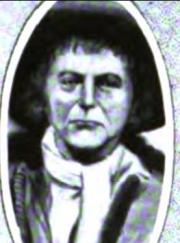
“Uncle Dick” Wootton, Source: Leading Facts of New Mexico History, R.E. Twitchell
It got so bad that Mexico Customs Officer Juan Bautista Vigil y Alarid had to deputize Rafael Luna as Taos’ border guard. Even that wasn’t enough. Eventually, Alarid authorized Luna and Taos Alcalde Severino Martinez to use the militia to intercept the Americans.
Calling out the militia seems like overkill until you realize how valuable the furs in question were. In 1837, “Uncle Dick” Wootton brought furs worth $25,000 into Taos. And that’s just what he was willing to pay the tax on. The trappers had incentive to skirt the law. And the Mexican authorities had incentive to try to keep them from doing so.
And so each spring the dance began again….
Sources: Den Galbraith, Turbulent Taos, Sunstone Press, Santa Fe, 1983; Leroy R. Hafen, Fur Trappers and Traders of the Far Southwest, Utah State UP, Logan, 1997; Joy L. Poole, editor, Over the Santa Fe Trail to Mexico, U of Oklahoma Press, Norman, 2015; David J. Weber, The Taos Trappers, U of Oklahoma Press, Norman, 1971.
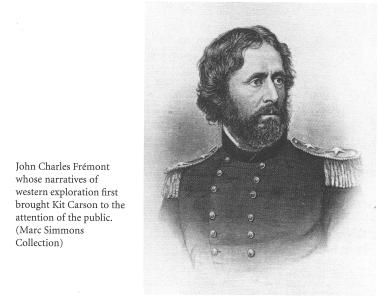
On this day in 1849, Saturday, January 13, celebrated explorer John C. Fremont stumbled into the Taos plaza so battered by exposure and starvation that no one recognized him.
Fremont had left what is now Pueblo, Colorado, 52 days earlier on a mission to identify a practicable railroad route across the Rockies to California. He had 32 men and 120 supply-laden mules with him.
Even before he’d left Pueblo, there was trouble. He’d already lost a guide. When former mountain man “Uncle Bill” Wootton took a look at the signs and realized just how bad the coming winter was likely to be, he backed out. But former Army Colonel Fremont refused to give up. He’d been forced to resign from the military in a cloud of disgrace two years earlier and was determined to redeem himself. Come hell or high water, he was determined to prove that a year-round transcontinental railroad operation across the mountains was feasible. If men and mules could cross the path he had in mind under winter conditions, then surely trains could, too.
Fremont hired “Old Bill” Williams to take Wootton’s place. While Williams was a brilliant tracker, he wasn’t exactly known for his tact. Since Fremont was known for his stubbornness, the partnership seemed destined for trouble. And trouble happened pretty quickly. When Williams announced that the expedition should veer from the route Fremont had laid out, trouble ensued. Fremont relieved Williams of his guide duties and gave them to men who Fremont had worked with before but who didn’t know the region.
As Wootton had predicted, the weather turned treacherously nasty and grew increasingly difficult as Fremont’s men tried to force their way through snow-bound canyons and across icy mountainsides. All of the mules either died of starvation or froze to death. Frostbite and snow blindness plagued both the animals and the men. Not only was the expedition’s goal doomed, but the conditions were so bad that the men feared for their lives. In a desperate attempt to make it to safety, Fremont divided his company into small groups and sent them south to try to reach Taos.
Only 21 men of the original 32 would make it out alive and Fremont himself would need weeks of nursing by Josefa Carson before he fully recovered from the ordeal. Even with the survivors in Taos and whole, the loss of life would continue. Williams would die trying to retrieve valuable records and medical equipment that had been left behind in the rush to escape the winter conditions Uncle Bill Wootton had warned Fremont about.
Although a year-round transcontinental railroad was eventually built across the Rocky Mountains, it was not constructed on the route that Fremont tried to blaze that winter of 1848/49. The glory of that deed would go to other men. Fremont’s exploring days were over .
Sources: Alpheus H. Favour, Old Bill Williams, Mountain Man, U of Oklahoma Press, Norman, 1962; Leroy R. Hafen, Ed., Fur Trappers and Traders of the Far Southwest, Utah State U Press, Logan, 1972; Marc Simmons, Kit Carson and His Three Wives, UNM Press, Albuquerque, 2003.
In 1867, the village of Don Fernando de Taos started its new year with a lynching. By Wednesday, January 2, the citizens of Taos had had enough of the antics of Thomas Means. The man had been on yet another drunken binge. During this one, he’d bounced around the plaza threatening people with a knife and pistol. When he finally went home, he took out his frustrations on his wife, nearly killing her in the process. That was when the authorities stepped in and arrested him.
Means was incarcerated in the local jail but there was apparently some concern that he wouldn’t get the justice he deserved: New Mexico juries were known for being reluctant to judge defendants guilty of death. To solve this problem, a group of citizens mob stormed the jail and removed Means from his guards’ protection. But they didn’t take him very far. 1867 must have started out cold, because the impromptu extra-legal jury decided to hang Means in the room next door to the jail: the courtroom where he would have been tried if they’d been a little more patient. The vigilantes dragged him into the space reserved for justice and hanged him from one of the vigas there. Although a judge may not have thought so, the men who dealt with Means clearly thought that justice was a good use for the room in question.
Source: Robert J. Torrez, Myth of the Hanging Tree, UNM Press, Albuquerque, 2008.
Give yourself a story break before you plunge into that holiday shopping! For the first time ever, I’m publishing Christmas stories set in Old New Mexico in ebook format!
Nine Days of Christmas is a never-before published long short story about a gringa who wants to participate in her village las posadas. Saloon Christmas is a collection of three stories, all of them set in Colfax County’s first county seat, Elizabethtown, New Mexico. If you don’t use Kindle, you can find links to other providers here. Enjoy!


 Fiction and Fact From Old New Mexico