The Excitement of Politics—Some Things Never Change

On Saturday, September 15, 1855, the political atmosphere of New Mexico was so tense that a group of political operatives took it upon themselves to steal the Rio Arriba County poll books at gunpoint. The poll books in question contained the county records of the recent election for New Mexico’s territorial delegate to Congress. The two candidates for the post were Jose Manuel Gallegos and Miguel Antonio Otero.

In Rio Arriba County, a Gallegos stronghold, Probate Court Clerk Ellis T. Clark was responsible for getting the vote results to Santa Fe. He stashed the records in his saddlebags and, accompanied by Territorial Attorney General Theodore Wheaton, headed south.

About 25 miles north of Santa Fe, near Pojoaque Creek, Wheaton and Clark happened to meet five men from Otero’s party. The meeting seemed innocent enough. According to the Santa Fe Weekly Gazette account of the incident, the two groups  “halted and passed the usual compliments, the former not suspecting the object of the latter.” During the ensuing conversation, one of Otero’s partisans asked Clark if he had the poll books and he said he did. The men continued to chat.

Then suddenly the mood changed. As their companions pulled out six shooters, two of Otero’s friends grabbed Clark’s and Wheaton’s arms and demanded the voting records. Then one of them pilfered  Clark’s saddle-bags and grabbed the books.

The thieves didn’t take off immediately. They paused long enough to explain that they planned to hold the records hostage until the votes for Otero’s home county, Valencia, were tallied. They’d heard that there were plans afoot to “disappear” the Valencia poll books and hand Gallegos the election. If Valencia’s votes were “lost”, the records for Rio Arriba would also disappear.

Then the five rode off, heading north. Clark and Wheaton continued south. They arrived in Santa Fe around 10 o’clock that night and told the Sheriff what had happened. He, Clark, and a posse immediately headed north after the thieves. A duplicate set of the Rio Arriba poll books were in Clark’s house. They figured the Otero partisans would want to acquire those as well.

Sept 15 illustration

They were right. In fact, when the posse arrived at Clark’s house the next day, they learned that three of the thieves had already been there. They’d tried to bully Clark’s wife into giving them the records and, when she refused, went in search of a lawman who’d force her to do what they wanted. There’s no record of who they found to play that role. When the Otero men returned to the house, the posse was waiting and the thieves were arrested.

They’d actually had good reason to be concerned about the election results. When all the votes were counted,  Gallegos had won by 99 votes. However, Otero contested the results, alleging illegal activities related to the vote, and was ultimately awarded the Delegate seat. He served in that position until 1861, when he lost a re-election bid to John S. Watts.

As for the theft, the Gazette expressed its editorial sorrow “that men, in the excitement of politics, should commit acts their judgment will condemn in their sober moments,” and called for more stringent laws related to election fraud.

Ironically, we’re still expressing the same kind of sorrow and calling for the same kind of laws today. Some things never change.

Sources: Don Bullis, New Mexico, A Biographical Dictionary, 1540-1980, Vol. 1. Los Ranchos de Albuquerque: Rio Grande books, 2007; Santa Fe Weekly Gazette, September 22, 1855, page 2.

DRY PICKINS

When Gerald and Old Pete reached the top of the rise, they paused to survey the long green valley that stretched north toward Baldy Peak and Touch Me Not Mountain. Below them, a cluster of bison browsed steadily.

“What’re buffalo doin’ clear up here?” Old Pete muttered as he unslung his rifle from his shoulder and checked the primer. “Must be dry pickins east o’ Cimarron to send this bunch so far up-mountain.”

“We can’t eat a whole buffalo or take the time to jerk it,” Gerald objected.

“No, but the robe’ll warm ya,” Old Pete said. He took careful aim at a yearling bull who’d been paying more attention to the rich grass than to his companions and had strayed to one side. The sound of the gun sent the small herd thundering up the valley, but the young male buckled to his knees as his head swung mutely toward the men on the hill.

Old Pete grunted in satisfaction, lowered the flintlock, and grinned at Gerald. “Or that girl you’ve been acourtin’.”

Copyright © 2016 Loretta Miles Tollefson

Future Governor Trades on Camino Real

On Monday, August 27, 1827 American traders Henry Connelly, Alphonso Wetmore, and James Erwin Glenn received written permission to travel El Camino Real de Tierra Adentro from Santa Fe to Chihuahua on a trading venture. Although Wetmore was an established Santa Fe trader at the time, then 27-year-old Henry Connelly would become the most well-known of the three men on this expedition, with the most influence on New Mexico.

A medical doctor, Connelly settled in Chihuahua at the end of his 1827 trip, and engaged in the mercantile trade there. However, he didn’t abandon his Santa Fe connections or his links to the United States. When General Stephen Watts Kearny’s army invaded New Mexico in 1846, Connelly had been in Mexico almost 20 years and had influential friends in Santa Fe.

Aug 27 post illustration.Connelly

In fact, Connelly’s connections may have been critical to the success of Kearny’s mission. He is believed to have been Governor Manuel Armijo’s agent during the negotiations that resulted in the bloodless handoff of New Mexico to the U.S.

By 1849, Connelly’s heart was definitely in New Mexico as opposed to Chihuahua. That year, he married Dolores Perea de Chavez of Peralta and subsequently became officially involved in New Mexico Territorial politics. In 1851, he became a member of the Territorial Council. Ten years later, President Abraham Lincoln named him Governor of New Mexico Territory.

Connelly was ill during much of his tenure as governor and actually left the Territory in Fall 1862 to try to recover. He returned in May 1863 and finally retired in mid-July 1866. He died less than a month later, in mid-August 1866, almost exactly 39 years after he first ventured south on the Camino Real.

 Sources: Don Bullis, New Mexico, a Biographical Dictionary, 1540-1980, Los Ranchos de Albuquerque: Rio Grande Books, 2007; Julie L. Pool, editor, Over the Santa Fe Trail to Mexico, the travel diaries and autobiography of Doctor Rowland Willard. Norman: University of Oklahoma Press, 2015; Jerry D. Thompson, A Civil War History of the New Mexico Volunteers and Militia, Albuqerque: UNM Press, 2015; Ralph Emerson Twitchell, The Leading Facts of New Mexico History, Vol. II, The Torch Press: Cedar Rapids, 1912; web.archive.org/web/20120406161610/http://www.newmexicohistory.org/filedetails.php?fileID=23527

PRODUCTIVE REVENGE

Placido Sandoval slammed the pick mattock into the rocks at his feet in a blind fury. “This Prussian, this not truly Americano, how dare he speak to me in such a way? As if I were dirt, less than nothing?” he fumed. “Mi familia has lived in this country for generations. I am of the conquistadors, the flower of España, while he is of the peasants in his country. I heard him bragging of it, how he has raised himself above his ascendientes.” He smashed the wide edge of his mattock against the largest of the rocks. A chip flew off, ricocheting into the face of the man working beside him.

“¡A redo vaya!” the other laborer said. “The devil! Be careful!”

Placido Sandoval swung the pick again, just as sharply, and his companion stopped his own work to turn away. “It does no good to be angry,” he said over his shoulder.

Placido glared at him. “It is good for my soul,” he growled. He slammed the pick against the nearest rock. Three large pieces broke free and tumbled farther down the stone-filled gully. “I will not be beaten by such as he. I will not be cowed.”

“You there!” Edward Bergmann, the mining supervisor, called from the bank above them. “You Mexicans!”

The two men paused and looked up. The Prussian’s finger pointed accusingly at Sandoval, his fierce black eyes indignant. “Did I not tell you to go slowly, to be more methodical in your approach? I’ll fine you again if you don’t stop flailing around!”

“I’ll flail you!” Placido muttered as he and his companion returned to their work. But his mattock chopped more sullenly now, reflecting the pattern Bergmann had set for it. Suddenly, gold glinted from the ground. Placido glanced up at the bank. Bergmann had disappeared. Placido bent swiftly and pocketed the chip of rock and ore.

Placido’s companion chuckled as he continued to swing his own tool. “That’s a more productive approach,” he said approvingly. He glanced toward the bank. “Though more dangerous if you are caught.”

Placido Sandoval grunted an unwilling acknowledgement as he continued on with his work, chopping at stones.

from Valley of the Eagles

Spanish Soldiers Killed on the Plains!

On Sunday, August 14, 1720 Santa Fe Presidio Garrison Lieutenant Pedro de Villasur died on the Platte River during an altercation with Pawnee Indians. Villasur was the leader of a force of Spanish soldiers, Pueblo Indian militia, and several citizens who’d set out that spring on an expedition to the Platte River in what is today’s Nebraska. The expedition was following up on reports that large numbers of Frenchmen were trading with the Pawnee, a tribe which dominated the central plains. This made Mexican officials nervous. Not only did Spanish mercantile policy forbid foreigners from trading within her empire, but the traders from French Louisiana could be providing the Plains Indians with arms and ammunition that could then be used against New Mexico’s settlements.

To find out what was going on, Villasur and his men were dispatched on a fact-finding mission. the reached the plains east of what is today Colorado’s Front Range in mid-August. When they found a large village of Pawnee, Villasur sent a note in to ask for a parlay.

It’s unclear whether there were any Frenchmen in the village to translate the note, which was in French, but the Pawnee didn’t waste any time responding to it. They attacked the next morning.

Villasur was among the first to fall and among the forty-five who died. The few expedition members who survived the battle carried the news back to Santa Fe and seem to have provided the details subsequently recorded in a unique artwork, one of two painted hides  that eventually came into the hands of Jesuit priest Philipp von Segesser von Brunegg.

In 1758 Segesser von Brunegg sent these artifacts to family members in Switzerland. They were eventually sold to the Palace of the Governors Museum in Santa Fe, New Mexico and returned to thecity that Villasur and his men departed from over 300 years ago. They are officially known as the Segesser hides.

There’s documentary evidence of other reposteros, or artwork painted on tanned hides, created in Santa Fe during the 1700s and some scholars believe the Segesser pieces were also produced there. Because of the details in the Segesser II hide, the painting that reflects contemporary accounts of the Villasur debacle, it seems clear that the painting was done by people who were familiar with the events.

Augst 14 post ilustration.Segesser detail

The other fascinating thing about this artwork is the way it combines pictorial elements characteristic of indigenous or folk-art paintings while also reflecting influences from European battle tapestries of the late 1600s and early 1700s. The wide borders on the hide painting contain flower and leaf designs similar to of those works.

If you’d like to know more about these unique historical artifacts and the Villasur expedition, the Segesser  hides are on display in Albuquerque, New Mexico through October 20, 2019 as part of a larger exhibit titled A Past Rediscovered. If you can’t make it to Albuquerque, you can view portions of the hide paintings here.

Sources: Marc Simmons, New Mexico, an Interpretive History, Albuquerque: University of New Mexico Press, 1988; Ruben Salaz Marquez, New Mexico, a brief multi-history, Albuquerque: Cosmic House, 1999; https://www.cabq.gov/culturalservices/albuquerque-museum/exhibitions/a-past-rediscovered

AN AUGUST MORNING

The old woman woke to a crisp but balmy August day, the kind that can only be experienced in the Sangre de Cristo mountains. She smiled as she threw back the cabin’s shutters. Sunlight and fresh air flooded in. The sky was a clear blue. In the west, a small white cloud lifted off the tip of Wheeler Peak.  She heard the whispery flutter of wings and a juvenile blue bird settled on the porch rail opposite the window. The bird tilted its head back and opened its beak, then looked around with a puzzled air. Where was its mother? A juvenile sparrow flew in and settled a few feet away. It pecked at the rail, looking for bugs, then gave up and flew off. The young blue bird chirped helplessly, but still its mother didn’t come.

The old woman chuckled and the bird startled and flew off. The woman took a deep breath of fresh air. There was work to be done in the cabin, but still she stood there, soaking in the light. “You would think I had never seen an August morning before,” she said to herself. “Yo contento como una niña con zapatos nuevos. I am as happy as a child with a new pair of shoes.”

She chuckled again and turned into the cabin, hurrying to complete her morning chores so she could go outside and play in the sunshine.

from Valley of the Eagles


Another Old New Mexico Novel

Not My Fathers House ebook

I’m pleased to announce that Not My Father’s House, the sequel to Not Just Any Man, will be published October 1 and is now available for pre-order.

Not My Father’s House follows Gerald and Suzanna into New Mexico’s Sangre de Cristo mountains.

Suzanna hates pretty much everything about the place. The isolation. The short growing season. The critters after her corn. The long snow-bound winters in a dimly-lit cabin.

But she loves Gerald, who loves this valley.

So she does her best to adjust, even when the babies come, both of them in the middle of winter. Her postpartum depression, the cold, and the lack of sunlight push her to the edge.

But the Sangre de Cristos contain a menace far more dangerous than Suzanna’s internal struggles. The man Gerald killed in the mountains of the Gila two years ago isn’t as dead as everyone thought.

And his lust for Suzanna may be even stronger than his desire for Gerald’s blood.

You can pre-order the ebook now at Amazon, Barnes and Noble, and Books2Read. Paperbacks will be available October 1 from on-line retailers or by your favorite brick-and-mortar bookstore.


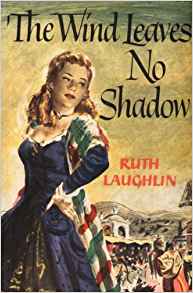
The Wind Leaves No Shadow: Book Review

The Wind Leaves No Shadow cover
by Ruth Laughlin
Caxton Printers, 1951
ISBN-13: 978-0870040832

Doña Tules Barceló was one of New Mexico’s most colorful 19th century characters, and The Wind Leaves No Shadow is, as far as I know, the only fictional or non-fictional treatment of her life.

From humble origins, which Ruth Laughlin imagines effectively, Doña Tules became owner of a Santa Fe gambling establishment where political opponents could meet to arrange accommodations that worked for everyone involved. She also acted as a kind of informal bank, lending money to key actors at critical junctures in New Mexico’s history. Because her gambling house gave her access to information not available everywhere, she was a valuable resource for both the Mexican and the American officials. She is said to have provided information in late 1846 to Governor Bent’s administration about the incipient rebellion against the U.S. occupation, the one that would result in his death a couple months later.

Not much is known about Doña Tules’ life, and Laughlin uses this fact to her advantage, weaving a story that places her in Santa Fe by the mid-1820’s and keeps her there until her death in 1852. The result is a story that not only imagines Doña Tules’ life but also provides the opportunity for an inside look at events (the 1837 Tax Revolt, the 1846 U.S. invasion, the 1847 death of Charles Bent) and people (the fur trappers, the ricos, the Santa Fe merchants, the priests) in Santa Fe during this period.

The Wind Leaves No Shadow was originally published in 1951 and reflects the historical information available to the author at the time as well as the prejudices that period. Although I didn’t always agree with Laughlin’s interpretation of historical events, she does a really great job of incorporating them into an effective story line. I was also uncomfortable with her insistence on Doña Tules’ white skin, red hair, and green eyes. In Laughlin’s interpretation, her coloring sounds more Irish than Spanish. In spite of these caveats, I believe this is still a useful book. If you’d like to get some idea of the life and trials of New Mexico’s famous lady gambler might have been like, or you’d like a fictional interpretation of New Mexico’s history in the 1820-1850 time frame, I recommend this book.

The Quickest Fort in the West

In late July 1851 Fort Union, New Mexico came into being very quickly. There had been nothing at the location at the beginning of the month, but after Colonel Edwin Vose Sumner reached Santa Fe on July 19, it was only a matter of time, and not very much of that.

The search for a new U.S. Army quartermaster depot site east of Santa Fe had already been. The Army needed a convenient point for receiving supplies in bulk from Fort Leavenworth and then distributing them to posts throughout New Mexico.

When Colonel Sumner saw the location chosen for the depot, he realized it was also an excellent spot for a new military post and Department headquarters. Known as Los Pozos (“the pits” or “the potholes”) the site had several spring-fed pools of water, something of a rarity on the plains east of the Sangre de Cristo mountains.

July 29 illustration.Fort Union Plan.1853.Oliva 72

Not only would the new Fort be supplied with water in an otherwise arid land, but the location was near the junction of the Santa Fe Trail Cimarron and Mountain routes, near the trail through Mora to the Rio Grande valley, and also near settlements such as Rayado and Las Vegas, which were being threatened by the Jicarilla Apaches.

Once Sumner made the decision, things moved quickly. By the end of July, the number of civilians employed by the quartermaster department in Santa Fe was reduced to three clerks and one carpenter and moved to the new site along with the soldiers who had been stationed in Santa Fe and in Las Vegas. New Mexico’s Fort Union was born.

Sources: Ruben Cobos, A Dictionary of New Mexico and Southern Colorado Spanish, Santa Fe: Museum of New Mexico Press, 2003; Lawrence R. Murphy, Philmont: a history of New Mexico’s Cimarron country, Albuquerque: University of New Mexico Press, 1972; Leo Olivas, Fort Union and the Frontier Army in the Southwest, Division of History, National Park Service, Southwest Cultural Resources Center, 1993; Marc Simmons, Kit Carson and His Three Wives, Albuquerque: University of New Mexico Press, 2003.

THE LOST SOUL

As Jorgé Ruibal wandered up the middle of the road toward Elizabethtown proper, the men outside the taberna watched him sympathetically. “El joven es como alma en pena,” Carlos Otero the jeweler said. “The young man is like a lost soul.”

“Si,” said the boy’s uncle. “He has lost his laborer job with Señor Bergmann. His papá is very angry with him.”

“I heard he was in love and that his love was unrequited,” Eduardo Suaso, the taberna’s musician, said.

María de la Luz, the boy’s cousin, appeared from around the corner of the building. She carried a basket of clean linens for delivery to Henri Lambert’s Etown restaurant and hotel. She gazed at Jorgé, who’d stopped to poke his foot at a stone in the road. “He wants to leave here, but his mamá is unwilling,” she said.

Jorgé, oblivious to these speculations, still stood in the dusty street, poking at the stone with his boot. It was so inert and yet so full of a kind of compressed energy. He looked east, toward the massive bulk of Baldy Mountain. The gullies that swung out from its sides were full of rocks and men scrambling through them looking for gold. Yet the mountain bulked there impassively, impervious to the miners who crawled over it. Jorgé crammed his hands in his pockets and stared upward, drinking in its stony greenness, its lack of engagement with the tiny men poking at its skin.

Outside the taberna, the americano miner called Hobart Mitchell came to the door with a drink in his hand and considered the staring boy. “He looks like’n idiot, standin’ there,” Mitchell said. “Touched in the head.”

The others all nodded noncommittally and continued to gaze sympathetically after Jorgé as he wandered on up the road.

from Valley of the Eagles