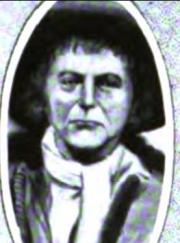
May Snow in New Mexico!

New Mexico’s weather so far this year has reflected the weather patterns across the nation—unpredictable, to put it kindly. To put the snow, rain, hail, and general nastiness into perspective, take a look at this May 9, 1907 article from the Cimarron News and Press.

May 9 illustration

The winter had been a dry one. The stockmen’s herds hadn’t been buffeted by much cold, so they were healthy, over all. But the dry conditions meant the summer was going to bring sparse summer grasses. Until early May. When it rained and snowed!

The Cimarron News and Press tended to be very upbeat, so I question just how positively the stockmen felt about the loss of their calves and lambs to the recent storms.

But we can take comforting in noting know that storms this late in the year are not a new phenomenon.


Spring Equals Trappers in Taos

It happened every spring in the early 1800s: Taos was invaded by trappers, either future or current. It made law enforcement rather complicated

In 1817, Jules DeMun didn’t even make it to Taos before he was headed off by a contingent of Spanish soldiers, who had been sent out in response to rumors in Taos that DeMun and his partner Pierre Chouteau had 20,000 Americans camped on the Purgatoire River, set to invade New Mexico. Even though the rumors weren’t true, DeMun and Chouteau were ordered to return to St. Louis. Somehow, they talked the soldiers into allowing them to travel north before heading east, ostensibly to avoid the Pawnee. Of course, they didn’t head directly to St. Louis. They trapped, supposedly outside of the boundaries of New Spain.

When news of Mexico’s independence from Spain reached the United States in 1821, things only got worse. Trappers and merchants could now enter New Mexico legally, but they still had trouble following Mexico’s rules. Up to this point, the Sangre de Cristo mountains had provided a protective barrier between Taos and incursions from the eastern plains. But they didn’t stop the Americans. In fact, the mountains were a great place to cache furs before smuggling them east to Missouri without paying export taxes. And Taos was still the favorite way to enter, especially if you were doing something slightly illegal. There were just so many ways to get there from the Santa Fe trail, which paralleled the mountains between it and Taos.

March 8 Illustration.Dick Wootton.Twitchell vol 2 source
“Uncle Dick” Wootton, Source: Leading Facts of New Mexico History, R.E. Twitchell

It got so bad that Mexico Customs Officer Juan Bautista Vigil y Alarid had to deputize Rafael Luna as Taos’ border guard. Even that wasn’t enough. Eventually, Alarid authorized Luna and Taos Alcalde Severino Martinez to use the militia to intercept the Americans.

Calling out the militia seems like overkill until you realize how valuable the furs in question were. In 1837, “Uncle Dick” Wootton brought furs worth $25,000 into Taos. And that’s just what he was willing to pay the tax on. The trappers had incentive to skirt the law. And the Mexican authorities had incentive to try to keep them from doing so.

And so each spring the dance began again….

Sources: Den Galbraith, Turbulent Taos, Sunstone Press, Santa Fe, 1983; Leroy R. Hafen, Fur Trappers and Traders of the Far Southwest, Utah State UP, Logan, 1997; Joy L. Poole, editor, Over the Santa Fe Trail to Mexico, U of Oklahoma Press, Norman, 2015; David J. Weber, The Taos Trappers, U of Oklahoma Press, Norman, 1971.

John Fremont Stumbles Into Taos

On this day in 1849, Saturday, January 13, celebrated explorer John C. Fremont stumbled into the Taos plaza so battered by exposure and starvation that no one recognized him.

Fremont had left what is now Pueblo, Colorado, 52 days earlier on a mission to identify a practicable railroad route across the Rockies to California. He had 32 men and 120 supply-laden mules with him.

Even before he’d left Pueblo, there was trouble. He’d already lost a guide. When former mountain man “Uncle Bill” Wootton took a look at the signs and realized just how bad the coming winter was likely to be, he backed out. But former Army Colonel Fremont refused to give up. He’d been forced to resign from the military in a cloud of disgrace two years earlier and was determined to redeem himself. Come hell or high water, he was determined to prove that a year-round transcontinental railroad operation across the mountains was feasible. If men and mules could cross the path he had in mind under winter conditions, then surely trains could, too.

Fremont hired “Old Bill” Williams to take Wootton’s place. While Williams was a brilliant tracker, he  wasn’t exactly known for his tact. Since Fremont was known for his stubbornness, the partnership seemed destined for trouble. And trouble happened pretty quickly. When Williams announced that the expedition should veer from the route Fremont had laid out, trouble ensued. Fremont relieved Williams of his guide duties and gave them to men who Fremont had worked with before but who didn’t know the region.

As Wootton had predicted, the weather turned treacherously nasty and grew increasingly difficult as Fremont’s men tried to force their way through snow-bound canyons and across icy mountainsides. All of the mules either died of starvation or froze to death. Frostbite and snow blindness plagued both the animals and the men. Not only was the expedition’s goal doomed, but the conditions were so bad that the men feared for their lives. In a desperate attempt to make it to safety, Fremont divided his company into small groups and sent them south to try to reach Taos.
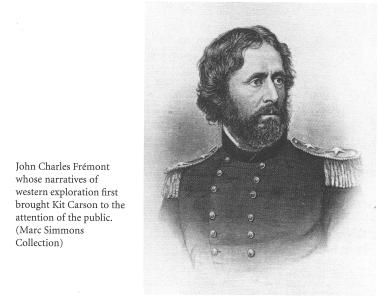
John C. Fremont.Simmons 3 wives

Only 21 men of the original 32 would make it out alive and Fremont himself would need weeks of nursing by Josefa Carson before he fully recovered from the ordeal. Even with the survivors in Taos and whole, the loss of life would continue. Williams would die trying to retrieve valuable records and medical equipment  that had been left behind in the rush to escape the winter conditions Uncle Bill Wootton had warned Fremont about.

Although a year-round transcontinental railroad was eventually built across the Rocky Mountains, it was not constructed on the route that Fremont tried to blaze that winter of 1848/49. The glory of that deed would go to other men.  Fremont’s exploring days were over .

Sources:  Alpheus H. Favour, Old Bill Williams, Mountain Man, U of Oklahoma Press,  Norman, 1962; Leroy R. Hafen, Ed., Fur Trappers and Traders of the Far Southwest, Utah State U Press, Logan, 1972; Marc Simmons, Kit Carson and His Three Wives, UNM Press, Albuquerque, 2003.