Timber Rail Moves Out From Cimarron

150 years ago this month, in the middle of June 1907, the Cimarron & Northwestern Railroad Company began laying track out of Cimarron, west toward the Ponil timber country, in what is today part of the Valle Vidal Unit of the Carson National Forest.

Work on the tracks had begun earlier that year. The Cimarron & Northwestern was a wholly-owned subsidiary of the Continental Tie and Lumber Company, whose president, T.A. Schomburg was a former Maxwell Land Grant Co. employee. The sole purpose of the Cimarron  & Northwestern line was to get timber out of the canyons of the Ponil. This timber would be turned into railroad ties for freight and passenger rail lines such as the Santa Fe and Colorado & Southern, red spruce mining props for the coal fields in the region, and building lumber.

Mining camps and small sawmills to pre-process the lumber grew up along the rail tracks which moved up the branches of the Ponil. Independent logging crews spread out into the forest and were remarkably efficient considering that they were felling the trees by hand. They could often bring in as many as 100 trees per day. The most effective way of doing this was to clearcut, leaving only diseased or deformed trees and the slash from the felled ones behind.

June 3 illustration.news article

Some of the timber was milled right there in the Ponil. Others were taken to East Cimarron, where it was dried, planed, treated, and packaged before being shipped out. Between the mill, the train staff, and the loggers coming into Cimarron for supplies, the lumber industry was an important boost to the town’s economy.

Even with a slump in lumber prices in the first few years, the project still did well financially, with the Continental Company paying a $6,000 royalty to the Maxwell Company in 1907, $16,000 in 1908, and $87,943 in 1910. For the next ten years, the forest continued to provide wealth to the area, but gradually the supply of usable timber thinned and, almost exactly 23 years after track construction got underway in Cimarron, on June 3, 1930, the company notified the New Mexico Interstate Commerce Commission that they wanted to abandon what was left of the track between Cimarron and the South Ponil. Due to the Depression, demand for timber had dropped sharply and capital wasn’t available for more construction. Even if there’d been a market, much of the land had been sold to private owners and large-operation logging was no longer feasible. The rails that were removed are thought to have been shipped to San Francisco, where they were sold to a Japanese industrialist.

Sources: Lawrence R. Murphy Philmont, A History of New Mexico’s Cimarron Country, UNM Press, 1972; Stephen Zimmer and Steve Lewis, It Happened in Cimarron Country, Eagle Trail Press, 2013.
Troops Save Gold Miner From Etown Mob

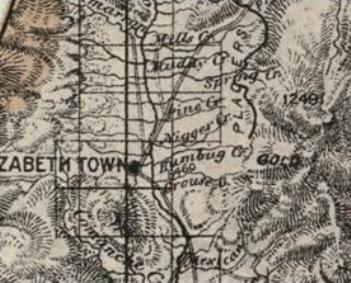
On Thursday, April 9, 1868, gold prospector William “Wall” W. Henderson killed a man in Humbug Gulch east of Elizabethtown, New Mexico Territory. Being a law-abiding man, Henderson went to Etown to turn himself into the authorities. The authorities seem to have been fairly weak at the time, because a mob of about eighty men threatened to take matters into their own hands. Fortunately, a messenger was able to reach the Fort Union cavalry troops stationed thirty miles away at Maxwell’s Ranch (today’s Cimarron) in time to request assistance.

April 9 illustration.Humbug Gulch Map
Source: 1889 Sectional map of Colfax & Mora Counties, New Mexico Territory

A sergeant and ten men travelled up Cimarron canyon overnight to reach Elizabethtown early the next morning and disperse the mob. They took Henderson back to Maxwell’s, out of harm’s way, and the miners went back to work. In fact, things calmed so much that Henderson returned to Elizabethtown and went back to mining. He was still there the following year, when he served as a member of the petit jury during the Colfax County District Court’s 1869 Spring session. And he did well financially. By the summer of 1870, Henderson had amassed $5,000 in real estate.

That year, he also stood security for Charles Kennedy’s bond to appear before the Fall Court response to embezzlement and assault charges. Ironically, Kennedy himself would be lynched by an Etown mob later that fall, following accusations that he’d killed and robbed a series of men at his cabin about ten miles south of Humbug Gulch.

Sources: Fort Union and the Frontier Army in the Southwest, Leo E. Oliva, Southwest Cultural Resources Center, National Park Service, 1993; 1870 Colfax County Census, Etown precinct; New Mexico Territory District 1 Court Records, 1869 through 1870.

Save

New Mexico Territory’s Chief Justice is Fooled Again

Friday, April 1 was the first day of the Spring 1870 Court session in Colfax County, New Mexico Territory, and Judge Joseph G. Palen must have thought someone had pulled an April Fool’s joke on him. At the end of the 1869 Fall session, he’d made three local men responsible for selecting jurors for the Spring term, but it hadn’t done much good. Only six of the identified grand jury members had showed up, so the Judge ordered Sheriff Andrew J. Calhoun to bring in 15 more potential jurors. Which he did but eleven of them had excuses. The 57-year-old Harvard-educated Judge Palen must have wished he’d never accepted President Ulysses S. Grant’s offer to promote him from Hudson, New York postmaster to Chief Justice of the New Mexico Territorial Court and therefore Judge of the Territory’s First District, which included Colfax County.

April 1 illustration.1870 court transcript.resized

Something similar had happened at the beginning of the Fall 1869 session, Judge Palen’s first in Colfax County, and he’d thought he’d solved the problem by giving E.B. Dennison, Benjamin F. Houx, and John Sutton the task of ensuring there’d be enough jurors for the Spring Session. But even their fellow citizens couldn’t corral the miners and ranchers of Colfax County to do their civic duty.

Late that day, the Sheriff finally brought in enough men to fill out the grand jury panel, none of them with reasons strong enough excuse them from the task. However, Palen still had no petit jury members. It was the morning of Tuesday, April 5 before he had both panels in place. Which wouldn’t have been too much of a problem, except that the court session was scheduled to end on Saturday, April 9. There wasn’t much time to address the over 70 separate actions that came before the court during the week-long Spring 1870 session.

Sources: Chasing the Santa Fe Ring, David L. Caffey, UNM Press, 2014; Colfax County District Court Civil and Criminal Record 1, 1869-1871, Serial No. 14400; The Leading Facts of New Mexico History Vol. II, Ralph E. Twitchell, Sunstone Press, 2007.


Decision Point

Three years after the Great Rebellion, Henry still drifted. There was nothing behind him in Georgia and nothing further west than San Francisco. Not that he wanted to go there. The California gold fields were played out.

But he needed to get out of Denver. A man could stand town life only so long and he’d been here three months. The Colorado gold fields were collapsing, anyway. Played out before he even got here.

“Been too late since the day I was born,” he muttered, putting his whisky glass on the long wooden bar.

“I hear tell there’s gold in Elizabethtown,” the bartender said. He reached for Henry’s glass and began wiping it out. He knew Henry’s pockets were empty.

“Where’s Elizabethtown?”

“New Mexico Territory. Near Taos somewheres.”

Henry nodded and pushed himself away from the bar. “Elizabethtown,” he repeated as he hitched up his trousers. “Now there’s an idea.”

 from Moreno Valley Sketches

Why “Colfax” County?

On January 25, 1869, eighteen months after Elizabethtown, New Mexico was founded in Mora County, New Mexico’s Territorial Legislature cut the County into two pieces and renamed the northern section Colfax County, in honor of the new U.S. Vice President Schuyler Colfax. Elizabethtown became the county seat. Schuyler Colfax had visited northern New Mexico Territory in late 1868, shortly before being sworn in as Ulysses S. Grant’s Vice President. Colfax was a journalist and politician from Indiana and was expected to one day be President.

schuyler-colfax

Unfortunately, the Grant administration scandals ruined those hopes, as well as the hopes of those who thought naming the County after him would be a smart move. When it was created, Colfax County included the entire Maxwell Land Grant, except for 265,000 acres in southern Colorado, and extended to the Texas/Oklahoma border, encompassing what is now Harding and Union County.

Sources: Lure, Lore, and Legends of the Moreno Valley. Angel Fire, NM: Moreno Valley Writers Guild, 1997: 5.  Daniel, Clifton. Chronicle of America. Mount Kisco, NY: Chronicle Publications, 1988: 408.

Misnomer

“Who you callin’ squirt?” The tall young man with the long sun bleached hair moved toward him down the bar, broad shoulders tense under his heavy flannel shirt.

“I didn’t mean anything,” the man said apologetically. The premature wrinkles in his face were creased with dirt.  Clearly a local pit miner. He gestured toward the tables. “I heard them callin’ you that. Thought it was your name.”

“Only my oldest friends call me that,” the young man said.

“Sorry ’bout that,” the other man said. He stuck out his hand. “Name’s Pete. They call me Gold Dust Pete, ’cuz that’s all I’ve come up with so far.”

They shook. “I’m Alfred,” the younger man said. “My grandfather called me Squirt. It kinda got passed down as a joke when I started getting my growth on.”

Pete chuckled. “I can see why it was funny,” he agreed. “Have a drink?”

from Moreno Valley Sketches