NOT MY FATHER’S HOUSE – Chapter 5

CHAPTER 5

Stands Alone’s prediction that fall will arrive early holds true, and Suzanna realizes irritably that he also correctly predicted that her corn won’t ripen in time. The September afternoons are chilly, but the ears of maíz are still so thin that the raccoons have stopped monitoring them.

The scarecrow she erected to keep the ravens away isn’t necessary, either. The big croaking corvines are too busy playing tag with the red-winged blackbirds in the clear sunlight. Two eagles circle endlessly above the smaller birds, seemingly indifferent to everything but each other.

As she stands in the middle of her corn patch, the Ute puppies playing at her feet, Suzanna rubs the sore spot under her ribs and turns slowly, studying the mountain slopes north and west. They’re gradually turning yellow, the patches of aspen getting brighter each day.

She turns back to her half-formed ears of corn. Tarnation. She planted as soon as she was able. There’d been so much to do when they arrived in mid-May. Although it’s unlikely that planting any earlier would have done any good. It had been too cold to expect corn to sprout.

Suzanna’s cheeks redden. It hadn’t been too cold for other things. The little lean-to she and Gerald had slept in those first few nights before Ramón arrived and the men started work on the cabin had never really felt chilly.

She smiles and rubs the sore spot just below her rib cage again. She has to admit she was a little preoccupied when they first arrived in the valley and not terribly concerned with getting the planting underway. She chuckles. As a result, she’s going to be preoccupied next spring, too. She’ll have a baby to care for.

But surely that won’t take all her time. And surely this last spring was colder than usual. Suzanna studies the anemic rows of corn. “This child had better like to garden,” she mutters. “Because next year I need to get seed into the ground a good month earlier than I did this season.”

She shakes her head at the maíz and turns away. There isn’t a blessed thing she can do to speed it to harvest. She moves on to her produce garden, which lies closer to the marsh. At least the squash is doing nicely.

When she returns to the house, she’s dragging a half-full bushel basket of fat green-striped squash behind her. The kitchen is empty. Ramón and Gerald are in the hayfield in the valley bottom, turning the windrows they’d scythed that morning.

Suzanna sets aside the squash she thinks Ramón will need for the evening meal, wraps an apron over her dress, and begins washing and slicing the remaining vegetables into strips for drying. “At least I can do this much,” she mutters.

When she’s filled the largest of Ramón’s wooden bowls, she carries it to the ramada that shelters the woodpile behind the house. There’s just enough space beside the stacked wood for the woven-twig drying racks Gerald constructed for her. She arranges the strips of squash on the racks, covers them with a light cotton cloth to discourage the flies, and returns to the kitchen.

It’s almost noon. Suzanna’s feeling both hungry and restless. She pokes in the cupboard to see if she can tell what Ramón has planned for the midday meal. A cloth-wrapped stack of corn tortillas and a bowl of mashed beans. A plate containing the small tomatoes she harvested yesterday. The few that were ripe. She shakes her head in disgust. She’ll be drying green tomatoes before long.

She studies the tortillas, lifts them from the shelf, and turns to the fireplace. The coals are carefully banked, conserving their heat until a fire is needed again. She can at least get it going, ready for Ramón when he and Gerald come in. She sets the tortillas on the table and crouches beside the hearth.

Her father did her no favors when he banned her from her mother’s kitchen, she reflects as she scrapes ash from the live coals and feeds the resulting glow with thin strips of juniper bark. Regardless of what he thought of her mother’s morals and the value of a girl learning Latin, her father’s choices definitely stunted her development in wifely duties.

The baby kicks just then, jabbing a foot into Suzanna’s ribs, and she dimples self-consciously and pats her belly. Well, not all wifely duties. And she certainly knows how to sew, though it isn’t her favorite task.

She sits back on her haunches and studies the kitchen’s hand-hewn work table and food cupboards. She learned to sew by observing a neighbor woman and then asking Encarnación for occasional advice. Surely she could lean the rudiments of cookery the same way. Her lack of ability here makes her so dependent.

It’s also hard on the men. Ramón never seems to sit down. And his kitchen duties reduce his ability to assist Gerald outdoors. Assistance Suzanna can’t give, especially now that she’s pregnant.

In the fireplace, tiny flames lick at the narrow strands of juniper bark. Suzanna adds a few pieces of kindling, then layers thicker pieces over them. At least she can build a fire. She looks around the room. The water bucket is nearly empty. She adjusts a piece of wood to better catch the flames and pushes herself to her feet.

As she crosses the yard to the well, she sees the men in the field below, heading toward the house, the wooden windrow rakes over their shoulders. Gerald’s hat is pushed back on his head, his long stride shortened to keep pace with Ramón, who waves a hand at the remaining grassland and turns his head to say something to the taller man. Gerald laughs, then places his hand companionably on Ramón’s shoulder. They stop and turn to look back at their handiwork.

Suzanna lowers her bucket into the well. As she hauls it up again, her stomach rumbles. The men are certainly taking their time. Once they get their tools put away, they’ll still need to clean up. She turns toward the cabin. In the meantime, she might be able to warm the tortillas without burning them. And heat the mashed beans.

Back in the kitchen, she finds the smallest of the cooking pots, scrapes the beans into it, and sets it to heat at the edge of the fire. Then she positions the cast-iron skillet and its three-footed supporting grate over the flames and goes to the cupboard for a small pot of lard.

She drops a spoonful of the grease into the skillet and watches it slowly begin to soften. Suzanna yawns. The fat looks as if it’ll sit there all day, doing nothing. This is why she dislikes cooking. There’s so much sitting and waiting. She pokes at the fire with a stick and repositions a burning log so it’s more fully under the grate and the pan.

Finally the fat heats and liquefies. It sizzles busily and Suzanna nods in satisfaction and drops a tortilla into the black skillet. But the extra flame has made the pan hotter than she realized. The flat yellow tortilla buckles sharply in response and the fat pops furiously, then turns into a smoky haze.

Suzanna jumps up, grabs a wet towel from the counter, and darts back to the fire. Smoke fills the room. She leans down, tosses the towel over the skillet handle, and yanks it away from the flames. As she pulls, heat sears through the wet towel, stabbing her palm.

“I swear!” she yelps, jerking away. The skillet clatters to the floor and the charcoaled tortilla tumbles out beside it. Suzanna is doubled over, gasping in pain, when the men come through the door from the main room.

Gerald leaps toward her. “Are you all right? Let me see.”

Suzanna collapses onto the floor. “How stupid of me,” she gasps. “I know heat goes right through a wet towel.”

Gerald reaches gently for her hand. Two red welts bisect her palm. Ramón appears at Gerald’s elbow with a dripping cloth. Gerald wraps it around Suzanna’s hand, then lifts her to her feet and guides her to a bench beside the table. “Just sit,” he says soothingly. “I don’t think it’s very bad.”

She nods, ashamed of her outburst, embarrassed by her stupidity. “I know to use a dry towel,” she says again.

“We all make mistakes,” Gerald says soothingly.

“Not in the kitchen.” She raises her head, her mouth trembling. “I’m the only woman I know who makes mistakes in the kitchen.”

Ramón has placed the skillet and tortilla on the work counter and is now crouched over the fire, moving the pot of beans away from the licking flames. He half turns as he wraps a dry towel around the pot. “I almost killed my brothers and myself once,” he says. “I had no sisters at that time. My parents were called away and I was assigned to cook while they were gone. I used a haunch of pork that had gone bad.” He rises, places the pot on the wooden counter, and stirs it gently. “These are nicely warmed.”

He returns to the fire and uses a thick piece of kindling to maneuver the three-legged grate away from the center of the flames. Over his shoulder he says, “I decided the meat simply needed more seasoning to cover the bad taste.” He rises and lifts the skillet from the counter. As he wipes it out with a small towel, he shakes his head. “I didn’t want to take the time to check the rabbit snares or go fishing.”

He leans to place the skillet on the grate. “We were all sick as dogs when my parents returned.” He chuckles. “And soon after they returned, I was also sore on my backside. My father was very angry and he was a firm believer in the dicho that says la letra con sangre entra.”

Gerald raises an eyebrow. “The word enters better with blood?”

Ramón grins. “The parents’ words. There seems to be some truth to that saying. Never since then have I forgotten to throw out bad meat.”

Suzanna chuckles and rearranges the cloth over her palm. Her fingertips tingle with incipient blisters. She winces. “My hand will certainly remember to reach for a dry towel when I need to lift something hot from the fire.”

You’ve just read the fifth chapter of the forthcoming novel Not My Father’s House by Loretta Miles Tollefson. You can order it now from your favorite bookstore or online retailer, including Amazon, Barnes and Noble, or Books2Read.

Sabino’s Map: Book Review

Sabinos Map cover
Sabino’s Map, Life in Chimayó’s Old Plaza
by Don J. Usner
Museum of New Mexico Press, Santa Fe, 1995
ISBN 0-89013-289-5

Sabino’s Map is, I suspect, something of a rarity. It combines interviews with aging locals with an anthropologist’s research skills and fine eye for detail. That’s a difficult balance to achieve, but Don J. Usner does an excellent job arriving at and maintaining the necessary equilibrium.

This book is clearly the result of a labor of love, but it is also a very useful book for anyone who wants to know more about the history of the northern New Mexico village of Chimayo, its people, and its landscape.

Usner, who is related by birth to a good number of the people interviewed for this book, provides an extensive history of Chimayo which begins long prior to the first Spanish settlements.

The book is titled Sabino’s Map because in the 1950s a man named Sabino Trujillo hand-drew a detailed map of Chimayó’s Plaza del Cerro as it existed during his boyhood in the early 20th century. Sabino’s map identified each house on the plaza, who owned it at the time, the location of the acequias, where horses were pastured, where trees were located (or not), and a host of other detail. This detail forms the basis for and triggered the oral histories that provide much of the detail in the book.

This much detail, along with extensive interviews with people with plenty of stories to tell, could easily overwhelm a community narrative, but Usner does an excellent job of sifting through a wealth of knowledge and story to give us the nuggets that help the reader see what it might have been like to live in the Plaza del Cerro or its surrounding homes and farms in the late 1800’s and early 20th century.

Sabino’s Map is a beautifully researched and written produced book.

The Mexican Frontier: Book Review

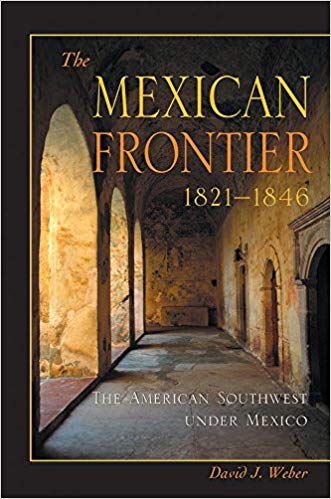
The Mexican Frontier cover
The Mexican Frontier 1821-1846, the American Southwest under Mexico, David J. Weber, ISBN 0826306039, University of New Mexico Press, 1982

The Mexican Frontier is the book for those of us who think the American West was “unsettled” before the United States expanded into and past the Rocky Mountains in the mid-1800s. Its author, noted historian David J. Weber, reminds us that Spain had claimed what is now  Texas, New Mexico, Arizona, and California, in the 1500s, long before the various British attempts to colonize the East Coast.

When Mexico declared its independence from Spain in 1821, what is now known as the American Southwest came under its jurisdiction. The Mexican Frontier 1821-1846 is a comprehensive look at the  the region between 1821 and 1846, when it was acquired by the United States as a result of the Mexican War.

This book fills an important gap in our knowledge of North American history. Weber not only provides a good overview of Mexican policy and how it affected the country’s Northern Frontier, he also points out the similarities and differences between Texas, New Mexico, and California, both in terms of how government policies were interpreted and enforced and how the different regions reacted to them. This discussion was particularly helpful to me in clarifying the connections between events in Texas and in New Mexico in the 1830s and 40s. It’s been foundational to my research for upcoming novels, especially as I dive into the complexities of the New Mexico Tax Revolt in the 1830s.

If you want to understand the history of Texas, New Mexico, Arizona, and California prior to the American takeover, I recommend that you read this very readable book.


President Keeps His Word!

On Thursday, June 16, 1910, the United States Congress finally agreed to allow New Mexico to become a State, ending a quest that had begun 62 years before.

The delay was partly New Mexico’s fault. In their first bid for statehood in 1848, New Mexico’s citizens had stipulated that they enter the Union as a free (non-slave) state. That requirement guaranteed that the slave-holding states would oppose New Mexico’s entry.

But a little opposition never has kept New Mexico from trying again. There were at least three other attempts to gain Congressional approval—in 1850, 1875, and 1902.

When Congress approved a process in 1906 for a combined state of New Mexico/Arizona, it looked like success was in sight. New Mexico voted for the proposal. However, Arizona voters rejected the plan.

Then in 1908, William Howard Taft became President. During the campaign, he’d pledged to make New Mexico a state. He kept his word. His Republican-controlled House and Senate approved legislation that initiated the formal process for Statehood and Taft signed it into law on Saturday, June 18, 1910.

A year and a half later, those formalities were completed and, on Saturday, January 6, 1912, President William H. Taft signed the formal proclamation that approved New Mexico’s entry into the Union. New Mexico was finally a state.

So the next time someone tells you that Presidents never keep their campaign promises, remember President Taft and the case of New Mexico statehood.

Sources: Thomas C. Donnelly, The Government of New Mexico. UNM Press: Albuquerque, 1953; David V. Holtby, Forty-Seventh Star, New Mexico’s struggle for statehood. University of Oklahoma press: Norman, 2012; Marc Simmons, New Mexico, an interpretive history, UNM Press, Albuquerque, 1988


Over The Trail to Mexico: Book Review


Over The Santa Fe Trail to Mexico cover
Joy L. Poole, editor
ISBN: 9780806157511
University of Oklahoma press, 2017

Early in the summer 1825, yet another young man joined a wagon train headed over the Santa Fe Trail to New Mexico.

This particular traveler’s name was Doctor Rowland Willard. Dr. Willard’s diary during his time on the Trail and afterwards in New Mexico, Chihuahua, and Durango has now been published with detailed notes and provides a fascinating look at life in Mexico in the second half of the 1820s.

As a medical doctor, Doctor Willard’s perspective was slightly different from other Americans on the Trail and in Mexico. However, in some ways it was very much the same — he was there to make money.

He spent less than six months in New Mexico and did not find there the financial success he was looking for. However, he did find it in Chihuahua. He returned to the States in 1828 with $7000 in cash.

Willard’s diary has actually been published before. Excerpts were included in the Western Travel Review in 1829 and two years later the entire diary was added as an appendix to The Personal Narrative of James Ohio Pattie. The physical diary disappeared into Willard family archives and didn’t resurface until  2005, when it began its journey to publication as Over The Santa Fe Trail To Mexico, the travel diaries and autobiography of Doctor Rowland Willard

This edition provides not only the diary but also Joy L. Poole’s extensive notes and Willard’s autobiography, published here for the first time. This book is worth its price for Poole’s notes alone, which provide the context for fully appreciating Willard’s experiences and observations.

If you’re a student of the Santa Fe trail or of New Mexico history in the late 1820s, Over the Santa Fe Trail to Mexico  will be a valuable addition to your library. If you’re simply looking for a good read about old New Mexico— or old Mexico— I would definitely recommend it.

West of Penance: Book Review

West of Penance cover
by Thomas D. Clagett
ISBN: 9781432831417
Five Star/Cengage, 2016

There were a lot of pieces to the conflict that engulfed New Mexico’s Colfax County in the 1870s–the conflict we know today as the Colfax County War. As far as I know, no one has ever provided a good fictional account of how some of those pieces fit together and just who did what to whom. Until now.

The hero of Thomas D. Clagett’s West of Penance doesn’t get to Colfax County until a little over one-third of the way into the book. But once he does, he’s in the middle of events that actually happened. Events that Clagett lines up nicely and for which he provides explanations that not only make sense, but make for a great story.

Although Father Graintaire and the woman who takes him in are fictional characters, everyone else in this section of the book actually existed. Based on my own Colfax County research, Clagett’s conceptions of them and their actions are right on target. The portraits of Clay Allison and Sheriff Chittenden, and the explanation of why Cruz Vega was in William Lowe’s cornfield the night he was lynched are especially well done. And Clagett’s portrait of Santa Fe Ring attorney Melvin W. Mills gave me new insight into Mills’ character. I wish I’d read West of Penance before I wrote his scenes in The Pain and The Sorrow!

Given how well Clagett handles the Colfax County material in this book, I think it’s safe to assume that the first part of West of Penance  is just as authentic. I certainly feel like I know more now about the French Foreign Legion than I did before I read this book.

So, if you’re interested in the French Foreign Legion at the battle of Camerone and the role they played in acquiring Mexico for France, or in New Mexico’s Colfax County war, I recommend that you read West of Penance!


Fateful Trapping Party Is Last Of Its Kind

In August 1827, trapper Sylvester S. Pratte led 36 men north from Abiquiu on the last large-scale trapping expedition out of New Mexico. It would also be Pratte’s last expedition: he would die on it.

Pratte’s death at 28 from an infected dog bite was not the only disaster that befell the group of trappers. A week and a half later, Indians attacked. During the fight, Thomas L. Smith was hit by an arrow which shattered the bones a few inches above his ankle. Smith dealt with the issue immediately, slicing through the mangled tendons with his own hands. Fellow trapper Milton Sublette helped him finish the job by applying a tourniquet of buckskin thongs and covering the wound with an old dirty shirt. Amazingly, although the wound was never cauterized, it did eventually heal.

Aug 8 illustration.Pixabay
The sure sign of beaver in the vicinity. Source: Pixabay

Pratte had asked his boyhood friend Ceran St. Vrain to act as the expedition’s clerk. After Pratte’s death, the men requested St. Vrain to take his place as its leader. However, this also turned out to be problematic, not on the hunt itself, but when they returned. The venture ended up losing money. Even after Pratte’s personal belongings were sold off to cover expenses, there was still a deficit of over $500.

All in all, this final large-scale trapping expedition out of New Mexico was a disaster on a good many levels, and the negative aspects may have been why the experiment was never repeated.


Sources: Leroy R. Hafen, ed. Fur Trappers And Traders Of The Far Southwest, Utah State University press, Logan. 1997; David J Weber, The Taos Trappers, University of Oklahoma press, Norman. 1971.


No Rain In Taos

On Sunday, July 31, 1825, Taos-based physician Rowland Willard had been in Taos since July 2 and the village had received no rain in the past month. The doctor was disappointed.

The New York born Willard had apparently expected to find not only rain but a prosperous community that could afford American fees and make him rich. He was destined to be disappointed on both counts.

July 31 illustration
Source: Over the Santa Fe Trail to Mexico, Julie L. Poole, ed.

Although Doctor Willard had a number of clients in Taos and as far south as Santa Cruz de la Canada, payment for services in the 1820s tended to be in goods rather than in cash. By September, it was clear that Taos was not the land of opportunity he had sought. On September 15, he headed south, to try his luck in Chihuahua.

The move paid off. Willard developed a successful practice in Chihuahua and remained there for the next two years, where he invested in the Santa Rita copper mines as well as his medical practice.

In 1828 Willard decided to return to the United States. To be eligible to leave the country, Mexican law required a 2% duty payment. The good Doctor paid $80 on the $4000 he declared, but actually left Mexico with $7000 in cash and his “outfit.”

Clearly, trappers were not the only Americans who believed they didn’t need to comply with Mexico’s duty laws.

Source: Julie L. Poole ed., Over The Santa Fe Trail To Mexico, The Travel Diaries And Autobiography Of Dr. Rowland Willard, University of Oklahoma Press, Norman 2015

Navajo Exile Finally Ends

In late June 1868, after five years of exile, the Navajo people began their return to their homeland.

Five years earlier, also in June, U.S. Army General James Henry Carleton had ordered Colonel  Christopher “Kit” Carson to march west to starve out the Navajos and move them 450 miles east to Bosque Redondo. Although Carson argued that his health was poor and that he’d joined the Army to fight Confederate Texans, not Indians, Carleton ordered him to go him anyway.

Carson did as he was told. The majority of the Navajos residing in the Southwest were gathered up and marched east to Bosque Redondo, and old meeting ground for Indians of the southern Plains along the Pecos River.

The experience was a disaster.

The Navajos were incarcerated alongside their long-time enemies, the Mescalero Apache, so that was difficult enough.

Then the crops failed, not only at Bosque Redondo, but also in the Taos and Mora Valleys, which reduced the food supplies that could be purchased to feed the captives. In fact, there were so few supplies that General Carleton suspended operations against the Navajos still at large. He didn’t have enough to feed those he had, much less more.

June 23 illustration.Carleton.nuevomexicano homeland

And Kit Carson, who went with the Navajo to Bosque Redondo, proved an inadequate administrator. Not only was he hampered by his illiteracy, but he found that he had no real power or control. Between Carleton’s micromanagement and Army bureaucracy and corruption, he was as overwhelmed with his Bosque Redondo tasks as the captive Navajos were with the miserable conditions there. Carson left in mid September 1864. The Navajo would remain until June 1868.

Finally, two years after Carleton had been relieved of his military command, General Tecumseh Sherman arrived. He agreed with the Navajo leaders’ rejection of the idea of moving to a new reservation in Oklahoma and negotiated a peace with them that would send them home. Three weeks after the treaty was signed on June 1, the People began the 450 miles or more journey home.

You can find more information about the Navajo Long Walk at http://newmexicohistory.org/people/navajo-long-walk-to-bosque-redondo-1864

Sources: Hampton Sides, Blood And Thunder, an epic the American West, Doubleday, New York, 2006; Jerry D Thompson, A Civil War History Of The New Mexico Volunteers And Militia, U of New Mexico P, Albuquerque, 2015

John Fremont Stumbles Into Taos

On this day in 1849, Saturday, January 13, celebrated explorer John C. Fremont stumbled into the Taos plaza so battered by exposure and starvation that no one recognized him.

Fremont had left what is now Pueblo, Colorado, 52 days earlier on a mission to identify a practicable railroad route across the Rockies to California. He had 32 men and 120 supply-laden mules with him.

Even before he’d left Pueblo, there was trouble. He’d already lost a guide. When former mountain man “Uncle Bill” Wootton took a look at the signs and realized just how bad the coming winter was likely to be, he backed out. But former Army Colonel Fremont refused to give up. He’d been forced to resign from the military in a cloud of disgrace two years earlier and was determined to redeem himself. Come hell or high water, he was determined to prove that a year-round transcontinental railroad operation across the mountains was feasible. If men and mules could cross the path he had in mind under winter conditions, then surely trains could, too.

Fremont hired “Old Bill” Williams to take Wootton’s place. While Williams was a brilliant tracker, he  wasn’t exactly known for his tact. Since Fremont was known for his stubbornness, the partnership seemed destined for trouble. And trouble happened pretty quickly. When Williams announced that the expedition should veer from the route Fremont had laid out, trouble ensued. Fremont relieved Williams of his guide duties and gave them to men who Fremont had worked with before but who didn’t know the region.

As Wootton had predicted, the weather turned treacherously nasty and grew increasingly difficult as Fremont’s men tried to force their way through snow-bound canyons and across icy mountainsides. All of the mules either died of starvation or froze to death. Frostbite and snow blindness plagued both the animals and the men. Not only was the expedition’s goal doomed, but the conditions were so bad that the men feared for their lives. In a desperate attempt to make it to safety, Fremont divided his company into small groups and sent them south to try to reach Taos.

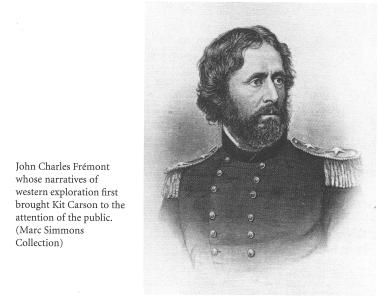
John C. Fremont.Simmons 3 wives

Only 21 men of the original 32 would make it out alive and Fremont himself would need weeks of nursing by Josefa Carson before he fully recovered from the ordeal. Even with the survivors in Taos and whole, the loss of life would continue. Williams would die trying to retrieve valuable records and medical equipment  that had been left behind in the rush to escape the winter conditions Uncle Bill Wootton had warned Fremont about.

Although a year-round transcontinental railroad was eventually built across the Rocky Mountains, it was not constructed on the route that Fremont tried to blaze that winter of 1848/49. The glory of that deed would go to other men.  Fremont’s exploring days were over .

Sources:  Alpheus H. Favour, Old Bill Williams, Mountain Man, U of Oklahoma Press,  Norman, 1962; Leroy R. Hafen, Ed., Fur Trappers and Traders of the Far Southwest, Utah State U Press, Logan, 1972; Marc Simmons, Kit Carson and His Three Wives, UNM Press, Albuquerque, 2003.