A Piece of No Secret Too Small

Here’s another piece of my new novel No Secret Too Small. This section is set at the plaza del Chimayo in northern New Mexico during the feast of Santiago, the village’s saint.

CHAPTER 18

Finally, the fields are all blessed and the procession has returned to the plaza. The little carved saint is placed back in its chapel, the horses are released into the corrals outside the plaza, and everyone’s voice is louder and more cheerful.

The children and their mother follow Señora Ortega into her cousin’s house, where they’re given a seat at the table. The stew is thick with meat and fresh corn, and hot with green chile. When the señora passes the platter of bread, she says, “And here is some the americano child helped to bake,” and everyone laughs kindly.

As Alma dips a piece into her bowl, Prefect Abreú enters the house. Donaciano Vigil stoops through the door after him.

“Ah, Don Ramón!” the host says. “You are most welcome! And Señor Vigil as well!”

The prefect gives the sergeant a quizzical look. “Señor Vigil? You’ve come up in the world, Donaciano. Or else he’s angry at you. I thought you were his cousin.”

The host flushes. “I was just being polite. In honor of his companion.”

The big soldier puts a hand on the man’s arm. “It’s only me, primo. There’s no need to stand on ceremony.” He looks at Ramón Abreú. “I believe you know everyone here, Excellency?”

The prefect looks around the room, smiling and nodding to those at the table as well as the women who are serving. Then his eyes reach the children and their mother. “I don’t believe I’ve had the honor of meeting this young woman and her siblings,” he says gallantly.

Donaciano Vigil and Alma’s mother exchange a wry grin. “Suzanna Peabody Locke, may I introduce our prefect, Don Ramón Abreú,” he says formally.

“I’m pleased to meet you.” She touches the children’s shoulders. “These are my children, Alma and Andrew.”

The prefect’s face tightens slightly. “You are of the family which squats in the mountains east of Don Fernando de Taos.”

Her hand is still on Alma’s shoulder. Her fingers tighten into Alma’s cotton dress, but her voice remains calm. “We reside on the border there, guarding the Passes,” she says evenly. “And maintaining friendship with the Utes.”

The prefect breaks into a smile. “Ah, well put! Keeping an eye on things for us, are you?” He spreads his hands. “But you are here, not there watching!”

“My husband and father-in-law are there.”

“They are business partners with Juan Ramón Chavez,” Donaciano Vigil interjects. “Juan Ramón is my cousin on my mother’s uncle’s side.”

Prefect Abreú laughs and slaps his thigh. “You people! I have lived here all my life and still I cannot grasp the way you are all so connected!”

“Live here long enough and you will find it is the same for yourself,” his host says. “But please, be seated and take a bite and talk with us. Perhaps you will find that you’re related to someone here after all.”

“I’m sure the Sergeant will be!” Ramón Abreú says. “But I’m afraid my duties demand that we continue on our way. However, I thank you for the kind invitation.”

As the host walks the two visitors to the door, Señor Vigil turns and grins at Alma’s mother, then gives Alma a wink. She smiles back at him shyly. He’s almost as nice as Gregorio.

“I wonder where Alcalde Esquibel is eating,” someone at the other end of the table says in a low voice.

“Down by the river, I hope,” a man answers. “Where he can escape.”

Alma’s mother sends them a sharp look, then leans toward the woman sitting opposite her. “Can you explain this corrida del gallo to me?”

Andrew stops eating to listen.

The woman glances at him, then says reluctantly, “It is a horse race, but they do not race to see who finishes first. Instead, they chase each other to capture the prize.”

“And the prize is a rooster?”

The other woman nods. She glances at Andrew again before she answers. “The rooster is pegged out on the ground and the initial contest is to see who can get to him first and grab him up while the rider is still on his horse. Then the second part is to try to grab the bird from the rider who has him.”

“How do they decide who wins?” Andrew asks.

The woman moves her spoon through her stew. “I’ve never known for sure.”

Andrew frowns. “There must be rules.”

The woman looks away. “I think it’s when the rooster gives up.”

“Gives up the ghost?” his mother asks quietly.

“Something like that.”

Andrew is looking at his mother, waiting for an explanation.

She grimaces. “When the rooster dies.”

“Oh.” He puts his spoon in his bowl. His hands drop to his lap. Then he pushes back from the table. “May I be excused?”

She nods and he maneuvers around the other diners and out the door.

“Lo siento,” the woman says apologetically.

Alma’s mother shakes her head. “You only spoke the truth, and that as gently as possible. He has an adventurous heart but a tender soul.”

“Pobrecito,” the other woman murmurs.

Andrew has disappeared by the time Alma and her mother return to the plaza. Men on horseback mill in groups up and down the road, Señor Beitia among them. Alma spies Alcalde Esquibel in the middle of a cluster at the eastern end, leaning forward from his saddle to shake someone’s hand.

Then she’s distracted by Gregorio, who appears at her mother’s elbow with Señorita Fajardo on his arm. The girl dimples at Alma, then her mother. Gregorio is opening his mouth to make introductions when silence falls over the plaza.

Prefect Abreú is back on his white horse, once again riding in from the western entrance at the head of his blue-jacketed soldiers. Donaciano Vigil brings up the rear. There’s something about the set of the men’s shoulders that says they’re not here for a rooster race. Gregorio’s breath hisses between his teeth as they pass.

The only sound is the clomp of horses’ hooves on the dirt road, then the prefect pulls up in front of the group that contains Juan José Esquibel. Words are exchanged, too low for Alma to hear. The alcalde’s chin lifts angrily and the prefect turns his head and barks a command at the blue-coated men behind him. The soldiers’ horses move nervously, but not forward.

The prefect scowls. “I said, take him into custody!”

Sergeant Vigil’s horse edges around the soldiers and draws alongside Alcalde Esquibel’s. “Perdóneme, primo,” he says courteously. His voice echoes across the plaza. “We have come to place you in safekeeping until the events of recent months can be investigated and addressed.”

The alcalde’s eyes narrow. He shakes his head. Alma stiffens. Will there be a fight?

But then he smiles. “Ah, amigo,” he says. “You have a rare gift for words. It’s too bad you insist on working for men who know so little of honor.”

The prefect’s head jerks. He scowls at Esquibel, then the sergeant. “I said, arrest him!”

Donaciano Vigil looks at the alcalde and shrugs eloquently. He turns his head, studying the men in the plaza, the women at the house doors, the children. When he turns back to Señor Esquibel, his face is grave. “I believe it would be best if you come with us quietly, amigo.”

The other man glances around the plaza, then nods. He reins his horse past Ramón Abreú without looking at him and heads toward the western exit. As he passes Alma’s little group, he spies Gregorio. He leans from his saddle. “Get word to the Montoyas.”

“Silence from the prisoner!” the prefect shouts. He spurs his horse into a trot and moves past the soldiers and the alcalde. The big white breaks into a canter as it passes the houses and heads down the hill.

In the plaza behind him, voices erupt. “What about the rooster?” someone calls.

“Oh, just let him go,” a man answers. “We have more important races to run now.”

Señor Beitia’s horse trots toward Alma’s mother.The man’s eyes flash with something between anger and excitement, but he speaks calmly enough. “I’m afraid there will be no more festivities today,” he tells her. “The prefect has used the feast for his own ends and spoiled it.” He turns to Gregorio. “But we know what to do in response, do we not?”

Gregorio’s eyes are hooded and his jaw tight. He looks at Alma’s mother, then Gertrudis Fajardo. “It may be best for you to return home. I fear events may take an ugly turn.”

“Or at least the discussion will be ugly.” Señor Beitia’s voice is grim and excited at the same time. “Decisions must be made.”

Gregorio frowns. “I must seek out the Montoyas. I believe they are in the eastern orchards arranging for the race and this evening’s dance.” He looks at the señorita. “Let me return you to your cousins and give them the message.” He turns to Alma’s mother. “Will you go back to Señora Ortega’s house?”

“I will escort las senoras y los chamacos,” Señor Beitia says officiously. He swings off his horse and bows to Alma’s mother.

She gives him a brief smile and nods to Gregorio. “We will be fine. Go safely.” She turns to Gertrudis Fajardo. “I hope we will meet another day.” Then she holds out her hands to Alma and Andrew. “Come along, children.” She glances at the senora. “That is, if you are ready to leave?” Senora Ortega’s face is grim and irritable at the same time. She nods and turns away abruptly to lead them down the hill.

from No Secret Too Small.

New Mexico’s Rebellions

My new Old New Mexico novel No Secret Too Small is set during what is commonly called the Chimayó rebellion of 1837. However, this wasn’t the only time the people of New Mexico let the ruling elite know they weren’t happy. This video provides a great overview of New Mexico’s tradition of forceful protest. Enjoy!

Excerpt – No Secret Too Small

This is an excerpt from my new novel No Secret Too Small. Enjoy!

CHAPTER 4

Although the children don’t agree on the righteousness of their mother’s anger, they do agree that it’s best not to turn her sharp gaze on themselves. So when they’re in the barn feeding the chickens and collecting eggs two days later, they don’t go running to the house to announce that the black hen has once again escaped the pole-latticed chicken pen and is in the hayloft.

Instead, Alma dumps the rest of the feedgrain into the chickens’ narrow cottonwood trough and follows Andrew out of the pen. She latches the door behind them, then pushes the sides of her sunbonnet away from her face to see into the loft above the chicken enclosure. The hen is trotting along the edge of the loft. “Tarnation!” Alma says. “We’re going to have to go get her.”

Andrew is carrying the woven willow basket of eggs. The yellow barn cat rubs against his feet. He looks down at her. “You’d just love to have an egg to eat, wouldn’t you?”

“Cats don’t eat eggs,” Alma says absently. She’s still watching the black hen.

Andrew eyes the cat, who looks much thinner than she did a few days ago. “I wouldn’t put it past her.” He turns and studies the barn interior. “There ain’t no place really safe from a cat, is there?” He lugs the basket to the tack room at the other end of the big dusty space, unlatches the door, sets the basket down next to Old Pete’s gear, and pushes the peg firmly back into the latch. Then he nods at the cat. “Try to get into that, why don’t ya?”

Alma looks over her shoulder at the closed barn door and jiggles impatiently. “We’re wasting time. If Mama comes in, we’ll have to tell her about the hen.”

“Come on, then.” Andrew scrambles up the ladder and she follows close behind. As he swings into the loft, the hen begins to squawk angrily.

“What’d you do, step on her?” Alma laughs. She’s on the top rung now.

But Andrew is still next to the ladder and the hen is in the far corner, hopping along a small ridge of hay and peering at something behind it. She flaps her wings irritably.

Andrew begins unbuttoning his shirt. “We need something to cover her head.”

“She’ll scratch your bare chest with her feet,” Alma says. “Just a minute.” She swings into the loft and reaches for her sunbonnet. “This stupid thing turns out to be useful after all.”

She hands the floppy cotton to Andrew. He grasps a side flap in each hand and moves cautiously toward the chicken. She’s too busy scolding the hay to notice him. He swoops the sunbonnet over her head and bundles it tight against her wings before she can react. Her feet scrabble at empty air as he lifts her, then she goes still. Alma grabs the dangling strings, wraps them around the hen’s enclosed body, and ties them in a neat bow. “That should do it.”

Andrew grins and hefts the chicken in his arms. “Maybe this will teach her to stop trying to get out.” He turns and leans to look into the space she’d been fussing at. “Oh look! It’s kittens!”

The children have their heads together, examining the blind babies in their nest, when a door hinge squeals below. They look at the trussed hen in Andrew’s arms, then each other, and sink onto the hay-strewn loft boards so whoever is below can’t see them.

“We need to talk.” Their father’s voice has a grim weariness to it. The children look at each other apprehensively. There’s only one person he speaks to in that way.

“How could you not tell me?” Their mother’s voice is low and furious. There are no tears in it. Alma looks at Andrew, who has closed his eyes. He looks like he’d put his hands over his ears if he wasn’t still clutching the hen.

“How dare you not tell me such a thing?” their mother continues. “How could you keep such a thing from me? Why, what you’ve done is downright criminal!” A hand slaps the side of the empty cow stall, rattling the boards. “You lied to me! Not with words, but with every action you took!” Her voice rises. “You lied to me! How dare you!”

“Suzanna—” He sounds almost like he wants to plead with her. Alma leans forward, wishing she could see, but Andrew jabs her ribs with his elbow. His eyes are wide open now. He shakes his head at her urgently.

“Don’t you touch me!” their mother snaps.

There’s a shuffling sound, as if their father is moving as far away from her as he can without actually leaving the barn. “I’m sorry.” His voice is stiff now, not pleading.

“That’s all you can say?”

“If you’ll recall, I tried to tell you.” Then his voice changes, becomes sadder. “I was a coward. I see that now. But I didn’t want to lose you. And you said you didn’t care about my past, my background. That it was me you wanted. That my character was all that mattered.” There’s a long silence, then he says quietly, “And I wanted to believe you.”

A piece of harness jingles as he paces past it. The children look at each other and smile slightly in spite of the tension. Papa paces when he’s thinking. “Enoch Jones would have told you all about me,” he says. “Given half a chance.”

“Is that why you tried to kill him in the Gila wilderness?”

He stops moving. “Of course not! Jones was attacking Gregorio Garcia. I had to do something to stop him. Then when he came at me, I had no choice. You know that. I told you what happened.” He begins moving again. Another piece of harness jingles as he brushes past. “I’m surprised he didn’t tell you about me when he attacked you in the cornfield six years ago. But I suppose he had other things on his mind.”

“He did say there was something about you I didn’t know. But I thought he was just trying to distract me. I never expected anything like this.” She snorts. “And I was in no position to give him a chance to explain.”

There’s a short pause. Then her voice hardens. “All right. I suppose I invited you to not tell me the truth. But the fact remains that you’ve been living a lie all these years, letting me believe your Irish mother was married to a man of the same race. That you simply had skin that tanned well and stayed that way. Not bothering to explain just where Alma’s skin color and those so-called freckles on her face came from.”

She pauses as if she’s waiting for him to answer. When he doesn’t, she says, “But now it turns out that you’re negro, of all things. Son of a man who’s a runaway slave.” Her voice rises. “What in tarnation did you expect? That I’d simply say ‘oh my goodness, what a pleasant surprise’?”

“My father isn’t a runaway slave. His mother was. His father was Cherokee.”

“It’s still in the blood.”

“What, the runaway part or the African part?” There’s a harshness in his voice that Alma’s never heard before. She bites her lip.

But then he seems to catch himself. His tone changes. “I wanted to tell you,” he says quietly. “So many times. But when that first opportunity passed and you didn’t seem to care, well, I thought I’d wait a while, until we’d been married a bit.” He begins pacing again. “I thought you’d guessed and that it truly didn’t matter. That it wasn’t something even worth discussing. That with your own Navajo grandmother, you’d understand.”

There’s a long silence. When he speaks again, there’s bitterness in his voice. “But it’s not the Cherokee part of me that’s the problem, of course. It’s the negro, the blackness. Not telling you was sheer foolishness. I should have known you were just like all the others.”

“What others?” she snaps. “What in tarnation is that supposed to mean? And skin color has nothing to do with this! You lied to me!”

“And if I hadn’t? Would you have married me anyway?”

There’s a long silence. “I—” Her voice catches as she speaks. “I don’t know.”

“Probably not.”

“But you’ll never know, will you?” Her voice rises. “Because you didn’t have the courage to find out!”

Alma’s breath catches. Her mother has just called her father a coward.

In the barn below, his hand thuds against a board. “What the blazes, Suzanna? You said then that you didn’t care where I came from and now you say that if you’d known, you wouldn’t have married me! I gave you what you said you wanted and now you throw it in my face! What’s a man supposed to do?”

There’s another long silence. When she speaks again, her voice is icy. “We have clearly come to a parting of the ways in terms of our perspective on this matter. I think—”

But just then, the outer door rattles. Alma cranes her neck. A sliver of light dances upward from the opening.

“Children?” Ramón’s voice calls. The door swings farther open. “Ah, perdóneme,” he says. “I sent los chamacos to gather the eggs and they have not yet returned.”

“Those two are so irresponsible,” their mother says irritably, though her voice sounds oddly relieved.

“They’re probably down in the canyon watching beaver,” their father says.

Their mother’s skirts swish as she crosses to the door. It swings farther open. “Alma!” she shouts. “Andrew!”

Andrew’s mouth opens instinctively. He leans forward, but Alma grabs his arm and pulls him back. She shakes her head and he nods reluctantly and sinks back onto the floorboards.

“Ah well, they will return when they are ready,” Ramón says. “Perhaps the black hen has escaped again and they have gone in search of her.”

“I wouldn’t put it past that hen to keep trying to get out,” their mother agrees. “She ought to go in a soup pot, then we wouldn’t have—” Her voice fades as the three adults leave the barn.

The hen clucks nervously and twitches her feet. Andrew chuckles as he strokes the cloth. “Don’t worry, I won’t let them eat you,” he whispers.

Alma moves cautiously to the edge of the loft and sticks her head out far enough to see the dim interior below. The door is firmly shut.

“Did Ramón know we were up here?” Andrew asks. Alma shrugs. She suddenly doesn’t want to talk anymore. She touches the heart-shaped freckle on her face. Light flickers from the roof and she glances up. There are holes between the wood shingles. Like her heart. “Let’s get out of here,” she says.

from No Secret Too Small

No Secret Too Small Is Live!

The newest book in my Old New Mexico series went live this morning! Please help me welcome No Secret Too Small! This novel is set in New Mexico in the late 1830s, during what is popularly known as the Chimayó Revolt. If you’ve seen my historical blog posts in the last couple months (start here), you know a little about that event.

The story is from the perspective of Alma Locke, the eight-year-old daughter of Gerald and Suzanna. Gerald and Suzanna have been married almost ten years. In that time, he’s never told her that his grandmother was a runaway slave.

When Gerald’s father shows up in the valley, the truth comes out. Suzanna is furious. She leaves the family’s New Mexico mountain home and takes Alma and six-year-old Andrew with her. As she and the children reach Santa Fe, revolt breaks out and Alma and Andrew are exposed to sights no child should ever have to experience.

This trauma and the prejudice they experience because of their heritage makes Alma long for home.

But even if her mother can forgive past secrets, the way back to the valley is now blocked by winter weather and entrenched rebels. Will Alma’s family ever be reunited?

Early readers agree that this is a heart-breaking yet ultimately triumphant story about secrets, prejudice, love, and the impact of adult conflict on our children.

I hope you’ll think so, too! Here’s the link for the ebook. I’ll post the ones for the paperback as soon as they’re available.

Happy Reading!

The Sequel to Not My Father’s House is Almost Here!

I’m pleased to announce that the sequel to Not My Father’s House will be released Thursday,  November 5.

This is No Secret Too Small, the book set during New Mexico’s 1837 tax rebellion, the series of events commonly called the Chimayó Revolt. If you’ve had a chance to read my historical blog posts in the last couple months (start here), you know a little about the revolt. It provides the background for No Secret Too Small, which centers on the Locke family’s personal upheaval.

The story is from eight-year-old Alma’s perspective. Ten years ago, her father, Gerald, chose not to tell her mother, Suzanna, that some of his ancestors were born in Africa. When Gerald’s father shows up in the valley, Alma’s mother learns the truth.

Stunned and furious, Suzanna leaves the family’s mountain valley and takes Alma and six-year-old Andrew with her. Gerald allows the children to go because he believes they’ll be safer with their mother than with him in the mountains.

However, as Suzanna, Alma, and Andrew reach Santa Fe, revolt breaks out and the children are exposed to sights no child should ever have to experience. This trauma and the prejudice they experience because of their heritage makes Alma long for home.

But even if her mother can forgive past secrets, the way back to the valley is now blocked by winter weather and entrenched rebels. Will Alma’s family ever be reunited?

Early readers agree that this is a heart-breaking yet ultimately triumphant story about secrets, prejudice, love, and the impact of adult conflict on our children.

I hope you’ll think so, too! You can pre-order the ebook here. I’ll post the sale links for the paperback as soon as they’re available.

DUCK HUNTING

The girl lifted her skirts away from her feet and eased toward the small brown-mottled duck on the creek bank. It was busily investigating a small marshy area where water had seeped past the bank. Alma wished she’d brought her bow and arrows, but she’d been sent out to collect greens, not meat.

The duck had its back to her. Alma eased forward and crouched, getting into position. Her right foot pressed her skirt into the mud, but she didn’t notice.

The duck turned slightly. Alma lunged forward. As her hands touched the bird’s smooth feathers, her foot ground into her skirt, yanking her off balance. The duck flew off with a panicked series of quacks and Alma pitched forward into the mud.

“Hell and damnation!” she said angrily. “I hate dresses!”

She got to her feet and looked down ruefully. Her mother was not going to be happy.

from Valley of the Eagles

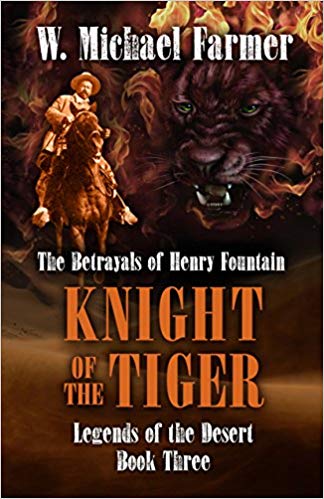
Book Review: Knight of the Tiger

Farmer.Knight of the Tiger.cover
Five Star Publishing, 2018
ISBN: 9781432837990

I don’t know much about Pancho Villa. At least, I didn’t until I read Knight of the Tiger. I knew Villa was one of a group of generals who competed for control of Mexico in the early 1900’s and that he led a raid into New Mexico in March 1916. I knew nothing about his background or his personality.

Now I know a good deal more than I did. But I didn’t pick up Knight of the Tiger in order to learn about Pancho Villa. I wanted to know what happened next to Henry Fountain, the protagonist of W. Michael Farmer’s Mariana’s Knight and Knight’s Odyssey.

This third volume of the Legends of the Desert didn’t disappoint me. I did follow Henry on his further adventures. But I also learned about Pancho Villa.

At its finest, that’s what historical fiction does. It tells us a good story and also teaches us something along the way. However, Knight of the Tiger does more than that. It also explores the concept of revenge—when it’s appropriate, when it’s counter-productive, and what exacting it can do to the human soul.

Knight of the Tiger did a great job of telling a great story, teaching me some history, and giving me something to think about. I recommend it!


ELEGANCE IN ETOWN

The men in Seligman’s Mercantile watched silently as the young woman in the trailing pale blue silk skirts swept out of the store.

“She’s a lardy dardy little thing, isn’t she now?” Charles Idle, the expatriate Englishman, asked. He shook his head and stretched his feet closer to the wood stove. “That dress and hat.”

Joseph Kinsinger spat a stream of tobacco toward the empty lard can by the stove. “Those silks ain’t gonna last long in this mud. And the wind’l take that hat.”

His brother Peter grinned. “You’re just worried Desi’s gonna see her and want a getup just like it,” he said.

“I wonder where’s she’s staying,” Idle said thoughtfully. “Hey Jim, where’d she say to deliver that sterling brush and comb set?”

The clerk hesitated, then shrugged. It would be all over town soon enough anyway. “The Moreno Hotel,” he said.

There was a short silence, then Idle said, “Well, I guess I’d better go see how my mine’s doing this morning,” and rose from his chair.

“I’ll bet,” Peter said sardonically, but Idle only smiled and went out.

from Valley of the Eagles

ROTTEN QUARTZ

The three men and two mules stopped and stared up the mountainside. A fall of broken rock blocked their way.

“Well, shit!” Gus said. “How’re we supposed to get to that old mine shaft with this in the way?”

Herbert pulled off his hat and fanned his week-old beard. “Maybe we can go around.”

Alonzo pulled his suspenders away from his rounded belly and looked down and then up the sharply-angled slope. “Mules ain’t gonna like that,” he said.

“Guess we’re done then.” Gus rubbed his jaw. “Hell, I needed that gold.”

Herbert shrugged and began maneuvering the mules to face back down the mountainside.

Alonzo stared across the slope at the fractured stone. “That’s rotten quartz,” he said thoughtfully. He moved out onto the rocks.

“Careful there,” Gus said, but Alonzo only crouched down and stretched to pluck a piece from near the center of the rock fall. He turned it carefully. “Will you look at that,” he said wonderingly.

Gus and Herbert looked at each other, then Alonzo. He grinned back at them. “Might be this is  as far’s we need to go,” he said. He lifted the quartz in his hand. “Looks like there’s gold enough right here!”

from Valley of the Eagles

NOT MY FATHER’S HOUSE – Chapter 10

CHAPTER 10

The next morning, Suzanna wakes in the cabin loft with a headache and a pain in her chest. She rubs her hands over her face. Why does she feel so miserable? So exhausted? Then she remembers. Encarnación. Dead.

Suzanna closes her eyes against the hopeless tears. They won’t do any good. Her friend is gone. Never to join her here in these mountains. Nausea grips her and she fights it down, then gingerly pushes herself from the sleeping pallet. The only thing that might help is to move, to get outside, to breath the fresh outdoor air.

She dresses, climbs clumsily down the ladder, and retrieves the egg basket from the kitchen. Ramón nods to her somberly but she can’t meet his eye. She slips out of the house to the barn.

There’s a small door at the end nearest the corral, there to provide foot access when they’re not leading animals in and out. The door is partly open, though it provides little light to the interior. Suzanna steps inside and stops to let her eyes adjust to the dimness. She can hear Gerald and Gregorio in the far stall, preparing the mule for Gregorio’s return to Taos. As she crosses the straw-covered earth floor toward them, Gregorio says, “A knife was found.”

Suzanna freezes. He has clearly waited until now to tell Gerald about the knife. There must be a reason he didn’t mention it yesterday. She swallows against a sudden surge of anxiety and closes her eyes, listening.

“It was that big horn-handled one Enoch Jones used to carry.”

Suzanna’s throat tightens. Her fingers are cold on the basket’s woven handle.

“Jones is dead,” Gerald says, his voice stiff.

“So we believed.”

“No man could survive that wilderness with those wounds. If nothing else, the wolves would trail his blood and finish him off.”

The mule moves impatiently. Gregorio speaks to it softly.

Gerald clears his throat. “Someone must have found Jones’ body and stolen the knife.”

There’s a pause, then Gregorio’s reluctant voice. “There have been stories.”

Suzanna starts to move forward, then thinks better of it. They’ll stop talking the moment they know she’s here.

“Encarnación laughed and called them ghost stories,” Gregorio says. “Tales of a man shaped like Jones in the mountains.” There’s another pause. “Between here and Don Fernando,” he adds, his voice dropping. Suzanna has to strain to hear him.

“I did not wish to alarm la señora,” he adds. “Especially with the child coming.”

“I appreciate that,” Gerald says. “They may just be stories.”

“Sí, they may just be stories.”

Suzanna opens her mouth and steps forward, then stops. They’re only trying to protect her. And there’s no point in worrying them about worrying her. She moves quietly back to the door and the cold sunshine. She waits a long moment, then shoves the door open all the way and reenters the barn.

“Hola!” she calls. “Gregorio, are you leaving so early?” The two men turn toward her almost eagerly, as if they don’t want to think about what Gregorio has just said.

After Gregorio returns to Taos, a pall falls on the cabin, a haze of pain that refuses to lift. Gerald seems anxious and unwilling to stray far from the hillside. Suzanna watches him impatiently, suddenly refusing to believe her own fears about the man she saw on the ridge. Somewhere deep in her belly, she knows she’s being unreasonable. That the stories being told in Taos and the presence of the knife beside Chonita’s dead body mean that it’s likely Jones did somehow survive that terrible knife fight and has returned from the wilderness.

But surely that’s impossible. It must be someone else who’s haunting the mountains between the valley and Taos. She simply cannot allow herself to live in terror of any other possibility.

Besides, if Gerald believed that Jones had returned, he would have told her so. He’s said nothing about the Taos rumors or Jones’ bone-handled knife. He’s staying close to the cabin solely out of concern for both her and Ramón’s emotional state. There’s also her physical condition. The baby is due soon and Suzanna is increasingly uncomfortable.

The shock of Encarnación’s death has hit Ramón hard. The realization that she lay dead while he happily anticipated their marriage has left him in a kind of stupor. He still cooks and tends the animals, chops wood and hauls water, but he goes about his tasks in a sort of daze, eyes glazed with pain.

Suzanna herself finds that she’s sitting for long stretches, hands empty in her lap, staring blindly at the windows, glowing yellow with afternoon light. It’s hard to imagine a world without Chonita’s vital laugh, those knowing eyes, that gift for las natillas. Even the mica windowpanes remind her of the other woman. Suzanna smiles, remembering the arguments between her father and the cook about the need for sunlight and fresh air through the old-fashioned kitchen windows with their carved wooden grills, the ones her father wanted to replace with mica.

Ramón enters the room carrying an armload of firewood. Suzanna looks up at him. “You know, I think Encarnación was right,” she says. “The clear light from an open window aperture is so much brighter and truer than sunlight filtered through mica.”

Ramón kneels to add the wood to the small stack at the far end of the fireplace. “It is so,” he says. “She—” Then he stops, a piece of juniper still in his hand. He shakes his head, carefully positions the chunk of wood on top of the stack, then stands and moves toward the kitchen without looking back.

She closes her eyes. She shouldn’t have spoken. It only deepens his pain. And yet, how can she not speak, when everything seems to remind her of her dead friend? She sighs and sorrowfully rubs her belly. She had assumed Encarnación would come for the child’s birth, to assist her through it and perhaps stay on with Ramón.

Grief overwhelms her again, and Suzanna creeps across the room and climbs clumsily up the ladder to the loft. Out of the way, where she can’t do anything else to increase Ramón’s pain.

When the tears finally wear out, Suzanna lies limp on the blanket-covered pallet and stares at the bare rafters overhead. The weeping will erupt again. She hasn’t completed grieving for her friend. But the pressure in her head and chest has subsided a little. She wonders if Ramón has wept at all, if he’s found an outlet for his grief. But he’s a man. Men learn early to suppress their emotions. Perhaps speaking of his loss to another man will be all he can manage.

But when she asks Gerald that night if Ramón has spoken to him of Encarnación’s death. Her husband shakes his head.

“It will fester in him if he doesn’t express it.” Suzanna pushes another pillow behind her back, trying to get comfortable on the thin bed. “It isn’t good to hold in that kind of pain.”

“You don’t know that he’s not expressing it,” Gerald says. “We each have our own way of dealing with grief.” He leans down to give her a kiss and pokes at the pillows behind her. “Are you comfortable yet?”

“Not until this child decides to be born,” she says, exaggerating her grumbling tone, glad to have something else to think about. “Ouch!” She presses a hand against her lower chest. “That foot just jabbed my rib and now it’s pushing straight out.”

“Pushy little thing, isn’t it?” Gerald grins and he stretches out beside her. “Must be a girl.”

She gives him a slit-eyed look. “You certainly are in a good mood tonight.” Guilt wells up in her and she turns her head away. How can she be happy when Encarnación is dead and Ramón so bent with grief? Tears brim into her eyes. “When my father arrives for Christmas, Chonita won’t be with him.” She gives Gerald a bleak look. “If I can’t bear the thought of that, how must Ramón feel?”

Gerald lifts himself onto one elbow and gently strokes her dark hair. “I don’t mean to be hard hearted. I know your heart weeps for her and that Ramón is burdened with grief and self-reproach.”

“Self-reproach?”

“He believes that if he’d insisted that they marry when we did, she would have been here and safe, instead of on that acequia path.”

Suzanna’s eyes fill again. “On that path with potatoes from my patch, so far away from the village.” She shakes her head. “And I was so willing for her to stay in Don Fernando, so quick to leave her with all the work while I took what I wanted. When I left, she remained to arrange everything, to take all the responsibility for my father. And to have none of my joy.” She turns her head away from his sympathetic eyes. Her voice shakes. “I’m more to blame than Ramón!”

“Neither of you are to blame,” Gerald says firmly. “Encarnación insisted, remember? She decided what she wanted to do and that was it.” He chuckles. “Did you ever know her to change her mind once she had decided a thing?”

“No, not that I can remember.” She manages a small smile. “In fact, it was never clear whether she or my father was the first to decide that she would be our cook and housekeeper. I’ve always suspected it was Chonita’s idea before it was his, even though she was only fourteen at the time.”

Gerald grins. “She set you a good example.”

She narrows her eyes. “Now what exactly is that supposed to mean?”

He laughs. “Only that you and she both know how to get what you most want.” He leans forward and kisses her forehead. “Now please relax and let that baby finish its last bit of growth so it can arrive soon.” He reaches for her hand. “Ramón and I expect to have a surprise for you tomorrow morning, but if it’s to truly be a surprise, you’ll need to stay up here until we’re ready to show it to you. Can you do that?”

She grimaces. “Since I now need help to get down the ladder, I suppose I don’t have much choice, do I?”

He laughs and squeezes her hand. “I suppose not.” He looks around the loft. “You have the lamp and your books. The chamber pot’s empty and the wash basin has clean water in it. Is there anything else you need?”

“Chonita to be alive and this child to be born,” she says, closing her eyes. She can feel the grief pulling at her again.

Gerald touches her hair. “I wish I could make both those things happen,” he says. “I didn’t know Encarnación well, but I also feel her loss.”

Suzanna reaches for his hand. “I don’t mean to be such a weepy woman about it. I suppose it’s as much the weight of the child as grief for Chonita. If my time doesn’t come soon, I may dissolve in a lake of tears.”

“When the baby does arrive, it will be a comfort to all of us.” He looks up at the rafters. “Though I dread the process of its coming.”

“I’ll be fine.” Suzanna puts more courage into her voice than she actually feels at the moment. “We both know what to expect. After all, cows aren’t much different from humans.”

“Still, I wish you could be in your father’s house.” He turns his head, eyes dark with concern. “I shouldn’t have taken you from Taos.”

“It’s too late for that now,” she says. “I’ll be fine. I’m sure of it.”

He rolls toward her. “I’ll certainly be glad when it’s over,” he says, his face against her shoulder.

Suzanna turns her head to kiss him gently, then turns back to stare at the rafters herself. She can sleep only on her back now. Every other position is uncomfortable. As she stares into the darkness, Gerald’s body relaxes into sleep.

She can’t let go that easily. Despite Gerald’s reassurances, she still regrets her eagerness to hasten her own marriage and delay Encarnación’s. One of them needed to stay in Taos with her father and arrange for and train a new housekeeper. She had selfishly let that person be Chonita. Who is now dead. The tears slip silently down Suzanna’s face.

Finally, she sleeps. She wakes to a muttered curse in the room below and a muffled thud on the plank floor. “Are you two moving furniture?” she calls, but the only response is the scuff of boots across the floor and the thud of the front door shutting.

Suzanna frowns. What are those two up to? Oh, yes. The surprise. Well, if it distracts Ramón a little from his pain, it’s a good thing.

She closes her eyes against her own grief, then sits up. Her bladder is full to bursting. Or at least it feels like it. It could just be that the baby is pushing against it again. That nothing much will happen when she uses the chamber pot.

She gets up anyway, then slips back onto the thin pallet. She shifts impatiently, trying to get comfortable. The loft’s floor boards seem especially hard this morning, the pallet especially thin. It’s no use. She’ll read for a while, until they’re ready to show her the surprise.

She pushes herself into a sitting position. As she reaches to light the lamp, the door below thuds open again. “Shhh!” Gerald hisses. “Careful now! She’ll hear us!”

Suzanna pulls her hand away from the lamp and lies down again, a small smile playing on her lips. Let them think she’s still sleeping.

She’s actually dozed off again when Gerald’s head appears at the top of the ladder. “Wife?” he says.

“Ummm?”

“Your surprise is ready.” He sounds so pleased with himself.

She sits up and stretches her hand to him.

“Well, almost ready,” he says. “You have to see it before it can be completed.”

She chuckles. “Now I’m really curious.”

“Don’t look over the edge of the loft,” he warns. “And you’ll need to close your eyes on the way down.”

“Isn’t that’s rather dangerous?”

He laughs. “You haven’t been able to see your feet on the ladder rungs for the last month,” he reminds her. “I’ll stay right below you just like I’ve been doing, and you’ll be perfectly safe.”

“I put myself in your hands,” she says, smiling. She wraps a shawl around her shoulders and ties it firmly in place. “All right, I’m ready.”

Gerald guides her carefully down the ladder, then places his hands on her shoulders and turns her, eyes still closed, toward the fireplace. “Here it is!” he says.

Suzanna opens her eyes. A bed stands between the fireplace and the window. A real bed, large enough for two people, with a sturdy pale-gold wooden post at each corner and thinner pieces forming the frame. Strips of rawhide have been woven together and attached to the frame to create a mattress support.

“It isn’t quite ready,” Gerald says apologetically. He slips his arm around her waist. “We’ll bring the pallet and blankets down and make it up properly.”

Ramón stands on the far side of the bed, watching her. His face holds the glimmer of a smile, the first she’s seen since Gregorio arrived with his news. “It is for you and the little one,” Ramón says. He glances at the ladder to the loft. “You will be safer here.”

“It’s beautiful.” Suzanna leans against her husband and smiles at Ramón, both hands on her protruding belly. She looks at the bed. “The wood is such a beautiful soft yellow. Is it aspen?”

“Sí,” Ramón says eagerly. “And we have coated it with a thin layer of resin, to preserve it. It should last all your days—” He stops suddenly and looks away.

Suzanna’s throat catches. She turns to Gerald. “I want to try it right away,” she says. She moves to her chair and eases herself into it. She looks at Ramón, her eyes twinkling. “I’m afraid you’ve made more work for yourself, because I’ll also need the lamp and my books.”

The men move up the ladder to do her bidding and the cabin is filled with activity, pushing the loss of Encarnación into the shadows, at least for a little while.

You’ve just read the tenth chapter of the forthcoming novel Not My Father’s House by Loretta Miles Tollefson. You can order it now from your favorite bookstore or online retailer, including Amazon, Barnes and Noble, or Books2Read.