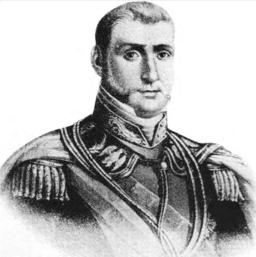
On Saturday, February 24, 1821, halfway between Mexico City and Acapulco, General Agustin de Iturbide published the Plan of Iguala and effectively established Mexico’s independence from Spain and set the stage for American conquest of New Mexico, California, and the land in between.
General Augustin de Iturbide. Source: R. E. Twitchell
The plan of Iguala maintained the Catholic Church as the official religion of Mexico, created an independent limited monarchy, and established equal rights for Spaniards and creoles. The new government also reversed the Spanish policy which forbade foreign merchants to enter New Mexico, thus opening the door for William Becknell and his mule train of goods as well as the many trappers and traders who would follow him down the Santa Fe Trail.
However, the new relationship with the United States was fraught with complications. Within a few years, Mexican officials realized that the Americans were taking every opportunity to keep from paying customs duties on the goods they brought into and the furs they took out of nuevomexico. Although officials tried various measures to control the Americans, nothing was really effective. The American trappers and traders continued to be a thorn in the side of the Mexican government. In fact, it could be argued that the Americans that the Mexicans allowed in after 1821 would turn out to be a major factor in the lack of resistance to the American invasion in 1846, 25 years later.
Sources: Paul Horgan, Great River,The Rio Grande in North American History, Wesleyan Univeristy Press, Middletown, CT, 1984; : Ralph E. Twitchell, The Leading Facts of New Mexico History, Vol. II, The Torch Press, Cedar Rapids, 1912; David J. Weber, The Taos Trappers, David J. Weber, U of Oklahoma Press, Norman, OK, 1970.
“Rues? Your last name is Roo-ess?” The young white man sitting at the Elizabethtown restaurant table looked at the old black man quizzically. “You mean Ruiz? Roo-eez? You got some Spanish in you?”
The cook shook his head. “All I know’s what my mama tol’ me,” he said. “My daddy was a Frenchman visiting ’round in Alabama. He stayed at the Big House for three weeks and took a shine to my mama while he was there. When I was born, she give me his last name.”
“Your master let her do that?”
The black man studied the plate of food in his hands for a long minute. “After the war, we could choose what last name we wanted,” he said quietly. “I chose my daddy’s name.”
“That food sure looks good,” the white man said. He moved his knife and fork farther apart on the bare wooden table.
Louis Rues put the plate down and turned away. He shook his head. People are people, no matter where you go, he thought ruefully as he went back to his stove.
On Saturday December 7, 1878 the first Atchison, Topeka and Santa Fe (ATSF) railway engine crossed from Colorado into New Mexico Territory and the New Mexico and Southern Pacific, an ATSF subsidiary began building south toward Santa Fe.
It had been a race right to the finish, the ATSF barely making reaching the New Mexico Territory border from Kansas before the Denver and Rio Grande Railroad reached it from Denver.
The race began on October 30, 1868, when the ATSF railroad began laying track in Topeka, Kansas. The rail line headed west from there, following the already-established Santa Fe Trail to Raton Pass. Once into New Mexico, the track extended south to Las Vegas, then west through the Glorieta Pass. West of the pass, it moved away from the Trail and headed south to Albuquerque, which it reached in 1880. At Lamy, source of the limestone for Santa Fe’s Catholic cathedral, the New Mexico and Southern Pacific built a spur line north to Santa Fe, thus ensuring a connection to the Territorial capital.
With the railway came connections south and west, as well as east. The New Mexico and Southern Pacific line reached Albuquerque on April 5, 1880, then pushed south and west. It arrived in El Paso, TX in 1881, where it would connect to the Southern Pacific, which moved steadily west toward Arizona, reaching that boundary in late July 1881. In 1882, this southern route line would extend link Texas and California, forming, with the New Mexico and Southern Pacific’s routes in the rest of New Mexico, a network of rail throughout the Territory.
Fred Harvey was already providing food and lodging for ATSF’s passengers by the time ATSF tracks reached New Mexico, but the Territory was critical to the full development of his Harvey House concept. In 1883 the male waiters at Harvey’s Raton establishment became so unruly that he fired all of them and hired young women instead. The waitress experiment was so successful that Harvey got rid of the male waiters in all of his rail establishments and replaced them with young women, the iconic waitresses who would become known as the Harvey Girls. So, not only did rail come to New Mexico in early December 1878, but New Mexico would give rail the Harvey Girl, that image of feminine efficiency that has clung ever since to the legend of Fred Harvey and his railroad restaurant/hotels.
Sources: Francis L. and Roberta B. Fugate, Roadside History of New Mexico, Mountain Press, Missoula, 1989; Richard W. Etulain, Beyond the Missouri, UNM Press, Albuquerque, 2006; Corina A. Santisteven and Julia Moore, Eds., Taos, A topical history, Museum of New Mexico Press, Santa Fe, 2013; Marta Weigle, editor, Telling New Mexico, a new history, Museum of New Mexico Press, Santa Fe, 2009; Victor Westphall, The Public Domainin New Mexico, 1854-1881,UNM Press, Albuquerque, 1965.
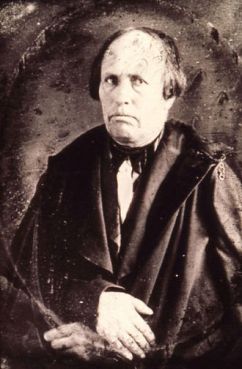
When New Mexico’s first printing press arrived in Taos in late November 1835, its new owner Padre Antonio José Martinez didn’t waste any time putting it to work. On Friday, November 27, he announced that the press was be available to residents to use to publish “literary contributions.”
Padre Antonio Jose Martinez circa 1848
The press and its printer, Jesús María Baca of Durango, Mexico, had arrived in Santa Fe in 1832, brought there by Don Antonio Barreriro, a barrister and governmental deputy from Mexico City, apparently at the behest of nuevomexico Legislature’s Secretary, Don Ramón Abreu.
Barreriro used the new press to print a short-lived newspaper El Crepúsculo de la Libertad (The Dawn of Liberty), the first newspaper in New Mexico and possibly the first paper published west of the Mississippi. Abreu may have also used it to publish the first book printed in New Mexico, a spelling primer titled Cuaderno de Ortografía.
Following Barreriro’s return to Mexico, Ramón Abreu sold the printing equipment to Padre Martinez, the priest assigned to Taos’ Our Lady of Guadalupe chapel, who moved it to Taos. Once it and its printer were in place, Martinez put them to work, with output ranging from diligencia matrimonials (the standard forms for pre-nuptial investigations) to religious books. And hopefully Taos residents’ “literary contributions,” as well!
Sources: Fray Angelico Chavez, But Time and Chance, Sunstone Press, Santa Fe, NM 1981; Richard W. Etulain, New Mexican Lives: Profiles and Historical Stories, UNM Press, Albuquerque 2002; Rubén Saláz Márquez, New Mexico A Brief Multi-History, Cosmic House, Albuquerque, 1999.
Placido Sandoval slammed the pick mattock into the rocks at his feet in a blind fury. “This Prussian, this not truly Americano, how dare he speak to me in such a way? As if I were dirt, less than nothing?” he fumed. “Mi familia has lived in this country for generations. I am of the conquistadors, the flower of España, while he is of the peasants in his country. I heard him bragging of it, how he has raised himself above his ascendientes.” He smashed the wide edge of his mattock against the largest of the rocks. A chip flew off, ricocheting into the face of the man working beside him.
“¡A redo vaya!” the other laborer said. “The devil! Be careful!”
Placido Sandoval swung the pick again, just as sharply, and his companion stopped his own work to turn away. “It does no good to be angry,” he said over his shoulder.
Placido glared at him. “It is good for my soul,” he growled. He slammed the pick against the nearest rock. Three large pieces broke free and tumbled farther down the stone-filled gully. “I will not be beaten by such as he. I will not be cowed.”
“You there!” Edward Bergmann, the mining supervisor, called from the bank above them. “You Mexicans!”
The two men paused and looked up. The Prussian’s finger pointed accusingly at Sandoval, his fierce black eyes indignant. “Did I not tell you to go slowly, to be more methodical in your approach? I’ll fine you again if you don’t stop flailing around!”
“I’ll flail you!” Placido muttered as he and his companion returned to their work. But his mattock chopped more sullenly now, reflecting the pattern Bergmann had set for it. Suddenly, gold glinted from the ground. Placido glanced up at the bank. Bergmann had disappeared. Placido bent swiftly and pocketed the chip of rock and ore.
Placido’s companion chuckled as he continued to swing his own tool. “That’s a more productive approach,” he said approvingly. He glanced toward the bank. “Though more dangerous if you are caught.”
Placido Sandoval grunted an unwilling acknowledgement as he continued on with his work, chopping at stones.
On Wednesday, November 10, 1875 Manuel Cardenas was shot and killed by an unknown gunman in the short distance between the Colfax County jail and courtroom in Cimarron, New Mexico Territory. Cardenas had been on his way to tell the justice of the peace what he knew about the mid-September death of Methodist missionary Franklin J. Tolby. Because Cardenas died when he did, the mystery of who shot Reverend Tolby, and why, was never solved.
Tolby had been a bur under the Maxwell Land Grant Company’s saddle since he’d arrived in the Territory in early 1874. He pointed out that Congress had thrown the grant land was open to homesteaders and objected strenuously to the Company’s program against the settlers they called “squatters.” Because of Tolby’s status as a minister of the gospel, people listened to him and resisted the Land Gant Company’s enforcers.
When Tolby was killed in the Cimarron canyon in September, many thought Civil War veteran Cruz Vega was responsible. As a result, Vegas was tortured and killed, but before he died, Vega fingered Manuel Cardenas as the man who’d shot Tolby.
Cardenas, in turn, claimed that the now-dead Vega had killed the minister. More importantly, he asserted that three prominent members of the community—men who were believed to be part of the Santa Ring—had ordered the killing. Since members of the Ring had a controlling interest in the Maxwell Land Grant Company, Cardenas’ claim made a lot of sense to many Colfax county residents.
However, Cardenas had yet to make his accusations before the County Court. And he died before he could do so. Since his killer was never identified, questions about Tolby’s killing and its aftermath remain to this day: Who killed Manuel Cardenas and why? Was it a Cruz Vega adherent, revenging the aspersion on his good name? Was it Clay Allison or a member of the vigilante group that killed Cruz Vega, seeking vengeance for Reverend Tolby’s death? Or did the Santa Fe Ring send out a killer to take out their killer before he could officially name names? For that matter, who killed Reverend Tolby? Was it Cruz Vega or Manuel Cardenas? And did members of the Santa Fe Ring really put them up to it? If so, how far did the conspiracy go? The Governor’s office? Unless new evidence shows up now, 142 years later, we’ll never know for sure.
And so the saga of Reverend Tolby’s death ends with more questions raised than answered. This is the stuff that novels are made of!
Sources: Chuck Parsons, Clay Allison, portrait of a shootist, Pioneer Book Publishers, 1983; David L. Caffey, Chasing the Santa Fe Ring, UNM Press, 2014.
Monday, November 1, 1875 in Cimarron, New Mexico should have been a quiet day after an eventful weekend. Cruz Vega, the man thought to have murdered Methodist missionary Reverend Franklin J. Tolby in September, was dead and buried. Now the County could get back to ranching and mining. But Vega’s confession at his Saturday, October 30 lynching had not put the matter to rest.
Vega confessed merely to being involved in the plot to kill Reverend Tolby. He said Manuel Cardenas was the actual shooter. So there was still that to deal with.
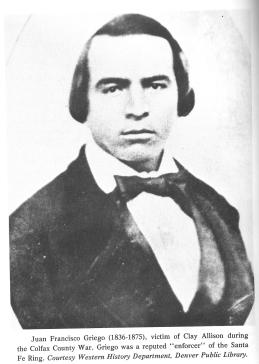
Then there was the matter of how Vega had died. Following the telegraph-pole lynching that produced his accusation against Cardenas, Vega was shot and killed. When his battered body was found the next day, his friends and relatives were upset, to say the least. Their thoughts turned almost immediately to revenge. In fact, before the funeral was over, Civil War veteran Juan Francisco “Pancho” Griego vowed vengeance on the men who’d tortured and killed his friend.
There’s no concrete evidence that gunslinger R. Clay Allison was part of the Vega lynch mob, but the fact that Griego confronted him about it implies that Allison either participated in the lynching or was concerned for the welfare of those who had.
At any rate, Griego and Allison met late Monday, November 1 at Henri Lambert’s saloon in Cimarron (today’s St. James Hotel) and Griego didn’t make it out alive. According to Lambert, who’d been born in France, “Pancho try to pull the pistol. Mr. Allison smarter.” When Pancho fell, Lambert ordered everybody out and closed up shop. It was a smart thing to do. Allison and his friends spent the night “hoorahing” the town and probably would have caused more damage to Lambert’s place besides the blood-stained saloon floor if he hadn’t closed down when he did.
But Tolby’s killer still needed to be dealt with and there were still strong suspicions that the Santa Fe Ring was somehow behind it all. Certainly, the bloodshed hadn’t ended. There would be more in the coming days. Stay tuned . . . .
Source: Clay Allison, Portrait of a Shootist, Chuck Parsons
Sources: Las Vegas Gazette, November 14, 1875. Chuck Parsons, Clay Allison, Portrait of a Shootist, Pioneer Book Publishers, 1983.
On the night of Saturday, October 30, 1875 New Mexico Territory rancher William Low joined Mexican-born Cruz Vega beside a campfire about a mile and a half north of Cimarron. Low had hired Vega to watch his cornfields that Halloween weekend. But when a group of masked men led by Methodist missionary Oscar P. McMains showed up that night, Low wasn’t surprised. Reverend McMains had asked him to hire Vega to watch that particular cornfield. He wanted him within easy reach of the Poñil River stage road and the telegraph line that ran it.
McMains and his men had a sinister use for those telegraph poles. They suspected Vega of murdering McMain’s fellow missionary, the Reverend Franklin J. Tolby the month before, and they intended to extract a confession from him.
Las Vegas Gazette, Nov. 14, 1875
According to William Low, “One of them says, halloo boys, and he walked up toward Cruz with a lariat and put it around his neck, and says, come on, and they took him into the road and we along with him. We went up I judge about 500 yards among the timber, along the telegraph line: there was a party of men. It was pretty dark. These four or five men took him to a telegraph pole of their own accord: none of the parties said a word . . . One of the four or five men climbed the telegraph pole and put the rope over the wire and they raised him up, on their own accord, and after a few seconds let him down again.” After Vega recovered enough to talk, McMains interrogated him.
This process was repeated until McMains got all the information he was looking for. Then the Reverend returned to the Poñil River ranch where he and Low were staying the night and left Vega to the mercy of the now-drunken mob. McMains said later that he thought they were too drunk to do Vega any real damage. But shortly after McMains reached the ranch house, he and Low heard gunshots. “My God!” McMains exclaimed. “I fear these are the shots that kill Cruz Vega.”
And he was right. Vega’s body was found the next morning near the base of the telegraph pole. A clump of hair from his bashed-in head lay nearby and rope burns circled his neck.
Ironically, the information McMains gathered that night acquitted Vega of Tolby’s murder. Although Vega admitted that he’d witnessed the killing, he identified Manual Cardenas of Elizabethtown as the shooter. So the murderer was still at large. The saga of Reverend Tolby’s murder wasn’t quite over, and more deaths would ensue before it was. . . . Stay tuned.
Sources: Las Vegas Gazette, Nov. 14, 1875. Las Vegas Gazette, August 25, 1877.
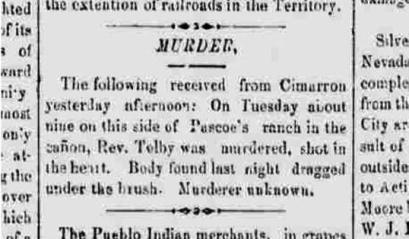
On Thursday, September 16, 1875, 142 years ago today, the body of Methodist missionary Franklin J. Tolby was found lying beside the Cimarron Canyon road near the mouth of Clear Creek, shot in the back. He’d been there two days, killed while returning from church services at Elizabethtown. His horse was tethered nearby and none of Tolby’s goods were missing. It was clearly a case of assassination and many people believed they knew why he was killed. But who did it and who’d ordered the killing? Those were the burning questions that some people believe were never answered.
Tolby had begun preaching vehemently against the Maxwell Land Grant & Railway Company almost as soon as he’d arrived in Colfax County in early 1874. The Company had bought the Beaubien-Miranda Grant from Lucien B. Maxwell and his wife four years before. The fact that the Grant boundaries were disputed wasn’t going to stop them from maximizing their profits from every bit of its roughly 1.9 million acres. They would use whatever means necessary to keep anyone they deemed a squatter off the Grant, even people the Maxwells had work/share agreements with prior to the sale.
Source: Las Vegas Gazette, Sept. 18, 1875
The 33 year old Reverend Tolby preached that the farmers and ranchers were more in the right than the Grant people. After all, the U.S. Department of the Interior had ordered the grant land to be treated as public, which made it available to homesteaders.
In addition, Tolby advocated that part of the grant be set aside a reservation for the bands of Utes and Arapahoes who traditionally hunted there. And he said so quite strongly.
Tolby became increasingly annoying to the Company, whose board of directors included Dr. Robert Longwill (Colfax County Probate Judge), Stephen B. Elkins (New Mexico Territorial delegate to Congress), and Thomas B. Catron (U.S. Attorney for New Mexico Territory), all members of the Santa Fe Ring and working hard to extract as much money as possible from the Territory in general and the former Maxwell Grant in particular.
Any of these men and their associates, including Cimarron Attorney Melvin W. Mills and its part-time Justice of the Peace (who was Mills’ office clerk) had reason to wish Tolby dead. After all, the Reverend was interfering with their business interests! But consensus among the anti-Grant folks in the County was that none of the Ring men were likely to dirty their hands with the actual deed itself. In fact, many suspected substitute mail carrier Cruz Vega of killing Tolby. After all, Vega’s Tuesday, September 14 mail route took him through the Cimarron Canyon, but he hadn’t reported seeing a body. This seemed mighty suspicious. Clearly, he knew something.
But Vega spoke only Spanish, which was a problem for the primarily English-speaking men who suspected him. They couldn’t find out what he knew. And they weren’t getting much help from the County’s Spanish-speaking population.
But there was another stubborn Methodist minister in Cimarron, and this one would prove to be even more tenacious than his predecessor. Rev. Tolby’s assistant Rev. Oscar P. McMains was now in charge, and he was hell bent on finding out what Vega knew. It would take six weeks before that confrontation occurred, and when it did it would create even more havoc. Stay tuned . . .
Sources: David L. Caffey, Chasing the Santa Fe Ring, UNM Press, 2014; Moreno Valley Writers Guild, Lure, Lore and Legends of the Moreno Valley, Columbine Books 1997; Chuck Parsons, Clay Allison, Portrait of a Shootist, Pioneer Book Publishers, 1983; Stephen Zimmer, For Good or Bad, People of the Cimarron Country, Stephen Zimmer, Sunstone Press, 1999.
On January 25, 1869, eighteen months after Elizabethtown, New Mexico was founded in Mora County, New Mexico’s Territorial Legislature cut the County into two pieces and renamed the northern section Colfax County, in honor of the new U.S. Vice President Schuyler Colfax. Elizabethtown became the county seat. Schuyler Colfax had visited northern New Mexico Territory in late 1868, shortly before being sworn in as Ulysses S. Grant’s Vice President. Colfax was a journalist and politician from Indiana and was expected to one day be President.
Unfortunately, the Grant administration scandals ruined those hopes, as well as the hopes of those who thought naming the County after him would be a smart move. When it was created, Colfax County included the entire Maxwell Land Grant, except for 265,000 acres in southern Colorado, and extended to the Texas/Oklahoma border, encompassing what is now Harding and Union County.
Sources: Lure, Lore, and Legends of the Moreno Valley. Angel Fire, NM: Moreno Valley Writers Guild, 1997: 5. Daniel, Clifton. Chronicle of America. Mount Kisco, NY: Chronicle Publications, 1988: 408.


 Fiction and Fact From Old New Mexico