In early October 1846, the 500-member Mormon Battalion of Volunteers of the U.S. Army of the West marched through Las Vegas, New Mexico. They were on their way to California from Council Bluffs, Iowa, where they’d volunteered to fight in the Mexican-American conflict.
Their service had two conditions. First, each man would receive his $42 uniform allowance in advance but would wear his civilian clothing on the march. This enabled the men to donate most of their clothing money to the Church to buy wagons, animals, and other necessities for the coming move to what is now Utah. Second, the Battalion members would serve twelve months and no longer.
These men hadn’t volunteered because they supported the war against Mexico. Their leaders had asked them to join up. The Latter Day Saints needed Federal government agreement to cross what was rapidly becoming U.S. Territory and settle around the Great Salt Lake.
The LDS leadership also hoped that the Volunteers, the only single-religion battalion in U.S. military history, would help change public perception of the Church and its members by demonstrating their loyalty to the United States.
The Mormon Battalion was divided into two groups which traveled several days apart, but they were all in Santa Fe by mid-October 1846, where they met their new Captain, Philip St. George Cooke.
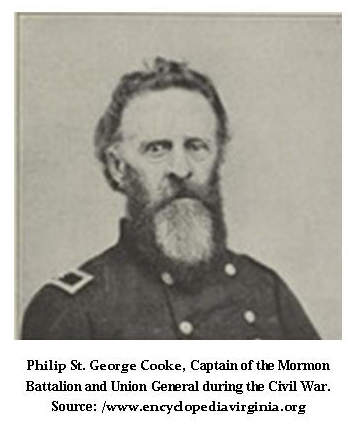
They were now about 45 percent through their 2,000 mile trek. Mountain man Jean Baptiste Charbonneau, the child born to Sacagawea during the 1805 Lewis and Clark Expedition, would guide them the rest of the way. Charbonneau, Cooke, and the men of the Mormon Battalion would create Cooke’s Wagon Road, a route used after American annexation to transport goods and people to California.
They arrived in California in January 1847, shortly after Mexican capitulation to John Fremont, and therefore didn’t see battle. But they completed other useful tasks and fulfilled their full twelve month contract. After their service expired, some of the Battalion members stayed in California. A few of them were working at Sutter’s Mill when gold was discovered there on January 24, 1848.
As a result, not only did the Church receive much of the $30,000 the volunteers had earned during their military service, it also received $17,000 in contributions from the first fruits of what would become the 1849 California Gold Rush. Those funds were instrumental in getting the LDS congregation through the winter, providing the means for their epic journey to the Great Salt Lake area, and helping to establish them there.
Sources: en.wikipedia.org/wiki/Mormon_Battalion Accessed 9/4/19; Paul J. Horgan, Great River, the Rio Grande in North American History, Connecticut: Wesleyan UP, 1984; John W. Kirshon, Ed., Chronicle of America, Mt. Kisko: Chronicle Press, circa 1989; Benjamin M. Read, Illustrated History Of New Mexico, Santa Fe, 1912; Ralph E. Twitchell The Leading Facts of New Mexican History, Vol. 2, Cedar Rapids: Torch Press; www.mormonbattalion.com Accessed 9/4/19.


 Fiction and Fact From Old New Mexico