What to Believe?

What to Believe?

If you’ve been reading my blog posts, you’ve probably noticed that I sometimes quote Lewis Garrard, the seventeen-year-old American who visited New Mexico in 1847.  His book about his adventures there, Wah-to-yah and the Taos Trail, was published in 1850. It doesn’t seem to have made much of a hit at the time, but it’s now often used as a primary source for everything from how to make coffee on the trail to the April 1847 trials after the Taos insurrection was suppressed. In fact, Garrard’s report of the trials and subsequent hangings is the only firsthand account of them that we have.

Title page of Lewis H. Garrard’s 1850 edition, courtesy of archive.org

But Wah-to-yah also contains secondhand accounts. Of the insurrection itself and the battle at Taos Pueblo, as well as of the death of Taos leader Tomás Romero afterward. And this is where things get complicated.

The circumstances around Romero’s assassination are of particular interest to me because his death plays a role in my novel An Unhappy Country. Based on U.S. military records this is what we know about what happened:

  1. People from Taos pueblo sued for an end to hostilities the morning of Friday, February 5, 1847. Colonel Price agreed on condition that the remaining insurrection leaders be turned over to him.
  2. The only uncaptured leader alive and in the Taos area was Tomás Romero, who turned himself in later that day.
  3. Romero was taken to the jail in the village of Taos, where he was shot and killed by a U.S. Army dragoon private named Fitzgerald.
  4. Fitzgerald was arrested and jailed.
  5. About six weeks later, on March 18, 1847, Fitzgerald was dishonorably discharged from the U.S. Army. This was well before the expiration of his term of enlistment.

And that’s all we know from the official accounts.

According to Lewis Garrard, he met Fitzgerald in the second half of March, while Garrard and his party were camped roughly 55 miles east of Taos in the vicinity of today’s village of Cimarron, New Mexico. He says Fitzgerald told him that he’d come to New Mexico specifically to wreak vengeance on “the Mexicans” for the death of his older brother, who’d been a member of the 1841 Texas Expedition to Santa Fe.

According to Garrard, the older Fitzgerald had been killed by Damasio Salazar, the militia captain who supervised the Texans’ removal from New Mexico. The younger Fitzgerald boasted that he accomplished his mission when “in the fight at the Pueblo, three Mexicans fell by his hand; and, the day following, he walked up to [Romero] and deliberately shot him down.”  

Whether Fitzgerald did kill three men in addition to Tomás Romero is anyone’s guess. But Garrard’s report of Fitzgerald’s motivation raises a number of issues. Either he was confused, or Fitzgerald was.

You see, the only Fitzgerald with the 1841 Texas Santa Fe Expedition was an Irish/Anglo man whose first name was Archibald. And Archibald Fitzgerald didn’t die in New Mexico. He survived the trek under Captain Salazar as well as imprisonment in Mexico and was released in late February 1842.

Instead of returning home to Ireland, Archibald Fitzgerald went back to Texas. There, he joined the young republic’s forces and fought with them at the December 1842 battle of Mier. According to historian Noel Loomis, Fitzgerald was captured there and thrown into prison at Salado. He and his fellow Texans staged a successful breakout, but Fitzgerald was killed in the aftermath.

So, either Archibald’s younger brother didn’t know what happened to him, Private Fitzgerald told Lewis Garrard a tall tale in order to justify what he’d done, or Garrard misremembered/embroidered the story when he retold it in 1850. In any case, this is one portion of Wah-to-yah which does not hold up to verification by other sources.

The younger Fitzgerald apparently also told Lewis he’d escaped from his Taos prison one night by breaking through the roof of his cell, noiselessly creeping to the edge of the roof, and waiting until the guard pacing below turned his back. Then Fitzgerald swung to the ground and “with as much ease as possible” walked to a mess fire where his waiting friends provided him with a pistol and clothing. Fitzgerald headed into the mountains east of Taos and “when day broke,” Garrard says, “The town lay far beneath him.”

Whether this is what actually happened is open to question. I have to admit I’m skeptical. It sounds a little too much like something out of an Alexander Dumas novel.

But then, Garrard also says Fitzgerald told him he was one of five men who breached the wall of the Taos Pueblo church and that during this event the man ahead of him was killed. Somebody is conflating two events here: the first being the attempt to enter the church that resulted in the death of Captain John H.K. Burgwin, and the second successful assault later that day, when no one was killed.

I have incorporated a variation on Garrard’s report of Fitzgerald’s version of events into An Unhappy Country, but whether it reflects what actually happened is anyone’s guess.  But then, that’s why my novels are labeled “historical fiction.” Because no one knows for sure.

Sources: James A. Crutchfield, Revolt at Taos; John Durand, The Taos Massacres; Lewis H. Garrard, A.B. Guthrie, Jr., Ed., Wah-to-yah and the Taos Trail; Noel Loomis, The Texan-Santa Fe Pioneers; Michael McNierney, Ed., Taos 1847, The Revolt in Contemporary Accounts.

© Loretta Miles Tollefson

Rebellion Ends With a Bang – TAOS REVOLT, Part 3

Rebellion Ends With a Bang – TAOS REVOLT, Part 3

By Friday, February 5, 1847, the Taos insurrection against the American occupation of New Mexico was over. All that remained was the formal surrender of Taos Pueblo leader Tomás Romero.

The Americans had conditioned the end of hostilities on Romero’s surrender. And the people at the pueblo were eager for things to end. Their church, where the rebels had made their stand, was in ruins. Any further action put the massive housing complexes in danger.

So, Romero surrendered. But he was never tried for his actions in a court of law. While he made it to the Taos village jail, that’s as far as he got. A U.S. dragoon named Fitzgerald shot and killed the Taos leader that morning, instead.  

Fitzgerald later bragged about the killing to seventeen-year-old Lewis Garrard, who reported that Fitzgerald killed Romero and three other men as vengeance for the death of his older brother Archibald Fitzgerald. Archie had been a member of the 1841 Texas Santa Fe Expedition and later died during a prison breakout. Why his younger brother thought the death of Romero and the others avenged him is unclear.

What is clear is that Tomás Romero’s death on February 5 was the last shot fired in the Taos Revolt. Other men would die, but they would do so after a cursory court case and the administration of at least the semblance of law. The Taos leader’s death was simple murder.

Fitzgerald was locked up afterwards in the Taos village courthouse, where he was allowed to escape a month later. On March 18 he was dishonorably discharged from his company at Albuquerque, apparently for desertion. He had fled east by that time and would eventually make his way to Geelong, Australia, become the owner/operator of the Western Sea bathhouse, and die in 1882.

Source: Find-a-Grave.com

Fitzgerald’s action at Taos was one of two links between the revolt and the 1841 Texas Santa Fe Expedition. The Texans had brought along a six-pound cannon which was captured along with them and left behind when they were marched south. The cannon ended up in Santa Fe and was still there when the U.S. Army arrived. They took it with them to Taos, where it was key to the action that breached the pueblo church walls.

While the use of this particular piece of artillery may simply have been convenient, its presence may also have sparked the younger Fitzgerald’s memories of his brother and triggered the subsequent shooting at the Taos village jail. Or maybe he’d planned Romero’s death all along. Or was simply a confused young man with a propensity for killing people.

Like most historical or even current events, it’s doubtful we will ever know why the U.S. dragoon did what he did and why Tomás Romero had to die.

© Loretta Miles Tollefson

Sources: James A. Crutchfield, Revolt at Taos, The New Mexican and Indian Insurrection of 1847; John Durand, The Taos Massacres; Mark L. Gardner and Marc Simmons, eds., The Mexican War Correspondence of Richard Smith Elliott; Lewis Garrard, Wah-to-yah and the Taos Trail; Ralph Emerson Twitchell, The History of the Military Occupation of the Territory of New Mexico; Alberto Vidaurre,” 1847: Revolt or Resistance?” in Corina A. Santisteven and Julia Moore, Taos, A Topical History.  

The Black Avengers of Ceran Saint Vrain – TAOS REVOLT, Part 2

The Black Avengers of Ceran Saint Vrain – TAOS REVOLT, Part 2

When Sterling Price set out from Santa Fe in late January to meet the Mexican insurgency from Taos, he was accompanied by a rag-tag group of men who would be instrumental to his ability to carry out his mission.

He had sworn the group of men Ceran St. Vrain called the Avengers into Federal service the Saturday they left and seen their worth at Santa Cruz de la Cañada they next day, when they were instrumental in keeping the rebels from seizing the U.S. supply wagons.

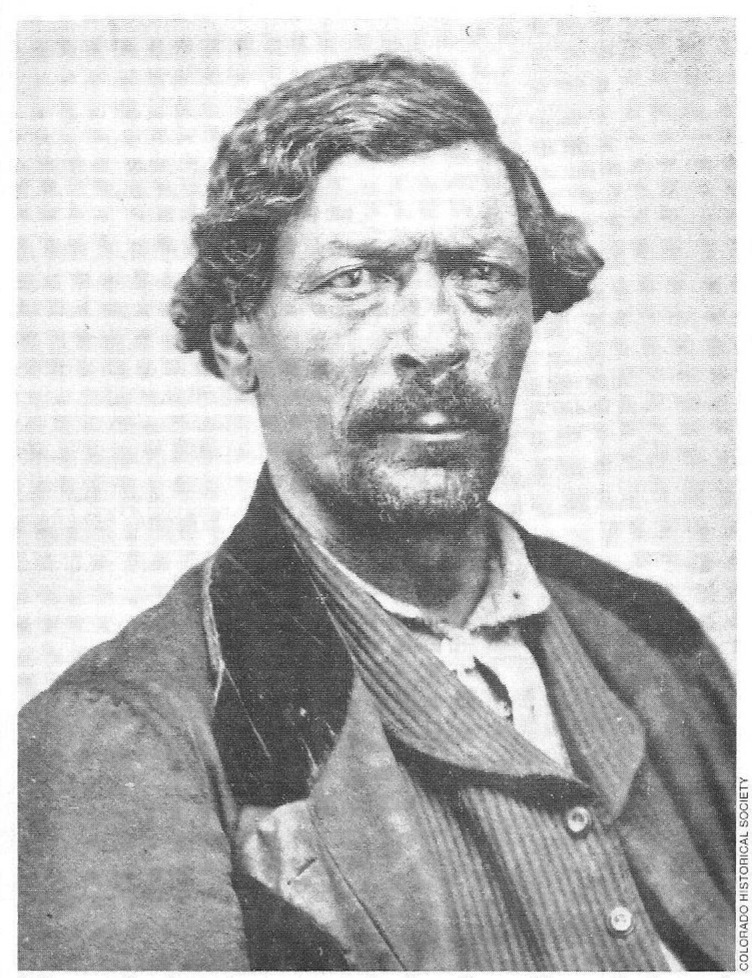
The Avengers were an interesting group of Mexican and American merchants, laborers, and mountain men. One of the mountain men was Jim Beckworth, son of a Virginia plantation overseer and a woman named “Miss Kill,” almost certainly a slave. Renowned for his exploits as a mountain man and his ability to tell a story, Beckworth had more than one thing in common with the Bent family slave who also signed up as an Avenger. Neither of them was supposed to be there.

By law, people of color could not join the U.S. military. They’d been banned from serving since the Federal Militia Acts of 1792. But there Beckworth and Green both were, marching with the rest of the Avengers.

Jim Beckworth, Source: Wild West Magazine, June 1993

And fighting. Although Dick Green was badly wounded at the battle of Embudo Canyon on Friday, January 29, there are reports that he also fought at Taos Pueblo the following week. The Bent family was so grateful for his service that they freed Green, his wife Charlotte, and his brother Andrew. The three of them headed east toward Missouri that summer and, hopefully, some place where they could live in peace.

We don’t know anything more about them. There are some tantalizing clues. The 1829 manifest for a schooner to New Orleans includes a five-foot-tall 14-year-old slave girl named Charlotte Green. Could she have ended up in the Bent household? And there’s an August 1863 New Orleans interment record for a “colored” man named Richard Green. Is this the man who was wounded at Embudo Canyon?

Unfortunately, I have been unable to find any definitive link between these pieces of information and the Dick Green who fought alongside his Mexican and Anglo cohorts in early 1847. And may have been one of only two Black men to enlist in the U.S. Army between 1792 and the Civil War.

© Loretta Miles Tollefson

Sources: James A. Crutchfield, Revolt at Taos, The New Mexican and Indian Insurrection of 1847; Ferguson, Paul-Thomas, “African American Service and Racial Integration in the U.S. Military,” http://www.army.mil/article/243604/, accessed 9/15/24; Mark L. Gardner and Marc Simmons, eds., The Mexican War Correspondence of Richard Smith Elliott; Howard R. Lamar, The Far Southwest, 1846-1912, A Territorial History; Ralph Emerson Twitchell, The History of the Military Occupation of the Territory of New Mexico; Alberto Vidaurre,” 1847: Revolt or Resistance?” in Corina A. Santisteven and Julia Moore, Taos, A Topical History.  

Sheriff’s Leniency Isn’t Enough – TAOS REVOLT, Part 1

Sheriff’s Leniency Isn’t Enough – TAOS REVOLT, Part 1

On Friday, January 22, 1847, the residents of Santa Fe, in the occupied territory of New Mexico, were on high alert. News had arrived two days before that the U.S.-appointed governor, Charles Bent, was dead at the hands of a mob loyal to Mexico. This came as a surprise because Bent and the U.S. military commander, Sterling Price, had assured everyone that all opposition to the U.S. invasion had been quelled the month before.

Apparently not. The outbreak had started in the early hours of Tuesday, January 19 during an altercation at the village jail about whether Sheriff Stephen Lee would release three men who’d been incarcerated for theft. Lee, intimidated, was about to let them go when Prefect Cornelio Vigil showed up and intervened. In the ensuing argument, friends of the jailed men killed Vigil and released the prisoners, while Lee escaped to his house.

But not for long. Despite the fact that he’d been willing to release the prisoners, Lee would die along with five other men, including Bent, his brother-in-law Pablo Jaramillo, and Judge Carlos Beaubien’s nineteen-year-old son Narciso.

Taos, January 1847. The crosses mark the location where people died. Source: The Taos Massacres, John Durend, 2004.

By the time news of the deaths reached Santa Fe late Wednesday, the fighting at Taos had spread north to Arroyo Hondo and the compound of whisky purveyor Simeon Turley. Of the nine men at Turley’s, seven had died and two escaped before Price could complete his arrangements to head north. He would march out on Saturday morning with 290 men, four howitzers, and a ragtag mob of about fifty men under mountain man Ceran St. Vrain.

It would not be an easy trek. January 1847 was an unusually cold month and there was snow in the north. There weren’t enough horses to carry Price’s men. Even the dragoons were on foot. And the rebels didn’t wait for the Americans to come after them. They mobilized and headed toward Santa Fe. Fortunately, they wouldn’t get that far. But it would still be a campaign to remember.

© Loretta Miles Tollefson

Sources: James A. Crutchfield, Revolt at Taos, The New Mexican and Indian Insurrection of 1847; John Durand, The Taos Massacres; Mark L. Gardner and Marc Simmons, eds., The Mexican War Correspondence of Richard Smith Elliott; Howard R. Lamar, The Far Southwest, 1846-1912, A Territorial History;  Ralph Emerson Twitchell, The History of the Military Occupation of the Territory of New Mexico; Alberto Vidaurre, “1847: Revolt or Resistance?” in Corina A. Santisteven and Julia Moore, Taos, A Topical History.