No Rain In Taos

On Sunday, July 31, 1825, Taos-based physician Rowland Willard had been in Taos since July 2 and the village had received no rain in the past month. The doctor was disappointed.

The New York born Willard had apparently expected to find not only rain but a prosperous community that could afford American fees and make him rich. He was destined to be disappointed on both counts.

July 31 illustration
Source: Over the Santa Fe Trail to Mexico, Julie L. Poole, ed.

Although Doctor Willard had a number of clients in Taos and as far south as Santa Cruz de la Canada, payment for services in the 1820s tended to be in goods rather than in cash. By September, it was clear that Taos was not the land of opportunity he had sought. On September 15, he headed south, to try his luck in Chihuahua.

The move paid off. Willard developed a successful practice in Chihuahua and remained there for the next two years, where he invested in the Santa Rita copper mines as well as his medical practice.

In 1828 Willard decided to return to the United States. To be eligible to leave the country, Mexican law required a 2% duty payment. The good Doctor paid $80 on the $4000 he declared, but actually left Mexico with $7000 in cash and his “outfit.”

Clearly, trappers were not the only Americans who believed they didn’t need to comply with Mexico’s duty laws.

Source: Julie L. Poole ed., Over The Santa Fe Trail To Mexico, The Travel Diaries And Autobiography Of Dr. Rowland Willard, University of Oklahoma Press, Norman 2015

A MAN’S DREAM, 1 of 2

They climbed a small hill near the headwaters of the Cimarron River to get a better view. The long narrow valley spread out below them. It was a couple miles wide and probably twelve long. The land slanting toward them was mostly grass. Small creeks meandered across it, creating dark indentations. Pine and fir hugged the banks, spreading out occasionally to absorb moisture from a sloughy spot. The streams met in a marshy area just below where Gerald and Suzanna stood, then drained into the small river that flowed eastward through the rocky canyon.

Suzanna studied the valley warily as Gerald plucked a piece of grass from the hillside. He examined it, then bit into the fleshy end and chewed carefully.

He spit it out. “Sweet,” he said approvingly. He gestured at the view below. “It has everything we could want,” he told his wife. “Water, feed, game, timber.”

from Moreno Valley Sketches


SOFT IN THE HEAD

Suzanna scowled sleepily at the lopped-off branches that formed the wall of the hillside lean-to and burrowed deeper into the bedding. At least there’s a bear skin to add some warmth, she thought irritably. It was too cold to get up, and if Gerald thought she was going to actually live in this God-forsaken place, he wasn’t thinking clearly.

“Wife?” he asked from the open side of the shelter.

Suzanna burrowed deeper, covering her head.

Gerald chuckled and came to kneel beside her. “I have a fire going,” he said. “I’ve toasted some bread and am heating water for tea.”

Suzanna sighed and reluctantly uncovered her head. “All right,” she said.

“There’s a herd of elk on the other side of the valley,” he said. “I thought I’d try for one after breakfast. We could use the meat. Do you want to come with me?”

“I’m not staying here by myself.” She sat up. “Not until you’ve built me a cabin.”

He leaned in to kiss her forehead. “I love you,” he said.

“And I you.” She shook her head. “Though I still think you’re soft in the head. This valley is so isolated and cold. How does anything grow up here?”

He grinned, stood, and went out. “The water’s hot!” he called from the fireside.

Moreno Valley Sketches II

Navajo Exile Finally Ends

In late June 1868, after five years of exile, the Navajo people began their return to their homeland.

Five years earlier, also in June, U.S. Army General James Henry Carleton had ordered Colonel  Christopher “Kit” Carson to march west to starve out the Navajos and move them 450 miles east to Bosque Redondo. Although Carson argued that his health was poor and that he’d joined the Army to fight Confederate Texans, not Indians, Carleton ordered him to go him anyway.

Carson did as he was told. The majority of the Navajos residing in the Southwest were gathered up and marched east to Bosque Redondo, and old meeting ground for Indians of the southern Plains along the Pecos River.

The experience was a disaster.

The Navajos were incarcerated alongside their long-time enemies, the Mescalero Apache, so that was difficult enough.

Then the crops failed, not only at Bosque Redondo, but also in the Taos and Mora Valleys, which reduced the food supplies that could be purchased to feed the captives. In fact, there were so few supplies that General Carleton suspended operations against the Navajos still at large. He didn’t have enough to feed those he had, much less more.

June 23 illustration.Carleton.nuevomexicano homeland

And Kit Carson, who went with the Navajo to Bosque Redondo, proved an inadequate administrator. Not only was he hampered by his illiteracy, but he found that he had no real power or control. Between Carleton’s micromanagement and Army bureaucracy and corruption, he was as overwhelmed with his Bosque Redondo tasks as the captive Navajos were with the miserable conditions there. Carson left in mid September 1864. The Navajo would remain until June 1868.

Finally, two years after Carleton had been relieved of his military command, General Tecumseh Sherman arrived. He agreed with the Navajo leaders’ rejection of the idea of moving to a new reservation in Oklahoma and negotiated a peace with them that would send them home. Three weeks after the treaty was signed on June 1, the People began the 450 miles or more journey home.

You can find more information about the Navajo Long Walk at http://newmexicohistory.org/people/navajo-long-walk-to-bosque-redondo-1864

Sources: Hampton Sides, Blood And Thunder, an epic the American West, Doubleday, New York, 2006; Jerry D Thompson, A Civil War History Of The New Mexico Volunteers And Militia, U of New Mexico P, Albuquerque, 2015

Jim Bridger Keeps His Job

On June 15, 1866 Colonel Henry B. Carrington defied orders from the U.S. War Department to fire mountain man Jim Bridger from his position as Carrington’s  expedition guide. Instead, he gave Bridger a raise, to $10 a day.

Carrington’s expedition was tasked with opening a wagon road around the Big Horn mountains to Montana, across Sioux and Cheyenne treaty lands. The road was needed to enable miners to get to the gold fields in the West. The gold from the mines was needed to pay Civil War debts.

It isn’t clear why the War Department wanted to fire Bridger, but Carrington’s response to the order is clearing up. He reported that it was “impossible of execution.” Then he doubled Bridger’s pay from $5 a day to $10 a day. Bridger stayed on, and assisted Carrington not only with opening the road but also “subduing” the Sioux and Cheyenne and building Fort Phil Kearney.

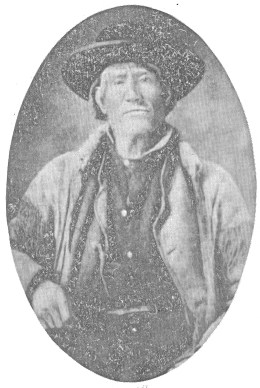
June 15 illustration.Jim Bridger.vestal
Source: Jim Bridger, Stanley Vestal


This was the last of Jim Bridger’s big adventures. He would return to Missouri, where by 1875 he was completely blind. He died in mid 1881.

Bridger had been active in the West since the early 1820s. He is said to be the first American to discover the Great Salt Lake and crossed South Pass, an important link in the United States’ westward expansion, in 1827. After he founded Fort Bridger in 1843, it became an important stopping place along the Oregon Trail.

Although Bridger spent little if any time in New Mexico, he and trappers and guides like him were instrumental in breaking down the barriers, for good or ill, between New Mexico and the United States. If the story of the War Department’s decision and Carrington’s response has anything to tell us, it’s that even in their own time, the activities of these men met with a mixed reception, even in the United States.

Source: Stanley Vestal, Jim Bridger, mountain man, U of Nebraska P, Lincoln, 1946.

Ebook Available!

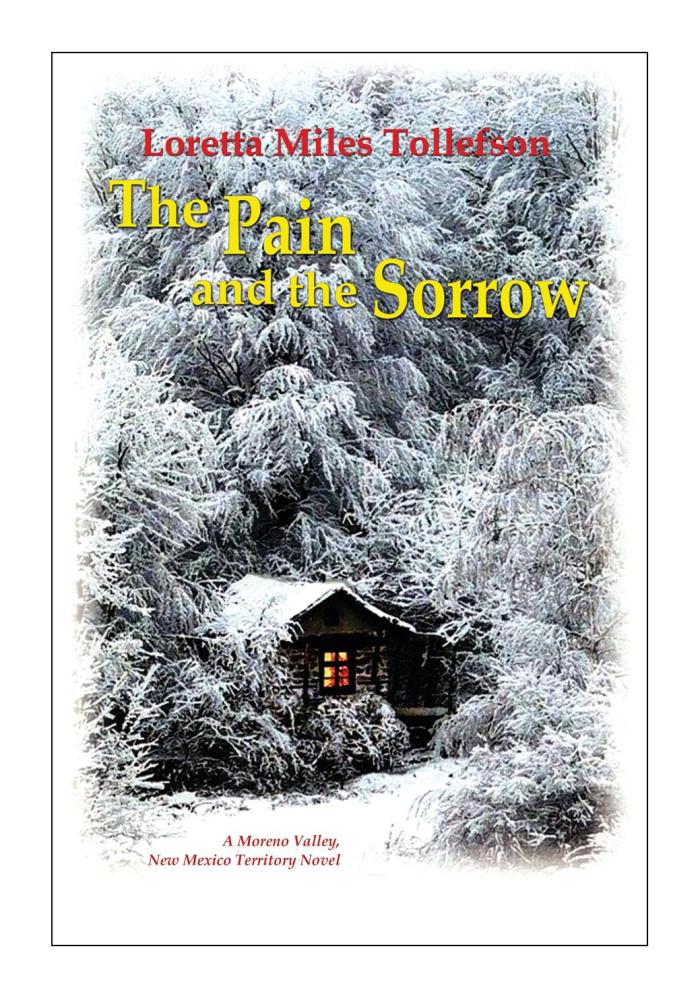
I’m pleased to announce that The Pain and The Sorrow is now available as an ebook from  Amazon (for Kindle users) and Barnes and Noble (for Nook users).

This novel about Old New Mexico serial killer Charles Kennedy and the wife who turned him in was published by Sunstone Press last summer and has not been available in ebook form until now.

Pain and Sorrow cover.framed

Old Bill Williams Begins His Adventurous Life

On this day June 3, 1787, one of the West’s most memorable mountain men, William Sherley Williams, was born in North Carolina. The fourth of nine children, he was called “Will” by family members, although before he was 40, his fellow mountain men were calling him “Old Bill.”

The Williams family moved to Missouri when Bill was 9 years old. Seven years later, at 16, Bill left home to live among the Osage Indians. Twenty-one years later, after the death of his ostrich wife and the dissolution of the reservation, Bill headed west. He would become a legendary mountain man, known as much for his eccentricities as his prowess in the wilderness.

The lean, 6’1”, red-headed Williams was based in Taos and had a propensity for hunting beaver on his own, or with only a camp-follower as a companion. Where he went was anyone’s guess–he also had a propensity for keeping his hunting grounds secret.

Before he left home, Williams had received an education that included training in Greek and Latin. This, along with excellent hunting and tracking skills and a gift for languages, gave him a self-confidence that didn’t suffer fools gladly. Especially people who doubted his geographic knowledge of the West.

This strong personality was bound to get Williams in trouble when he encountered someone with a similar character. In Williams’ case, this was former Army Colonel John C. Fremont.

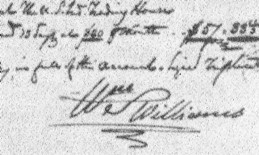
June 3 illustration.Bill Williams signature.favour
Bill Williams signature. Source: Old Bill Williams, A. H. Favour

In late 1848, Fremont hired Williams as guide for an expedition into the Rocky Mountains to identify an all-season railroad route to California. When Williams insisted that the expedition should veer from the route Fremont had already identified, Fremont relieved Williams of his guide duties and gave them to others.

Unfortunately, Williams was right. Fremont’s route was a mistake. Winter set in with a vengeance and Fremont’s men were trapped in the Rockies. Only 21 men of Fremont’s original 32 made it out alive. Although this would include Williams, he would die a couple months later, trying to retrieve valuable records and medical equipment that had been left behind.

So, while Williams’ vivid personality and self-confidence made him a legend in his own time, it also cut his time short. But the stories of his exploits would live on, and some of us still wonder just where those secret beaver hunting grounds actually were.

Sources: Robert Glass Cleland, This Reckless Breed of Men, UNM Press, Albuquerque, 1976; Leroy R. Hafen, Ed., Fur Trappers and Traders of the Far Southwest, Utah State UP, Logan, 1997; Alpheus H. Favour, Old Bill Williams, Mountain Man, U of Oklahoma P, Norman, 1962

MAXWELL BEFORE THE BAR, 3 of 3

“Things are changing, Mr. Maxwell.” Judge Joseph Palen set his whisky glass on the saloon table and looked around the room. “In another year or so, these ragged placer miners will be replaced by businessmen with laborers to do the rough work.”

Maxwell nodded, following his gaze. “And many of these men will be laborers, instead of independent men with claims of their own.”

“Claims so poorly worked they bring in barely enough to keep body and soul together.” Palen flicked a speck of dust from the sleeve of his dark broadcloth suit.

“That’s all that matters, I suppose.” Maxwell grimaced. “Efficiency.”

“It’s a large territory, and its resources are going to waste.”

“So they tell me,” Maxwell said. He shook his head, put his glass on the table, and reached for his battered black hat. “I’ve been here a long time, Mr. Palen, and I happen to like Nuevo Mexico’s lack of efficiency. So do most of the men in this room, I expect.” He stood, towering over the table. “Good day to you, Judge.” A mischievous smile flashed across his face. “And good luck.”

Moreno Valley Sketches II

The Year of the Little Doves

Folks in Socorro County called 1862 the “year of the little doves,” but they weren’t talking about birds. They were speaking of locusts. That Spring, an unusually heavy snow pack in the northern mountains that spring caused major floods along the Rio Grande. In Socorro County, the river was more than a mile wide in places. Newly planted corn and wheat fields, peach orchards and vineyards were inundated, and many acequias were destroyed.

Then the “little doves” arrived. By the time the locusts had left, the County was stripped clean and its inhabitants were close to starvation.

Relief was slow in coming, because the Territory was caught up in pushing back the Navajo depredations that had followed hard on the heels of the Confederate invasion. There were also concerns that the Confederates would try again.

May 28 blog illustration
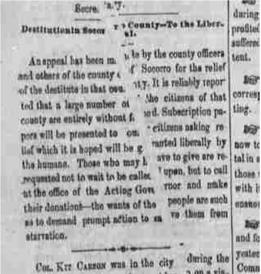
Source: Santa Fe Gazette, May 2, 1863

But help did eventually arrive. In early May, the Santa Fe Gazette printed a plea for help and donations began to pour in. They came from as far north as Arroyo Seco and as far east as Maxwell’s Ranch on the Cimarron. Leading citizens in Taos, Arroyo Seco, Placitas, Cordova, and Espanola contributed $356.  Antonio Baca and Francisco Aragon of Arroyo Seco, Francisco Sanchez of Placitas, Pascuel Martinez of Ranchita, Jose Dolores Tafolla of Cordova, Pedro Antonio Vigil of Cordilleras, and Juan Antonio Espinosa and Juan Suaso of San Francisco del Rancho donated 141 fanegas of wheat between them, and Taos’ Fr. Gabriel Ussel raised $82 from his parishioners.

So, while the locusts had destroyed their crops in 1862, “little doves” of help came to Socorro’s rescue in 1863. It was a long time to wait, but help did eventually arrive.


Source: Jerry D. Thompson, A Civil War History of the New Mexico Volunteers & Militia, UNM Press, Albuquerque, 2015.   Pages 215-221

Fur Catch Causes Nothing But Trouble

Ewing Young had thirteen 90-pound packs of beaver fur in his possession in early May 1827, and he wasn’t interested in having them confiscated. According to the rumors, outgoing Governor Narbona was cracking down on trappers without the proper permissions and incoming Governor Manuel Armijo was likely to be even stricter than Narbona.

So Young did the only sensible thing an American trapper could do. He hid his furs at the Pena Blanca home of his associate Luis Maria Cabeza de Baca.

But he had neglected to realize that some of the men with him might have different ideas about the most sensible approach to government mandates. A member of his trapping party, Ignacio Sandoval, told officials in Santa Fe what Young was up to.

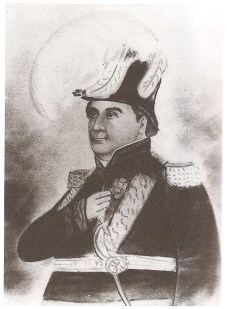
From that point on, things took a turn for the worse. Governor Narbona ordered soldiers to Pena Blanca to confiscate the furs and, in the process, Luis Maria Cabeza de Baca was killed. Then Manuel Armijo became governor on May 20 and signed an order for Young’s arrest for illegal trapping. Young seems to have talked his way out of that predicament and instead got permission to clean the confiscated furs. He and the Santa Fe alcalde were in front of the governor’s long adobe palace, shaking out and inventorying the furs, when another member of Young’s trapping party appeared on the scene. Milton Sublette grabbed a bundle of pelts and made off with them.

When Sublette and the furs disappeared, the governor blamed Ewing Young. He called Young to the palace and threatened him with jail. Young turned on his heel and walked out of Armijo’s office, but he wasn’t free for long. And when the soldiers did catch up with him, he was thrown in the calaboza, where he languished until he became ill and was finally released.

May 15 blog illustration.Armijo, Manuel.illustrated history of nm
Source: Illustrated History of New Mexico,
Reed

But he didn’t get his furs back. Many of them had been badly damaged by rain leaking through the roof of the building where they were stored, so they were sold for about two-thirds what they would have brought in good condition. The total was still a decent amount, about $3500. But it’s not clear who received the resulting funds. After all, the plews were government-confiscated property.

Sources: Carl P. Russell, Firearms, Traps, and Tools of the Mountain Men, Skyhorse Publishing, 2010; David J. Weber, The Taos Trappers, University of Oklahoma Press, 1970.