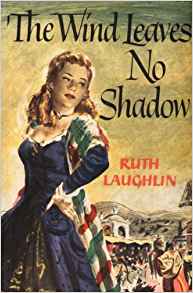
by Ruth Laughlin Caxton Printers, 1951 ISBN-13: 978-0870040832
Doña Tules Barceló was one of New Mexico’s most colorful 19th century characters, andThe Wind Leaves No Shadow is, as far as I know, the only fictional or non-fictional treatment of her life.
From humble origins, which Ruth Laughlin imagines effectively, Doña Tules became owner of a Santa Fe gambling establishment where political opponents could meet to arrange accommodations that worked for everyone involved. She also acted as a kind of informal bank, lending money to key actors at critical junctures in New Mexico’s history. Because her gambling house gave her access to information not available everywhere, she was a valuable resource for both the Mexican and the American officials. She is said to have provided information in late 1846 to Governor Bent’s administration about the incipient rebellion against the U.S. occupation, the one that would result in his death a couple months later.
Not much is known about Doña Tules’ life, and Laughlin uses this fact to her advantage, weaving a story that places her in Santa Fe by the mid-1820’s and keeps her there until her death in 1852. The result is a story that not only imagines Doña Tules’ life but also provides the opportunity for an inside look at events (the 1837 Tax Revolt, the 1846 U.S. invasion, the 1847 death of Charles Bent) and people (the fur trappers, the ricos, the Santa Fe merchants, the priests) in Santa Fe during this period.
The Wind Leaves No Shadow was originally published in 1951 and reflects the historical information available to the author at the time as well as the prejudices that period. Although I didn’t always agree with Laughlin’s interpretation of historical events, she does a really great job of incorporating them into an effective story line. I was also uncomfortable with her insistence on Doña Tules’ white skin, red hair, and green eyes. In Laughlin’s interpretation, her coloring sounds more Irish than Spanish. In spite of these caveats, I believe this is still a useful book. If you’d like to get some idea of the life and trials of New Mexico’s famous lady gambler might have been like, or you’d like a fictional interpretation of New Mexico’s history in the 1820-1850 time frame, I recommend this book.
In late July 1851 Fort Union, New Mexico came into being very quickly. There had been nothing at the location at the beginning of the month, but after Colonel Edwin Vose Sumner reached Santa Fe on July 19, it was only a matter of time, and not very much of that.
The search for a new U.S. Army quartermaster depot site east of Santa Fe had already been. The Army needed a convenient point for receiving supplies in bulk from Fort Leavenworth and then distributing them to posts throughout New Mexico.
When Colonel Sumner saw the location chosen for the depot, he realized it was also an excellent spot for a new military post and Department headquarters. Known as Los Pozos (“the pits” or “the potholes”) the site had several spring-fed pools of water, something of a rarity on the plains east of the Sangre de Cristo mountains.
Not only would the new Fort be supplied with water in an otherwise arid land, but the location was near the junction of the Santa Fe Trail Cimarron and Mountain routes, near the trail through Mora to the Rio Grande valley, and also near settlements such as Rayado and Las Vegas, which were being threatened by the Jicarilla Apaches.
Once Sumner made the decision, things moved quickly. By the end of July, the number of civilians employed by the quartermaster department in Santa Fe was reduced to three clerks and one carpenter and moved to the new site along with the soldiers who had been stationed in Santa Fe and in Las Vegas. New Mexico’s Fort Union was born.
Sources: Ruben Cobos, A Dictionary of New Mexico and Southern Colorado Spanish, Santa Fe: Museum of New Mexico Press, 2003; Lawrence R. Murphy, Philmont: a history of New Mexico’s Cimarron country, Albuquerque: University of New Mexico Press, 1972; Leo Olivas, Fort Union and the Frontier Army in the Southwest, Division of History, National Park Service, Southwest Cultural Resources Center, 1993; Marc Simmons, Kit Carson and His Three Wives, Albuquerque: University of New Mexico Press, 2003.
As Jorgé Ruibal wandered up the middle of the road toward Elizabethtown proper, the men outside the taberna watched him sympathetically. “El joven es como alma en pena,” Carlos Otero the jeweler said. “The young man is like a lost soul.”
“Si,” said the boy’s uncle. “He has lost his laborer job with Señor Bergmann. His papá is very angry with him.”
“I heard he was in love and that his love was unrequited,” Eduardo Suaso, the taberna’s musician, said.
María de la Luz, the boy’s cousin, appeared from around the corner of the building. She carried a basket of clean linens for delivery to Henri Lambert’s Etown restaurant and hotel. She gazed at Jorgé, who’d stopped to poke his foot at a stone in the road. “He wants to leave here, but his mamá is unwilling,” she said.
Jorgé, oblivious to these speculations, still stood in the dusty street, poking at the stone with his boot. It was so inert and yet so full of a kind of compressed energy. He looked east, toward the massive bulk of Baldy Mountain. The gullies that swung out from its sides were full of rocks and men scrambling through them looking for gold. Yet the mountain bulked there impassively, impervious to the miners who crawled over it. Jorgé crammed his hands in his pockets and stared upward, drinking in its stony greenness, its lack of engagement with the tiny men poking at its skin.
Outside the taberna, the americano miner called Hobart Mitchell came to the door with a drink in his hand and considered the staring boy. “He looks like’n idiot, standin’ there,” Mitchell said. “Touched in the head.”
The others all nodded noncommittally and continued to gaze sympathetically after Jorgé as he wandered on up the road.
Five Star Publishing, April 2019 ISBN-13: 978-1432851187
It’s always a treat to discover that a book I’m reading and enjoying is part of a series, so I was delighted to discover that the characters in Jim Jones’ The Lights of Cimarronare featured in other books as well.
Set in Cimarron, New Mexico in the 1870s, The Lights of Cimarron features Tommy Stallings, a very young sheriff who has the makings of a great man. He’s fallible, a little insecure, and he has a great mentor who’s a legend among sheriffs and a wife who doesn’t take him too seriously.
Tommy has challenges, though. For one thing, Colfax County officials want him to relocate to the new county seat in Springer, away from Cimarron where his wife is a teacher. So there are marital issues.
More ominously, there’s a gang of rustlers at work in the County and they’re doing more than stealing stock. They’re killing people, women and children as well as men, and leaving mutilated bodies in their wake.
But Tommy’s been charged with taking a bribe, a charge a local mayor seems more concerned with than murder. The accusation is keeping Tommy from finding and dealing with the rustlers. In fact, the mayor seems to be using it to block the rusting investigation. Can Tommy clear his name and get the rustlers too?
In my opinion, the test of a good series is whether the books in that series can stand alone as separate stories. This one does. It’s a pleasure to read and left me wanting to know more about the characters and what will become of them in the future. I’m looking forward to locating and reading the Jared Delaney series, of which The Lights of Cimarron is a spin-off.
If you’re looking for a light-hearted Western with interesting characters and which is part of a series, I definitely recommend The Lights of Cimarron!
Almost as soon as he woke that morning, he decided to go fishing. There were chores to do, sure, but the sky was slightly overcast and the breeze was light and cool on his skin when he stepped onto the cabin’s porch. Good fishing weather.
He let the chickens out of their pen and gathered the eggs, then cut himself some bread. The cow hadn’t calved yet, so there was no butter, but that was all right.
He collected his pole and headed to the river. As he settled onto his heels just below the beaver ponds, he heard the swoosh of wings overhead. He looked up. A bald eagle was settling itself onto a snag at the head of the pool. A heron stood in the water below, apparently ignoring both eagle and man.
“Why in tarnation would any man want to live in a town?” the man wondered.
On Tuesday, July 5, 1825 Irish-born Taos resident James Kirker became a Mexican citizen. Given Kirker’s history up to this point, this was probably not the most optimum citizenship decision the Mexican government ever made.
Kirker had left Ireland at sixteen in order to avoid being drafted by the British during the Napoleonic wars. Ironically, shortly after he arrived in New York City Kirker signed on with the Black Joke, a privateer whose mission was to raid and harass the British fleet.
This didn’t work out too well. The Black Joke was captured by the British. Fortunately for Kirker, the crew was rescued by the USS Hornet and the USS Constitution (later renamed Old Ironsides), and Kirker was returned to New York. When he got there, Kirker headed to the grocery store where he’d been working before he became a privateer, married the young widow who owned the store, and settled down and had a son.
However, Kirker was still in his late teens at this point and he wasn’t really ready to settle down. In 1817 he abandoned his family and headed to St. Louis with some Irish cousins. There, he started another grocery.
But Kirker soon got wanderlust again and in 1823, signed on with Major Andrew Henry to go up the Missouri River. This didn’t last long. Kirker quit in a dispute over terms of employment and headed to Santa Fe.
Mexico seems to have been more to Kirker’s liking. He got involved with managing the Santa Rita copper mines near what is today Silver City, New Mexico and trapped with George Yount and James Ohio Pattie and his father.
But he still wasn’t ready to settle into a routine. In 1835, Kirker obtained a license from New Mexico Governor Albino Perez to trade with the Apaches. But he couldn’t stick to the rules for trading, either. He began illegally providing weapons and ammunition to the Apaches and participating in their raids into Texas and central Mexico.
When the Mexican officials got wind of Kirker’s activities, Governor Perez rescinded his license, ordered him arrested, and placed a $800 bounty on his head. Kirker fled north across the Mexican/American boundary to Bent’s Fort.
This was shortly before Perez’s death during the tax revolt of 1837 (which some people believe Kirker machinated) and by early 1838, newly appointed New Mexican governor Manuel Armijo had invited Kirker back into the country. Kirker went. And immediately returned to his old ways, only this time (at least theoretically) on the side of the establishment.
In early 1838, he was invited to help the Santa Rita mine operators combat the Apache activities that had forced the mines to close. Kirker gathered a couple dozen men and struck an Apache village headed by Mangus Colorado near what is today Cook’s Peak. The attack was brutal but effective, and Chihuahuan officials asked Kirker to lead a full-scale follow-up campaign against the Apaches.
Kirker agreed to their proposal but his first battle was, oddly enough, at Rancho de Taos, not Chihuahua. He lured a band of Apaches into Ranchos with some unguarded horses, then ambushed them after they’d captured the animals and were heading back into the mountains.
This is where the story turns sour. Instead of attacking the Apaches and retrieving the horses, Kirker and his men forced them back into Ranchos, into the walled square around the church there, and picked them off one by one, killing them at leisure. After this ‘success,’ Kirker’s band ranged across New Mexico, Chihuahua, Sonora, and West Texas, killing Apaches and organizing local militia against them.
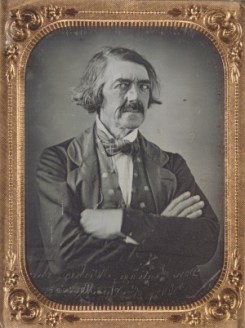
James Kirker. Source: Missouri History Society
A change in governance in Chihuahua put a stop to his activities, but unfortunately also brought an increase in Apache attacks. Kirker was eventually redrafted. His attacks on the Apaches would result in the undying hatred of Cochise and probably actually increased the intensity of the Apache attacks until the last bands were finally subdued in the 1880s.
But Kirker wasn’t satisfied with killing Apaches. Just as he’d turned traitor to them, he also turned traitor to his adopted country. When Colonel Alexander Donovan marched his Missouri Volunteers into northern Mexico in 1846, Kirker provided Donovan with valuable information about the location, strength, and best strategies for capturing the Mexican gun emplacements at Chihuahua. He was familiar with the fortifications there because of his work for Chihuahua officials against the Apaches.
After the war, Kirker returned to Santa Fe after the war, where he participated in at least one campaign against the Utes. Eventually he headed to California, where he settled and died in early 1853. He seems to have been a model citizen there. Maybe by that time (he was in his mid-50s), he’d decided that there was more to life than adventure.
Richard Batman, James Pattie’s West, the dream and the reality. Norman: University of Oklahoma press, 1986; Leroy R. Hafen, Fur Traders and Trappers of the Far Southwest, Logan: Utah State University Press, 1997; David J. Weber, The Taos trappers, the fur trade in the far Southwest, 1540-1846, Norman: University of Oklahoma press, 1971
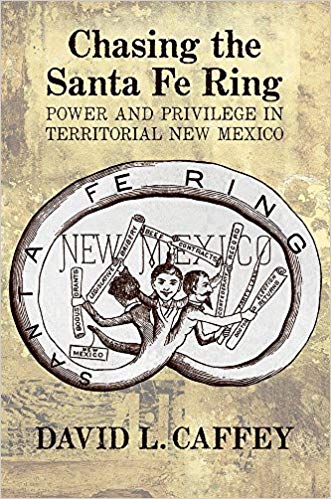
by David L. Caffey University of New Mexico Press, 2014 ISBN: 978-0-8263-1947-0
In New Mexico, the words “Santa Fe Ring” convey the same concept as the words “Tammany Hall” in New York. The Ring is synonymous with collusion by a few to suppress the many, the use of political power for private ends, and the accumulation of wealth by unsavory means.
InChasing the Santa Fe Ring, David L. Caffey describes the beginnings, height, and end of the Ring and the people involved in it. The major figures he discusses include, of course, Thomas Catron, Governor Samuel Beach Axtell, Stephen Benton Elkins, and William Breeden. But there were a number of less well-known figures that had links to the ring—Colfax County men like physician Robert Longwill and attorney Melvin W. Mills and Santa Fe merchants like Lehman Spiegelberg and Abraham Staab. Caffey places the activities of these men in context and also provides a helpful summary of their activities in the back matter.
One of the pleasures of reading this book is learning about the connections between the Ring and the various events in New Mexico Territory that tend to be treated as stand-alone eruptions—for example, the Lincoln County War and the Colfax County War. Chasing the Santa Fe Ring is actually a great way to obtain a comprehensive history of the Territory from the lens of the Ring and its particular chronology of events.
Catron and his allies seem to have had their hands in any and every opportunity that appeared to promise a monetary return. This included something as large as using their legislative power to “open up” the land grants to acquisition by outsiders and as small as arranging for jury members to be paid in script with little or no monetary worth, buying that script up, and then forcing a law through the legislature which increased its value.
But this book isn’t just a record of the wrongs perpetuated by the Santa Fe Ring. It’s also the story of how a few people took action and brought an end to its power. One of those people was Mary Tibble McPherson, a woman who didn’t actually live in New Mexico. But her daughter did. By the time McPherson was finished raising hell, even Washington D.C. was taking notice.
Mary McPherson wasn’t the only person involved in the fight against the Ring. But to find out more, you’ll have to read the book. If you’re interested in New Mexico history in the Territorial period, Chasing the Santa Fe Ringis a great resource. I recommend it!
Suzanna’s eyes narrowed and her lips tightened. “I did not come to this god forsaken valley to live in a cave,” she snapped. The toddler on her hip started fussing but Suzanna only shifted impatiently and continued to glare at her husband on the other side of the room. “You promised me glass windows. You also said you wanted to farm, that you were finished with trapping.”
Gerald gestured at the beaver pelts lying just inside the cabin door. “I was finding the means to buy glass,” he said mildly.
Suzanna turned away. “The money will just go to something else.” Alma fussed again and Suzanna bent to place her on the floor. “The mule will go lame or cougars will take down a couple more calves.”
“Suzanna sweet–”
“Don’t you ‘sweet’ me!” She straightened, hands on her hips. “I will not be sweet-talked out of this! You can’t expect me to live in a cabin with just shutters at the windows, sitting in the dark whenever it rains!”
“We have lamps.”
“It’s not the same and you know it!”
Alma had toddled to her father. She clung to his leg, looking up at him. “Papa stay home?” she asked. “Mama ang’y.” She shook her dark curly head. “Me don’ like Mama ang’y.”
Gerald and Suzanna stared at each other for a long moment. Then Gerald scooped Alma into his arms and Suzanna threw her hands in the air helplessly and crossed the room. She leaned her head against his shoulder. “I had no idea when you would return,” she said into his sleeve.
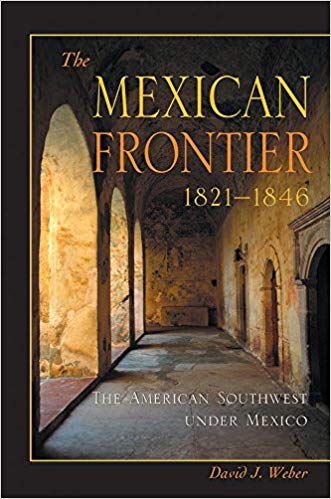
The Mexican Frontier 1821-1846, the American Southwest under Mexico, David J. Weber, ISBN 0826306039, University of New Mexico Press, 1982
The Mexican Frontieris the book for those of us who think the American West was “unsettled” before the United States expanded into and past the Rocky Mountains in the mid-1800s. Its author, noted historian David J. Weber, reminds us that Spain had claimed what is now Texas, New Mexico, Arizona, and California, in the 1500s, long before the various British attempts to colonize the East Coast.
When Mexico declared its independence from Spain in 1821, what is now known as the American Southwest came under its jurisdiction. The Mexican Frontier 1821-1846 is a comprehensive look at the the region between 1821 and 1846, when it was acquired by the United States as a result of the Mexican War.
This book fills an important gap in our knowledge of North American history. Weber not only provides a good overview of Mexican policy and how it affected the country’s Northern Frontier, he also points out the similarities and differences between Texas, New Mexico, and California, both in terms of how government policies were interpreted and enforced and how the different regions reacted to them. This discussion was particularly helpful to me in clarifying the connections between events in Texas and in New Mexico in the 1830s and 40s. It’s been foundational to my research for upcoming novels, especially as I dive into the complexities of the New Mexico Tax Revolt in the 1830s.
If you want to understand the history of Texas, New Mexico, Arizona, and California prior to the American takeover, I recommend that you read this very readable book.
On Thursday, June 16, 1910, the United States Congress finally agreed to allow New Mexico to become a State, ending a quest that had begun 62 years before.
The delay was partly New Mexico’s fault. In their first bid for statehood in 1848, New Mexico’s citizens had stipulated that they enter the Union as a free (non-slave) state. That requirement guaranteed that the slave-holding states would oppose New Mexico’s entry.
But a little opposition never has kept New Mexico from trying again. There were at least three other attempts to gain Congressional approval—in 1850, 1875, and 1902.
When Congress approved a process in 1906 for a combined state of New Mexico/Arizona, it looked like success was in sight. New Mexico voted for the proposal. However, Arizona voters rejected the plan.
Then in 1908, William Howard Taft became President. During the campaign, he’d pledged to make New Mexico a state. He kept his word. His Republican-controlled House and Senate approved legislation that initiated the formal process for Statehood and Taft signed it into law on Saturday, June 18, 1910.
A year and a half later, those formalities were completed and, on Saturday, January 6, 1912, President William H. Taft signed the formal proclamation that approved New Mexico’s entry into the Union. New Mexico was finally a state.
So the next time someone tells you that Presidents never keep their campaign promises, remember President Taft and the case of New Mexico statehood.
Sources: Thomas C. Donnelly, The Government of New Mexico. UNM Press: Albuquerque, 1953; David V. Holtby, Forty-Seventh Star, New Mexico’sstruggle for statehood. University of Oklahoma press: Norman, 2012; Marc Simmons, New Mexico, an interpretive history, UNM Press, Albuquerque, 1988


 Fiction and Fact From Old New Mexico