CULTURE CLASH

Ewing Young and his trappers were well into the Gila wilderness and moving steadily through its rocks and pines the afternoon the string of four men and three mules came into view. The strangers were working their way up a dry arroyo that intersected with Young’s path.

Young held up a hand and his men all stopped in their tracks and watched the other group scramble toward them, though Enoch Jones huffed impatiently at the delay.

“Chalifoux!” Young said when the newcomers got within speaking distance. “I thought you were trapping south with James Baird.”

“Baird, he is dead,” the tallest of the two long-haired Frenchmen said. “La maladie, it got him.”

“I’m sorry to hear that.”

“We came on anyway,” Chalifoux said. He gestured behind him. “Me, my brother, Grijalva, and him.”

The men behind Chalifoux nodded at Young politely. The youngest, the one with the dark skin and tightly-curled black hair, seemed to tense as Young’s gaze landed on him, but Young only nodded absently and turned to Chalifoux. “We’ve got thirty in our troop,” he said. “I figure that’s about all the Gila can handle at any one time. You headin’ that way?”

“It is as God wills,” Chalifoux said. “Perhaps to the north, toward the salt bluffs[1] of the Navajo.” He scratched his bandanna-covered forehead and nodded toward the third man in his small train. “Grijalva here, he shot a buck.” He jerked his head toward the pack animal being led by the dark-skinned young man. “A good size one. You want we share the meat tonight?”

“Sure, why not?” Ewing Young grinned and jerked his head toward the end of his own train. “Fall in behind and we’ll help you to cut that deer down to a more packable size.”

The Frenchman’s party stood and waited as Young’s men filed past. The trappers eyed the dead buck with interest. A good meal of venison would make for a pleasant evening.

But it wasn’t quite as pleasant as it could have been. The visitors produced whisky to accompany the meal and Enoch Jones took more than his share. Jones was apt to be more surly than usual when he drank and the presence of the young black man seemed to aggravate him.

He was leaning sullenly against a large rock that jutted from the ground a few yards beyond the fire, nursing yet another drink, when the younger man approached, a small book in his hand. The stranger crouched down beside the stones that circled the fire, opened the book, and angled its pages so the light would fall on them.

Jones scowled and leaned forward. “What’re ya doin’ there?” he demanded. He set his tin cup on top of the big rock, stepped forward, and nudged at the black man with his foot. “Hey! I asked a question! What’re ya doin’?”

The man looked up. “I’m reading,” he said. He turned the book so Jones could see the spine. “It’s a play by Mr. Shakespeare called Othello.”

Jones scowled at him. “What’s yer name, anyway?”

“I’m called Blackstone.” The man considered Jones for a long moment, then asked. “And what is your name?”

Jones stalked away into the night. Blackstone’s eyes followed him thoughtfully, then returned to his book.

But Jones was back a few minutes later, followed by Chalifoux. Jones jabbed a thumb toward Blackstone. “You see what he’s doin’?” he demanded.

Chalifoux grunted. “It appears to me that he is reading.” He turned away, but Jones blocked his path.

“That’s illegal!” Jones said. “Ya can’t let him do that!”

“He is a free man, Mr. Jones,” Chalifoux said. “He can do as he likes.”

Jones’ face turned red. “He’s a nigger! He ain’t allowed t’ read!”

Chalifoux raised an eyebrow. “This is a new law? One I know nothing of?” He turned to Blackstone. “What is this law?”

The younger man looked up, moved a small ribbon to mark his place, and closed the book. “I believe there is a law in South Carolina which makes it illegal for slaves to learn to read or write.” He shifted the book into his left hand, lifting it as if its very bulk was pleasant to him. “However, as you say, I’m a free man. So the law wouldn’t apply to me even if we were still in the United States.”

“Which it is certain we are not,” Chalifoux said. He bent, picked up a stray pine cone, and tossed it into the fire.

Blackstone glanced at Jones, then away. “And there’s certainly no such law here,” he said.

“Damn uppity nigger!” Jones said. He surged past Chalifoux, leaned down, and grabbed Blackstone’s arm. “You talkin’ back t’ me?”

Blackstone rose in one easy motion, elbowing Jones aside. “I was speaking to Mr. Chalifoux,” he said evenly.

Jones reached for the Shakespeare, but Blackstone lifted it out of his reach. Then Jones’ foot struck sideways, into Blackstone’s shin, and the younger man stumbled and lost his grip on the book, which landed, page end down, on the stones beside the fire.

“You bastard!” Blackstone turned and shoved Jones with both hands. Jones sprawled backward, away from the fire and onto the ground beside the big rock.

Blackstone swung back to the fire and the Shakespeare, but Chalifoux had already leaned down and lifted it away from the licking flames.

As the Frenchman handed the book to Blackstone, Jones heaved himself from the ground. He was halfway to the fire again, his fists doubled and ready for battle, when Ewing Young stepped from the darkness.

“What’s goin’ on?” Young asked.

Jones stopped short. “Nigger bastard sucker punched me!” he growled. He glared at Blackstone. “You ain’t seen the last o’ me.” Then he turned and stalked into the night.

“Is he always so pleasant, that one?” Chalifoux asked Young.

Young spread his hands, palms up. “There’s one in every bunch.”

Chalifoux shrugged expressively, then tilted his head back to study the trees and the stars overhead. “We will move north in the morning,” he said. “My party and me to the salt bluffs, I think. They tell me they are a sight worth the seeing.”

from Old One Eye Pete
WILD KNOWLEDGE

He wasn’t a man to pay much attention to girl children, but this one was different. She didn’t seem interested in cooking or clothes. More likely, she’d be in the canyon, fishing the Cimarron River. Her brother was the dreamy one, the one watching the fish swim ’stead of trying to catch ’em.

So the man was surprised when she came around the curve of the path and stopped to watch him cook the wild carrot root. He’d cut off the flowers and was slicing the root into the pot on the fire.

“Good eatin’,” he told her. “Back home, they say these make your eyes strong.”

She frowned. “Not that,” she said, shaking her head.

He was hungry. He lifted the last piece to his mouth.

“No!” she said sharply.

He raised an eyebrow at her and lowered his hand.

“That isn’t carrot,” she said. “It’s poison hemlock.”

from Valley of the Eagles

What is a “Genízaro”?

My August 3, 2020 post discussed the 1837 rebellion in New Mexico and described the rebel governor as genízaro Jose Angel Gonzales. Today, I want to discuss what meant by the word “genízaro.”

In New Mexico in the 1830s, the term was technically outlawed. All racial identifiers had been banned in the 1820s, after Mexico gained its independence from Spain. However, the term was still generally used for people whose ancestors originated in one of the Native American tribes in the region, more specifically the “wild tribes” of the Utes, Apaches, Comanches, or Navajos.

My 1960s-era Spanish dictionary tells me “genízaro” means “composed of different species,” or, in Mexico, “half-breed.”  According to Ruben Cobos’ dictionary specific to New Mexico, in the 1800s, the term referred to the children of non-European parents of mixed blood, or to a non-Pueblo Indian captive rescued by the Spanish settlers.

This term “rescued” is very telling. It underscores the idea that a child taken from a nomadic tribe, baptized Catholic, and raised by Spanish settlers was both saved from hell and given the chance to be “civilized.” This idea a justification purchasing children from tribes that had stolen them from other tribes, as well as capturing them directly. Thus, a Navajo child could be “rescued” from its Comanche captors but could also be “rescued” by stealing it away from its parents.

The resulting group of people formed a useful work force for the Spanish settlers. As adults, they often set up households of their own. In some cases, they banded together in communities at the margins of the Spanish settlements. Some of these—Abiquiu, Jarales, and Carnué, for examplte—still exist.

In recent years, there’s been a resurgence in interest in these communities and their story. The two links below are to videos with more information about this topic.

https://www.npr.org/2016/12/29/505271148/descendants-of-native-american-slaves-in-new-mexico-emerge-from-obscurity

New Book Shares Genízaro Slavery History in New Mexico

This book was released December 1, 2019. You can find it here.

Sources: James F. Brooks, Captives and Cousins, Chapel Hill: University of North Carolina Press, 2002; Cassell’s Spanish Dictionary, New York: Funk & Wagnalls, 1960; Ruben Cobos, A Dictionary of New Mexico and Southern Colorado Spanish, Santa Fe: Museum of New Mexico Press, 2003.

TOO SILENT

The boy sits silently near the creek bank and watches his twelve week old puppy among the grasses, sniffing invisible trails. The boy has learned from long practice to sit motionless for long stretches of time. Being still has enabled him to see much that other humans, especially adults, will never discover–coyote puppies learning to hunt, damsel fly nymphs emerging from their chrysalis, the way a brook eddies at times against the wind.

The dog may never see these things either, the boy reflects complacently as he watches his new pet. Not until he is much older and has learned to be still.

In the warm mountain sun, the boy’s shoulders relax and his eyes begin to glaze over. He is not prepared for the sudden movement from above. The golden eagle’s outstretched wings shadow the boy and dog at the same moment, then the pup gives a high-pitched yelp and is gone, the boy too startled to cry out.

When he stumbles home with tear-streaked face, his mother folds him wordlessly into her arms. “I sat too still,” he moans into her chest. “I was too silent!”

from Valley of the Eagles


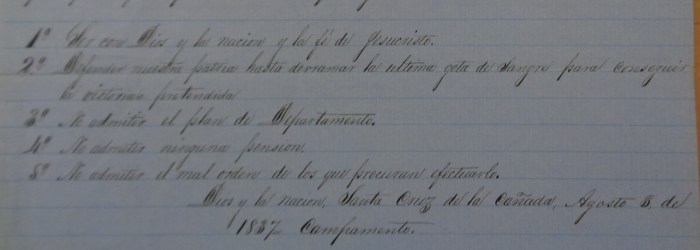
Rebellion in Northern New Mexico!

On Thursday, August 3, 1837, rebellion broke out in northern New Mexico.

Trouble had been brewing for over a year, fed by a Governor who was quicker to borrow money than distribute it, new laws restricting the right to vote, and the threat of new taxes. On top of that, Governor Perez was now inserting himself into local affairs. When he slapped the alcalde of Santa Cruz de la Canada in jail for making a decision the Governor didn’t like, something snapped.

A mob freed Alcalde Esquibel and he came out of prison with a plan. The people would set up their own government, one that he felt reflected the original intentions of the Mexican revolution and also asserted the right of New Mexicans not to pay taxes.

When Perez got wind of the rebel’s intents, he marched out of Santa Fe with a coalition of his officials, Presidio troops, militia, and Pueblan warriors. Unfortunately for the Governor, on the morning of Tuesday, August 8, shortly after he and his men stumbled on the rebel troops at the volcanic outcropping known as Black Mesa, most of his militia and warriors switched sides.

1837 Rebel Pronouncement
A copy of the rebel proclamation, courtesy of the New Mexico State Archives.

The battle took less than an hour. The Governor and his officials fled south. The rebels followed. By nightfall two days later, Perez and his men were dead and the rebels had installed a new Governor, genizaro Jose Angel Gonzales.

There would be push-back from the government loyalists in New Mexico, of course, especially those in the Albuquerque area and farther south. But, for now, the rebels were in charge.


Sources: Lecompte, Janet. Rebellion in Rio Arriba 1837. Albuquerque: University of New Mexico Press, 1985; Simmons, Marc. New Mexico: An Interpretive History. Albuquerque: University of New Mexico Press, 1988; Weigle, Marta, Ed. Telling New Mexico. Santa Fe: Museum of New Mexico Press, 2009


RATTLED

“I don’ keer if you don’ believe me,” the old trapper said as he pushed his matted brown hair away from his eyes. He shifted the Harpers Ferry 1803 rifle impatiently. “If’n yer too smart for yer own good, it ain’t none o’ my doin’.” He stroked the maple half-stock with its short barrel, looked balefully at the younger man, and turned to place the rifle next to his pack. The metal rib brazed to the underside of the barrel glinted in the firelight. “Thinks he’s smarter’n the rest o’ us,” the trapper muttered to the wagon master, who was sitting on his heels on the other side of the fire, smoking a carved cottonwood pipe.

“I didn’t say that I disbelieved you,” the young man in the black broadcloth coat said evenly. He brushed a piece of ash from his sleeve. “I simply stated that I was unaware of any unique characteristic of the 1803 issued to Lewis and Clark’s Corps of Discovery, other than the half-stock and its excellent balance.” He shrugged a shoulder. “My father was issued an 1803 during the 1812 conflict. He recollected it quite fondly and frequently. However, he never mentioned an unusually short barrel.”

“Jest cuz yer Daddy didn’ say it, don’ mean it weren’ so,” the old trapper grumbled.

“That may be the case,” the young man said stiffly. “I was unaware that I was contradicting you. I understood that we were merely exchanging some particularly intriguing information.”

“Ten dollar words.” The old man rubbed his matted hair, unfolded himself upward without looking at the others, and stalked off into the night.

The young man in the black coat looked across the firelight at the wagon master. “I didn’t intend to offend him,” he said uneasily.

The wagon master took his pipe from his mouth. “Oh, I wouldn’t worry ’bout it,” he said. “Ol’ Matt gets himself worked up like that sometimes. But he’s like a garden snake, all fizz an’ no real fury.” He glanced into the darkness. “But don’t say I said so. Not where he can hear. He wants ya t’ think he’s a rattler.”

from Valley of the Eagles

New Mexico’s Casa Real

This video is a good overview of the Casa Reale, or Palace of the Governors, in Santa Fe, New Mexico, and of some of the major personalities who governed from it.

Estancia’s Press

Watch this video for information about the town of Estancia and the press that published Jack Thorpe’s seminal 1908 book Songs of the Cowboys. It also shows how a platen press worked! I really enjoyed this one.

BEAVER TALE

The yearling beaver is hungry, but when he tries to filch a piece of tender green shoot from his baby siblings, his mother hisses sharply. He moves toward the lodge’s diving hole, but his father blocks the way and chitters at him. The yearling slinks to one side of the den and begins grooming his fur with his right hind foot. The divided nail on his second toe makes for a kind of comb that simplifies this process considerably.

There are three new kits this spring, which keep his parents busy. His father moves to help with the feeding, and the yearling sees his chance. He slides into the diving hole and out into the pond.

The sky is bright overhead. The beaver dives, but not before the old trapper on the bank nudges the young girl beside him. “See, I tol’ you that ole lodge was still occupied!” he says gleefully.

* * *

“Old Pete ain’t gonna trap it, is he?” Andrew whispers. The two children are crouched on the edge of the beaver pond, peering at the yearling beaver feeding on the opposite bank.

“He says he needs a new hat, and beaver tail is mighty tasty,” Alma answers.

“He don’t need a new hat!” Andrew says loudly. There’s a slapping sound on the water to their left, and the yearling turns and slides into the pond.

“I didn’t even see the other one,” Andrew says sorrowfully.

“Should of kept your voice down.” Alma stands up.

“How can you watch ’em like you do and not worry about Old Pete trapping ’em?”

She shrugs. “Everything dies. Mama says it’s all part of God’s plan.” She moves away, toward the rocky path that leads up the Cimarron River toward home.

“Old Pete don’t need a new hat,” Andrew insists as he follows.

* * *

“Beaver tail is almighty tasty,” Old Pete observes as he sits on the front porch whittling a stick.

Andrew scowls. “Papa says it’s all fat and grease. Not good at all.”

“Fat tastes plenty good when you’ve been eatin’ venison and elk a long spell. Wild game’s almighty lean.”

“You been eatin’ here,” Andrew insists. “We’ve got plenty o’ fat from the hogs.”

Andrew’s mother comes out of the house. “The kindling box is empty,” she tells him.

He rises obediently and heads toward the woodpile.

“Are you still teasing him about trapping that beaver?” she asks Old Pete.

The old man grins. “He’s a right risible youngster, ain’t he?”

“Who admires you, although I can’t think why,” she says tartly. “He’s beginning to believe that men kill for the sheer pleasure of it.”

Old Pete grunts and tosses his stick to the ground. “Think I’ll help with that kindling,” he says.

* * *

“I ain’t gonna place a trap for that beaver, son.” Old Pete and the boy are resetting a garden fence post. Andrew holds it steady as Old Pete shovels dirt into the hole.

“Alma said you need a new hat.”

The old man chuckles. “Hat’s good fer another season or two.”

“But what then?”

“Somethin’ll turn up.”

“You said beaver tail was tasty.”

Old Pete leans on his shovel. “Funny thing ’bout that. Only really tasted good when there was plenty to trap an’ the peltries were sellin’ high.” He begins tamping down the dirt around the post with his foot. “You think this’ll be strong enough t’ keep those elk out?”

“I hope so. Mama got pretty mad at them last spring. She was out here with the shot gun, but Papa says all she did was scare ’em. They’ll be back when they’re hungry enough.”

from Old One Eye Pete


The Spanish Language in New Mexico

Although this is a presentation about a book, it has some interesting information about New Mexico Spanish and it’s origins and external (Caribbean and Nahuatl) and internal (Pueblo) influences. Interesting!