In June this year, I posted something very rare for me: a less-than-positive book review. The review was of a book that serves as a primary source for most historical research about the ill-fated 1841 Texan Santa Fe Expedition. I had a number of issues with that text. However, during my own work on the Expedition, I was pleased to discover primary source that I can recommend wholeheartedly: Letters and Notes on the Texan Santa Fe Expedition, 1841-1842 by Thomas Falconer.
Falconer was one of the few British members of the Expedition. A trained barrister with a strong interest in the natural sciences, he traveled to Texas to explore emigrating there and was almost immediately invited by President Lamar to accompany the Expedition as a scientific observer. Kendall describes Falconer as a “gentleman of high literary and scientific attainments [with] mild and agreeable manners,” who was “extremely sociable and companionable” (Kendall, I, 26-27), rather careless of his appearance, but well equipped with “a number of books and scientific instruments” (Kendall, I, 43).
Falconer’s books, instruments, and notes were, unfortunately, confiscated when the Texans finally reached New Mexico. However, his memory and interest in his surroundings stood him in good stead. After he was released from prison in Mexico City, he went to New Orleans, where he developed a report for Kendall’s newspaper, the New Orleans Picayune. This and his “Notes of a Journey Through Texas and New Mexico,” published in the British Journal of the Royal Geographical Society in 1844, form the core of Letters and Notes.
This book is valuable for several reasons. First, it provides an antidote to Kendall’s more excitable, and not altogether trustworthy, version of events in New Mexico in 1841; second, it gives us valuable information about the geography and plants of the region during the early 1840s; and third, it provides an outsider’s view of the Texans and their foibles, as well as insight into the sort of information about the North American continent that the English found useful.
Falconer’s other books, one about the Oregon question, and another about the discovery of the Mississippi, are also fascinating reads, but if you’re interested in the history of New Mexico, particularly the 1841 Texan Santa Fe Expedition, I highly recommend his Letters and Notes.
Mexican militia captain Damasio Salazar hadn’t been particularly pleased about his assignment to take the final batch of Santa Fe Texas Expedition prisoners south to El Paso del Norte. However, the past four days hadn’t been too bad. The prisoners had complained, of course, and he’d had a bit of trouble locating enough food for them, but the communities between San Miguel del Bado and Valencia had been surprisingly generous, especially the pueblos north of Albuquerque.
But now, on Monday, October 21, 1841, trouble had really started. First, he woke to a dead prisoner. Felix Ernest had been weak to begin with. And no wonder. He’d been with the Texans who had been out the longest and starved the most. The poor scurvy-ridden devils had ended up eating lizards, snakes, and boiled horse hide. Ernest hadn’t been actually ill, as far as Salazar knew. He was just too weak to wake up.
The Captain acted quickly to prevent other prisoners from dying on him by immediately requisitioning a cart from the Valencia alcalde and loading the weakest men onto it. But the dilapidated thing was so overwhelmed with riders that it fell apart a mile down the road.
This disaster precipitated another problem. A Texan who’d been riding, a man named McAllister, was so lame he couldn’t walk any further. When one of the more stupid of Salazar’s guards threatened to shoot him, the Texan yelled at him to do just that, and the idiot took him at his word.
Now Salazar had two dead prisoners to account for when he reached El Paso. He couldn’t very well carry the bodies with him. He’d had to resort to cutting off the men’s ears as proof they hadn’t run away.
He must have been thankful when he and his column finally reached the day’s destination, a grove of cottonwoods on the east bank of the Rio Grande south of Belen. The captain ordered one of the nineteen Texan cattle slaughtered. Maybe the meat would put some strength into the men and get them through what was to come. There were only a few more towns where he could acquire rations. Then, he and his prisoners would face the Jornada del Muerto.
By his calculations, they would be crossing right at the end of October. He needed to get 187 men, their guards, and the animals across a 90 mile stretch of wasteland notorious for a lack of water, especially this time of year. It was at least a three-day journey across a land of sand, rocky outcroppings, and an occasional stunted cactus. There was a reason it was called the journey at death.
The place lived up to its name. Three more men died crossing the Jornada. Salazar took their ears as well, and presented them to the Presidio commandant at El Paso del Norte. Although the Texan prisoners, particularly American newsman George Kendall, were appalled by what they saw as his savagery, the Captain was actually following orders —and precedent. The use of ears to account for dead enemies had been instituted by the man he presented them to in early November 1841.
Salazar did face a court-martial however, in response to questions Kendall raised about the Texan cattle left grazing outside El Paso. Once he’d been cleared of wrongdoing, the Captain returned to New Mexico. He would live out his days there, although he did have a brush with Anglo retribution in December 1846, when he was accused of participating in a conspiracy against American occupation.
There was no evidence that he’d been involved in those aborted plans and Salazar was allowed to go home in peace. Whether or not he was still haunted by the memories of the 1841 march south to El Paso is another question entirely.
Instead of doing a typical book review this time, I’ve chosen to write about one of my favorite New Mexico authors, the man who wrote under the pseudonym Fr. Stanley. Born in New York in 1908, Stanley Louis Crocchiola was ordained at age 30 in the Franciscan Order of Atonement. He had contracted tuberculosis by this time, so his superiors sent him to Hereford, Texas where they assumed the arid climate would help him heal. Ironically, he arrived there in February 1939 during a black dust storm. He survived that, though, and in 1940 was transferred to Santa Fe, New Mexico. The dry climate does seem to have suited him. He lived to be 87.
He used that time to learn about the history of the various communities he served in New Mexico and, in 1948, began chronicling their history. The resulting books, published under the pseudonym Fr. Stanley, are a charming mixture of stories told by old-timers, newspaper clippings, and on-the-ground observations. Many of them are printed on folded-over 8.5 x 11 paper stapled in the cross-section, or saddle-stitched, a kind of historical chapbook.
Fr. Stanley’s books often have the same simple cover design–a bright yellow background containing a red zia symbol and typeface. At least for the New Mexico books, the titles are also often nearly identical. The four I own are The Stanley (New Mexico) Story, The Elizabethtown (New Mexico) Story, The San Miguel del Bado (New Mexico) Story, and The Miami (New Mexico) Story.
Father Stanley wrote and published over 170 books, the majority in this simple format, though some, like The Duke City: The Story of Albuquerque, New Mexico and The Civil War in New Mexico were published in hardback. They are all a great resource for discovering the details of New Mexican life in the late 19th and early 20th centuries–everything from the types of apples grown in Miami to the names of the men on the Elizabethtown baseball team.
This interest in the minutiae of life is the defining characteristic of Father Stanley’s books and makes them well worth reading because they give us an almost newspaper-like glimpse into a bygone world. The only trouble is, they’re no longer currently being published. If you want a copy of The Bethel (New Mexico) Story, The Texico (New Mexico) Story, The Causey (New Mexico) Story, The Grant That Maxwell Bought, The Magdalena (New Mexico) Story, The Abo (New Mexico) Story, The Golden (New Mexico) Story, or any of the others, you’re going to have to find a secondhand bookseller.
I encourage you to do so, even at the risk of driving up prices on the many Stanley books that I still don’t have in my collection. For sheer joy in New Mexico history, in all its details, I recommend Father Stanley’s work!
After a torturous journey, George Wilkins Kendall and a small group of fellow Texans finally reached New Mexico in mid-September 1841. And were under lock and key.
The approximately 300 men of the Texas Expedition to Santa Fe had divided into two groups at the end of August and sent 100 (including Kendall) ahead to find provisions for the rest, who waited with the wagons.
On Tuesday, September 14, 1841 Kendall and three other men rode into Anton Chico, New Mexico looking for food. When it became clear that the little village couldn’t supply what was needed, they headed across country toward San Miguel del Bado. They made it, but not quite the way they’d planned. By the time they reached town, they were in the custody of Mexican militia under Captain Damasio Salazar.
Kendall and his group spent just over a month incarcerated at San Miguel del Bado, where flirted with the women, engaged in shooting contests, and observed village life while they waited for word of their comrades. News finally came on Monday, September 20, when the group of 100 (less four) marched through on the way to Mexico City.
The larger group who’d been left farther behind wouldn’t arrive until October 12. After a three-day rest, they also would head south, along with Kendall and his comrades, under the supervision of Captain Salazar.
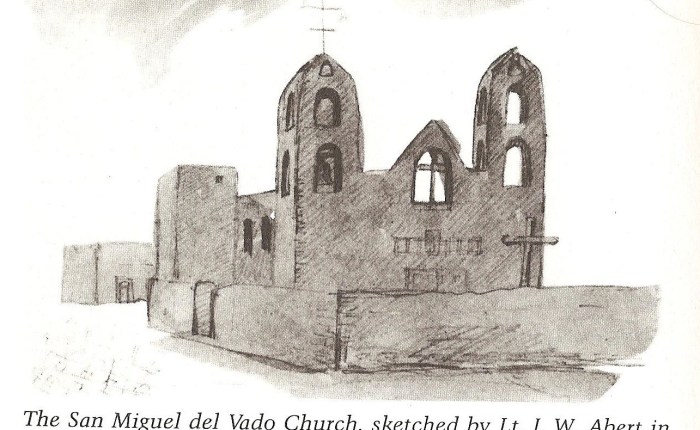
San Miguel del Bado was a logical place to incarcerate Kendall et al, as it was America’s port of entry into Mexico at the time. The town included barracks for the presidio soldiers stationed there, as well as mercantiles and other services for the 2000-plus residents. It even provided a space west of the church where in-bound merchant trains could wait for the customs official to survey their goods and calculate the import fees necessary to go on to Santa Fe or farther south to Chihuahua.
There isn’t much left of 1840s San Miguel del Bado today, except for the church with its three-foot-thick stone walls topped with adobe bricks and its twin bell towers. In Fall 1841, this building was the starting point for at least two religious processions that celebrated and gave thanks for the capture of the Texan Expedition. Kendall sneered at them both, describing the second one as “nonsensical mummeries.” He would have much to learn in the weeks to come.
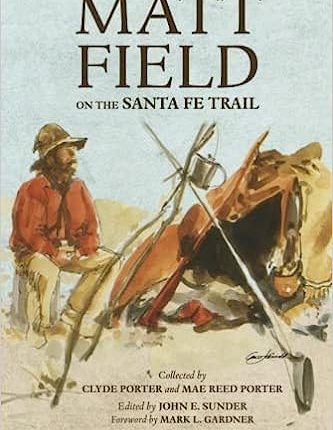
In 1839, a former actor named Matt Field decided to go to Santa Fe, New Mexico to regain his health. Although he failed to recover his physical well-being, Field did collect impressions and notes throughout his journey. After he returned to the U.S., he got a job at what is now the Time-Picayune/New Orleans Advocate and converted his jottings into a series of newspaper articles. The pieces were popular and were reprinted in papers as far away as London. I believe their positive reception inspired Picayune editor George Wilkins Kendall to make his own attempt to reach Santa Fe, a journey he would record in his Narrative of an Expedition Across the Great Southwestern Prairies from Texas to Santa Fé, which I discussed in June.
Over a hundred years after his trip, Matt Field’s articles were collected and published as Matt Field on the Santa Fe Trail. The young actor turned reporter definitely reflected the attitudes of his day, and some readers may find those biases upsetting, but there is also much to enjoy and to learn from this book. Field’s views of Santa Fe specifically and New Mexico in general are excellent examples of how Americans viewed the land and people that blocked their access to the Pacific Ocean. The book is a mixture of admiration for the women’s beauty, fascination with everything from Taos Lightning (wheat-based whiskey) to the New Mexican custom of community dances, and shock at the idea of priests and women who gamble and make money at it.
Matt Field on the Santa Fe Trail can be an exasperating book. His description of Governor Manuel Armijo’s wife as an elephant dancing is just rude and his misunderstanding of the role of Gertrudes Barceló as a business woman is a clear example of one society’s gender expectations being loaded onto another culture. However, these and other passages are precisely why I keep this book in my library. Matt Field on the Santa Fe Trail reminds me that we do not always see ourselves and our biases as clearly as we think we do. Even when we believe we’re open to new experiences, our unexpanded frames of references can still distort our perceptions.
And that is why I recommend Matt Field on the Santa Fe Trail to anyone interested in history in general and New Mexico in particular. It’s a fascinating historical document in itself and can also help keep us honest about our own take on the world around us and remind us that we may also possess attitudes we haven’t completely examined. And may not want others to know about a hundred years from now.
I’ve mentioned George Wilkins Kendall in recent posts and thought I should explain who he was and why I think he’s important to the events that led to the 1846-47 conflict between the United States and Mexico.
A rather handsome man, Kendall had thick, wavy brown hair and loved fashionable clothes. He was also a quick learner who tended to focus only on what he was particularly interested in. At age 16, he announced that he wanted to become a printer and went to work for the Amherst Herald, which was owned by his first cousin and a friend.
When the paper collapsed 12 months later, Kendall went to Boston, where he apprenticed with the Statesman and experienced Boston theater. This sparked an interest in acting that took him to New York City and a position with a wandering theatrical group.
For the next five or six years, Kendall around the U.S., sometimes working in theater, sometimes in print shops or as a reporter. At one point, he even operated a stage coach line in North Carolina. Somewhere along the way, he returned to his first interest and acquired the skills of a journeyman printer. Around the same time, he began to transition into the role of newspaper reporter, writing for the Mobile, Alabama Register; the United States Telegraph and National Intelligencer in Washington City; the True American in New Orleans; and the Sentinel in Greensboro, Alabama. In 1836, he settled in New Orleans and he and a friend prepared to begin printing what is today the Times-Picayune/New Orleans Advocate.
For folks in New Orleans, Kendall’s legacy would appear to be a newspaper that’s been in print since January 1837. However, in the 1840’s, he had a more immediate impact on events at large. The Picayune had published a series of pieces by a reporter named Matt Field. The articles, based on Field’s 1839 trip to New Mexico, were picked up by papers across the country and as far away as London. Field made New Mexico look both wild and accessible at the same time, and the popularity of his pieces seems to have sparked Kendall’s interest in going there himself.
Around the same time, there was a lot of national discussion about whether the Republic of Texas should be invited to join the Union. Kendall, and other who supported annexation, saw it as an opportunity to expand the U.S. as far west as the Rio Grande.
Since its founding, Texas had claimed that its western boundary extended to the river and included Santa Fe. In 1840, Texan President Mirabeau B. Lamar decided to enforce that claim by sending a group of soldiers to New Mexico along with a few merchants, to make it look like a commercial venture. The Texas Santa Fe Expedition started from Austin in June 1841 and included Kendall, who, unlike his fellow travelers, had a passport from the Mexican vice-consul in New Orleans. As a reporter/publisher, Kendall had developed the habit of carrying a small black notebook, where he recorded ideas, jokes, and “sparks of wit” for future publication. He kept up this practice en route to New Mexico, noting both the good and the bad about the Expedition, its members, and their activities. He was devastated and furious when his notes were confiscated after he and other members were captured by New Mexico militia that Fall.
However, Kendall’s years as a reporter and his time on the stage seem to have stood him in good stead. He remembered in great detail what occurred between his capture, incarceration in Mexico City, and final return to New Orleans in May 1842.
As soon as he reached home, he began writing his memories down. The first installments were published in the Picayune in early June. This and the following chapters were reprinted in newspapers across the country and then into a book, A Narrative of an Expedition Across the Great Southwestern Prairies, from Texas to Santa Fe. The two-volume edition published in 1844 went on to become a best seller, with more than 40,000 copies sold over the next eight years.
The Narrative’s description of Mexico was both inflammatory and racist. Kendall portrayed the Texans as brave risk-taking Anglo adventurers while Damasio Salazar, the man who superintended the first part of the Texans’ journey south to Mexico City, was a “dark-visaged” monster with a vendetta against Americans. In addition, Mexican men in general were shiftless and the Mexican Army in particular was weak and poorly armed.
As the prisoners’ route takes them closer to Mexico City, Kendall begins to provide detail about the condition of the roads and the fortifications in the towns along the way. In fact, the book begins to seem more like a reconnaissance report than a traveler’s narrative. One has the sense Kendall hoped it would serve not only as a rallying cry against the “pernicious” Mexicans, but also as a handbook for an American invasion.
And he appears to have got what he wished for. When the war Mexicans know as “The War of the United States Against Mexico” came in 1846, many of the invading volunteers carried copies of Kendall’s book. After it was over, he published an illustrated book about the conflict, then went to Texas, where he settled in its Hill Country.
He is remembered there for his contributions to Texas sheep ranching. However, I consider the Narrative to be Kendall’s most lasting contribution to history. While many in the United States were already convinced in 1842 that its manifest destiny was to own everything to the Pacific, there was no justification for going to war to get it. But Kendall’s account of what he considered the inhumane treatment of the Texan prisoners gave people the excuse they needed.
He should be remembered for that, not with admiration, but as a caution to ourselves to carefully evaluate what we are told and the possible motivations that might influence that story’s content and message. As a reminder to watch out for the Kendalls in our own midst.
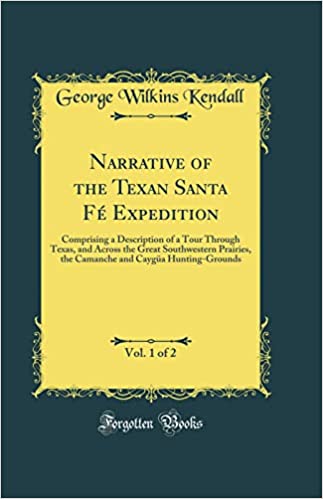
The Narrative is Kendall’s report of the experiences of the roughly 300 men who left Austin, Texas in June 1841 to capture New Mexico for the Republic of Texas. Many of the approximately 280 soldiers accompanying the Texas Santa Fé Expedition had been told it was a trading mission. In actuality, the goal was to enforce the Texan claim that its boundaries extended west to the Rio Grande and north to that river’s headwaters.
That enforcement never happened. The rugged landscape between Austin and New Mexico, along with the Expedition’s lack of planning and discipline, weakened the starving Expedition to the point that men threw away their weapons to lighten the load they carried.
Rounded up by the New Mexicans, the Expedition members were taken south to Mexico City in three groups. The third included Kendall and 186 other men. It was escorted by Mexican militia Captain Damasio Salazar and roughly 150 guards.
Salazar, hurrying to get this largest of the three groups south to El Paso del Norte before winter set in, did not spare his guards or the Texans, the majority of whom were still weak from their ordeal on the Eastern Plains. Five died, three from natural causes. Kendall’s Narrativeblames Salazar for all these deaths, painting him as such a monster that the Americans who invaded New Mexico five years later made it one of their first tasks to hunt the Captain down.
The fact that these men made finding Salazar a priority points to the popularity of Kendall’s Narrativeand its impact in the run-up to the Mexican-American War. Indeed, it could be argued that Kendall accompanied the Texas Expedition with the sole purpose of providing a reconnaissance report for the conflict on the horizon. From El Paso to Mexico City, he provides details about distances, road conditions, and fortifications, as well as his perception of the make-up and morale of Mexico’s military.
The way Kendall’s Narrative blames the Mexicans for not welcoming the invading Texans with open arms, brushes aside the gifts of food and clothing they did receive, and lays out information useful for a military incursion is almost breathtaking in its audacity. And yet his readers seem to have accepted his assertions without question. This makes the Narrativea useful example of the risks of reading uncritically, something that is still a danger for us today.
If you are interested in exploring historical sources with an eye to reading between the lines and trying to determine what might have really happened, and if you can stomach racist attitudes throughout the text, then I suggest you pick up a copy of Kendall’s Narrativeand read it in light of the inception and outcome of the subsequent 1846 invasion. You may find it quite enlightening.
The third book in Mary Armstrong’s Two Valleys saga, The White Sands, takes a further dive into the history of southern New Mexico as it explores the events that led up to the famous feud between Albert Fountain and Albert Fall. While Fall would go on to be implicated in the Teapot Dome scandal, Fountain would disappear into the White Sands in 1896 with his ten-year-old son Henry.
But I’m getting ahead of myself and Armstrong’s novel The White Sands. In this book, her narrator, Jesús Messi, gets to know the Lee family, the clan that was thought by many to be responsible for the Fountain disappearance. What he discovers is that there are two sides to every story, and more than one way to deal with a problem.
Armstrong uses Messi’s memory loss, suffered at the end of Book 2, to place him in the midst of the Tularosa Basin and the Lee network of family and friends. As part of that group, he comes to understand their perspective, which makes things awkward for him when he returns to Las Cruces. The teenage Jesús is caught between two worlds as he realizes that neither side is totally in the right—or the wrong.
His struggles are thoughtfully portrayed and provide a great way for Armstrong to explore the antagonism between the political parties at the time and the way those political divisions became deeply personal. In fact, the attitudes and events she recounts are eerily echoed in today’s news. They involve strong, opinionated personalities, convoluted legal questions, impatient and potentially coerced witnesses, and much more.
If you’re interested in southern New Mexico history in the late 1800s, the way our past is echoed by our present, or simply want an insightful coming-of-age story about an intelligent and perceptive young man, I highly recommend The White Sands.






 Fiction and Fact From Old New Mexico