“How old is Old Pete, anyhow?” Suzanna asked as she perched herself on a large granite rock and looked down at the valley with its long grass and meandering streams. She glanced at Gerald. “He doesn’t look much older than you.”
Gerald chuckled. “He’s been Old Pete as long as I’ve known him. They say Old Bill Williams started calling him that in ’26 when they were trapping with St. Vrain and his bunch north of the Gila. Pete was kinda harrassing Bill, wanting to know just how old he was. Finally, Old Bill got aggravated and started callin’ Pete ‘Old Pete.’” He grinned, plucked a piece of grass, and looked it over carefully. “And that’s what he’s been ever since.” Gerald put the grass stem in his mouth, bit down appreciatively, and chuckled again as he gazed at the green landscape below.
“Those mountain men are quite something,” Suzanna said.
“No, don’t go out there now,” Maria said. “It is late and there is no moon. El es oscuro como boca de lobo.”
“How d’you know how dark it is inside a wolf’s mouth?” Alvin Little grumbled as he put on his boots. “Leave me be.” He paused again, listening. The sound came again, the rattle of sticks tumbling off the pile of kindling just outside the door. “I spent two hours yesterday cuttin’ that kindling and I’m damned if someone’s gonna go stealin’ it.”
“El noche es más mala que Judas,” she protested. “It is unsafe.”
He reached for the door latch, then turned to look at her. “More evil than who? Judas, you say? Where d’you get this stuff?”
He stopped on the sill and shook his head as he peered into the darkness. A pale sliver of moon and no starlight. Heavy clouds blanketing the sky. He chuckled. So this was what a wolf’s mouth looked like. He leaned forward and peered at the wood piled alongside the cabin. He could just see the once neatly stacked kindling. Sticks lay haphazardly at the foot of the pile, as if someone had tried to climb it. Alvin scowled and stepped into the yard to gather them up.
A slight scratching sound came from the wooden roof, but Alvin didn’t have time to do more than lift his head before the mountain lion was on top of him, or hear more than Maria’s single scream before the big cat’s teeth found his throat.
When New Mexico’s first printing press arrived in Taos in late November 1835, its new owner Padre Antonio José Martinez didn’t waste any time putting it to work. On Friday, November 27, he announced that the press was be available to residents to use to publish “literary contributions.”
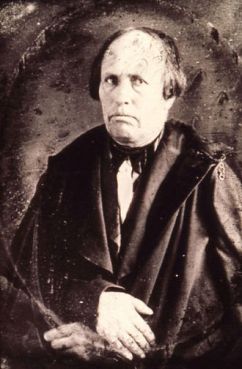
Padre Antonio Jose Martinez circa 1848
The press and its printer, Jesús María Baca of Durango, Mexico, had arrived in Santa Fe in 1832, brought there by Don Antonio Barreriro, a barrister and governmental deputy from Mexico City, apparently at the behest of nuevomexico Legislature’s Secretary, Don Ramón Abreu.
Barreriro used the new press to print a short-lived newspaper El Crepúsculo de la Libertad (The Dawn of Liberty), the first newspaper in New Mexico and possibly the first paper published west of the Mississippi. Abreu may have also used it to publish the first book printed in New Mexico, a spelling primer titled Cuaderno de Ortografía.
Following Barreriro’s return to Mexico, Ramón Abreu sold the printing equipment to Padre Martinez, the priest assigned to Taos’ Our Lady of Guadalupe chapel, who moved it to Taos. Once it and its printer were in place, Martinez put them to work, with output ranging from diligencia matrimonials (the standard forms for pre-nuptial investigations) to religious books. And hopefully Taos residents’ “literary contributions,” as well!
Sources: Fray Angelico Chavez, But Time and Chance, Sunstone Press, Santa Fe, NM 1981; Richard W. Etulain, New Mexican Lives: Profiles and Historical Stories, UNM Press, Albuquerque 2002; Rubén Saláz Márquez, New Mexico A Brief Multi-History, Cosmic House, Albuquerque, 1999.
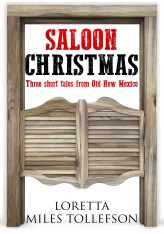
Give yourself a story break before you plunge into that holiday shopping! For the first time ever, I’m publishing Christmas stories set in Old New Mexico in ebook format!
Nine Days of Christmas is a never-before published long short story about a gringa who wants to participate in her village las posadas. Saloon Christmas is a collection of three stories, all of them set in Colfax County’s first county seat, Elizabethtown, New Mexico. If you don’t use Kindle, you can find links to other providers here. Enjoy!
The girl lifted her skirts away from her feet and eased toward the small brown-mottled duck on the creek bank. It was busily investigating a small marshy area where water had seeped past the bank. Alma wished she’d brought her bow and arrows, but she’d been sent out to collect greens, not meat.
The duck had its back to her. Alma eased forward and crouched, getting into position. Her right foot pressed her skirt into the mud, but she didn’t notice.
The duck turned slightly. Alma lunged forward. As her hands touched the bird’s smooth feathers, her foot ground into her skirt, yanking her off balance. The duck flew off with a panicked series of quacks and Alma pitched foward into the mud.
“Hell and damnation!” she said angrily. “I hate dresses!”
She got to her feet and looked down ruefully. Her mother was not going to be happy.
Placido Sandoval slammed the pick mattock into the rocks at his feet in a blind fury. “This Prussian, this not truly Americano, how dare he speak to me in such a way? As if I were dirt, less than nothing?” he fumed. “Mi familia has lived in this country for generations. I am of the conquistadors, the flower of España, while he is of the peasants in his country. I heard him bragging of it, how he has raised himself above his ascendientes.” He smashed the wide edge of his mattock against the largest of the rocks. A chip flew off, ricocheting into the face of the man working beside him.
“¡A redo vaya!” the other laborer said. “The devil! Be careful!”
Placido Sandoval swung the pick again, just as sharply, and his companion stopped his own work to turn away. “It does no good to be angry,” he said over his shoulder.
Placido glared at him. “It is good for my soul,” he growled. He slammed the pick against the nearest rock. Three large pieces broke free and tumbled farther down the stone-filled gully. “I will not be beaten by such as he. I will not be cowed.”
“You there!” Edward Bergmann, the mining supervisor, called from the bank above them. “You Mexicans!”
The two men paused and looked up. The Prussian’s finger pointed accusingly at Sandoval, his fierce black eyes indignant. “Did I not tell you to go slowly, to be more methodical in your approach? I’ll fine you again if you don’t stop flailing around!”
“I’ll flail you!” Placido muttered as he and his companion returned to their work. But his mattock chopped more sullenly now, reflecting the pattern Bergmann had set for it. Suddenly, gold glinted from the ground. Placido glanced up at the bank. Bergmann had disappeared. Placido bent swiftly and pocketed the chip of rock and ore.
Placido’s companion chuckled as he continued to swing his own tool. “That’s a more productive approach,” he said approvingly. He glanced toward the bank. “Though more dangerous if you are caught.”
Placido Sandoval grunted an unwilling acknowledgement as he continued on with his work, chopping at stones.
On Wednesday, November 10, 1875 Manuel Cardenas was shot and killed by an unknown gunman in the short distance between the Colfax County jail and courtroom in Cimarron, New Mexico Territory. Cardenas had been on his way to tell the justice of the peace what he knew about the mid-September death of Methodist missionary Franklin J. Tolby. Because Cardenas died when he did, the mystery of who shot Reverend Tolby, and why, was never solved.
Tolby had been a bur under the Maxwell Land Grant Company’s saddle since he’d arrived in the Territory in early 1874. He pointed out that Congress had thrown the grant land was open to homesteaders and objected strenuously to the Company’s program against the settlers they called “squatters.” Because of Tolby’s status as a minister of the gospel, people listened to him and resisted the Land Gant Company’s enforcers.
When Tolby was killed in the Cimarron canyon in September, many thought Civil War veteran Cruz Vega was responsible. As a result, Vegas was tortured and killed, but before he died, Vega fingered Manuel Cardenas as the man who’d shot Tolby.
Cardenas, in turn, claimed that the now-dead Vega had killed the minister. More importantly, he asserted that three prominent members of the community—men who were believed to be part of the Santa Ring—had ordered the killing. Since members of the Ring had a controlling interest in the Maxwell Land Grant Company, Cardenas’ claim made a lot of sense to many Colfax county residents.
However, Cardenas had yet to make his accusations before the County Court. And he died before he could do so. Since his killer was never identified, questions about Tolby’s killing and its aftermath remain to this day: Who killed Manuel Cardenas and why? Was it a Cruz Vega adherent, revenging the aspersion on his good name? Was it Clay Allison or a member of the vigilante group that killed Cruz Vega, seeking vengeance for Reverend Tolby’s death? Or did the Santa Fe Ring send out a killer to take out their killer before he could officially name names? For that matter, who killed Reverend Tolby? Was it Cruz Vega or Manuel Cardenas? And did members of the Santa Fe Ring really put them up to it? If so, how far did the conspiracy go? The Governor’s office? Unless new evidence shows up now, 142 years later, we’ll never know for sure.
And so the saga of Reverend Tolby’s death ends with more questions raised than answered. This is the stuff that novels are made of!
Sources: Chuck Parsons, Clay Allison, portrait of a shootist, Pioneer Book Publishers, 1983; David L. Caffey, Chasing the Santa Fe Ring, UNM Press, 2014.
They badly needed the meat. Stanley had borrowed a rifle and used store credit for the ammo, but they’d had to pay cash for the license fees, and Carolyn wasn’t happy.
He studied the landscape. Not an elk in sight. He sat down on a nearby log and pondered his situation. This move had been a mistake. There was no work and they were getting deeper in debt. He’d been a fool. You couldn’t eat a Ponderosa forest or a clear mountain stream.
But the forested hillsides were green, the air scented with pine, the sun warm on his shoulders. Stanley took a deep breath and just sat, soaking it in. “It’s going to have to last me a long time,” he thought ruefully.
There was a slight rustle in the clearing below, then a six-point bull elk stepped into the open. Slowly, carefully, Stanley raised the rifle and sighted.
Cruz Vega didn’t go quietly to his death. He told the Cimarron, New Mexico Territory mob who lynched him that they were killing the wrong man. He hadn’t shot Methodist missionary Franklin J. Tolby in Cimarron Canyon on September 14, 1875. Manuel Cardenas had.
Vega’s accusation didn’t save him from death, but it did turn attention to Elizabethtown in the mountains west of Cimarron, where Cardenas lived. When word of Vega’s accusation reached the mining town on Saturday, November 6, 1875, Cardenas turned himself in rather than face a lynch mob of his own. Then he proceeded to tell Etown’s Justice of the Peace what some county residents had suspected from the beginning: Santa Fe Ring members were responsible for Tolby’s murder.
The Santa Fe Ring controlled the Maxwell Land Grant Company and they’d badly wanted to silence Reverend Tolby. Tolby inveighed regularly against the Company evictions of people they considered squatters as well as the Company’s other efforts to get maximum value from the land they’d purchased from Luz and Lucien Maxwell five years before. According to Tolby, the grant lands were open to homesteading and, if anything, at least part of it should be returned to the Ute and Apache bands who’d used it before the Anglo invasion.
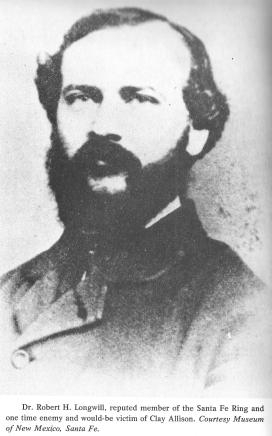
Manuel Cardenas told the Elizabethtown Justice of the Peace that three men associated with the Santa Fe Ring—mail contractor Florencio Donoghue, County probate judge Dr. Robert Longwill, and Attorney Melvin W. Mills—had offered him $500 to kill Tolby. However, according to Cardenas, he turned the job down and the trio hired the now-dead Cruz Vega to shoot Tolby instead.
Cardenas’ charges resulted in a flurry of activity. Robert Longwill fled to Santa Fe pursued by a posse led by anti-Grant Company gunman Clay Allison. Since Allison had bested Santa Fe Ring enforcer Juan Francisco “Pancho” Griego in a shootout at Henri Lambert’s Cimarron saloon earlier that week, Longwill was wise to take him seriously.
Source: Clay Allison, Portrait of a Shootist, Chuck Parsons
Melvin Mills was made of sterner stuff. He’d been in Colorado when the charges were made and he returned to Cimarron, indignantly insisting on his innocence. Mills must have arrived back in town around the same time the cavalry detachment from Fort Union showed up on Monday, November 8. The horse soldiers had been dispatched to Cimarron to maintain civil order, sent out at the request of Territorial Governor Samuel Axtell, who just happened to also be a member of the Santa Fe Ring.
With Longwill safely in Santa Fe, Cardenas and Donaghue in jail, and Mills released for lack of evidence, it seemed reasonable to assume that things had quieted down and would remain so. A hearing date to address Cardenas’ evidence was set for Wednesday, Nov. 10. But there was going to be a least one more death before it was all over. Can you guess who? . . . . Stay tuned.
Sources: David L. Caffey, Chasing the Santa Fe Ring, UNM Press, 2014; Chuck Parsons, Clay Allison, portrait of a shootist, Pioneer Book Publishers, 1983
Monday, November 1, 1875 in Cimarron, New Mexico should have been a quiet day after an eventful weekend. Cruz Vega, the man thought to have murdered Methodist missionary Reverend Franklin J. Tolby in September, was dead and buried. Now the County could get back to ranching and mining. But Vega’s confession at his Saturday, October 30 lynching had not put the matter to rest.
Vega confessed merely to being involved in the plot to kill Reverend Tolby. He said Manuel Cardenas was the actual shooter. So there was still that to deal with.
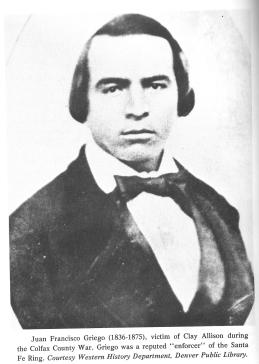
Then there was the matter of how Vega had died. Following the telegraph-pole lynching that produced his accusation against Cardenas, Vega was shot and killed. When his battered body was found the next day, his friends and relatives were upset, to say the least. Their thoughts turned almost immediately to revenge. In fact, before the funeral was over, Civil War veteran Juan Francisco “Pancho” Griego vowed vengeance on the men who’d tortured and killed his friend.
There’s no concrete evidence that gunslinger R. Clay Allison was part of the Vega lynch mob, but the fact that Griego confronted him about it implies that Allison either participated in the lynching or was concerned for the welfare of those who had.
At any rate, Griego and Allison met late Monday, November 1 at Henri Lambert’s saloon in Cimarron (today’s St. James Hotel) and Griego didn’t make it out alive. According to Lambert, who’d been born in France, “Pancho try to pull the pistol. Mr. Allison smarter.” When Pancho fell, Lambert ordered everybody out and closed up shop. It was a smart thing to do. Allison and his friends spent the night “hoorahing” the town and probably would have caused more damage to Lambert’s place besides the blood-stained saloon floor if he hadn’t closed down when he did.
But Tolby’s killer still needed to be dealt with and there were still strong suspicions that the Santa Fe Ring was somehow behind it all. Certainly, the bloodshed hadn’t ended. There would be more in the coming days. Stay tuned . . . .
Source: Clay Allison, Portrait of a Shootist, Chuck Parsons
Sources: Las Vegas Gazette, November 14, 1875. Chuck Parsons, Clay Allison, Portrait of a Shootist, Pioneer Book Publishers, 1983.

 Fiction and Fact From Old New Mexico