At first, the girl thought it was snowing, the tiny flakes glinting in the early morning sun. Then she saw they were miniscule ice crystals, floating from the cabin’s cedar-shake roof and the long green needles of the ponderosas looming above it: sparkling flecks of ice drifting through the air like frozen sunlight. She held her breath for a long moment, taking it in.
Then her mother opened the heavy wood-plank cabin door behind her. “It’s freezing out there!” she exclaimed. “What are you doing? You’ll catch your death!” And the girl turned reluctantly toward the house.
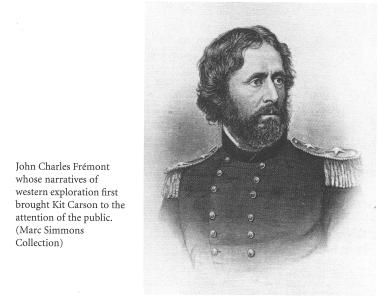
On this day in 1849, Saturday, January 13, celebrated explorer John C. Fremont stumbled into the Taos plaza so battered by exposure and starvation that no one recognized him.
Fremont had left what is now Pueblo, Colorado, 52 days earlier on a mission to identify a practicable railroad route across the Rockies to California. He had 32 men and 120 supply-laden mules with him.
Even before he’d left Pueblo, there was trouble. He’d already lost a guide. When former mountain man “Uncle Bill” Wootton took a look at the signs and realized just how bad the coming winter was likely to be, he backed out. But former Army Colonel Fremont refused to give up. He’d been forced to resign from the military in a cloud of disgrace two years earlier and was determined to redeem himself. Come hell or high water, he was determined to prove that a year-round transcontinental railroad operation across the mountains was feasible. If men and mules could cross the path he had in mind under winter conditions, then surely trains could, too.
Fremont hired “Old Bill” Williams to take Wootton’s place. While Williams was a brilliant tracker, he wasn’t exactly known for his tact. Since Fremont was known for his stubbornness, the partnership seemed destined for trouble. And trouble happened pretty quickly. When Williams announced that the expedition should veer from the route Fremont had laid out, trouble ensued. Fremont relieved Williams of his guide duties and gave them to men who Fremont had worked with before but who didn’t know the region.
As Wootton had predicted, the weather turned treacherously nasty and grew increasingly difficult as Fremont’s men tried to force their way through snow-bound canyons and across icy mountainsides. All of the mules either died of starvation or froze to death. Frostbite and snow blindness plagued both the animals and the men. Not only was the expedition’s goal doomed, but the conditions were so bad that the men feared for their lives. In a desperate attempt to make it to safety, Fremont divided his company into small groups and sent them south to try to reach Taos.
Only 21 men of the original 32 would make it out alive and Fremont himself would need weeks of nursing by Josefa Carson before he fully recovered from the ordeal. Even with the survivors in Taos and whole, the loss of life would continue. Williams would die trying to retrieve valuable records and medical equipment that had been left behind in the rush to escape the winter conditions Uncle Bill Wootton had warned Fremont about.
Although a year-round transcontinental railroad was eventually built across the Rocky Mountains, it was not constructed on the route that Fremont tried to blaze that winter of 1848/49. The glory of that deed would go to other men. Fremont’s exploring days were over .
Sources: Alpheus H. Favour, Old Bill Williams, Mountain Man, U of Oklahoma Press, Norman, 1962; Leroy R. Hafen, Ed., Fur Trappers and Traders of the Far Southwest, Utah State U Press, Logan, 1972; Marc Simmons, Kit Carson and His Three Wives, UNM Press, Albuquerque, 2003.
As the man on the ridge watched, the herd of elk below suddenly broke and pounded across the icy stream toward the cover of the trees. Three wolves, two grays and a black, chased after them, then slowed and sat, watching them go. A young bull elk with a limp had lagged behind the herd, and the wolves appeared to be studying him. A raven cawed overhead.
The man smiled. The wolves had identified his target for him. He reached to lift the bow from his back. It was a good arrangement, he mused as he slipped down from the ridge and began circling to get downwind of the straggling bull. When he had finished with the elk, the wolves and ravens would attack the remains. “We will all eat well tonight,” he murmured. Which was good, because the elk herd would move more swiftly tomorrow, without the lagging one to slow them.
In 1867, the village of Don Fernando de Taos started its new year with a lynching. By Wednesday, January 2, the citizens of Taos had had enough of the antics of Thomas Means. The man had been on yet another drunken binge. During this one, he’d bounced around the plaza threatening people with a knife and pistol. When he finally went home, he took out his frustrations on his wife, nearly killing her in the process. That was when the authorities stepped in and arrested him.
Means was incarcerated in the local jail but there was apparently some concern that he wouldn’t get the justice he deserved: New Mexico juries were known for being reluctant to judge defendants guilty of death. To solve this problem, a group of citizens mob stormed the jail and removed Means from his guards’ protection. But they didn’t take him very far. 1867 must have started out cold, because the impromptu extra-legal jury decided to hang Means in the room next door to the jail: the courtroom where he would have been tried if they’d been a little more patient. The vigilantes dragged him into the space reserved for justice and hanged him from one of the vigas there. Although a judge may not have thought so, the men who dealt with Means clearly thought that justice was a good use for the room in question.
Source: Robert J. Torrez, Myth of the Hanging Tree, UNM Press, Albuquerque, 2008.
The three men and two mules stopped and stared up the mountainside. A fall of broken rock blocked their way.
“Well, shit!” Gus said. “How’re we supposed to get to that old mine shaft with this in the way?”
Herbert pulled off his hat and fanned his week-old beard. “Maybe we can go around.”
Alonzo pulled his suspenders away from his rounded belly and looked down and then up the sharply-angled slope. “Mules ain’t gonna like that,” he said.
“Guess we’re done then.” Gus rubbed his jaw. “Hell, I needed that gold.”
Herbert shrugged and began maneuvering the mules to face back down the mountainside.
Alonzo stared across the slope at the fractured stone. “That’s rotten quartz,” he said thoughtfully. He moved out onto the rocks.
“Careful there,” Gus said, but Alonzo only crouched down and stretched to pluck a piece from near the center of the rock fall. He turned it carefully. “Will you look at that,” he said wonderingly.
Gus and Herbert looked at each other, then Alonzo. He grinned back at them. “Might be this is as far’s we need to go,” he said. He lifted the quartz in his hand. “Looks like there’s gold enough right here!”
On Saturday, December 22, 1821 Antonio José Martinez of Taos was ordained in Durango, Mexico as a deacon in the Catholic church. He was 28 years old. Martinez had arrived at Durango’s Tridentine Seminary four years earlier just after his 25th birthday. He came to the ministry late, following the death of his wife in childbirth. The ceremony on December 22, 1821 marked the beginning of the end of Martinez’ life at the Seminary. A year later, he would be an ordained priest and on his way by to New Mexico, where he would eventually become pastor in exclusive charge at Taos.
Padre Antonio Jose Martinez
Besides his priestly duties, Padre Martinez would be a force to be reckoned with in New Mexico cultural and political affairs, both before and after the 1846 American takeover. Before the war, he was consul for expatriate Americans in New Mexico, he founded a school in Taos and also installed a printing press in Taos for literary publications as well as church forms , and he served as one of seven deputies to New Mexico’s Departmental Assembly. After the American invasion, the Padre served as president of both New Mexico’s 1848 and 1849 state constitutional conventions and of the 1851 New Mexican Legislative Assembly.
To describe Antonio José Martinez as a busy man seems like an understatement. One wonders whether he had any idea on that long ago day in late 1821 just how much he would accomplish for New Mexico and for Taos before he died almost 50 years later at the age of 75.
Sources: Fray Angelico Chavez, But Time and Chance, the story of Padre Martinez of Taos, Sunstone Press, Santa Fe, 1981; Thomas C. Donnelly, The Government of New Mexico, UNM Press, Albuquerque, 1953; Richard W. Etulain, New Mexican Lives: Profiles and Historical Stories, UNM Press, Albuquerque, 2002; Dan Galbraith, Turbulent Taos, Sunstone Press, Santa Fe, 1983; Pedro Sanchez, Recollections of the Life of the Priest Don Antonio José Martínez, Sunstone Press, Santa Fe, 2006.
“Why have a wife at all?” Joseph Herburger grumbled as he slammed out the door into Elizabethtown’s morning cold. “I still must feed myself.” He gripped his stone masonry tools in his mittened hands and scowled at the icy December wind. Dolores had been too busy with the children to prepare a hot meal. She seemed to forget where her first duty lay.
The irritation stayed with him all day, as he chipped out the headstone for a small child in the cemetery on the hill. When he was done, he gathered his tools and glanced eastward. Baldy Mountain loomed against a darkening sky. The sweet scent of burning Ponderosa pine drifted from cabin chimneys. Joseph shrugged, scowled, and stomped down the mud-frozen path toward home.
But as he opened the door, there was the smell of just-baked bread and the sound of Dolores laughing.
“Say it again, mamá!” little George demanded.
“Dijo el gallo: ¡Cocorocó! ¡Cristo nació!” Dolores said. She swung the baby in her arms to the rhythm of the words. “Said the cock, ¡Kokoroko! Christ is born!”
Georgie ran to his father. “¡Kokorokó!” he cried, flapping his arms. “I am a rooster! Cristo is born!”
Joseph laughed in spite of himself and scooped the child into his arms.
On Tuesday, December 15, 1970, United States President Richard Nixon signed the bill that effectively returned Taos Pueblo’s sacred Blue Lake and the surrounding 48,000 acres of National Forest to the people of Taos Pueblo.
The pristine lake, which lies at the bottom of a glacier-carved depression in the Sangre de Cristo mountains east of Taos pueblo, is the Pueblo’s most sacred shrine and the site of some of its most important yearly rituals. Blue Lake and its watershed had been confiscated by President Theodore Roosevelt’s administration in June 1906 as part of the U.S. Forest Service process of creating Carson National Park.
Pueblo leaders took action almost immediately following Roosevelt’s actions, but met with resistance from Washington. Various attempts were made to accommodate the multiple potential uses for the lake and its watershed, but, because the area was national forest, it was subject to non-recreational uses like logging. In the early 1960’s, increased interest in logging the area created a renewed sense of urgency. The resulting pressure on Washington culminated in the legislation Nixon signed in late 1970, sixty-four years after Roosevelt’s signature.
While the return of Blue Lake was of major significance to the Taos Pueblo people, it also had a wider value, because the legislation set a legal precedent for the idea of Native American land ownership based on religious significance. The law also inspired the Indian Religious Freedoms Act of 1978. This act required the U.S. government to preserve and protect American Indians’ inherent right to believe, express, and exercise their traditional religions. It also enabled access to religious sites and the use and possession of sacred objects. So, while the loss of Blue Lake for so many years was tragic, its return was a blessing that extended far beyond Taos Pueblo itself and is an event worth celebrating. Sources: William deBuys, Enchantment and Exploitation, UNM Press, Albuquerque, 1985; Rubén Sálaz Márquez, New Mexico: a brief multi-history, Cosmic House, Albuquerque, 1999; Corina A. Santisteven and Julia Moore, eds., Taos, a topical history, Museum of NM Press, Santa Fe, 2013; Marc Simmons, New Mexico, UNM Press, Albuquerque, 1993.
“Disaster seems as inevitable as clouds piling over those mountains and more rain with them,” she said drily. She jerked her chin toward the western horizon, where gray-lined white clouds towered above the rocky peaks.
“Rain isn’t necessarily a disaster,” he said mildly. “It’s water for the crops and cattle, recharge for the well.”
“I haven’t been out of this cabin for the last ten days,” she complained. “By the time I’m done with the morning chores, it’s raining again. You’re out and about, tending the cattle, seeing to the crops. I’m in the house getting the children decent and cleaning up after them.”
“The rain means you don’t have to haul water to the garden,” he pointed out. “The clouds are bringing it to you.”
She took a deep breath, as if gearing up for an argument, then let it out, letting the anger go with it. “I’m just feeling so cooped up,” she said. “I feel like a winter-bound chicken in the hen house.”
“Well, we could eat you and take you out of your misery,” he teased.
She laughed and shook her head. “I’ll certainly be glad when the monsoon season is over with.” She looked up at him, over her shoulder. “We will get a respite from this before winter sets in, won’t we?”
He chuckled, drew her to him, and silently watched the clouds moving his way.
On Saturday December 7, 1878 the first Atchison, Topeka and Santa Fe (ATSF) railway engine crossed from Colorado into New Mexico Territory and the New Mexico and Southern Pacific, an ATSF subsidiary began building south toward Santa Fe.
It had been a race right to the finish, the ATSF barely making reaching the New Mexico Territory border from Kansas before the Denver and Rio Grande Railroad reached it from Denver.
The race began on October 30, 1868, when the ATSF railroad began laying track in Topeka, Kansas. The rail line headed west from there, following the already-established Santa Fe Trail to Raton Pass. Once into New Mexico, the track extended south to Las Vegas, then west through the Glorieta Pass. West of the pass, it moved away from the Trail and headed south to Albuquerque, which it reached in 1880. At Lamy, source of the limestone for Santa Fe’s Catholic cathedral, the New Mexico and Southern Pacific built a spur line north to Santa Fe, thus ensuring a connection to the Territorial capital.
With the railway came connections south and west, as well as east. The New Mexico and Southern Pacific line reached Albuquerque on April 5, 1880, then pushed south and west. It arrived in El Paso, TX in 1881, where it would connect to the Southern Pacific, which moved steadily west toward Arizona, reaching that boundary in late July 1881. In 1882, this southern route line would extend link Texas and California, forming, with the New Mexico and Southern Pacific’s routes in the rest of New Mexico, a network of rail throughout the Territory.
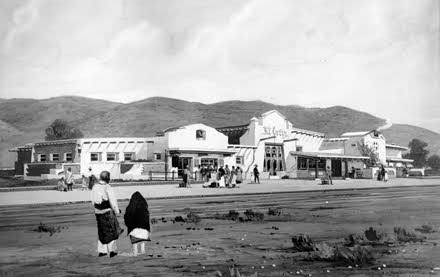
Fred Harvey was already providing food and lodging for ATSF’s passengers by the time ATSF tracks reached New Mexico, but the Territory was critical to the full development of his Harvey House concept. In 1883 the male waiters at Harvey’s Raton establishment became so unruly that he fired all of them and hired young women instead. The waitress experiment was so successful that Harvey got rid of the male waiters in all of his rail establishments and replaced them with young women, the iconic waitresses who would become known as the Harvey Girls. So, not only did rail come to New Mexico in early December 1878, but New Mexico would give rail the Harvey Girl, that image of feminine efficiency that has clung ever since to the legend of Fred Harvey and his railroad restaurant/hotels.
Sources: Francis L. and Roberta B. Fugate, Roadside History of New Mexico, Mountain Press, Missoula, 1989; Richard W. Etulain, Beyond the Missouri, UNM Press, Albuquerque, 2006; Corina A. Santisteven and Julia Moore, Eds., Taos, A topical history, Museum of New Mexico Press, Santa Fe, 2013; Marta Weigle, editor, Telling New Mexico, a new history, Museum of New Mexico Press, Santa Fe, 2009; Victor Westphall, The Public Domainin New Mexico, 1854-1881,UNM Press, Albuquerque, 1965.

 Fiction and Fact From Old New Mexico